

An SEO audit service is a structured examination of a website’s technical health, search visibility, content, site architecture, and authority signals, followed by a prioritized plan for fixing the issues that matter most.
The important distinction is that an audit should do more than produce a list of errors. Automated tools can identify missing metadata, crawl problems, broken links, performance issues, and other detectable conditions.
A professional audit adds interpretation: which findings matter, why they matter, what should be fixed first, and who should implement each change.
Google’s SEO Starter Guide provides the foundational guidance for helping search engines crawl, index, and understand website content.
Google itself describes SEO as helping search engines crawl, index, and understand website content, while emphasizing that following SEO best practices does not guarantee crawling, indexing, or rankings.
For SEO professionals and webmasters, the best audit is therefore not the one with the longest checklist. It is the one that converts technical and search data into a clear, evidence-based implementation roadmap.
[IMAGE-01: SEO audit service workflow from website discovery → technical diagnosis → content/architecture analysis → prioritization → implementation roadmap]
What Does an SEO Audit Service Include?
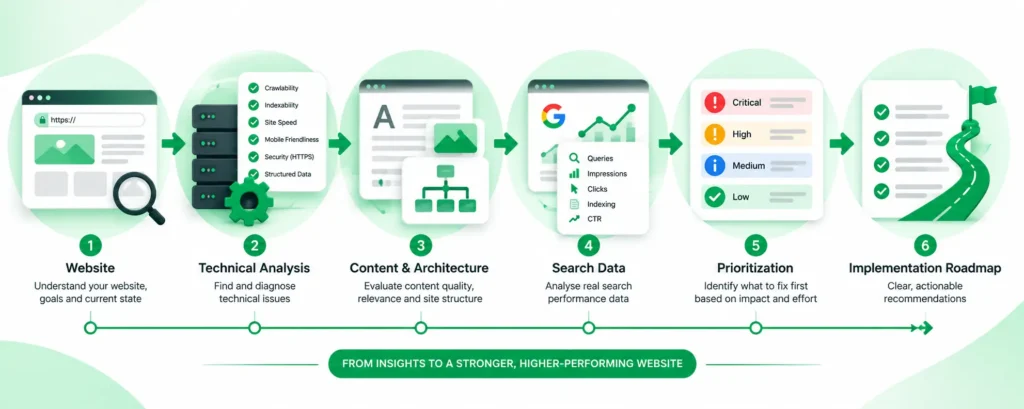
A professional SEO audit normally combines several connected areas rather than examining isolated ranking factors.
| Audit area | What it examines | Typical output |
|---|---|---|
| Technical SEO | Crawling, indexability, status codes, canonicals, robots directives, rendering | Technical issue list |
| On-page SEO | Titles, headings, content structure, internal links, media | Page-level recommendations |
| Content | Relevance, duplication, thin or outdated content, search intent | Content actions |
| Site architecture | URL hierarchy, navigation, internal linking, depth | Architecture improvements |
| Performance | Page speed, mobile experience, Core Web Vitals | Performance priorities |
| Off-page SEO | Backlinks, referring domains, authority signals | Link-profile assessment |
| Search data | Queries, pages, impressions, clicks, indexing patterns | Opportunity diagnosis |
| Competitors | Competing content, SERP coverage, gaps | Competitive opportunities |
| Measurement | Analytics and Search Console configuration | Reporting-confidence assessment |
The exact scope should depend on the website. A small informational site does not necessarily require the same audit depth as a large ecommerce, publishing, or enterprise website.
SEO Audit Tool vs. SEO Audit Service
This distinction is often overlooked.
An SEO audit tool is primarily designed to scan a website and identify detectable conditions. For example, SEOptimer offers automated audits, prioritized recommendations, crawling, reporting, and additional SEO tools.
Semrush similarly uses automated crawling to identify technical and on-page issues, group them by severity, and provide recommendations. Its Site Audit includes areas such as crawlability, HTTPS, performance, Core Web Vitals, internal linking, and other technical checks.
An SEO audit service, however, should answer the questions an automated report cannot reliably answer on its own:
- Which problems are actually affecting the site’s objectives?
- Which issues should be fixed first?
- Are multiple symptoms caused by one underlying architectural problem?
- Is a technically correct change likely to improve the relevant user or search experience?
- What should the developer, content team, or SEO specialist actually do?
- Which recommendations should not be implemented?
That last question matters. A good audit is not simply an exercise in finding more things to change.
What Should a Professional SEO Audit Find?
1. Crawl and Indexation Problems
The first question is whether important content can be discovered, crawled, processed, and potentially indexed.
An audit should examine areas such as:
- robots.txt directives
- noindex and other robots directives
- XML sitemap coverage
- HTTP status codes
- redirect chains
- canonicalization
- orphaned or poorly connected pages
- crawlable internal links
- rendering dependencies
- important resources blocked from crawlers
Google explains that its systems discover pages through crawling and then process them for indexing and serving. Its developer SEO guidance also covers how developers can ensure that Google can access and process important website resources.
It also recommends checking whether important resources are accessible and whether robots.txt or noindex directives unintentionally prevent Google from accessing or indexing content.
For a deeper look at sitemap architecture and discovery, see our guide to choosing between XML and HTML sitemaps.
2. Site Architecture and Internal Linking
An audit should not treat every URL as an independent document.
It should examine how important pages relate to one another:
Homepage → Hub → Supporting content → Conversion/resource page
Questions include:
- Can important pages be reached through crawlable links?
- Are valuable pages buried unnecessarily deep?
- Do related pages link to one another naturally?
- Are there orphaned pages?
- Does the internal-link structure reflect the site’s actual topical organization?
Google specifically recommends crawlable links and explains that Googlebot uses links, sitemaps, and redirects to discover URLs.
For larger websites, SearchEngineZine’s Technical SEO Hub provides a broader framework covering crawl/index management, performance, structured data, mobile optimization, and site architecture.
3. Content and Search Intent
A technically clean website can still have an ineffective SEO strategy.
The audit should determine:
- whether important pages target the correct search intent;
- whether multiple pages compete for the same intent;
- whether content satisfies the query sufficiently;
- whether important topics are missing;
- whether outdated content requires revision;
- whether pages contain substantial original value.
Google’s guidance emphasizes helpful, reliable, people-first content and specifically asks whether content provides original information, meaningful analysis, and substantial value compared with other search results. Its people-first content guidance provides additional context for evaluating whether content is genuinely useful.
4. Performance and Mobile Experience
Performance should be evaluated in context rather than treated as a score-chasing exercise.
An audit can examine:
- Core Web Vitals
- page-loading behavior
- large or inefficient resources
- mobile rendering
- layout instability
- interaction responsiveness
- unnecessary scripts
- image delivery
Google recommends that sites be secure, fast, accessible, and functional across devices, while its developer documentation provides specific guidance for diagnosing how Google sees pages.
5. Search Performance Data
A professional audit should ideally connect technical findings with actual search data.
Useful sources include:
- Google Search Console
- analytics data
- ranking data
- crawl data
- page-level performance
- conversion data where available
This allows an auditor to distinguish a theoretical problem from a problem that deserves immediate attention.
For example, a duplicated metadata warning affecting two low-value pages may deserve less attention than an indexation problem affecting hundreds of important URLs.
How Should SEO Audit Findings Be Prioritized?
This is where a professional service can provide significantly more value than a raw crawler report.
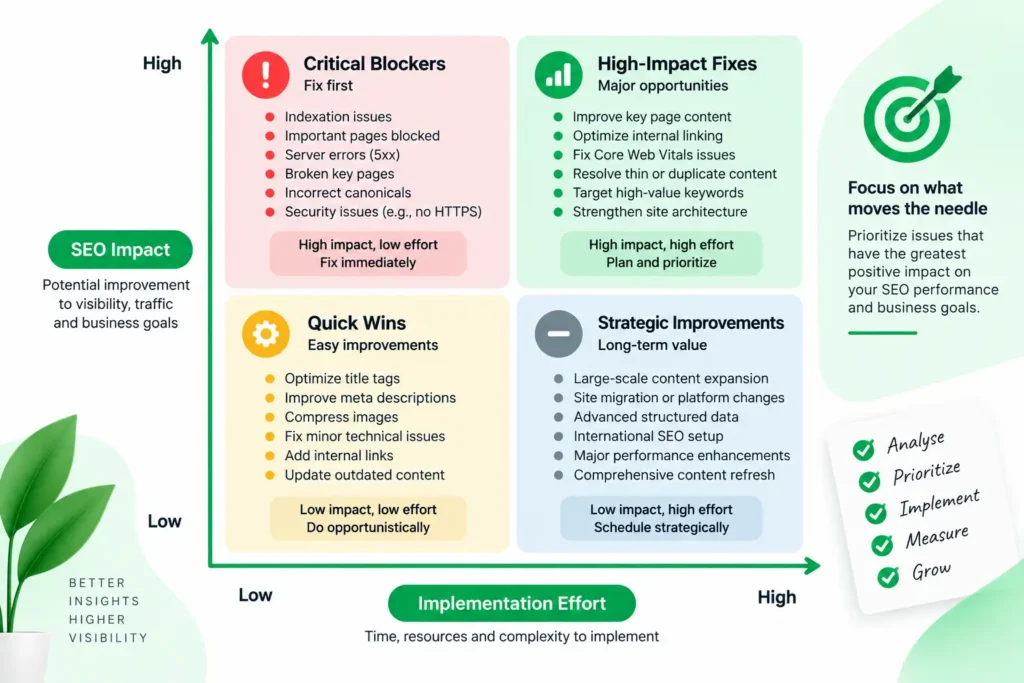
A useful prioritization model is:
| Priority | Situation | Action |
|---|---|---|
| Critical | Prevents important pages from being crawled, indexed, or served correctly | Fix immediately |
| High | Affects important pages or substantial search opportunity | Schedule early |
| Medium | Meaningful optimization opportunity with limited risk | Add to roadmap |
| Low | Minor improvement with limited expected impact | Fix opportunistically |
The audit should also identify root causes.
For example, ten separate warnings might actually originate from one template-level implementation problem. Fixing the underlying template can be more valuable than treating each warning as an independent task.
Semrush’s own audit workflow similarly separates errors, warnings, and notices by severity rather than treating every detected issue equally.
[IMAGE-02: Priority matrix showing SEO impact vs implementation effort, with critical technical blockers separated from low-value cosmetic issues]
What Should the Final SEO Audit Deliver?
A professional audit should finish with something the website owner or team can actually use.
A strong deliverable should contain:
- Executive summary — the most important findings.
- Evidence — URLs, examples, screenshots, crawl data, or search data where appropriate.
- Impact assessment — why each finding matters.
- Priority — what should be fixed first.
- Recommended action — what needs to change.
- Ownership — SEO, developer, content, analytics, or another team.
- Implementation notes — enough detail to execute the recommendation.
- Validation method — how to determine whether the change was implemented correctly.
The final document should therefore function as an implementation roadmap, not merely an inventory of warnings.
When Should You Hire an SEO Audit Service?
An external audit becomes particularly useful when:
- organic traffic has declined unexpectedly;
- a site migration has created uncertainty;
- important pages are not being indexed;
- a redesign has changed URLs or templates;
- a large website has accumulated technical problems;
- organic performance is stagnant despite publishing content;
- multiple SEO problems appear interconnected;
- internal teams disagree about what should be fixed first;
- the site needs an independent technical assessment.
For smaller websites, an automated audit combined with Search Console and a competent manual review may be sufficient.
For complex websites, the value of a service generally comes from diagnosis, prioritization, interpretation, and implementation planning, not simply from running a crawler.
How to Evaluate an SEO Audit Service
Before purchasing an audit, ask six questions:
1. What will you actually audit?
Avoid vague promises such as “complete SEO analysis.” Ask for the specific scope.
2. Will the audit include manual analysis?
Automated crawling and human interpretation are different activities.
3. Will findings be prioritized?
A 200-page report is not useful if every recommendation appears equally important.
4. Will you receive implementation guidance?
The report should explain what needs to change, not just identify a problem.
5. What evidence supports the recommendations?
Good findings should be traceable to crawl data, search data, documentation, or clearly identified analysis.
6. Does the provider promise rankings?
Be cautious. Google explicitly states that following its SEO guidance does not guarantee that a page will be crawled, indexed, or served in Search.
The Bottom Line
The best SEO audit service is not the one that discovers the greatest number of issues. It is the one that determines which problems matter, why they matter, what should happen next, and how the result should be validated.
Automated SEO tools are valuable for scalable detection. Human analysis is valuable for context, prioritization, diagnosis, and decision-making. Google’s Search Essentials provide the baseline technical and spam-policy framework that should inform an SEO audit.
For a webmaster or SEO professional, the ideal audit therefore moves through a simple chain:
Discover → Diagnose → Prioritize → Implement → Validate
For a broader implementation reference, you can also work through our SEO implementation checklist
That turns an SEO audit from a static checklist into a practical system for improving a website’s search infrastructure and content.