
On-page SEO is where strategy meets execution. While technical infrastructure enables visibility, on-page optimization communicates relevance, expertise, and trust to both users and search engines.
Every headline, paragraph, media element, and internal link contributes to how a page is interpreted and evaluated.
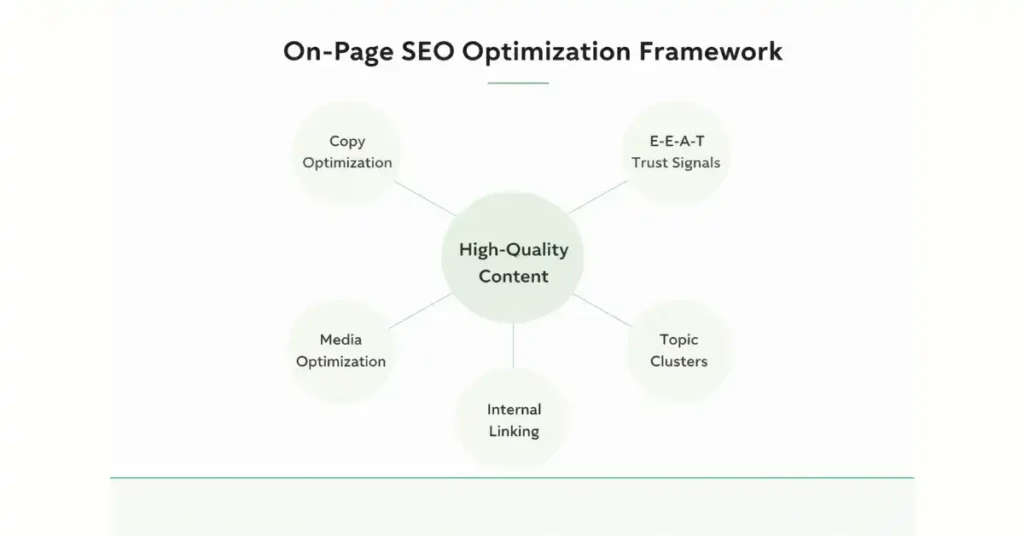
This On-Page Strategy structures optimization into five interconnected systems: strategic copywriting, E-E-A-T trust signals, topic cluster development, media optimization, and internal linking architecture.
Together, these elements determine whether your content merely exists — or performs competitively in search results.
Modern search algorithms evaluate more than keywords. They assess clarity, depth, authoritativeness, and user satisfaction. Well-optimized pages demonstrate subject expertise, answer real user questions comprehensively, and guide visitors logically through related resources.
Internal linking reinforces topical relationships, while structured content improves crawl efficiency and comprehension.
By approaching on-page SEO as a coordinated framework rather than a checklist, you create content that ranks sustainably, builds credibility, and strengthens overall site authority.
A Complete On-Page Optimization System Covering Copywriting, E-E-A-T Trust Signals, Topic Clusters, Media Optimization & Strategic Internal Links
COPY (15)
- B2B SaaS SEO Copywriting Services: How to Choose the Right Partner NEW
- SEO Copywriting Services: Enterprise Frameworks for Content Scalability
- Copy Refresh Lifecycle: Systematic Content Updates to Protect Organic Authority
- B2B Technical Copywriting: Content Architecture for Software Buying Personas
- Product Copy Schema: Structured Data Implementations for Product Variant Variants
- Programmatic Copy Hygiene: Post-Generation Filtering for Quality System Filters
- Microcopy UX SEO: Structural Microcopy Design for Interface and Search Intent Alignment
- Readability Linguistic Metrics: Engineering Text Complexity for Intent Matching
- Snippet Optimization Copywriting: Layout Design Rules for Rich Features
- Conversational Copy Retrieval: Structuring Informational Content for Intent Alignment
- Entity Density Optimization: Semantic Modeling for Contextual Search Extraction
- EEAT Writing Signals: Structural Guidelines for Sourcing and Experience Verification
- Information Gain Copywriting: Editorial Mechanics for Unique Asset Placement
- Proper Heading Structure for SEO: Semantic Technical Best Practices
- Human-First SEO Content Writing: Editorial Guidelines for Information Gain
TRUST (5)
- E-E-A-T Audit Service for YMYL Websites: What a Professional Audit Should Actually Examine NEW
- Local Entity Verification: Trust Validation Best Practices
- Local Data Consolidation Framework: Establishing Multi-Location Trust Profiles
- Author Entity Optimization: Technical Mechanics and Trust Factors
- Demonstrate SEO Experience: Establishing Authoritative E-E-A-T
CLUSTERS (3)
MEDIA (3)
Strong on-page optimization transforms content into a reliable asset. When copy, structure, trust signals, and linking work together, search engines gain confidence in your expertise, and users experience clarity and value.
Use this hub as a reference when auditing pages, improving content depth, strengthening internal links, or enhancing trust elements. Sustainable search performance is built through consistent, high-quality execution — not isolated tweaks.
On-Page Strategy: Building Relevance, Clarity, and Sustainable Search Performance
Understanding On-Page Strategy in Modern SEO
On-Page Strategy is the structured process of optimizing individual webpages to improve relevance, semantic clarity, topical authority, user experience, and search visibility within modern search ecosystems.
While technical SEO helps search engines access and interpret content infrastructure, on-page optimization determines how effectively a page communicates meaning, expertise, usefulness, and contextual relevance to both users and search systems.
Modern search engines no longer evaluate pages based solely on keyword placement or isolated ranking signals. Search ecosystems have evolved significantly through:
- AI-assisted retrieval systems
- Semantic indexing
- Natural language processing
- Entity-based interpretation
- User satisfaction modeling
- Contextual search understanding
As a result, a successful On-Page Strategy now requires balancing:
- Content quality
- Search intent alignment
- Semantic relevance
- Structural organization
- Trust signals
- User experience
- Internal linking relationships
- Topical depth
Effective on-page optimization is not about manipulating rankings through repetitive keyword insertion or superficial SEO checklists. Instead, it focuses on helping search systems understand:
- What the content is about
- Who it serves
- Why is it valuable
- How it fits within broader topical ecosystems
This creates stronger long-term visibility while improving user satisfaction and informational trust.
Why On-Page SEO Still Matters
Even as search systems become increasingly AI-driven, on-page optimization remains foundational because search engines still rely on webpage-level signals to evaluate:
- Relevance
- Contextual clarity
- Topic depth
- Content quality
- Semantic relationships
- Expertise indicators
- User usefulness
A page may have strong backlinks and technical infrastructure, but weak on-page execution can still limit visibility if:
- Content lacks clarity
- Intent alignment is poor
- Structure is confusing
- Information depth is insufficient
- User experience is weak
On-Page Strategy helps align content with both user expectations and modern search interpretation systems.
The Evolution of On-Page SEO
Traditional on-page SEO often focused heavily on:
- Exact-match keywords
- Meta tag repetition
- Keyword density formulas
- Minimal content optimization
- Mechanical formatting tactics
Modern search systems now evaluate:
- Semantic meaning
- Topical relationships
- User satisfaction
- Contextual relevance
- Informational completeness
- Entity associations
- Content quality signals
This shift means modern On-Page Strategy must focus more on:
- User intent satisfaction
- Structured topic coverage
- Semantic organization
- Expertise communication
- Contextual clarity
rather than outdated keyword manipulation practices.
The Core Systems of On-Page Strategy
A modern On-Page Strategy framework typically involves several interconnected systems:
- Strategic Copywriting
- E-E-A-T Trust Signals
- Topic Cluster Development
- Media Optimization
- Internal Linking Architecture
Together, these components help create semantically strong, user-focused pages that support long-term search performance.
Strategic Copywriting
Why Copy Structure Matters
Strategic copywriting is one of the most important aspects of On-Page Strategy because content itself remains the primary medium through which search systems interpret meaning and relevance.
Well-structured copy helps search engines understand:
- Topic focus
- Search intent alignment
- Contextual relationships
- Informational depth
- Semantic relevance
Effective SEO copywriting balances:
- Readability
- Expertise
- Search intent
- Clarity
- Topic coverage
- User engagement
Content should prioritize communication quality rather than mechanical optimization.
Writing for Intent Instead of Keywords
Modern search systems increasingly prioritize pages that satisfy user intent rather than pages that repeat exact phrases unnaturally.
Users may search:
- To learn
- To compare
- To solve problems
- To make decisions
- To find resources
Strategic copywriting aligns page structure with these goals by:
- Answering real questions
- Providing contextual clarity
- Organizing information logically
- Anticipating user needs
This creates stronger alignment between search queries and user satisfaction outcomes.
Why Content Depth Matters
Search systems increasingly evaluate:
- Topical completeness
- Contextual understanding
- Informational usefulness
- Semantic relationships
Thin content often struggles because it fails to provide:
- Sufficient depth
- Supporting context
- Comprehensive answers
- Meaningful expertise signals
A strong On-Page Strategy focuses on creating content that demonstrates:
- Subject understanding
- Practical insight
- Informational completeness
- Structured educational value
This supports stronger long-term topical authority.
E-E-A-T Trust Signals
Understanding E-E-A-T
Google’s evolving quality systems increasingly emphasize:
- Experience
- Expertise
- Authoritativeness
- Trustworthiness
These principles influence how search systems evaluate content quality and reliability across many search environments.
On-page optimization plays a major role in communicating these trust signals.
Demonstrating Experience and Expertise
Modern search systems increasingly reward content demonstrating:
- First-hand experience
- Practical understanding
- Technical knowledge
- Contextual insight
Pages can strengthen expertise signals through:
- Original analysis
- Detailed explanations
- Transparent authorship
- Evidence-based discussion
- Clear educational structure
Experience-driven content often creates stronger trust than generic informational summaries.
Why Trust Signals Matter
Trustworthiness is increasingly important because search engines aim to reduce:
- Misinformation
- Manipulative SEO content
- Low-quality publishing
- Thin affiliate pages
- AI-generated spam ecosystems
A strong On-Page Strategy helps reinforce trust through:
- Clear sourcing
- Transparent authorship
- Accurate information
- Responsible explanations
- Structured educational value
These elements improve both user confidence and search system interpretation.
Topic Cluster Development
Why Topic Clusters Matter
Modern search systems increasingly evaluate websites contextually rather than page-by-page in isolation.
This means topical authority now depends heavily on:
- Semantic organization
- Supporting content relationships
- Cluster structures
- Internal contextual depth
Topic clusters organize content around:
- Core pillar pages
- Supporting cluster pages
- Related educational resources
This structure helps search systems interpret broader expertise ecosystems.
Building Semantic Relationships
Topic clusters strengthen:
- Internal linking relationships
- Semantic clarity
- Contextual relevance
- Crawl organization
- Topical completeness
For example:
Core Topic
Technical SEO
Supporting Clusters
- Crawl optimization
- Structured data
- Semantic indexing
- Internal linking
- Canonicalization
- Site architecture
This structure reinforces broader topical relevance.
Why Topical Authority Matters
Search systems increasingly reward websites demonstrating:
- Comprehensive expertise
- Structured educational depth
- Semantic consistency
- Contextual authority
A strong On-Page Strategy helps organize content ecosystems that reinforce:
- Expertise recognition
- Informational completeness
- Search relevance
This supports more sustainable long-term rankings.
Media Optimization
Why Media Matters
Media elements increasingly influence:
- User engagement
- Accessibility
- Content clarity
- Page experience
- Contextual communication
Modern pages often include:
- Images
- Infographics
- Charts
- Videos
- Interactive elements
Media optimization ensures these assets support both usability and SEO goals.
Image Optimization and SEO
Images contribute contextual signals through:
- Alt text
- File names
- Surrounding content
- Semantic placement
Proper optimization improves:
- Accessibility
- Search comprehension
- Media discoverability
- User experience
Media should reinforce content meaning rather than exist purely decoratively.
Why Accessibility Matters
Accessibility increasingly aligns with broader quality expectations involving:
- User-focused design
- Clarity
- Navigational usability
- Information accessibility
Media optimization supports accessibility by improving:
- Screen reader interpretation
- Contextual understanding
- Visual communication clarity
Accessible content often creates stronger overall user experiences.
Internal Linking Architecture
Why Internal Linking Matters
Internal linking remains one of the most important structural components of On-Page Strategy.
Effective internal links help:
- Reinforce semantic relationships
- Improve crawl accessibility
- Guide user navigation
- Strengthen contextual authority
- Clarify content hierarchy
Modern search systems increasingly interpret how pages connect contextually within broader website ecosystems.
Internal Linking and Semantic SEO
Search systems analyze:
- Link relationships
- Contextual anchor relevance
- Topic associations
- Navigational structures
Strategic internal linking helps communicate:
- Which pages are most important
- How topics relate
- Which resources support each other
This strengthens semantic organization and contextual understanding.
Reducing Orphaned Content
Poor internal linking often creates:
- Isolated pages
- Weak crawl visibility
- Fragmented topic structures
- Reduced discoverability
A strong On-Page Strategy ensures:
- Important pages receive contextual links
- Topic clusters remain interconnected
- Navigation pathways remain logical
This improves both user experience and crawl efficiency.
Search Intent Alignment
Why Intent Is Central to On-Page SEO
Modern search optimization increasingly revolves around satisfying search intent.
A keyword alone does not determine rankings. Search systems increasingly evaluate whether content matches:
- User goals
- Query context
- Informational needs
- Expected content formats
Intent-focused pages perform better because they align more closely with search behavior patterns.
Different Types of Search Intent
Search intent may include:
- Informational
- Transactional
- Commercial investigation
- Navigational
- Local intent
On-Page Strategy should structure content differently depending on the intended user journey.
For example:
- Educational queries require explanatory depth.
- Commercial queries may require comparisons and decision-support information.
- Transactional pages prioritize clarity and conversion-focused usability.
Semantic SEO and Contextual Relevance
Modern search systems increasingly interpret:
- Meaning
- Relationships
- Context
- Entity associations
This means pages should optimize for:
- Semantic completeness
- Contextual clarity
- Supporting concepts
- Related subtopics
rather than isolated keyword repetition alone.
Why Entity Relationships Matter
Search systems increasingly organize information around entities such as:
- Brands
- Concepts
- Products
- Locations
- Organizations
- Topics
On-page optimization helps reinforce:
- Entity relevance
- Contextual relationships
- Semantic consistency
This improves how search engines interpret broader topical ecosystems.
User Experience and On-Page SEO
Why UX Signals Matter
Search systems increasingly evaluate user-focused signals such as:
- Engagement
- Navigation quality
- Readability
- Accessibility
- Information clarity
Pages that frustrate users often struggle regardless of keyword optimization.
A strong On-Page Strategy improves:
- Readability
- Structural flow
- Mobile usability
- Information accessibility
- Content organization
This creates better overall satisfaction outcomes.
Why Structured Formatting Improves SEO
Structured formatting helps both users and search systems understand content more efficiently.
This includes:
- Clear headings
- Logical sections
- Organized hierarchy
- Consistent formatting
- Scannable structure
Well-structured pages improve:
- Crawl interpretation
- Semantic clarity
- User comprehension
- Engagement quality
Content Freshness and Maintenance
On-page optimization is not static.
Modern search ecosystems evolve continuously through:
- AI-assisted retrieval updates
- Semantic indexing refinements
- User behavior changes
- Search intent evolution
Strong On-Page Strategy includes:
- Periodic content reviews
- Information updates
- Structural improvements
- Expanded topical coverage
This helps maintain long-term relevance.
Why Sustainable SEO Requires Consistency
Sustainable search performance depends on:
- Consistent quality
- Semantic organization
- Informational usefulness
- Technical clarity
- User-focused optimization
Isolated page tweaks rarely create durable results without broader structural consistency.
On-page SEO works best when integrated into:
- Content strategy
- Information architecture
- Internal linking systems
- Topical authority development
Common On-Page SEO Mistakes
Many websites still rely on outdated practices such as:
- Keyword stuffing
- Thin content creation
- Duplicate topic targeting
- Weak internal linking
- Poor content structure
- Over-optimized anchor text
- Low-value AI-generated content
Modern search systems increasingly reward:
- Clarity
- Expertise
- Contextual relevance
- Semantic depth
- User-focused value
On-Page Strategy and AI Search
AI-assisted search systems increasingly evaluate:
- Semantic understanding
- Contextual relevance
- Informational clarity
- Topic relationships
- User intent satisfaction
This means modern On-Page Strategy must prioritize:
- Meaningful organization
- Structured expertise
- Contextual depth
- Clear educational value
rather than purely mechanical SEO tactics.
Why On-Page SEO Builds Long-Term Authority
Strong on-page optimization compounds over time because:
- Semantic structures strengthen
- Internal ecosystems expand
- Trust signals accumulate
- Topical authority grows
- Search systems gain contextual confidence
This creates more sustainable visibility compared to short-term optimization tricks.
Final Thoughts
On-Page Strategy is the foundation through which websites communicate relevance, expertise, structure, and trust to both users and modern search systems.
As search ecosystems continue evolving through:
- AI-assisted retrieval
- Semantic indexing
- Entity-based interpretation
- User satisfaction modeling
Effective on-page optimization increasingly depends on:
- Intent alignment
- Semantic clarity
- Structured expertise
- Contextual organization
- Trust-focused publishing
By integrating:
- Strategic copywriting
- E-E-A-T trust signals
- Topic cluster development
- Media optimization
- Internal linking architecture
Websites can create stronger semantic ecosystems that improve discoverability, reinforce topical authority, and support sustainable long-term search visibility.
Modern SEO success is no longer built through isolated optimization tactics alone. It is built through consistent, user-focused execution that helps search systems interpret content clearly while delivering meaningful value to real audiences.