

The era of writing a clever three-sentence bio and expecting search engines to trust your content is over.
Author Entity Optimization is the technical process of assigning a persistent, machine-readable identifier to a creator to ensure cross-platform authority reconciliation.
Generative search systems no longer read strings of text; they map deterministic nodes within a global Knowledge Graph.
If an author is not an established node, their content is mathematically treated as a high-risk probabilistic guess.
The demand for verified Author Entities and the deployment of Google’s Helpful Content System (HCS) represent a shift in information retrieval.
We have moved from a lexical era (keyword frequencies) to a semantic era (word relationships), and finally into the deterministic era of Knowledge Graphs and generative retrieval.
AI Overviews and Retrieval-Augmented Generation (RAG) architectures require verified nodes to minimize hallucinations.
To anticipate future algorithm updates, explore the journey of search engine innovation to understand the structural shifts driving modern retrieval models.
The Anatomy of a Verified Entity (The Technical Moat)
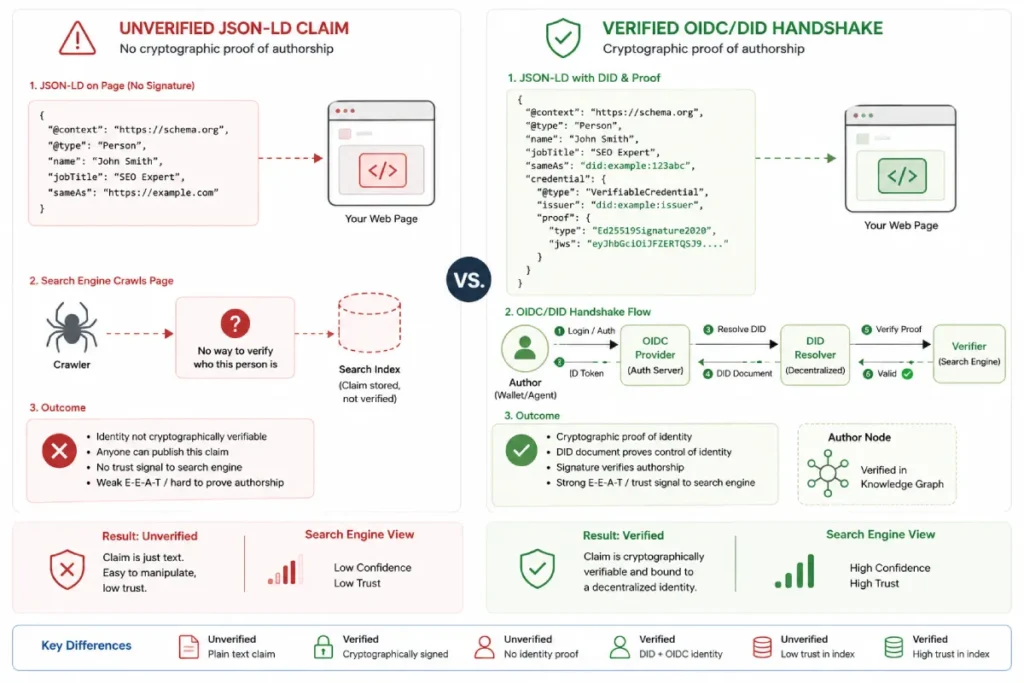
Search crawlers do not evaluate credentials through plain text; they require cryptographic and semantic proof that credentials exist within a trusted dataset. While structured data is foundational, malicious actors can manipulate standard JSON-LD.
To combat entity spoofing, modern search systems look toward OpenID Connect (OIDC) and cryptographic footprinting.
OIDC is an identity layer built on OAuth 2.0 that provides proof of authentication. In SEO, this allows search engines to verify authentication handshakes behind the scenes.
This evolution mirrors the core W3C Decentralized Identifiers architecture. The W3C’s Decentralized Identifier (DID) specification outlines a globally interoperable model where public key cryptography verifies entities without relying solely on HTML tags that attackers can easily spoof.
When an algorithmic evaluator detects a DID-compliant signature that page metadata embeds, it registers proof of authorship.
How Search Engines Transition from Strings to Entities
A Knowledge Graph Machine ID (KGMID) is a latency-reduction mechanism for search engine indexing infrastructure.
When an algorithm encounters a standard text string (e.g., “Dr. Sarah Jenkins”), it must execute probabilistic mapping to resolve entity ambiguity.
When an author is deterministically anchored to a KGMID via schema and sameAs arrays, the crawler bypasses the probabilistic phase entirely.
Establishing a verified KGMID is a core requirement for SERP visibility. Weak author profiles act as negative multipliers on domain trust.
For a complete methodology on restoring trust after quality updates, review strategies for recovering E-E-A-T scores after the December 2025 Core Update.
Integrating robust entity architecture must be combined with smart crawl resource allocation. Controlling site architecture and serving precise JSON-LD ensures crawlers allocate resources toward high-value semantic content.
A KGMID (e.g., /g/11b7q8z...) is a unique alphanumeric identifier assigned to a distinct entity within Google’s Knowledge Graph.
Anchoring local schema to an established KGMID ensures trust signals flow directly to the correct human node.
Persistent Identifiers (PIDs) in SEO
Persistent Identifiers (PIDs) are unique, universally recognized digital reference codes such as an ORCID, Wikidata Q-ID, or Google Scholar profile that tie an individual’s identity to a verified database.
PIDs act as truth signals that override ambiguous on-page text. Injecting ORCID identifiers into meta tags or JSON-LD provides an immediate validation layer that bypasses initial entity resolution delays.
The Author Trust Coefficient: A Quantitative Framework
Evaluating author authority requires moving past subjective guidelines toward quantitative modeling.
The Author Trust Coefficient (T_a) serves as a theoretical model for how search engines evaluate author reliability relative to a query:
Rd Relational Density
Quantifies explicit, structured connections linking the author entity to their specific niche across verified semantic nodes.
Cs Citation Salience
The weighted relevance of mentions within authoritative, non-reciprocal datasets (patents, journals, gov databases).
Se Stylometric Entropy
The linguistic variance in content production. Lower entropy validates consistent human expertise vs. synthetic generation.
Relational Density (R_d) and Topical Authority
Relational Density measures how tightly and consistently an author’s entity is connected to specific industry concepts across multiple trusted domains.
Building R_d requires external validation on high-authority platforms where an author’s name explicitly co-occurs with targeted concepts.
Building relational density requires aligning content strategy with search intent. Practitioners must utilize a rigorous framework for mapping keyword intent to semantic clusters to ensure every article they publish reinforces a niche they have verified.
Citation Salience (C_s) vs. Standard Backlinks
Citation Salience measures the contextual weight and relevance of an author mention, rather than mere link equity.
A citation from a peer-reviewed journal or patent database carries high salience, signaling primary-source authority.
Low-quality guest posts dilute entity trust. High salience is built by publishing original research, named methodologies, and proprietary datasets.
Advanced Nested Schema Architecture
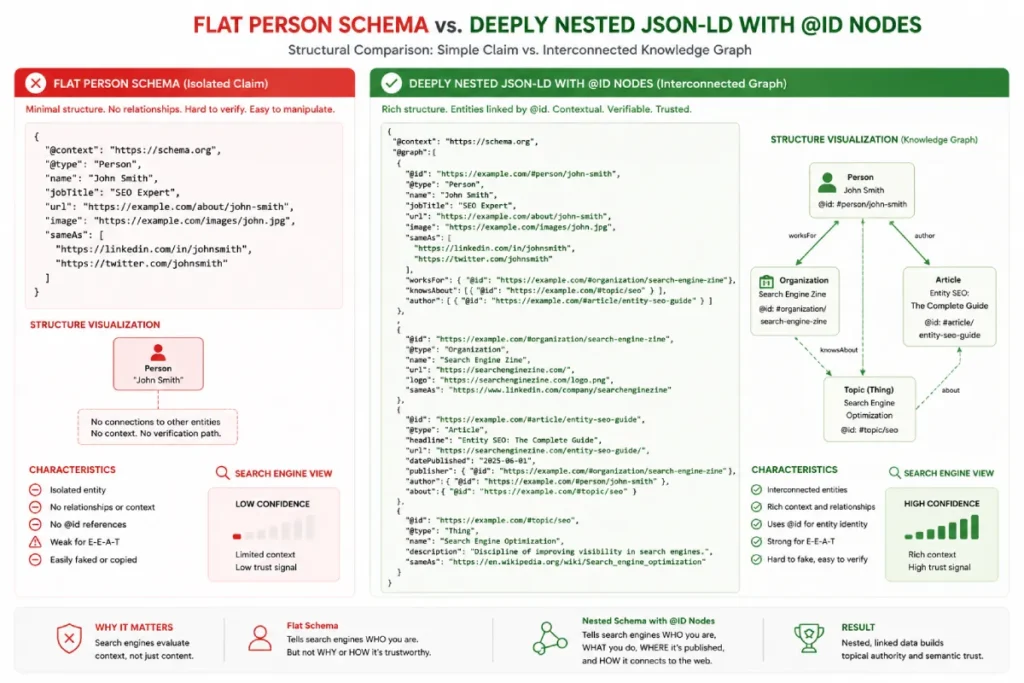
Basic SEO plugins often generate flat Person schema. To trigger Knowledge Panels and anchor an entity, engineer a nested schema architecture that explicitly maps identity to organizations, publications, and external profiles.
Structuring Person Schema for Entity Extraction
Architecting JSON-LD requires strict adherence to the official W3C JSON-LD 1.1 specification.
Aligning sameAs arrays and @id nodes with W3C serialization protocols allows search crawlers to validate syntax on the first pass.
Invalid IRIs in properties like alumniOf or memberOf can cause crawlers to drop entity relationships, severing R_d scoring.
Additionally, entity data must not be hidden behind client-side rendering. If author verification scripts rely on client-side execution, web rendering timeouts can hide schema from search bots.
All core entity identifiers must be delivered in the initial HTML payload using Server-Side Rendering (SSR). Review JavaScript rendering best practices to safeguard structured data execution.
Nested Schema Implementation Example
Author Entity Optimization Graph
Structured author identity connected to organizations, knowledge domains, and external entities.
{
  "@context": "https://schema.org",
  "@graph": [
    {
      "@type": "TechArticle",
      "@id": "https://searchenginezine.com/author-entity-optimization/#article",
      "headline": "Author Entity Optimization Secrets Google Doesn’t Want You to Know",
      "author": {
        "@type": "Person",
        "@id": "https://searchenginezine.com/author/krish-srinivasan/#author",
        "name": "Krish Srinivasan",
        "jobTitle": "Lead Technical SEO Architect",
        "worksFor": {
          "@type": "Organization",
          "name": "Search Engine Zine",
          "url": "https://searchenginezine.com"
        },
        "sameAs": [
          "https://www.wikidata.org/wiki/Q12345678",
          "https://orcid.org/0000-0000-0000-0000",
          "https://scholar.google.com/citations?user=Example",
          "https://github.com/example",
          "https://www.linkedin.com/in/example"
        ],
        "knowsAbout": [
          "https://en.wikipedia.org/wiki/Information_retrieval",
          "https://en.wikipedia.org/wiki/Knowledge_Graph",
          "https://en.wikipedia.org/wiki/Semantic_Web"
        ]
      }
    }
  ]
}
The sameAs Array Hierarchy
The sameAs array provides search engines with a deterministic list of verified URLs representing the same entity.
Tier 1 (Definitive): Wikidata, Wikipedia, Google Scholar, ORCID, official academic faculty directories.
Tier 2 (Professional): LinkedIn, Crunchbase, GitHub, Amazon Author Central.
Tier 3 (Social): X (Twitter), YouTube, Instagram.
Including Tier 1 and Tier 2 identifiers is required to trigger entity reconciliation.
Identity in the Age of AI and LLM Ingestion
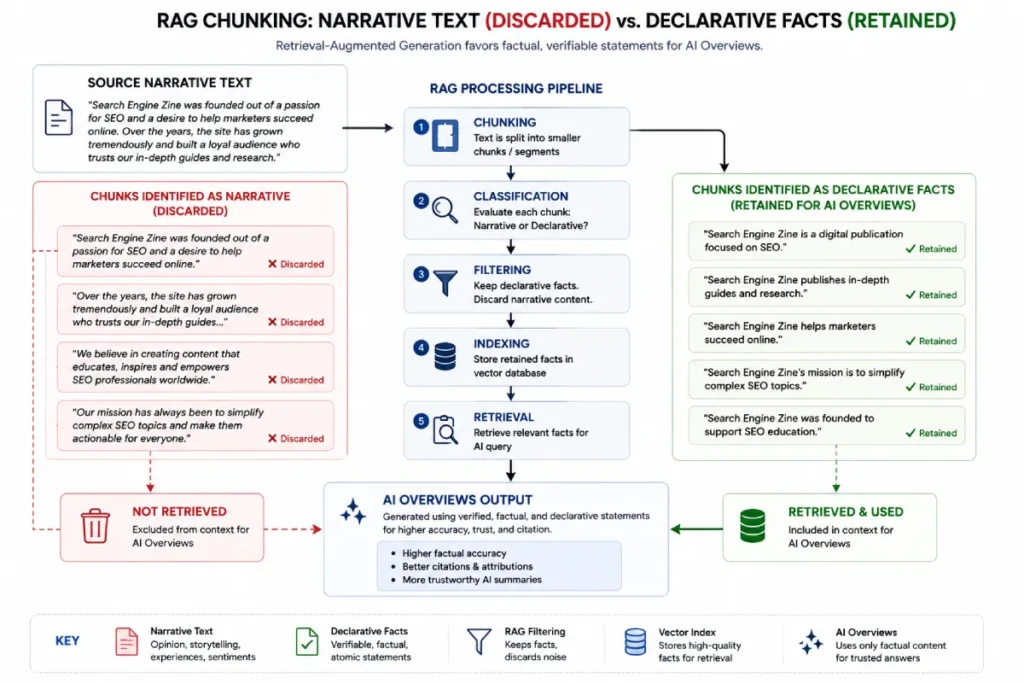
Generative search engines utilize Retrieval-Augmented Generation (RAG). RAG systems chunk documents into discrete semantic blocks, vectorize them, and store them for retrieval.
Narrative bios filled with marketing fluff have low factual density and are frequently discarded during chunking.
[Narrative Bio: Marketing Fluff] ──> RAG Chunking Parser ──> Discarded (Low Fact Density)
[Structured Bio: Direct Nouns] ──> RAG Chunking Parser ──> Ingested & Cited (High Fact Density)
To evaluate entity authenticity, search systems adapt security standards similar to the NIST digital identity verification framework.
Establishing an identity across academic profiles, hardware-authenticated publishing setups, and structured data raises the Identity Assurance Level (IAL), protecting author nodes from algorithmic devaluation.
Stylometry and Linguistic Fingerprinting
To differentiate human authors from synthetic LLM content, search engines deploy Stylometry and N-Gram Analysis.
Stylometry analyzes sentence structures, punctuation habits, and vocabulary patterns to form a unique biometric writing signature.
Generative AI models gravitate toward statistical averages. Running an expert’s draft through an AI tool for “polishing” alters their stylometric baseline, increasing S_e (Stylometric Entropy) and risking automated quality flags.
Preserving native human writing patterns maintains verifiable proof of experience.
Strategic Implementation & Cleanup Checklist
To maximize author entity trust across your organization, execute these steps:
Identifier Audit: Claim ORCID profiles, update Wikidata records, and align LinkedIn entries with official publishing names.
Deploy Nested JSON-LD: Replace basic plugin metadata with explicit @id references, knowsAbout Wikipedia nodes, and sameAs arrays.
Build Relational Density: Focus on authoritative citations that co-locate the author’s name with core technical topics.
Prune Legacy Profiles: Remove thin, auto-generated author archive pages that dilute domain-level E-E-A-T.
When removing author URLs that no longer belong to any content, deploy 410 Gone status codes to immediately purge dead nodes from search indexes.
Review the technical differences of executing 410 status codes for permanent removal to ensure clean entity signal consolidation.