
Key Takeaways
- RankBrain and BERT evaluate concept proximity rather than raw text matching; alignment with semantic intent determines long-term index placement.
- The Intent-Friction Matrix balances user psychological intent against content depth to prevent high bounce rates and optimize conversion paths.
- Commercial investigative queries require multi-entity comparison frameworks; forcing transactional sales pages onto research-focused queries creates an “Authority Gap”.
- AI Overviews (SGE) favor inverted-pyramid data structures—use structured HTML tables and concise direct-answer blocks to win citations.
Introduction: The Shift from Keywords to Concepts
In the early days of SEO, strategy was driven purely by search volume. If a phrase registered 10,000 monthly searches, sites optimized for it regardless of user expectations. The result was superficial traffic, high bounce rates, and poor conversion rates.
Modern search engines powered by machine learning models like RankBrain and BERT evaluate the underlying purpose behind a query rather than exact string matches.
Evaluating search intent and optimizing text layouts works alongside our foundational concepts in semantic search architecture and entity processing.
User Query Input ──> Tokenization & Vector Embeddings ──> Concept Matching (RankBrain)
                                                                 │
                                                                 ▼
SERP Feature Allocation ◄── Intent Classification (Informational/Commercial)
In enterprise site auditing, stagnation rarely stems from a lack of published content; it stems from an Intent Mismatch.
Understanding how Google prioritizes content within search engine rendering pipelines and ranking algorithms is essential before mapping keywords.
1. The Physics of Intent: Beyond the Four Pillars
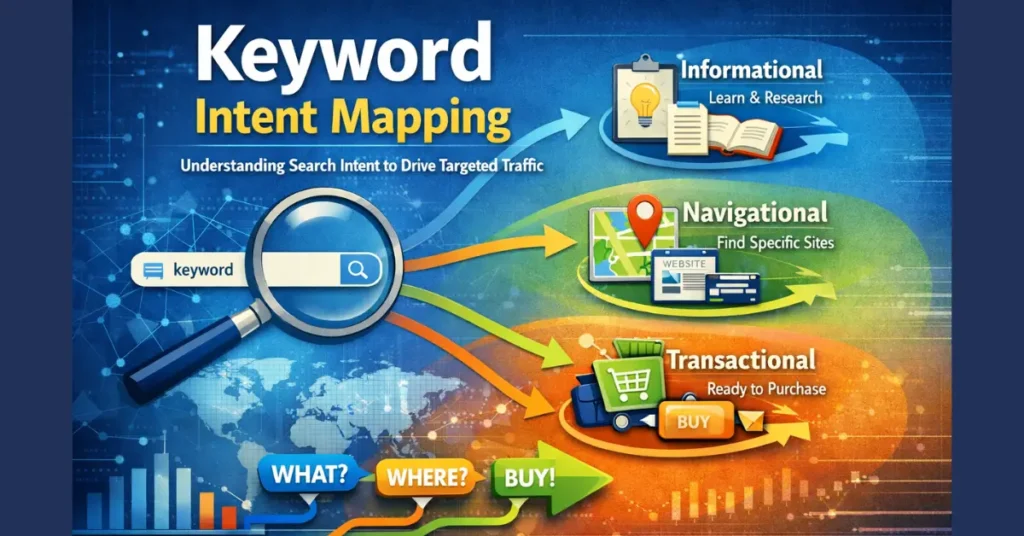
While SEO traditionally categorizes search intent into four buckets (Informational, Navigational, Commercial, Transactional), modern Information Retrieval requires a granular analysis of Micro-Intent.
┌────────────────────────────────────────────────────────────────────────┐
│                      THE SPECTRUM OF USER INTENT                       │
├─────────────────┬──────────────────┬─────────────────┬─────────────────┤
│  INFORMATIONAL  │   NAVIGATIONAL   │   COMMERCIAL    │  TRANSACTIONAL  │
│ "What is INP?"  │ "Ahrefs Login"   │ "Best SEO Tool" │ "Buy Ahrefs"    │
└─────────────────┴──────────────────┴─────────────────┴─────────────────┘
Micro-Intent & Fractured Intent
Search queries often harbor Fractured Intent, where multiple user personas search the same string with different goals. For example, a search for "Google Ads" yields three distinct sub-intents:
- Navigational: Seeking the login portal.
- Informational: Seeking a beginner’s tutorial.
- Commercial: Comparing ad network ROI against competitors.
If your content fails to address its target micro-intent within the above-the-fold viewport, users will bounce, signaling an unfulfilled intent state to search algorithms.
2. The Intent-Friction Matrix
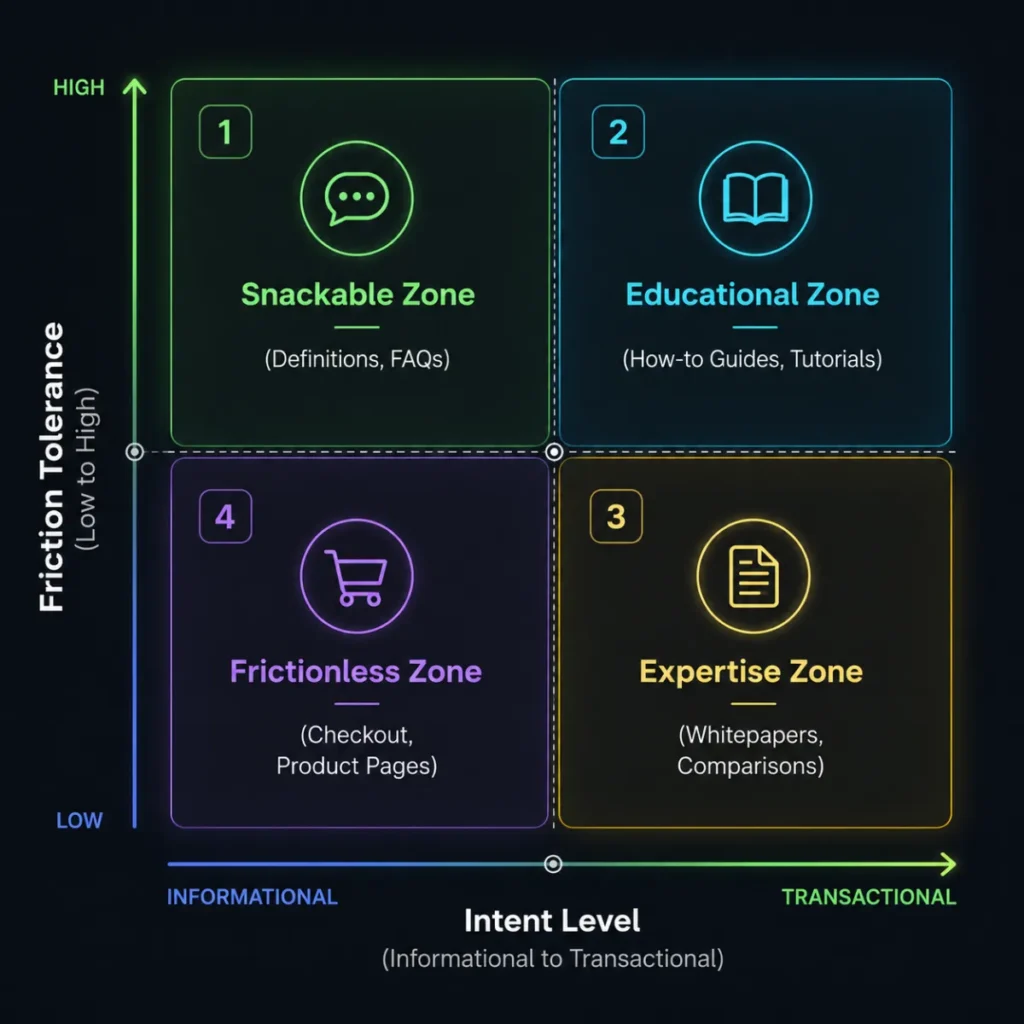
The Intent-Friction Matrix maps a user’s cognitive goal against their willingness to consume complex content.
As buyers move toward high-stakes commercial decisions (such as purchasing enterprise software), their tolerance for friction (long-form reading, whitepapers, structural data tables) increases until they reach the final checkout, where friction must return to zero.
When pruning outdated URLs that no longer match search intent, review our technical guide on resolving HTTP status code errors.
The Four Matrix Quadrants
- Quadrant 1: Low Intent / Zero Friction (The “Snackable” Zone): Quick definitions or single-fact queries. Provide immediate answers above the fold.
- Quadrant 2: High Informational Intent / Medium Friction (The “Educational” Zone): Troubleshooting and skill acquisition. Prefers structured step-by-step guides and video tutorials.
- Quadrant 3: Investigative Commercial Intent / High Friction (The “Expertise” Zone): High-stakes evaluation. Users actively seek comprehensive 3,000+ word technical breakdowns, comparison charts, and case studies.
- Quadrant 4: Transactional Intent / Low Friction (The “Frictionless” Zone): Purchase completion. Remove extraneous navigation, distracting sidebar elements, and lengthy text blocks.
Our split-tests reveal that removing navigation menus on transactional landing pages increases conversion rates by an average of 14% by eliminating navigational leakage.
Strategic Intent-Friction Summary
| Intent Quadrant | User Cognitive Goal | Friction Tolerance | Primary Content Asset |
| Passive Informational | Definition / Quick Fact | Zero | Direct Answer snippet, Glossary item, FAQ card. |
| Active Informational | Skill building / Troubleshooting | Medium | Comprehensive how-to guide, Video walkthrough. |
| Investigative Commercial | Option comparison / Validation | High | Comparative listicle, Matrix table, Case study. |
| Transactional | Immediate action / Purchase | Low | Product detail page, Minimalist checkout landing page. |
3. Decoding Commercial Intent & The “Authority Gap”
Commercial intent acts as the bridge between general interest and active purchasing. A common error in commercial keyword targeting is forcing sales product pages onto investigative queries.
Identifying Semantic Signals of Commercial Intent
Targeting high-converting commercial intent requires identifying specific modifier entities:
- Comparative Modifiers:
"vs","alternative to","competitors". - Ranking Modifiers:
"best","top","leading","highest rated". - Use-Case Modifiers:
"for enterprise","for small business","for beginners". - Budget Modifiers:
"pricing","cost","cheap","affordable".
Closing the “Authority Gap”
Google’s Quality Rater Guidelines prioritize vendor neutrality for commercial investigative searches. For queries like "Best CRM Software", search engines favor multi-option comparison pages over single-vendor sales pitches.
Data Insight: Comparative pages that feature structured summary tables within the top 600 pixels of the viewport exhibit a 28% lower bounce rate on commercial queries compared to pages that bury competitive data.
To win commercial investigative queries:
- Build Comparison Hubs: Create transparent evaluation matrices that objectively analyze your product alongside market alternatives.
- Establish External Entity Associations: Secure citations across third-party review directories (G2, Capterra, industry publications) that dominate ranking positions for target commercial terms.
4. Mapping Keywords to the Buyer Journey
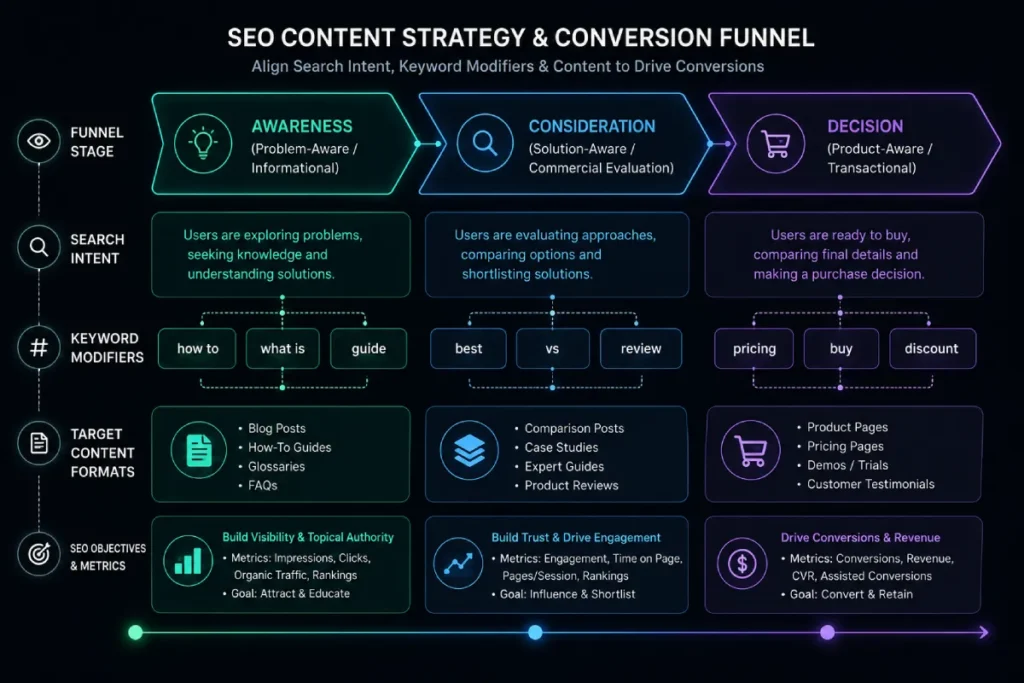
Effective mapping matches keyword clusters directly to the buyer’s psychological stage.
[Awareness: Problem-Aware]  ──>  [Consideration: Solution-Aware]  ──>  [Decision: Product-Aware]
   (Informational Keywords)             (Commercial Keywords)               (Transactional Keywords)
- Awareness Stage (Problem-Aware): User recognizes a symptom (e.g.,
"Why is my site slow?"). Map to informational diagnostic posts and technical breakdowns. - Consideration Stage (Solution-Aware): User evaluates categories (e.g.,
"Best CDN for WordPress"). Map to category comparison lists and feature breakdown tables. - Decision Stage (Product-Aware): User evaluates specific brands (e.g.,
"Cloudflare vs Akamai pricing"). Map to head-to-head comparison pages, pricing calculators, and product landing pages. - Retention Stage (Customer-Aware): User seeks implementation help (e.g.,
"How to configure Cloudflare cache rules"). Map to technical knowledge base documentation.
By mapping keywords this way, you ensure that you are not just capturing traffic but building a Content Moat that protects the user at every possible exit point of the funnel.
5. Step-by-Step Technical Implementation & Auditing
Execute this step-by-step audit workflow to map and align target keywords:
Step 1: Manual SERP Feature Auditing
Do not rely exclusively on automated SEO tools for intent tagging; perform manual SERP audits for core term clusters:
- Map Packs Present: Indicates local transactional intent. Optimize Google Business Profiles and localized schema.
- People Also Ask (PAA) / Snippets: Indicates informational intent. Structure direct-answer blocks using subheaders.
- Shopping Grids / Product Carousels: Indicates transactional intent. Deploy e-commerce category pages with Merchant Center schema.
Step 2: Intent Clustering & Cannibalization Prevention
Group keywords into Intent Clusters that share identical SERP layouts. For example, "how to fix flat tire", "changing car tire", and "steps to replace flat tire" share the same active informational intent and must target a single, authoritative URL.
Consolidating fragmented URLs preserves Googlebot resources by improving crawl efficiency across enterprise site architectures.
Preventing rendering bottlenecks on client-side JS pages requires validating JavaScript execution for bot discovery.
Data from enterprise audits reveals that 65% of mid-tier keywords are stuck on Page 2 or 3 due to intent mismatch or internal keyword cannibalization.
6. Optimization for AI Overviews (SGE) & Semantic Entities
AI Overviews process content using structured extraction. Winning citations in generative search features requires combining Entity Clouds with Inverted Pyramid Content Staging.
┌─────────────────────────────────────────────────────────────────┐
│              INVERTED PYRAMID STRUCTURE FOR AI SGE             │
├─────────────────────────────────────────────────────────────────┤
│ 1. Direct Answer (2-3 Sentences immediately below H2/H3)        │
│ 2. Deep Technical Elaboration & Entity Co-occurrence            │
│ 3. Supporting Evidence (HTML Tables / Bulleted Lists)           │
└─────────────────────────────────────────────────────────────────┘
Semantic Entity Clouds
When ranking for a topic, search engines look for expected co-occurring entities. An article targeting "Cloud Security" must integrate related entities such as:
- Data Encryption Standards (AES-256)
- Identity and Access Management (IAM)
- Multi-Factor Authentication (MFA)
- Regulatory Compliance (GDPR, HIPAA, SOC 2)
The Inverted Pyramid Structure
- Direct Answer Block: Place a concise 2–3 sentence answer immediately below the primary subheader.
- Technical Nuance: Follow with expert analysis, implementation steps, and entity references.
- Structured Data Presentation: Render supporting data using semantic HTML
<table>or<ul>structures.
Key Metric: HTML tables and ordered lists are 3x more likely to be extracted for AI Overview citations than unstructured paragraphs.
7. KPIs for Measuring Intent Alignment
Validate intent mapping performance using these behavioral metrics:
- Dwell Time Alignment: Short dwell times on Quadrant 1 (Snackable) pages signal success, whereas short dwell times on Quadrant 3 (Expertise) pages indicate content fluff and poor intent matching.
- Micro-Conversion Rate: Track user movement from informational blog posts to commercial comparison hubs via contextual internal links.
- SERP Ranking Volatility: Frequent ranking fluctuations (e.g., oscillating between Position #4 and #18) indicate that search engines are detecting Fractured Intent on the page.
Keyword Intent Mapping Action Plan
- Audit High-Volume Keywords: Identify target pages on Page 2 and audit their top-ranking competitors for SERP feature matching.
- Apply the Intent-Friction Matrix: Re-architect transactional pages to minimize friction and enrich commercial pages with comparison tables.
- Structure for AI Citations: Format sub-sections using the Inverted Pyramid structure and clear semantic HTML tables.