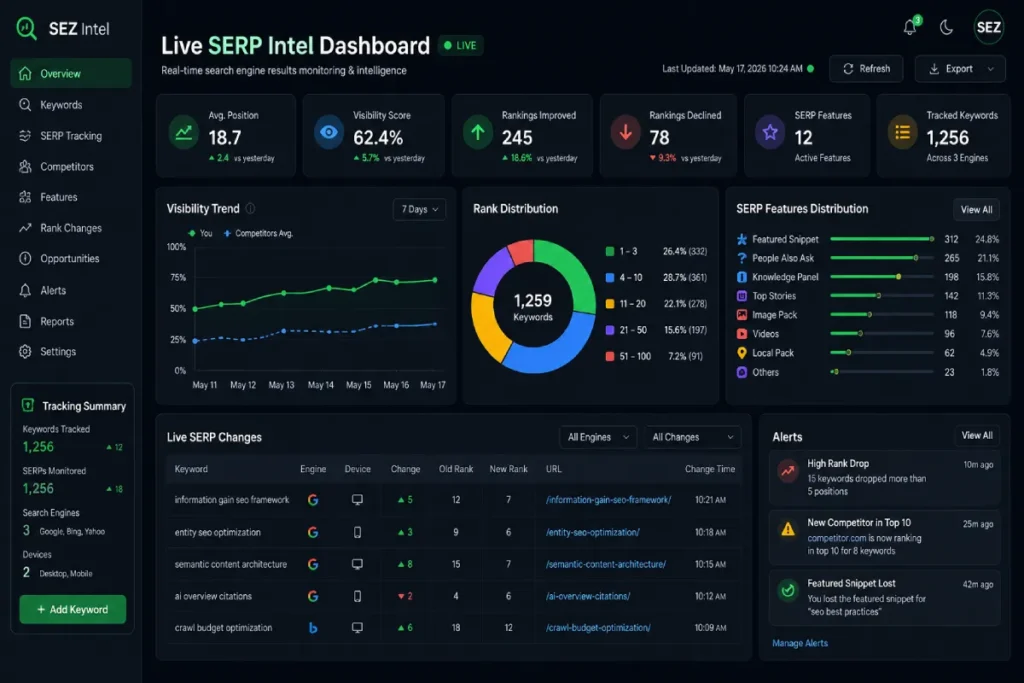
Live SERP Intel Dashboard
Extract DR, Backlinks, Traffic, and Keyword data for any query.
Analyze Real-Time Search Results, Ranking Signals, and Search Intent Data
What Is Live SERP Intel Dashboard?
Live SERP Intel Dashboard is a professional SEO intelligence and search analysis platform designed to help SEO professionals, publishers, agencies, marketers, businesses, and digital strategists analyze real-time search engine result pages (SERPs), competitor positioning, authority metrics, keyword opportunities, and user intent signals within modern search ecosystems.
As search environments become increasingly dynamic through artificial intelligence, semantic indexing systems, machine learning-driven ranking models, entity-based retrieval, and conversational search technologies, modern SEO requires more than static keyword tracking or isolated ranking metrics.
Effective optimization now depends on understanding how search results evolve in real time, how competitors structure authority, how user intent changes, and how modern search systems interpret contextual relevance across different query environments.
Live SERP Intel Dashboard combines multiple SEO intelligence workflows into a unified search analysis system designed to support:
- Real-time SERP analysis
- Competitor intelligence research
- Authority signal evaluation
- Keyword opportunity discovery
- Search intent analysis
- Topical relevance assessment
- User pain-point discovery
- Semantic SEO planning
- AI-search optimization readiness
The platform integrates four core SEO intelligence tools into a centralized dashboard environment:
- Ahrefs Insight
- Live SERP Results
- Traffic & Keywords
- Reddit Intent Research
Together, these systems help SEO professionals move beyond surface-level metrics toward a deeper contextual understanding of search ecosystems and user behavior.
Why Live SERP Analysis Matters
Modern search engine result pages are highly dynamic environments influenced by:
- User intent modeling
- Semantic relevance systems
- AI-assisted ranking signals
- Entity relationships
- Search personalization
- Topical authority frameworks
- Behavioral engagement patterns
- Query interpretation systems
Search rankings are no longer determined solely by keyword matching alone. Search engines increasingly evaluate broader contextual factors involving:
- Content quality
- Topical depth
- Authority signals
- Semantic consistency
- User satisfaction outcomes
- Search behavior patterns
This means SEO professionals must analyze live search environments continuously rather than relying entirely on static keyword reports or outdated ranking assumptions.
Live SERP Intel Dashboard helps users evaluate how search results behave in real time while identifying meaningful opportunities within evolving search ecosystems.
Why We Built Live SERP Intel Dashboard
Many SEO tools focus only on isolated metrics such as:
- Search volume
- Ranking position
- Backlink counts
- Keyword difficulty scores
While these metrics remain useful, modern search optimization increasingly requires deeper strategic insight involving:
- Intent interpretation
- Competitive context
- Semantic analysis
- User behavior understanding
- Topical authority evaluation
- AI-search readiness
We built Live SERP Intel Dashboard to unify multiple search intelligence workflows into one structured environment that helps users analyze:
- Ranking ecosystems
- Search demand
- Competitor authority
- User questions
- Semantic opportunities
- Real-world search behavior
The goal was to create a practical SEO intelligence system that supports modern search strategy development within increasingly AI-driven search environments.
Who Should Use Live SERP Intel Dashboard?
SEO Professionals
SEO consultants and agencies can use Live SERP Intel Dashboard to analyze ranking environments, evaluate authority metrics, discover search opportunities, and strengthen semantic SEO strategies for client campaigns.
Publishers & Bloggers
Content creators and editorial publishers can identify topical opportunities, search intent patterns, and audience questions to improve content planning and long-term topical authority.
Ecommerce Websites
Online stores can evaluate transactional search landscapes, competitor authority, commercial intent opportunities, and product-focused search behavior.
Local Businesses
Local SEO campaigns benefit from live SERP evaluation, authority analysis, and real-world search intent research.
Digital Strategists
Growth marketers and digital strategists can use the platform to improve:
- Content planning
- Search visibility analysis
- Competitive intelligence
- Search demand forecasting
- Audience understanding
Understanding the Four Core Tools
1. Ahrefs Insight
Analyze Authority Signals and Link Profiles
The Ahrefs Insight component helps users evaluate:
- Domain Rating (DR)
- Backlink profiles
- Referring domains
- Authority distribution
- Link ecosystem strength
Authority metrics remain important because search engines continue evaluating trust, credibility, contextual authority, and link relationships across the web.
While backlinks alone do not guarantee rankings, strong link ecosystems often correlate with:
- Higher crawl trust
- Better discoverability
- Stronger topical authority
- Improved search visibility
Ahrefs Insight helps SEO professionals understand how authoritative websites compete within specific search environments.
Why Authority Analysis Matters
Modern search systems increasingly evaluate:
- Website trustworthiness
- Contextual authority
- Semantic consistency
- Topic expertise
- External citation relationships
Authority analysis helps identify:
- Competitive barriers
- Link-building opportunities
- Topical authority gaps
- Trust signal disparities
This helps websites develop more realistic SEO strategies grounded in actual search competition.
2. Live SERP Results
Analyze Real-Time Top 10 Ranking Pages
The Live SERP Results module allows users to evaluate the current top-ranking pages for target queries in real time.
This includes analyzing:
- Ranking page structures
- Search intent alignment
- Content depth
- SERP volatility
- Competitive patterns
- Featured search elements
- Informational hierarchy
- Semantic relevance signals
Search result pages reveal how search engines currently interpret:
- Query intent
- User expectations
- Content quality standards
- Semantic relationships
By analyzing live SERPs directly, SEO professionals gain stronger insight into:
- What content performs well
- Which search intents dominate
- How competitors structure topical coverage
- What search engines prioritize contextually
Why Real-Time SERP Analysis Matters
Search ecosystems evolve continuously.
SERPs may change due to:
- Algorithm refinements
- AI-assisted retrieval updates
- User behavior shifts
- Emerging search trends
- Semantic interpretation changes
- Competitor publishing activity
Static keyword research often fails to capture these dynamic changes.
Live SERP analysis helps users monitor:
- Ranking ecosystem changes
- Competitive movement
- Search intent evolution
- Content opportunity shifts
This supports more adaptive and data-driven SEO strategies.
3. Traffic & Keywords
Discover Search Volume and Keyword Difficulty Data
The Traffic & Keywords component helps users extract:
- Search volume estimates
- Keyword difficulty metrics
- Organic visibility opportunities
- Competitive keyword patterns
- Search demand trends
Keyword research remains foundational within SEO because it helps identify:
- User demand
- Search behavior patterns
- Content opportunities
- Intent-driven optimization pathways
However, modern keyword research increasingly requires contextual understanding rather than simple volume chasing.
Why Search Demand Data Still Matters
Search systems may now interpret language semantically, but search demand data still helps SEO professionals understand:
- Which topics matter most
- How audiences search
- Where competition exists
- Which opportunities remain underserved
Traffic & Keywords helps users identify:
- Long-tail opportunities
- Semantic keyword variations
- Intent-focused search queries
- Content expansion pathways
This supports broader topical authority development and structured SEO planning.
4. Reddit Intent
Discover Real User Questions and Pain Points
The Reddit Intent module helps identify:
- Real audience questions
- User frustrations
- Search pain points
- Conversational language patterns
- Intent-driven discussion topics
Modern SEO increasingly rewards content that genuinely satisfies user needs rather than content optimized only around isolated keywords.
Reddit discussions often reveal:
- Natural language phrasing
- Unfiltered audience concerns
- Emerging trends
- Real-world problems
- Context-rich informational intent
This provides valuable insight into how users actually think, search, and communicate.
Why Intent Research Matters
Search engines increasingly prioritize:
- User satisfaction
- Intent fulfillment
- Contextual relevance
- Informational usefulness
Intent research helps websites create:
- More helpful content
- Better topical alignment
- Stronger semantic relevance
- Improved informational clarity
Reddit Intent supports this process by uncovering authentic audience language and informational demand.
Live SERP and Modern SEO Strategy
Modern SEO increasingly requires integrating:
- Technical SEO
- Semantic optimization
- Search intent analysis
- Competitive intelligence
- User behavior research
- AI-search readiness
Live SERP Intel Dashboard combines these workflows into a unified strategic framework.
Rather than optimizing pages blindly, users can analyze:
- Real search ecosystems
- Authority landscapes
- Intent structures
- Ranking patterns
- Audience needs
This improves decision-making across:
- Content strategy
- Topical expansion
- SEO audits
- Competitor analysis
- Search visibility planning
Semantic SEO and Search Intelligence
Modern search systems increasingly evaluate:
- Entity relationships
- Contextual meaning
- Semantic completeness
- Informational depth
- Topical ecosystems
Live SERP analysis helps identify:
- Which semantic relationships appear consistently
- Which content themes dominate rankings
- How topical authority is structured within SERPs
This supports stronger semantic SEO strategies aligned with evolving AI-driven search systems.
Why AI Search Changes SEO Research
AI-assisted search environments increasingly interpret:
- Context
- Relationships
- User goals
- Query intent
- Semantic patterns
This means SEO research must evolve beyond:
- Exact-match keyword targeting
- Surface-level metrics
- Static ranking assumptions
Live SERP Intel Dashboard helps users adapt by analyzing:
- Real-time search behavior
- Semantic ranking ecosystems
- Conversational intent signals
- Authority structures
Understanding Search Intent Ecosystems
Every SERP reflects a specific search intent ecosystem.
Some queries prioritize:
- Informational guides
- Product comparisons
- Transactional pages
- Local business results
- Video content
- Community discussions
Live SERP analysis helps identify:
- Which formats dominate
- Which intent categories appear strongest
- Which content structures do search engines prefer
This improves optimization accuracy.
Why Competitive Context Matters
SEO success is relative to the competitive landscape.
A keyword opportunity may appear attractive until:
- Authority barriers are evaluated
- SERP intent is analyzed
- Topical depth requirements are understood
Live SERP Intel Dashboard helps users benchmark:
- Authority strength
- Content quality expectations
- Competitive semantic depth
- Search ecosystem maturity
This leads to more realistic SEO strategies.
Live SERP and Topical Authority
Search engines increasingly reward websites demonstrating:
- Consistent expertise
- Structured topical ecosystems
- Semantic relevance
- Informational completeness
SERP analysis helps users understand:
- Which topics do competitors cover comprehensively
- Which semantic subtopics appear repeatedly
- How authority is distributed contextually
This supports long-term topical authority development.
Why Real User Language Matters
Keyword databases alone often fail to capture:
- Emotional nuance
- Conversational phrasing
- Real frustrations
- Emerging concerns
- Audience-specific language
Reddit Intent research helps uncover authentic user communication patterns that improve:
- Content relevance
- Intent alignment
- Audience understanding
- Semantic optimization
Live SERP and Content Strategy
Content planning increasingly requires:
- Intent-driven research
- Semantic topic analysis
- Competitor benchmarking
- Audience understanding
- Authority evaluation
Live SERP Intel Dashboard supports:
- Cluster content planning
- Hub development
- Long-tail expansion
- Search demand analysis
- Competitive gap discovery
This improves long-term SEO scalability.
Why Search Ecosystems Continue Evolving
Modern search systems increasingly prioritize:
- AI-assisted retrieval
- Semantic interpretation
- Contextual understanding
- User-focused relevance
- Information quality
- Entity relationships
SEO strategies must therefore evolve toward:
- Intent-focused optimization
- Structured semantic ecosystems
- User-centric content development
- Real-world search analysis
Live SERP Intel Dashboard supports this transition by helping users analyze live search environments more strategically.
Live SERP and EEAT Principles
Google’s evolving quality systems increasingly emphasize:
- Experience
- Expertise
- Authoritativeness
- Trustworthiness
Live SERP analysis helps support these principles by improving:
- Audience understanding
- Informational relevance
- Topical clarity
- Competitive awareness
- User satisfaction alignment
SEO research grounded in real search behavior often produces more useful and trustworthy content than strategies based solely on keyword metrics.
Why Sustainable SEO Requires Intelligence
Sustainable SEO is no longer built on:
- Ranking tricks
- Isolated metrics
- Keyword stuffing
- Volume chasing
It increasingly depends on:
- Contextual understanding
- Search intent modeling
- Semantic organization
- Authority development
- User-focused optimization
Live SERP Intel Dashboard helps support these more advanced SEO workflows.
Final Thoughts
Live SERP Intel Dashboard is designed to help SEO professionals, publishers, marketers, agencies, businesses, and digital strategists analyze modern search ecosystems more effectively through real-time SERP intelligence, authority evaluation, keyword research, and user intent discovery.
By combining:
- Ahrefs Insight
- Live SERP Results
- Traffic & Keywords
- Reddit Intent Research
The platform provides a structured SEO intelligence environment aligned with modern search behavior and evolving AI-driven retrieval systems.
As search engines continue advancing through semantic indexing, conversational AI search, contextual relevance systems, and entity-based interpretation frameworks, successful SEO increasingly depends on understanding:
- Real user intent
- Competitive ecosystems
- Search demand patterns
- Semantic relationships
- Authority signals
Live SERP Intel Dashboard helps bridge these insights into actionable SEO strategy development that supports long-term discoverability, stronger topical authority, and sustainable organic growth.