Domain Authority Checker

Instantly analyze domain authority, backlinks, and website trust metrics.

Please enter a valid domain name.
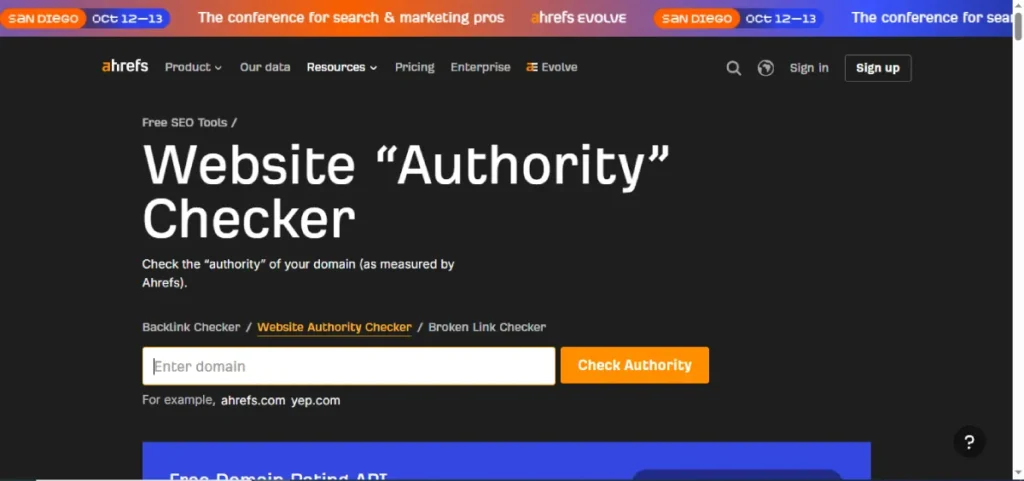
This tool connects directly with Ahrefs Website Authority Checker for live backlink and DR analysis.

Domain Authority Checker: Analyze Website Authority, Trust Signals, and SEO Strength Accurately

What Is Domain Authority Checker?

Domain Authority Checker is a professional SEO analysis tool designed by the hrefs to help website owners, SEO specialists, marketers, publishers, agencies, and digital businesses evaluate the relative authority and trust strength of a domain within search ecosystems.

In modern SEO, understanding website authority involves far more than looking at backlinks alone.

Search engines increasingly evaluate domains through a combination of signals that may include topical relevance, entity relationships, trust consistency, backlink quality, semantic authority, content reliability, technical infrastructure, and overall digital reputation.

Domain Authority Checker helps simplify the process of analyzing these signals by providing insights that support smarter SEO decision-making and long-term organic growth strategies.

Whether you are auditing your own website, researching competitors, evaluating expired domains, analyzing outreach opportunities, or monitoring SEO progress, Domain Authority Checker provides a faster and more accessible way to understand the relative strength and credibility of a domain.

Why Domain Authority Still Matters in Modern SEO

Search algorithms have evolved significantly over the past decade. Today’s search systems rely heavily on artificial intelligence, semantic understanding, natural language processing, entity-based indexing, and contextual relevance.

However, authority signals remain an important part of how search engines evaluate trust and credibility across the web.

Domain authority metrics are widely used within the SEO industry to estimate how strong and influential a domain may appear relative to competitors. While domain authority itself is not a direct Google ranking factor, authority-related signals often correlate with:

  • Strong backlink profiles
  • High-quality content ecosystems
  • Better crawl trust
  • Established topical authority
  • Consistent publishing history
  • Stronger digital reputation
  • Greater search visibility

Domain Authority Checker helps users interpret these broader authority patterns more effectively.

Why We Built Domain Authority Checker

Many authority analysis tools online are either overly complicated, cluttered with unnecessary metrics, or difficult for everyday users to interpret clearly.

We created Domain Authority Checker to provide a cleaner, faster, and more user-friendly experience focused on practical SEO analysis rather than overwhelming complexity.

Our goal was to build a tool that supports:

  • Clear authority evaluation
  • Faster competitive research
  • Better SEO decision-making
  • Simpler usability
  • Technical SEO workflows
  • Long-term search strategy planning

As modern search systems become increasingly AI-driven and entity-focused, understanding domain trust and authority continues to play a major role in sustainable organic growth.

Who Should Use Domain Authority Checker?

SEO Professionals

SEO consultants and agencies can use Domain Authority Checker to analyze competitors, qualify backlink opportunities, evaluate outreach targets, and assess overall domain strength within competitive niches.

Website Owners

Publishers, bloggers, and business owners can better understand how their domain compares within their industry and identify areas for long-term SEO improvement.

Content Marketers

Content teams can evaluate partnership opportunities, guest posting websites, and authoritative domains relevant to their topical ecosystem.

Link Builders

Backlink specialists can use authority insights to prioritize high-value outreach opportunities and avoid low-quality websites.

Developers & Technical Teams

Technical SEO teams can integrate authority analysis into broader site audits and digital performance evaluations.

Understanding Domain Authority in SEO

Domain authority metrics are designed to estimate the overall credibility and strength of a website relative to others within search ecosystems.

Authority is often influenced by:

  • Backlink quality
  • Referring to domain diversity
  • Content consistency
  • Topical relevance
  • Domain trust
  • Link profile health
  • Historical performance
  • Technical SEO quality
  • Semantic authority

Strong domains often demonstrate:

  • Consistent publishing activity
  • Trusted backlink relationships
  • High-quality informational content
  • Better topical organization
  • Stronger user engagement
  • Higher trust perception

Domain Authority Checker helps users evaluate these broader signals more efficiently.

Domain Authority vs Google Rankings

One of the most common misconceptions in SEO is assuming that domain authority itself directly determines rankings.

Google does not publicly use third-party “Domain Authority” scores as official ranking factors. However, authority-related signals often influence broader trust and relevance evaluation systems.

High-authority websites frequently perform better because they typically possess:

  • Strong backlink ecosystems
  • Better information architecture
  • Higher trust signals
  • Greater topical authority
  • Stronger brand recognition
  • Better user engagement
  • Established semantic relationships

Domain Authority Checker should therefore be viewed as a comparative SEO evaluation tool rather than a guaranteed ranking predictor.

Why Authority Signals Matter in AI Search

Modern AI-powered search systems increasingly evaluate:

  • Source credibility
  • Entity trust
  • Information consistency
  • Publisher authority
  • Content reliability
  • Semantic depth

As AI-generated search experiences continue evolving, authority signals may become even more important for determining which sources are trusted within generative search environments.

Search systems increasingly attempt to identify:

  • Trusted publishers
  • Reliable experts
  • Established topical entities
  • Consistent information sources

Domain Authority Checker helps users better understand where a website stands within broader authority ecosystems.

How Domain Authority Supports E-E-A-T

Google’s quality systems increasingly emphasize:

  • Experience
  • Expertise
  • Authoritativeness
  • Trustworthiness

Authority-related signals can indirectly support these evaluations through:

  • Strong backlink relationships
  • Consistent content quality
  • Recognized publisher identity
  • Established topical depth
  • Long-term credibility

While authority metrics alone do not define E-E-A-T, they often overlap with broader trust and credibility indicators.

Domain Authority Checker supports SEO professionals in analyzing these trust-related patterns more effectively.

Common Uses for Domain Authority Checker

Competitor Research

Analyze how competing websites compare. One of the most valuable uses of a Domain Authority Checker is competitor research.

Understanding how competing websites perform within your niche can provide important insight into the broader search landscape, helping businesses, publishers, and SEO professionals make more informed strategic decisions.

Competitor authority analysis allows you to evaluate how your website compares against other domains competing for similar keywords, audiences, and search visibility.

By analyzing authority-related signals, you can better understand which competitors have built stronger trust ecosystems, backlink profiles, topical relevance, and overall digital credibility within your industry.

For example, websites with higher authority often benefit from:

  • Stronger backlink networks
  • More trusted referring domains
  • Better topical consistency
  • Established publishing history
  • Higher brand recognition
  • Greater semantic authority
  • More stable search visibility

Using a Domain Authority Checker during competitor research can help identify why certain websites consistently perform well in search results and where opportunities for improvement may exist within your own SEO strategy.

Competitor analysis is especially valuable when planning:

  • Content strategies
  • Link-building campaigns
  • Outreach initiatives
  • Topical authority development
  • Digital PR efforts
  • Long-term SEO growth plans

Rather than focusing only on raw authority numbers, effective competitor research should also evaluate the overall quality and relevance of competing websites.

A smaller niche-focused domain with strong topical depth may sometimes outperform larger websites that lack subject relevance or semantic consistency.

Modern search systems increasingly evaluate contextual trust, expertise, and content quality alongside traditional authority signals.

Because of this, competitor research should be viewed as a broader strategic analysis process rather than a simple comparison of scores alone.

Domain Authority Checker helps simplify this process by providing accessible authority insights that support smarter SEO decision-making, competitive benchmarking, and long-term organic growth planning within increasingly AI-driven and trust-focused search environments in authority strength within your niche.

Backlink Opportunity Evaluation

Domain Authority Checker can also play an important role in backlink opportunity evaluation by helping SEO professionals, marketers, publishers, and businesses assess the quality and credibility of potential outreach targets before investing time, effort, or resources into link-building campaigns.

Not all backlinks provide equal SEO value. Modern search systems increasingly evaluate backlink quality, topical relevance, trust consistency, contextual relationships, and source credibility rather than simply counting the number of incoming links.

Because of this, evaluating websites carefully before pursuing partnerships, guest posting opportunities, or outreach campaigns has become an essential part of a responsible and sustainable SEO strategy.

Using a Domain Authority Checker allows users to analyze whether a website demonstrates stronger authority and trust signals within its niche. This can help identify websites that may provide greater long-term value through:

  • Trusted backlink profiles
  • Stronger topical relevance
  • Better search visibility
  • Established publishing consistency
  • Higher editorial standards
  • Greater semantic authority
  • More reliable content ecosystems

Before pursuing a backlink opportunity, it is important to evaluate more than just authority metrics alone. Effective backlink analysis should also consider:

  • Topical alignment with your niche
  • Content quality and originality
  • Website reputation
  • User experience and technical quality
  • Publishing consistency
  • Organic search visibility
  • Spam indicators or manipulative link patterns

A backlink from a highly relevant and trustworthy website often provides significantly more strategic value than links from unrelated or low-quality domains.

Search engines increasingly prioritize contextual trust and semantic relevance, making quality-focused outreach more important than ever.

Domain Authority Checker helps streamline this evaluation process by providing quick authority insights that support smarter outreach decisions and better resource allocation.

Instead of pursuing large volumes of low-value backlinks, SEO professionals can focus on building relationships with authoritative, relevant, and trustworthy websites that contribute to long-term organic growth.

This approach aligns more closely with modern search quality standards, sustainable SEO practices, and Google’s broader emphasis on expertise, trustworthiness, and content reliability.

As AI-driven search systems continue evolving, backlink quality and source credibility are likely to remain important components of broader digital authority evaluation.

SEO Audits

Domain Authority Checker can be a valuable component within broader SEO audits by helping professionals evaluate website authority, trust signals, backlink strength, and overall competitive positioning alongside technical and content-related factors.

Modern SEO audits are no longer limited to checking keywords or identifying isolated technical issues.

Today’s search ecosystems require a more comprehensive analysis that considers how authority, content quality, semantic relevance, user experience, and technical performance work together to influence search visibility.

Authority analysis provides important context during an SEO audit because it helps identify how a website compares against competitors within the same niche or industry.

A technically optimized website with high-quality content may still struggle to compete if competing domains possess significantly stronger trust signals, backlink ecosystems, topical authority, or established digital credibility.

Understanding these authority gaps can help businesses prioritize realistic SEO goals and develop more effective long-term growth strategies.

When incorporated into a full SEO audit, authority analysis may help evaluate:

  • Overall domain trust strength
  • Backlink profile quality
  • Referring to domain relevance
  • Competitive positioning
  • Topical authority development
  • Link acquisition opportunities
  • Historical authority growth trends
  • Potential weaknesses in trust perception

However, authority metrics should never be evaluated in isolation. Effective SEO audits combine authority analysis with technical and content-focused assessments such as:

  • Crawlability and indexation
  • Site architecture and internal linking
  • Structured data implementation
  • Mobile usability
  • Page speed and performance
  • Content quality and topical depth
  • Search intent alignment
  • Semantic optimization
  • User engagement signals

Modern search systems increasingly analyze websites holistically rather than relying on single ranking factors.

Search engines powered by AI-driven interpretation, natural language processing, and entity-based understanding evaluate how well websites demonstrate expertise, trustworthiness, relevance, and overall user value across multiple dimensions.

Domain Authority Checker helps support this broader evaluation process by providing accessible authority insights that complement technical SEO analysis and content audits.

These insights can help SEO professionals identify strengths, uncover weaknesses, benchmark competitors, and make more informed optimization decisions.

As search ecosystems continue evolving toward semantic understanding and trust-based evaluation models, incorporating authority analysis into SEO audits remains an important part of building sustainable organic visibility and long-term digital credibility.

Domain Acquisition

Domain Authority Checker can be an extremely useful tool when evaluating expired domains, aged domains, or potential domain acquisition opportunities before making a purchase decision.

In modern SEO and digital publishing, domain history, authority signals, backlink quality, and trust consistency can significantly influence the long-term value of a domain.

Conducting proper authority analysis before acquiring a domain helps reduce risk and supports smarter investment decisions.

Many SEO professionals, businesses, publishers, and entrepreneurs purchase domains for purposes such as:

  • Building niche websites
  • Launching authority brands
  • Expanding existing digital properties
  • Rebranding projects
  • Acquiring established backlink profiles
  • Recovering valuable domain names
  • Developing long-term content ecosystems

However, not all expired or aged domains provide positive SEO value. Some domains may carry historical issues that could negatively impact future search performance, including spam-related backlinks, manipulative SEO practices, toxic link patterns, irrelevant topical history, or search trust penalties accumulated over time.

Using a Domain Authority Checker during domain acquisition research can help evaluate whether a domain demonstrates stronger authority and trust signals within its historical backlink ecosystem. Important factors to consider may include:

  • Overall domain authority strength
  • Quality of referring domains
  • Topical relevance of backlinks
  • Link profile consistency
  • Historical trust indicators
  • Brand credibility signals
  • Semantic relevance within a niche

A domain with strong authority metrics and relevant backlink relationships may offer strategic advantages for future SEO growth, especially when combined with high-quality content, clean technical architecture, and sustainable publishing practices.

At the same time, authority metrics alone should never determine whether a domain is worth purchasing. A complete domain acquisition evaluation should also include:

  • Historical content analysis
  • Backlink quality reviews
  • Spam signal assessment
  • Indexation history
  • Trademark considerations
  • Search visibility trends
  • Archive history reviews
  • Technical health evaluations

Modern search systems increasingly prioritize trust, contextual relevance, and content quality over artificial authority manipulation.

Because of this, acquiring domains solely for inflated metrics without considering broader trust signals may create long-term SEO risks rather than advantages.

Domain Authority Checker helps simplify the initial evaluation process by providing accessible authority insights that support more informed domain acquisition decisions.

Whether purchasing expired domains for SEO projects, authority websites, business expansion, or long-term publishing strategies, careful authority analysis remains an important part of responsible and sustainable digital asset evaluation.

Content Partnership Screening

Domain Authority Checker can help businesses, publishers, SEO professionals, and content marketers evaluate potential content partnership opportunities before establishing collaborations, editorial relationships, or outreach agreements.

In modern digital marketing and SEO, partnerships with reputable and trustworthy websites can contribute to stronger brand visibility, improved authority signals, broader audience reach, and long-term organic growth.

Not every website offering collaboration opportunities provides equal value. Some websites may appear authoritative on the surface while lacking editorial quality, topical relevance, trust consistency, or genuine audience engagement.

Conducting authority analysis before entering partnerships helps organizations make more informed decisions and avoid investing resources into low-quality or potentially harmful websites.

Using a Domain Authority Checker during partnership evaluation allows users to analyze whether a website demonstrates stronger credibility signals within its niche or industry. This can help identify websites that may offer more meaningful value through:

  • Stronger backlink ecosystems
  • Established topical authority
  • Higher editorial quality
  • Better search visibility
  • Trusted publishing history
  • Consistent content standards
  • Greater audience credibility

Content partnership screening is especially important for activities such as:

  • Guest posting campaigns
  • Editorial contributions
  • Sponsored content placements
  • Co-marketing initiatives
  • Brand collaborations
  • Digital PR outreach
  • Industry partnerships
  • Thought leadership publishing

However, authority metrics should only be one part of the evaluation process. Responsible partnership screening should also assess:

  • Content originality and quality
  • Topical alignment with your industry
  • User experience and website usability
  • Publishing consistency
  • Spam indicators or excessive advertising
  • Reputation within the niche
  • Organic traffic trends
  • Audience trust and engagement

Modern search systems increasingly prioritize contextual trust, expertise, and semantic relevance rather than large volumes of low-quality backlinks or artificial partnership networks.

Collaborating with reputable, high-quality websites aligned with your niche often provides stronger long-term value than pursuing large numbers of weak or unrelated placements.

Domain Authority Checker helps simplify the early stages of partnership evaluation by providing accessible authority insights that support smarter outreach and collaboration decisions.

This approach aligns more closely with sustainable SEO principles, responsible digital publishing practices, and Google’s broader emphasis on trustworthiness, expertise, and high-quality content ecosystems.

As search environments continue evolving toward AI-assisted interpretation and entity-based trust evaluation, building relationships with credible and authoritative websites may become even more important for maintaining long-term digital visibility and reputation.

SEO Campaign Tracking

Domain Authority Checker can be a valuable tool for SEO campaign tracking by helping businesses, marketers, publishers, and SEO professionals monitor domain growth trends over time as authority signals gradually improve.

In modern SEO, long-term organic growth is rarely driven by a single ranking factor or isolated optimization tactic. Instead, sustainable visibility typically develops through consistent improvements in trust, topical relevance, backlink quality, technical performance, and overall content authority.

Tracking authority-related metrics over time can provide useful insight into whether an SEO campaign is moving in a positive direction.

As websites publish higher-quality content, earn stronger backlinks, improve technical infrastructure, and build greater topical expertise, authority signals may strengthen gradually across the broader search ecosystem.

Using Domain Authority Checker as part of ongoing SEO monitoring can help identify trends related to:

  • Domain authority growth
  • Backlink acquisition progress
  • Referring to domain quality
  • Competitive positioning changes
  • Topical authority development
  • Brand trust evolution
  • Long-term SEO momentum

SEO campaign tracking is especially useful for evaluating:

  • Content marketing performance
  • Link-building effectiveness
  • Digital PR campaigns
  • Authority-building strategies
  • Niche expansion efforts
  • Organic growth consistency
  • Long-term trust development

However, authority metrics should not be treated as short-term success indicators or standalone measures of SEO performance.

Search visibility depends on many interconnected factors, including content quality, semantic relevance, technical SEO, user experience, search intent alignment, and broader trust signals.

Authority growth often occurs gradually as websites establish stronger credibility and recognition over time.

Modern search systems increasingly prioritize sustainable trust and contextual expertise rather than artificial ranking manipulation.

Because of this, SEO campaign tracking should focus on broader long-term progress rather than temporary metric fluctuations alone.

Consistent improvements in authority-related signals may indicate that a website is building stronger digital credibility within its niche or industry.

Domain Authority Checker helps simplify this process by providing accessible authority insights that support ongoing SEO evaluation and strategic planning.

Combined with technical audits, content analysis, and performance monitoring, authority tracking can help organizations better understand how their SEO efforts contribute to broader search visibility and long-term organic growth.

As AI-driven search systems continue evolving toward entity-based trust evaluation and semantic understanding, monitoring authority development over time may become even more valuable for maintaining sustainable search performance and competitive positioning.

Important Limitations of Domain Authority

No authority metric perfectly reflects how search engines evaluate websites internally.

Authority scores should never be treated as:

  • Absolute ranking guarantees
  • Direct Google metrics
  • Standalone SEO indicators
  • Replacement for quality content
  • Replacement for technical SEO

Instead, authority metrics work best when combined with:

  • Content quality analysis
  • Technical SEO audits
  • Topical relevance evaluation
  • Search intent alignment
  • Semantic optimization
  • User experience analysis

Domain Authority Checker should therefore be used as part of a broader SEO strategy.

What Actually Improves Domain Authority?

Improving domain authority usually requires sustainable long-term SEO practices rather than shortcuts.

Key factors often include:

High-Quality Backlinks

Trusted referring domains strengthen authority signals more effectively than large volumes of low-quality links.

Topical Authority

Publishing consistent, high-quality content within a focused niche improves semantic trust.

Technical SEO Quality

Strong crawlability, clean site architecture, and performance optimization support better search visibility.

Content Consistency

Reliable publishing activity reinforces trust and expertise signals.

Brand Recognition

Established brands often earn stronger backlink ecosystems naturally.

Information Quality

Search systems increasingly prioritize reliable, useful, and experience-driven content.

Domain Authority and Topical Authority

Modern SEO increasingly prioritizes topical authority rather than generalized link quantity alone.

Search systems now evaluate:

  • Subject matter depth
  • Semantic relevance
  • Entity relationships
  • Contextual expertise
  • Information consistency

A smaller website with strong topical depth may outperform larger websites lacking semantic focus.

Domain Authority Checker helps identify broader authority strength, but long-term SEO success also depends heavily on topical expertise and content quality.

Why Technical SEO Still Matters

Even authoritative websites can struggle if technical foundations are weak.

Important technical factors include:

  • Crawl efficiency
  • Structured data
  • Mobile usability
  • Page speed
  • Indexation quality
  • Internal linking
  • Canonical management
  • Semantic architecture

Modern search systems increasingly combine technical quality with semantic understanding and authority evaluation.

How Search Is Evolving Beyond Traditional Metrics

Search is becoming increasingly:

  • AI-assisted
  • Entity-driven
  • Contextual
  • Semantic
  • Predictive

This means future SEO success may rely less on isolated metrics and more on:

  • Trust ecosystems
  • Content quality
  • Entity authority
  • Information reliability
  • User satisfaction
  • Semantic clarity

Domain Authority Checker helps users understand one important layer within this broader search evolution.

Why Trust Matters More Than Ever

Search engines increasingly prioritize trustworthy information sources in response to:

  • AI-generated spam
  • Low-quality content
  • Misinformation
  • Manipulative SEO tactics

Websites demonstrating:

  • Consistent expertise
  • Editorial quality
  • Strong reputation
  • Reliable information
  • Technical integrity

may build stronger long-term visibility.

Authority analysis helps identify which websites are building stronger trust ecosystems over time.

Best Practices When Using Domain Authority Metrics

For best results:

  • Compare websites within similar niches
  • Focus on backlink quality over quantity
  • Analyze topical relevance
  • Combine authority analysis with technical audits
  • Prioritize long-term SEO strategy
  • Avoid manipulative link schemes
  • Focus on sustainable growth

Domain Authority Checker works best as a strategic evaluation tool rather than a shortcut metric.

Final Thoughts

Domain Authority Checker is designed to help SEO professionals, publishers, marketers, developers, and businesses better understand website authority within modern search ecosystems.

As search systems continue evolving toward semantic understanding, AI-powered retrieval, entity recognition, and trust-based evaluation, authority-related analysis remains an important component of sustainable SEO strategy.

While authority metrics should never replace quality content, technical SEO, or user-focused publishing, they can provide valuable insight into domain trust, competitive positioning, backlink strength, and broader search credibility.

Whether you are conducting competitor research, evaluating backlink opportunities, monitoring SEO growth, or analyzing website trust signals, Domain Authority Checker provides a streamlined and accessible solution for authority evaluation in a rapidly evolving digital environment.


Scroll to Top