

A backlink should not be valued by Domain Authority, Domain Rating, or topical category alone. Link Relevance Valuation provides a more meaningful way to assess a backlink by considering whether the referring domain, specific page, surrounding context, audience, intent, and destination page form a logical relationship.
Google documents that links are used as a signal when determining the relevance of pages and for discovering new pages. It also recommends descriptive, concise, relevant anchor text and says the words surrounding a link provide context. Source: Google’s link best practices
No publicly documented Google formula assigns a fixed numerical value to backlink relevance. So the practical approach is to evaluate the relationship between the referring page and the destination, then assess authority and other quality signals separately.
What Makes a Backlink Relevant?
A relevant backlink creates a meaningful relationship between the page providing the link and the page receiving it.
Evaluate that relationship across several dimensions:
- Topic: Are the subjects meaningfully related?
- Page: Is the specific referring page relevant, rather than merely the domain?
- Context: Does the surrounding content naturally support the destination?
- Audience: Would the source page’s readers plausibly benefit from the destination?
- Intent: Do the two pages address a related user need?
- Destination: Does the target page satisfy the expectation created by the link?
The first important distinction is:
Domain relevance ≠ page relevance.
A broad technology publication might contain a highly relevant article about technical SEO. That individual article can be a strong topical match even though the publication covers many unrelated subjects.
Likewise, an SEO-focused domain can publish a page that has little relevance to your target.
Google’s documentation recommends relevant, descriptive anchor text and says the surrounding words provide additional context for links.
Evaluate Link Relevance at Six Levels
A practical evaluation moves from the broad source toward the specific destination.
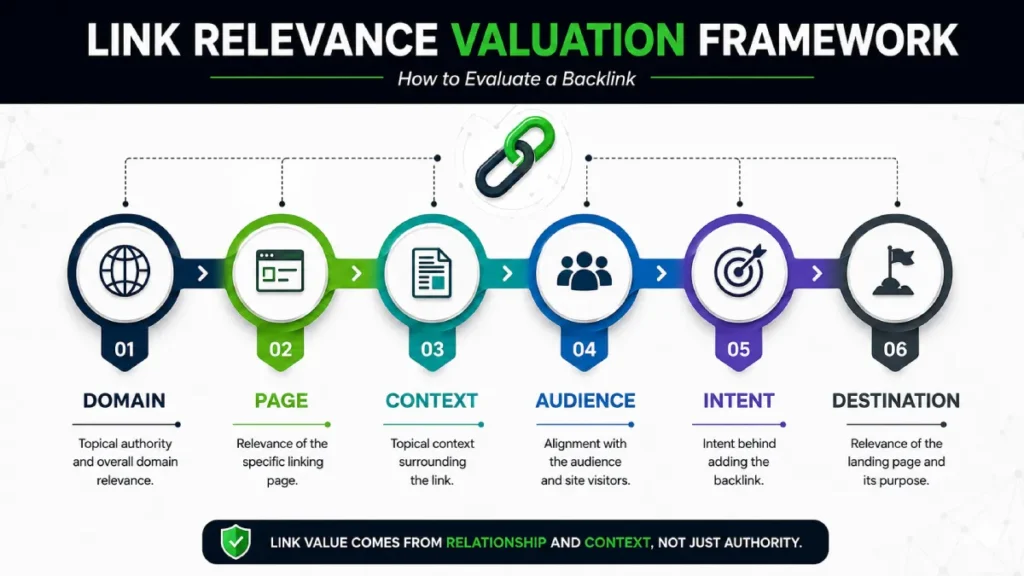
1. Domain relevance
Ask:
Does the referring website have a meaningful relationship with the subject of my target page?
Domain relevance provides useful context, but it should be the starting point, not the final decision.
2. Page relevance
Ask:
Is the actual page containing the backlink relevant?
This can be more useful than judging the entire domain.
A business publication, for example, might cover finance, management, technology, and marketing but have one article specifically about technical SEO. The article’s relevance should be evaluated independently of the publication’s broader subject coverage.
3. Context relevance
Inspect the actual placement.
Does the sentence and surrounding paragraph naturally lead to the destination?
Think of the relationship as:
Source topic → surrounding discussion → link → destination
The link should make sense to a reader even if SEO is removed from the equation.
Google explicitly advises publishers to provide context around links and notes that the words before and after a link matter.
4. Audience relevance
Ask:
Would the source page’s audience reasonably want the information on my destination page?
Two pages can mention the same keyword while serving completely different audiences. Semantic relevance helps distinguish genuine topical relationships from superficial keyword overlap.
Audience fit is therefore useful as an evaluation criterion, but it should not be presented as a separately documented Google ranking factor.
5. Intent relevance
Consider the purpose of the source page.
A page explaining how to diagnose crawl problems could naturally reference a detailed technical SEO resource. A page focused on purchasing enterprise software may mention technical SEO while serving a very different intent.
Intent helps distinguish superficial keyword overlap from a meaningful relationship.
6. Destination relevance
Finally, examine the receiving page.
Ask:
Does the destination actually fulfill the expectation created by the source context?
A highly relevant source pointing to a poorly matched destination creates a weaker overall relationship.
The resulting SearchEngineZine evaluation model is:
Domain → Page → Context → Audience → Intent → Destination
This is an analytical framework for evaluating link opportunities, not a claim that Google calculates relevance using these six categories.
Relevance vs. Authority: Which Matters More?
Relevance and authority answer different questions.
| Dimension | Question |
|---|---|
| Relevance | Does the source-to-destination relationship make sense? |
| Authority | How established or influential does the referring source appear according to the metric being used? |
| Page quality | Is the actual linking page useful and credible? |
| Context | Does the link naturally belong where it appears? |
| Audience fit | Is the source useful to people who may need the destination? |
This is why:
DR 80 does not automatically mean “better backlink” than DR 30.
But the reverse is also not automatically true. A highly relevant low-authority link cannot simply be assumed to outperform a highly authoritative link.
There is no universal relevance-versus-authority weighting published by Google that allows SEOs to calculate the outcome in advance. Source: Google’s ranking systems. The better approach is to evaluate authority metrics separately.
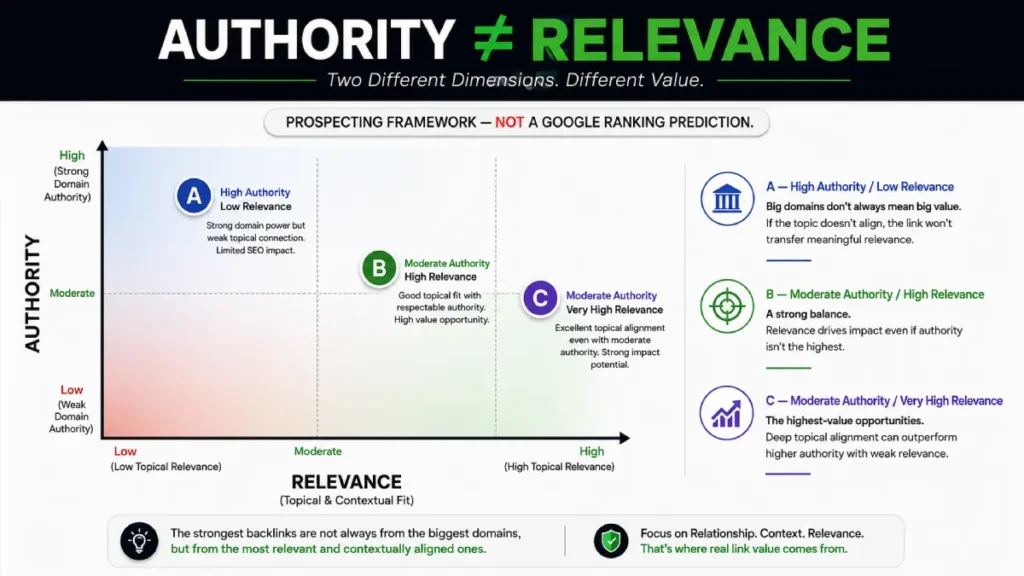
The better approach is to evaluate the dimensions separately.
| Prospect | Authority | Relevance | Evaluation |
|---|---|---|---|
| A | High | Low | Investigate carefully |
| B | Moderate | High | Strong candidate |
| C | Moderate | Very high | Strong contextual candidate |
These labels represent a prospecting framework, not predicted ranking outcomes.
A Practical Link Relevance Valuation Method
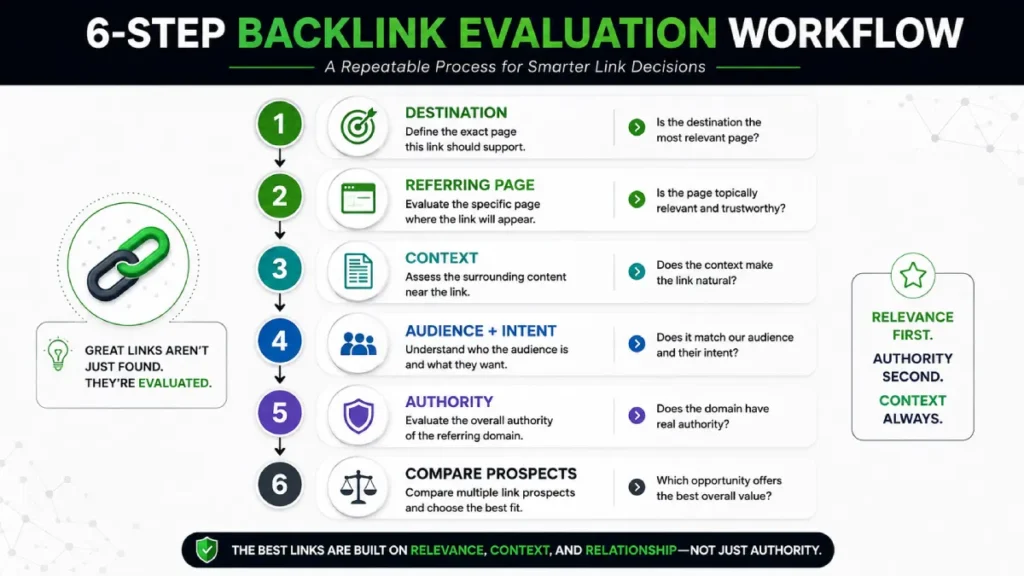
Use the following process when evaluating a real backlink opportunity.
Step 1: Identify the destination page
Start with the exact page that would receive the backlink.
Do not evaluate the opportunity against your entire website.
Step 2: Evaluate the referring page
Read the actual page containing the potential link.
Ask whether its subject has a meaningful relationship with the destination.
Step 3: Inspect the context
Read the surrounding paragraph and ask:
- Does the link naturally belong there?
- Does the source discuss a related problem?
- Does the destination provide useful continuation?
- Would the link make sense to a reader without considering SEO?
Step 4: Evaluate audience and intent
Ask whether the source audience could reasonably benefit from your destination.
Then compare the purpose of the two pages.
Step 5: Evaluate authority separately
Only after assessing relevance should you consider authority metrics, organic visibility, editorial quality, and other prospecting signals.
This prevents an authority metric from becoming a substitute for actual relevance.
Step 6: Compare opportunities
A simple evaluation matrix can make the decision more consistent:
| Dimension | Prospect A | Prospect B | Prospect C |
|---|---|---|---|
| Domain relevance | High | Medium | High |
| Page relevance | Low | High | High |
| Context relevance | Low | High | Very high |
| Audience fit | Medium | High | High |
| Intent alignment | Low | High | High |
| Authority | High | Medium | Medium |
| Overall priority | Reassess | Strong | Strongest candidate |
The scoring labels are SearchEngineZine’s analytical methodology, not Google’s ranking system.
The purpose is not to predict exactly how Google will treat a link. It is to make backlink prioritization more disciplined and explainable.
Common Link Relevance Mistakes and Edge Cases
High-authority but weakly relevant domain
A prestigious domain does not make every page on that domain relevant.
Evaluate the actual referring page.
Relevant domain, irrelevant page
A topical website can still publish content unrelated to your target.
Evaluate page-level relevance independently.
Broad publication, highly relevant article
A general publication may contain an exceptionally relevant article.
Do not reject a prospect solely because the domain covers multiple subjects.
Adjacent-topic relevance
A backlink does not necessarily need to come from an exact-match niche.
A closely related subject can still be a legitimate fit when the source, context, audience, intent, and destination align.
Keyword-rich anchor text
More keywords do not automatically create more relevance.
Google recommends natural, descriptive anchor text and cautions against forcing keywords into anchor text. Source: Google’s link best practices
Links created primarily to manipulate rankings
Relevance should not be used to justify manipulative link acquisition.
Google defines link spam as creating links to or from a site primarily to manipulate search rankings. Source: Google’s spam policies. Its examples include buying or selling links for ranking purposes, excessive link exchanges, automated link creation, and certain optimized links in paid or distributed content.
What Google Confirms About Link Relevance
Google’s current documentation supports several points relevant to this evaluation:
- Google uses links as a signal when determining page relevance.
- Links can help Google discover new pages.
- Descriptive, concise, relevant anchor text helps users and Google understand linked pages.
- The words surrounding a link provide context.
- Google advises against forcing keywords into anchor text.
Google does not, however, publish a formula such as:
Link Relevance Score = 40% topical match + 30% authority + 20% context + 10% anchor text.
Any such weighting should therefore be described as an SEO practitioner’s analytical model, not Google’s ranking formula.
That distinction is essential for trustworthy SEO content.
Conclusion
The most defensible way to value link relevance is to evaluate the relationship between the referring source and the destination, rather than judging the referring domain in isolation.
Start with the destination page. Then examine the referring page, surrounding context, audience, and intent. Evaluate authority separately rather than allowing DA or DR to substitute for relevance.
The practical rule is:
A backlink is a stronger relevance candidate when the source, page, context, audience, intent, and destination make sense together.
That gives you a more consistent basis for prioritizing backlink opportunities without pretending that third-party authority metrics or an invented relevance score can predict Google’s ranking decisions.