

The TTFB Reduction Framework starts with diagnosis, not optimization. A high TTFB can result from redirects, network and connection time, caching behavior, or processing at the origin.
The right fix depends on identifying which layer is responsible. Use this framework:
Measure → Decompose → Isolate → Fix → Validate
TTFB measures the interval from the start of a request until the first byte of the response is received. It can include DNS lookup, connection establishment, TLS negotiation, redirects, and server-side processing, as detailed in MDN’s Time to First Byte documentation
TTFB is not a Core Web Vital. Google’s current Search Console Core Web Vitals report uses LCP, INP, and CLS, as documented in Google’s Core Web Vitals documentation
Web.dev suggests about 800 ms or less as a rough TTFB target, while emphasizing that TTFB should be considered in the context of how a site delivers its content and how it affects subsequent metrics, as explained in Google’s TTFB optimization guidance
How to Diagnose Where TTFB Is Coming From
Before changing hosting, adding a CDN, or modifying application code, establish where the delay occurs.
1. Measure field and lab TTFB
Field and lab measurements serve different purposes. Field data reflects real-user conditions, while lab testing provides a controlled environment for investigation, as explained in web.dev’s field and lab TTFB measurement guidance
If field TTFB is much higher than lab TTFB, investigate differences in geography, networks, redirects, caching, and traffic conditions. If lab TTFB is high as well, controlled testing can help isolate a persistent problem.
For broader performance context, SearchEngineZine’s Core Web Vitals coverage provides the related LCP, INP, and CLS resources.
2. Compare cached and uncached responses
A cached response can conceal a slow origin.
If cached TTFB is fast but uncached TTFB is slow, investigate the work required to generate the response:
- database queries;
- server-side rendering;
- application logic;
- external API requests;
- other request-time processing.
web.dev recommends testing uncached responses when diagnosing TTFB because caching can hide underlying server latency.
3. Separate network from origin time
TTFB is not simply “server processing time.” Navigation Timing exposes phases of the request that can help distinguish connection and response delays, as documented in MDN’s Navigation Timing documentation
Use the observed pattern to narrow the investigation:
| Observation | Investigate first |
|---|---|
| High TTFB in both cached and uncached tests | Network, redirects, origin, and architecture |
| Fast cached, slow uncached | Origin generation and cache strategy |
| High TTFB mainly for distant users | Network distance and edge delivery |
| High backend timing | Application, database, API, or server processing |
| Good lab TTFB, poor field TTFB | Real-user geography, networks, redirects, or caching |
The goal is not to guess the cause from one TTFB number. Use the measurement pattern to identify the likely latency layer.
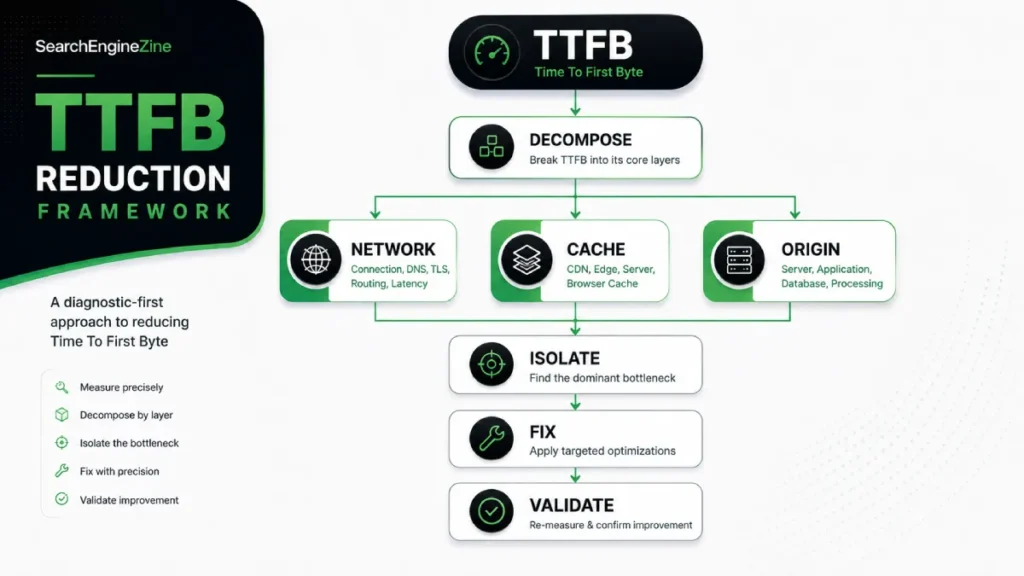
The TTFB Reduction Decision Framework
Once the latency layer is identified, choose the intervention that corresponds to the evidence.
High network or transport latency
Investigate:
- unnecessary redirects;
- geographic distance between users and the origin;
- connection establishment;
- edge/CDN placement;
- network conditions.
A CDN can reduce the distance between users and cached content by serving it from edge locations closer to them. But these benefits do not eliminate slow computation that still has to occur at the origin.
High uncached origin latency
If uncached requests remain slow, investigate the work required to produce the response.
Potential causes include:
- expensive database operations;
- server-side rendering;
- external API calls;
- excessive application processing;
- infrastructure constraints.
The appropriate intervention depends on the site’s architecture. A static site, WordPress installation, server-rendered application, and API-heavy application can have very different sources of origin latency.
Fast cached/slow uncached
This pattern points toward an origin-generation problem or insufficient cache coverage.
Prioritize:
- improving appropriate cache coverage;
- reducing unnecessary cache misses;
- improving cacheability;
- optimizing the origin for requests that genuinely cannot be cached.
Caching can substantially reduce repeated origin work, but it can also make a slow backend appear healthy during normal cached tests.
Slow across cache states
Do not immediately replace the host or add another performance layer.
Investigate the complete path:
Redirect → DNS → connection/TLS → network → cache → origin → application
Only then select the intervention.
What to Fix First
1. Remove unnecessary request-time work
Any operation that must finish before the initial response can be sent can increase TTFB.
That includes unnecessary external API calls, expensive database operations, and application processing that could instead be cached, precomputed, or moved outside the critical request path.
A documented case study by Salma Alam-Naylor illustrates the principle: after removing request-time Edge Functions that fetched third-party data, p75 TTFB fell from 3.46 seconds to 704 milliseconds, as documented in Salma Alam-Naylor’s TTFB case study
The result was specific to that site and architecture, but the underlying lesson is broadly useful: investigate unnecessary request-time work when origin latency is high.
The case study also demonstrates an important tradeoff. Moving one data-fetching operation to the client reduced TTFB but introduced CLS because content appeared later and caused layout movement. The eventual solution changed the architecture rather than optimizing TTFB in isolation.
2. Improve caching
If a response can safely be reused, caching can prevent repeated origin processing.
But personalized or highly dynamic content may not be appropriate for aggressive caching. Cache policy should therefore follow the application’s content model rather than simply maximizing cache duration.
3. Optimize network and edge delivery
If network distance materially contributes to TTFB, serving cacheable content closer to users can help.
This is particularly relevant when the origin is geographically distant from a substantial portion of the audience.
4. Use a CDN when the diagnosis supports it
A CDN should be a diagnostic conclusion, not a reflex.
If network distance and cacheable content are the main problems, edge delivery may be appropriate.
If a slow database query or application process dominates uncached TTFB, a CDN does not remove that computation.
How to Validate a TTFB Improvement
Treat optimization as an experiment:
Baseline → Change → Repeat → Compare → Check downstream metrics → Monitor field results
Use consistent test conditions for before-and-after comparisons. One unusually fast test does not establish that an optimization worked.
Also check downstream user-experience metrics. TTFB precedes metrics such as FCP and LCP, so reducing it can create more time for subsequent rendering—but a lower TTFB does not automatically guarantee a better overall experience.
This matters when server work is moved to the browser. The TTFB number may improve while client-side work, rendering, or layout stability becomes worse.
For the related rendering side of the problem, SearchEngineZine’s Cumulative Layout Shift guide and LCP optimization guide provide deeper coverage.
Advanced TTFB Diagnostics
For difficult cases, use Server-Timing to expose backend work.
The Server-Timing HTTP response header can communicate measurements such as database time, CPU time, file-system access, and cache operations, as detailed in MDN’s Server-Timing documentation
Browsers can expose those measurements through the Performance API.
For example, a server could expose:
cache;db;app;ssr.
That changes the diagnostic question from:
“Why is TTFB 1.5 seconds?”
to:
“Which backend operation is consuming the time?”
This is especially useful when the overall TTFB is known to be high but ordinary browser timing does not reveal which backend operation is responsible.
TTFB Reduction Framework: Quick Diagnostic Matrix
| What you observe | Investigate | First action |
|---|---|---|
| High TTFB + network delay | Network/transport | Check geography, redirects, connection, and edge delivery |
| Fast cached + slow uncached | Origin generation | Profile backend and improve cache coverage |
| Slow cached + slow uncached | Network and origin | Decompose the complete request path |
| High backend timing | Application | Investigate database, APIs, rendering, or server work |
| High TTFB mainly for distant users | Geographic delivery | Evaluate CDN/edge caching |
| Low TTFB but poor LCP | Post-response work | Investigate resource discovery and rendering |
| TTFB improves, but UX worsens | Architectural tradeoff | Compare downstream metrics before keeping the change |
The central principle is simple:
Do not optimize TTFB by collecting a larger list of speed techniques. Optimize it by identifying the layer responsible for the delay.
A defensible TTFB workflow remains:
Measure → Decompose → Isolate → Fix → Validate.