

Search intent is the primary goal, underlying motivation, or exact problem a user aims to solve when submitting a query to a search engine.
For SEO professionals in 2026, search intent optimization has evolved from simply mapping keywords to landing pages into a multidimensional discipline.
Modern search systems no longer rely on string-matching; they utilize advanced natural language processing and language models to infer intent, topic relevance, and contextual user needs.
Today, successfully capturing search intent requires moving beyond the traditional four pillars (Informational, Navigational, Commercial, Transactional) to address a newly emerged category: Generative AI Intent.
This means structuring your information architecture to satisfy both traditional algorithmic rankings and Generative Engine Optimization (GEO) models that power AI Overviews and AI-assisted search modes.
To win visibility, content must provide an immediate, answer-first resolution, deliver unique information gain, and align the page’s format seamlessly with the user’s micro-intent. You can review our full site architecture and topical clusters via the SearchEngineZine HTML Sitemap.
The 6 Classifications of Search Intent in Modern SEO
While the foundational categories remain relevant, the integration of LLMs into search ecosystems has expanded the intent spectrum.
- Informational Intent: The user seeks an answer, definition, or methodology. Informational queries dominate search volume.
- Optimization: Utilize “answer-first” architecture. Place a crisp definition at the top, followed by structured data (lists, mini-FAQs). These short, quotable blocks perform exceptionally well for AI engine extraction.
- Navigational Intent: The user aims to reach a specific brand, login page, or exact URL.
- Optimization: Keep content frictionless. Optimize site architecture, internal search, and footer links to generate sitelinks in the SERP, reducing the clicks required to reach the destination.
- Commercial (Investigation) Intent: The user is comparing options, evaluating tools, or shortlisting vendors.
- Optimization: Deploy criteria tables, real-world usage scenarios, and honest evaluations. In B2B environments, case studies and quantifiable evidence accelerate the move to the transactional stage.
- Transactional Intent: The user is ready to take a definitive action, such as purchasing, requesting a demo, or signing up.
- Optimization: Remove friction from the conversion funnel. Use clear Calls to Action (CTAs) and build trust through E-E-A-T (Experience, Expertise, Authoritativeness, and Trustworthiness) signals.
- Local Intent: The user requires localized services or geographically bound information (e.g., “near me” queries).
- Optimization: Maintain strict NAP (Name, Address, Phone) consistency, utilize geo-modifiers in the copy, and manage Google Business Profile (GBP) signals.
- Generative Search Intent (AI Mode): The user crafts complex prompts expecting tangible, actionable, or creative outputs (outlines, code, syntheses) rather than a list of blue links.
- Optimization: Provide original frameworks, clear logical sequencing, and highly structured data that AI models can easily parse, cite, and synthesize in their generative outputs.
The Shift from Keyword Density to “Micro-Intents”
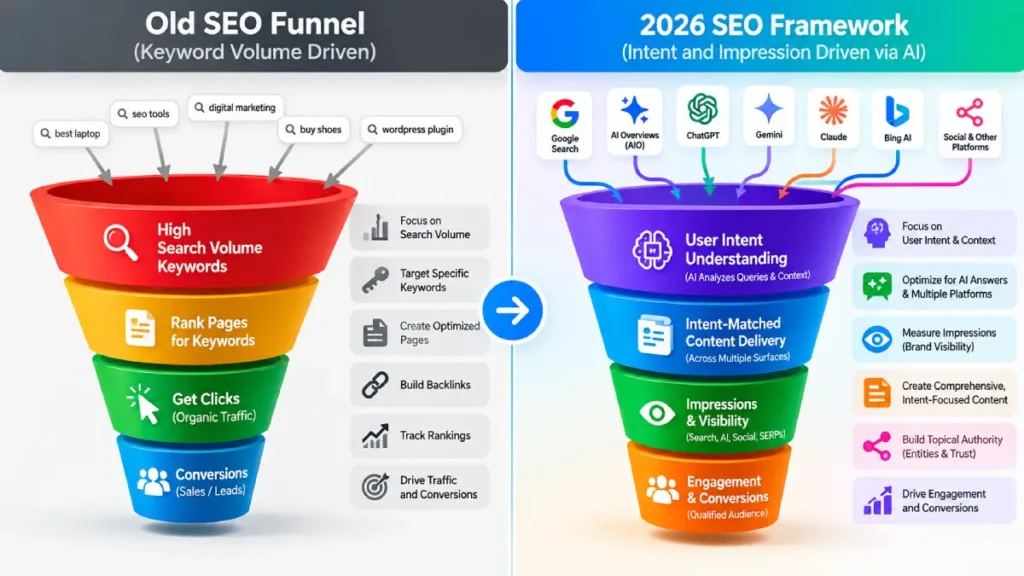
Industry consensus in 2026 dictates that keywords are no longer the ultimate goal of an SEO strategy; rather, they are the structural “Lego bricks” used to build topical authority and infer micro-intents.
As search becomes highly conversational, the focus has shifted from capturing high-volume keywords to capturing business-aligned traffic at the right stage of the user journey. Detailed quality expectations can be reviewed in Google’s Search Quality Rater Guidelines.
The Influence Game: Impressions Over Clicks
With the rise of zero-click searches and AI Overviews, SEO is transitioning from a strict “click game” to an “influence game.” Visibility at the category entry point is a primary KPI.
Earning citation links within AI-generated answers or occupying maximum pixel space on the SERP holds immense brand value, even if it does not immediately yield a direct click.
Analyzing the SERP to Determine Intent
To accurately classify the intent behind a target query, professionals must analyze the live Search Engine Results Page (SERP). The SERP itself is the ultimate indicator of how search engines currently understand user motivation.
- Identify SERP Features: The presence of a Featured Snippet or “People Also Ask” box strongly signals Informational intent. Conversely, Google Shopping carousels or heavy localized Map Packs indicate Transactional and Local intent, respectively.
- Analyze Competitor Formats: Review the top five ranking URLs. If all top results are listicles, creating a narrative essay will fail to match intent. You must adopt the dominant format while delivering superior information gain.
- Identify Intent Shifts: Search intent is not static. For example, the intent behind a query like “remote work” may shift from Informational (defining the concept) to Commercial (software tools for remote work) over time. Continuous SERP monitoring is essential to prevent ranking decay.
Strategic Framework: Optimizing for Generative Engine Optimization (GEO)
To rank effectively, content must be engineered for both human readability and machine parsing.
1. Prioritize Answer-First Content
Search engines and AI models prioritize rapid intent fulfillment. Do not bury the core answer beneath introductory fluff. Address the query’s primary intent within the first paragraph, then use subsequent H2 and H3 tags to provide nuance, context, and depth.
2. Maximize Information Gain
Regurgitating the existing top 10 search results is a liability. Google’s algorithms penalize redundant, highly derivative content. To satisfy complex intent, inject Information Gain—unique data, proprietary research, expert quotes, and fresh perspectives that do not exist elsewhere on the SERP. If an AI can generate your article from existing training data, it will not rank.
3. Format Matching and E-E-A-T
The format of your page must match the intent of the query.
- If the intent is Commercial Investigation, a narrative blog post will fail; a comparison matrix is required.
- If the intent is Informational, use numbered lists, bullet points, and optimized readability to facilitate F-pattern scanning.
Furthermore, embed explicit E-E-A-T signals directly into the copy, proving authentic, real-world expertise that AI models cannot simulate. To verify schema compliance across structured elements, test your deployment using the Google Schema Markup Validation Tool.
Search Intent Mapping Matrix
| Search Intent Type | User Goal | Content Format | Ideal CTA |
| Informational | Learn, Define, Understand | Guides, FAQs, How-To Steps | Soft (Newsletter, Related Article) |
| Navigational | Reach specific page/brand | Login, Support, Contact Pages | Frictionless Navigation |
| Commercial | Compare, Evaluate, Shortlist | Comparison Tables, Case Studies | Evaluation (Request Demo) |
| Transactional | Purchase, Sign up, Action | Product Pages, Checkout | Hard (Buy Now, Subscribe) |
| Local | Find nearby services | Local Landing Pages, Maps | Call Now, Get Directions |
| Generative AI | Synthesize, Create, Solve | Highly Structured Data, Frameworks | Prompt Variations, Tools |
Conclusion
Mastering search intent in 2026 requires looking beyond search volume. By categorizing queries into the six modern intent frameworks—and specifically engineering content to satisfy Generative AI extraction—SEO professionals can future-proof their visibility.
Align your page formats rigorously with user expectations, prioritize rapid answers, and ensure your content delivers undeniable information gain.