
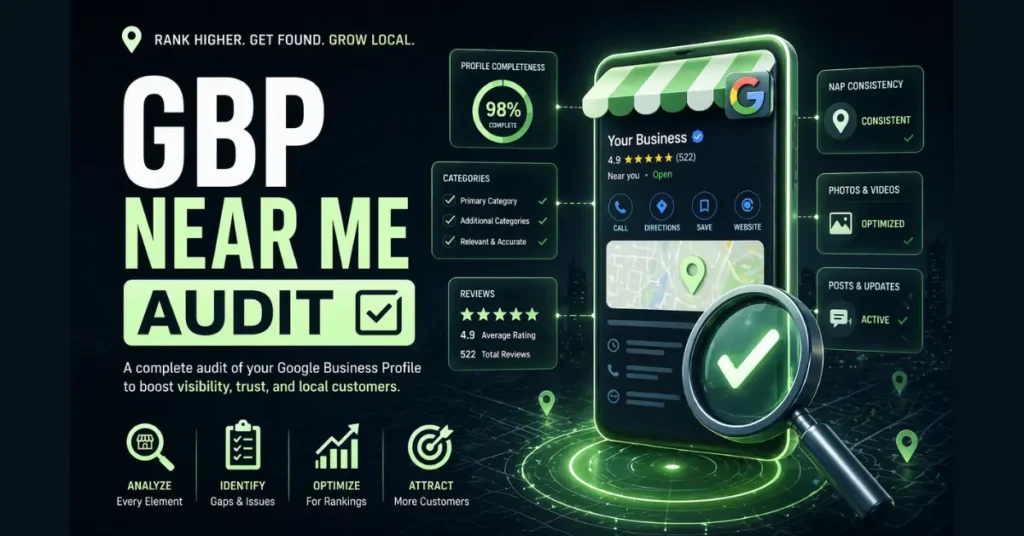
To dominate local search results, executing a Google Business Profile (GBP) audit is essential. Local intent accounts for nearly half of all search queries, with mobile “near me” prompts driving immediate real-world conversions.
A GBP is a dynamic entity evaluated by Google’s recommendation engine. To consistently rank in the Local Pack and AI Overviews, optimization must move beyond basic NAP (Name, Address, Phone) consistency toward establishing clear semantic relationships across your operational footprint.
Most Local Audits Fail to Rank
Superficial metrics such as checking address listings or basic phone details act as gatekeeper signals. They confirm eligibility to rank, but do not determine high placement.
Top-performing businesses win by eliminating Entity Ambiguity. Google prioritizes entity authority over broad domain authority.
If a website and its GBP lack a tight semantic link, rankings plateau. Providing structured data explicitly defines services, geographic boundaries, and market relationships.
The Proximity Paradox: Decoding “Near Me” Logic
Mastering localized proximity requires grounding map architecture in algorithmic coordinates. Explore our centralized Proximity & Spatial Geometry Hub to see how cell mathematics determines SERP visibility.
For advanced coordinate strategies, utilize The S2 Geometry Local SEO Secret Weapon for Massive Growth alongside Proven Local Business geo Shape Schema Techniques That Drive Real Results.
Resolving boundary data mechanics exposes hidden algorithms analyzed in Google Maps Ranking Secrets Revealed: What Actually Works.
Neural Matching in Local Search
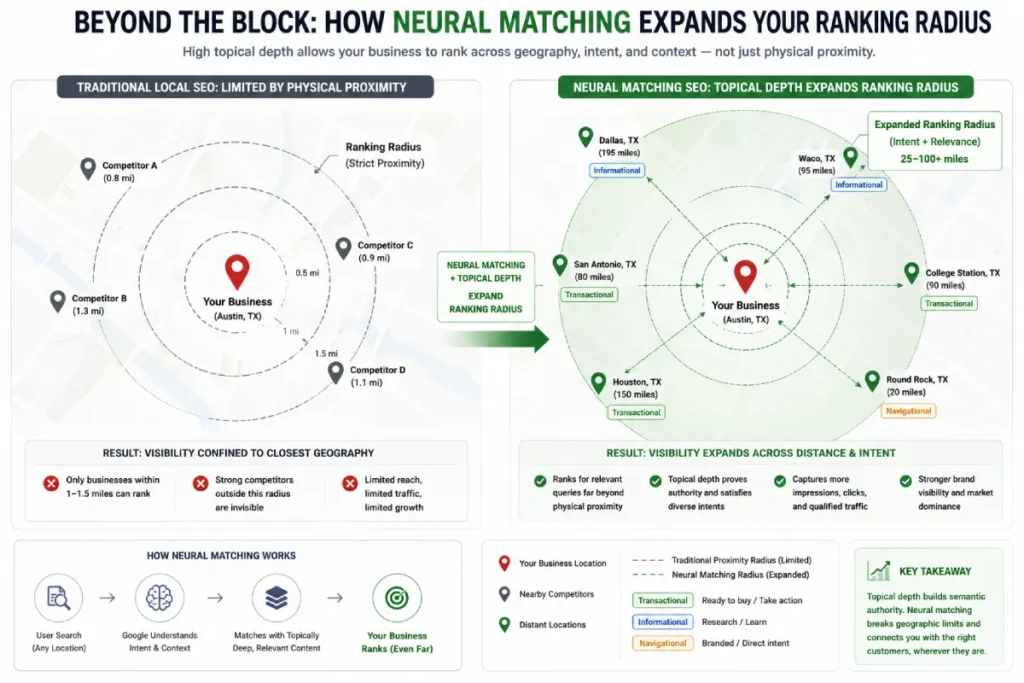
Neural Matching allows Google to map user intent to broader concepts rather than exact-match strings.
If a user searches for “leaking pipe fix near me,” Neural Matching connects the prompt to an emergency plumbing service.
Failing to map service offerings to these conversational queries causes missed visibility.
Address these gaps by structuring local service pages to cover symptoms and conversational questions.
Structuring interconnected content silos feeds Google’s Knowledge Graph. Learn how by structuring semantic topic clusters for local services.
Defining “Near Me” Boundaries
Search engines use IP intelligence, GPS coordinates, and historical activity to build neighborhood-level relevance scores.
Demonstrating operational depth across specific micro-neighborhoods expands entity boundaries. Use local headings, reference landmarks, and maintain detailed location copy.
The “Justification” Audit: A Missing Semantic Signal
Justifications are visual snippets (e.g., “Website mentions…” or “Review says…”) displayed in the Local Pack.
To secure justifications, seed website landing pages and GBP fields with the semantic phrasing customers naturally use in feedback.
When algorithmic flags or data discrepancies suppress listings, consult our Forensic GBP Troubleshooting & Trust Restoration Hub.
If a profile experiences suspension, execute the ultimate guide to recover your suspended profile fast.
Consolidate split authority using proven entity merger techniques to recover lost rankings while fighting spam via our manual redressal framework on how to fight Google Maps spam and recover lost rankings fast.
The Entity Map: Your Semantic Blueprint
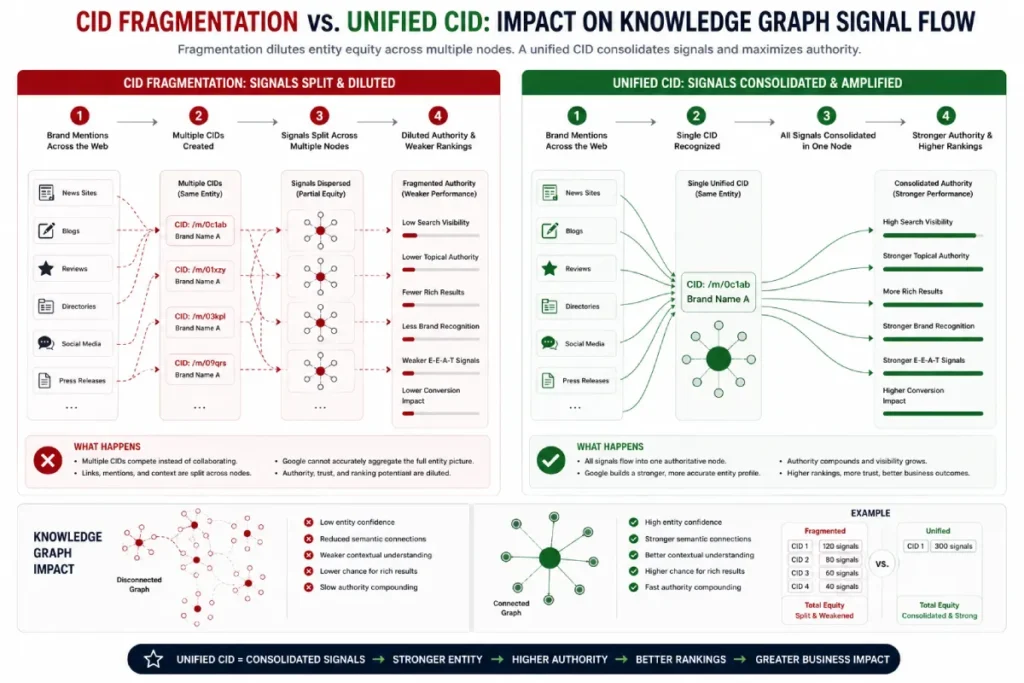
Google Place IDs and Customer IDs (CIDs) act as primary anchor nodes within the Knowledge Graph.
Address edits, rebrands, or accidental profile creations can cause CID fragmentation. Splitting off-page trust signals across orphaned nodes dilutes local ranking potential.
Google Place ID and Customer ID (CID) Architecture
Extracting the hexadecimal CID string from Map URL parameters helps confirm digital equity funnels into a single node. Verify primary and secondary categories against official supported Place Types within the Google Maps Places API.
Aligning Visual Assets with Google Vision AI
Google Vision AI performs entity extraction on profile media. Review our core hub to optimize visual signals for search engines.
Combine persuasive messaging with clear technical triggers using Visual SEO Optimization Made Easy With Persuasive Power Word Combinations.
Audit visual assets via The Ultimate GBP Photo AI Guide for Better Local Rankings and expand spatial signals using 360 View SEO Secrets That Smart Marketers Don’t Want You to Know.
Ensure images feature EXIF GPS data matching declared service areas. Learn to systematically optimize local media assets for Google Vision AI.
| Core Entity Component | Technical Signal / Requirement |
|---|---|
| GBP Core | Place ID, CID, Category Alignment |
| Local Signals | Coordinates, Geofencing, “Open Now” Status |
| Trust Layer | NAP-W Parity, ISO Address Formatting |
| Social Proof | NLP Review Sentiment, Justification Matching |
LocalBusiness Schema (JSON-LD)
To establish technical data alignment, implement schema following official LocalBusiness specifications.
Example Express Plumbing
Service-area schema markup using GeoCircle and geographic coordinates.
{
  "@context": "https://schema.org",
  "@type": "PlumbingService",
  "@id": "https://example.com/#organization",
  "name": "Example Express Plumbing",
  "url": "https://example.com",
  "hasMap": "https://maps.google.com/?cid=1234567890123456789",
  "areaServed": {
    "@type": "GeoCircle",
    "geoMidpoint": {
      "@type": "GeoCoordinates",
      "latitude": 37.7749,
      "longitude": -122.4194
    },
    "geoRadius": "16093"
  }
}
Advanced schema uses @id node chaining, geoShape, and areaServed declarations to eliminate ambiguity.
Tactical Execution: Building Real-World Authority
Google’s language models process user feedback to score entity sentiment. Explore our framework on Mastering Local Search Semantics.
Apply entity extraction rules using Analysis to Skyrocket Your Local SEO Results, consolidate signals via the powerful formula for small business success, and accelerate feedback through the Advanced Review Strategy.
[Customer Feedback] ──> [Google NLP Engine] ──> [Entity & Sentiment Extraction] ──> [Knowledge Graph Update]
Natural Language Processing (NLP) in Google Reviews
Google evaluates reviews using entity sentiment analysis. Review the official guidelines for Google’s entity sentiment analysis models to understand how saliency scores are calculated.
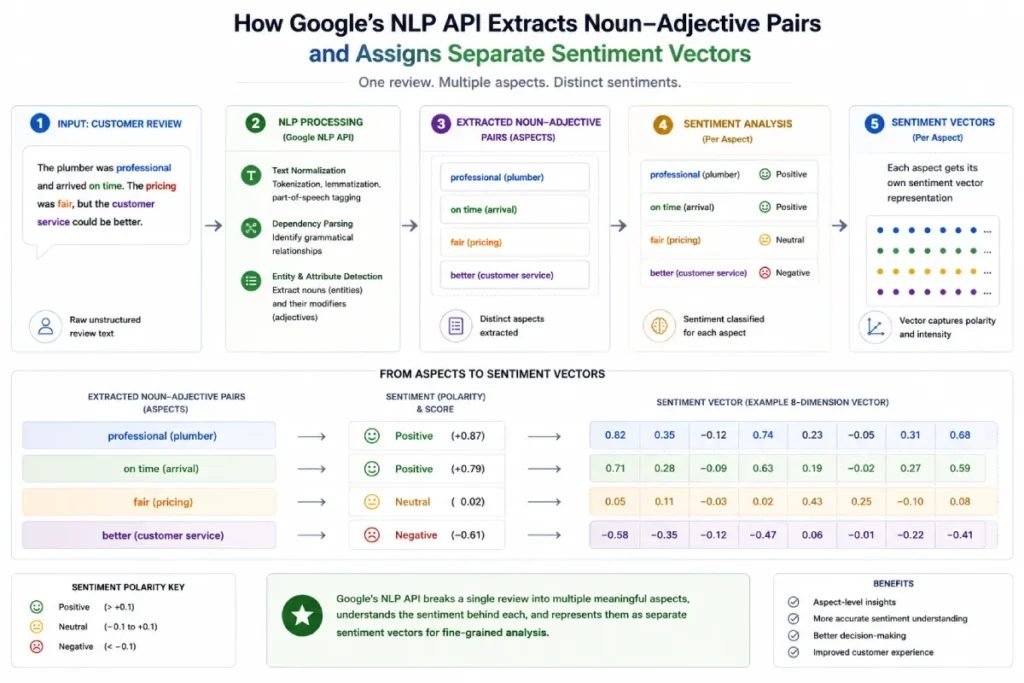
Guide customers toward providing detailed feedback regarding specific services and locations. Mirror these key terms in professional owner responses to reinforce semantic targets.
Discover low-competition conversational phrases using Unlock Hidden Low-Competition Keywords.
Off-Page Entity Signals & APIs
To manage API connections and external entities, review our hub on mastering local APIs & authority.
Resolve spatial data issues via Fixes that improve your local rankings, inject structured API nodes using the powerful techniques every SEO expert should know, and consolidate external listings with the complete local entity guide for your business growth. Build local backlink equity using the skyscraper technique 2.0.
Conclusion
A GBP Near Me Audit establishes enduring local authority. Aligning categories, cleaning CID instances, implementing accurate LocalBusiness JSON-LD, and leveraging review NLP transforms local profiles into reliable drivers of search traffic and customer actions.