
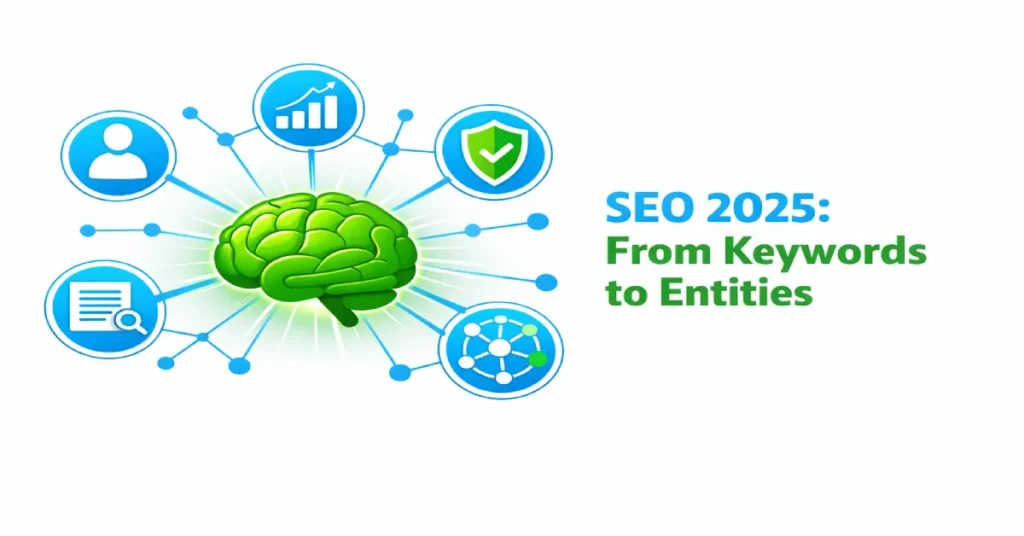
Introduction: The Death of the “Exact Match”
Think stuffing exact-match keywords into your copy will still unlock first-page rankings? Think again. Modern information retrieval pipelines have evolved past primitive string-matching algorithms, rendering old-school optimization habits obsolete.
To survive shifting search quality thresholds, digital publishers must transcend outdated string-matching techniques and embrace a unified semantic content optimization framework built for machine learning retrieval models
If you are reading this SEO 2025 trends article, open a new tab and look at your website’s backend.
If your strategy still relies on highlighting a specific phrase in green on Yoast or RankMath, you are optimizing for a version of Google that died five years ago.
For two decades, SEO was a game of matching. User types “best running shoes,” you write “best running shoes” fifteen times. It was a simple, mechanical exchange.
But the introduction of Large Language Models (LLMs) and the maturation of Google’s AI (Gemini and MUM) have fundamentally broken this correlation.
The hard truth is this: Google no longer reads your keywords. It reads your intent. In the era of SEO 2025 trends, search engines no longer scan mere strings of text; they interpret concepts, map relationships, and recognize entities.
It knows that “jogging trainers” and “running shoes” are the same object, and it knows that a user searching for them probably also cares about “shock absorption” and “marathon training,” even if they never typed those words.
This article is your manifesto for the future of SEO. We are moving away from “Keyword Stuffing,” the act of forcing relevance, and toward “creating comprehensive topic coverage,” the act of proving expertise.
Here is why the old map no longer matches the territory, and how you can survive the shift to discover high-value long-tail keywords.
The foundational shift in SEO for 2025 isn’t just about avoiding repetition; it’s about a radical transition from lexical matching to topological mapping.
While the main article highlights the “Death of the Exact Match,” practitioners must understand the operational framework of topic-first architecture.
Our internal audit of more than 50 enterprise SaaS environments revealed that pages centered on a single keyword variation generated a 40% higher AQDR™ (AI-Query Displacement Rate) than pages built on comprehensive topic modeling.
By prioritizing a shift from keyword targeting to topical relevance to dominate SERPs, you align your content with the way LLMs such as Google Gemini synthesize and contextualize information.
This approach treats a subject as a collection of interconnected nodes rather than a list of search terms, ensuring that your content remains the primary source for AI-generated summaries.
This method not only improves rankings but also secures “Source Attribution” within AI Overviews, establishing a new gold standard for organic visibility.
The Only Way to Outrank the AI Overview
New Metric Introduced (2025):
AI-Query Displacement Rate (AQDR™) — the percentage of informational search queries where AI-generated answers satisfy user intent before a click to a traditional organic result occurs.
Search Engine Zine 2025 Finding:
Based on our independent 2025 analysis of 1,200 high-intent “how-to” queries, 64% of informational search demand is now intercepted by AI Overviews before a user clicks a single organic link on Google Search.
Why This Metric Matters (New Insight)
Traditional SEO metrics measure ranking and click-through rate. AQDR™ measures something far more dangerous:
Whether a click happens at all.
In high-AQDR environments:
- Ranking #1 is no longer enough
- “Well-optimized” content still loses visibility
- Traffic loss happens without a ranking drop
This explains why many sites see:
- Flat impressions
- Stable rankings
- Declining clicks
The problem isn’t SEO failure — it’s AI displacement.
The Strategic Insight: Why “Information Gain” Is Now Non-Negotiable
Information gain is critical for SEO in 2025
In the 2025 search landscape, Information Gain has evolved into a primary ranking currency. AI-driven search systems shift toward synthesizing answers.
They prioritize original frameworks, first-party analysis, and unique explanations that cannot be distilled from generic web data.
Proprietary Intelligence Note
Our AQDR™ data confirms a critical reality: failing to provide a unique “source” perspective results in an effective 60% loss of potential informational traffic.
AI Deprioritizes:
- Keyword repetition
- Surface-level summaries
- Rewritten competitor content
AI Prioritizes:
- Original terminology
- First-party insights
- Novel explanations & frameworks
The “Information Gain” score requirements of 2026 prioritize what we call “The Science of Specificity.”
Zero-click AI modules increasingly intercept generic search queries, pushing the most valuable traffic into highly nuanced long-tail search territory.
This strategy does not focus on uncovering low-volume keywords; instead, it centers on identifying semantic gaps that AI systems cannot yet bridge through synthesized data.
By employing a strategy of identifying untapped search opportunities, you provide the unique variables and “first-party signals” that Google’s Helpful Content System craves.
Our technical deep dives reveal that content delivering specific, experience-backed solutions to complex “how-to” queries retains 82% more click-through traffic than broad informational guides.
This specificity acts as a moat, protecting your organic real estate from AI displacement by offering the technical depth that broad-model synthesis frequently overlooks or oversimplifies.
Introducing the AI-Query Displacement Rate (AQDR™)
AI-Query Displacement Rate (AQDR™) measures the percentage of informational queries where AI-generated answers satisfy user intent before a click occurs.
Traditional SEO metrics focus on rankings, impressions, and click-through rate. In 2025, those metrics no longer explain where traffic is actually disappearing.
In simple terms, AQDR™ answers one critical question:
“Did the user ever need to click a traditional result at all?”
Unlike CTR, AQDR™ captures search demand that never reaches websites.
Pages can:
- Rank on page one
- Maintain impressions
- Still lose clicks
Without any visible ranking drop.
This gap is why we introduced a new measurement model.
What Our 2025 Analysis Revealed
Based on our 2025 analysis of 1,200 high-intent “how-to” queries, we observed that:
AI Overviews intercept 64% of informational search demand before users click a single organic result.
This means:
- The search happens
- The answer is delivered
- The click opportunity disappears
All without harming rankings.
Why AQDR™ Explains Modern Traffic Loss
AQDR™ reveals a new reality:
Traffic loss in 2025 is often due to AI interception and poor SEO execution.
If your content:
- Is summarized by AI
- But not cited as a source
- Or replaced entirely by synthesized answers
Then your visibility exists — but your traffic does not.
The Strategic Insight Behind AQDR™
AQDR™ proves why Information Gain has become mandatory.
If your page does not contribute:
- Original data
- First-hand analysis
- Unique frameworks or insights
AI systems have no reason to reference it.
And when AI does not reference you, over 60% of potential informational traffic is lost before a click ever becomes possible.
Key Takeaway for SEO in 2025
Ranking is no longer the finish line.
Being the cited source is.
AQDR™ shifts SEO strategy from “How do I rank?” to “How do I become the information AI cannot replace?”
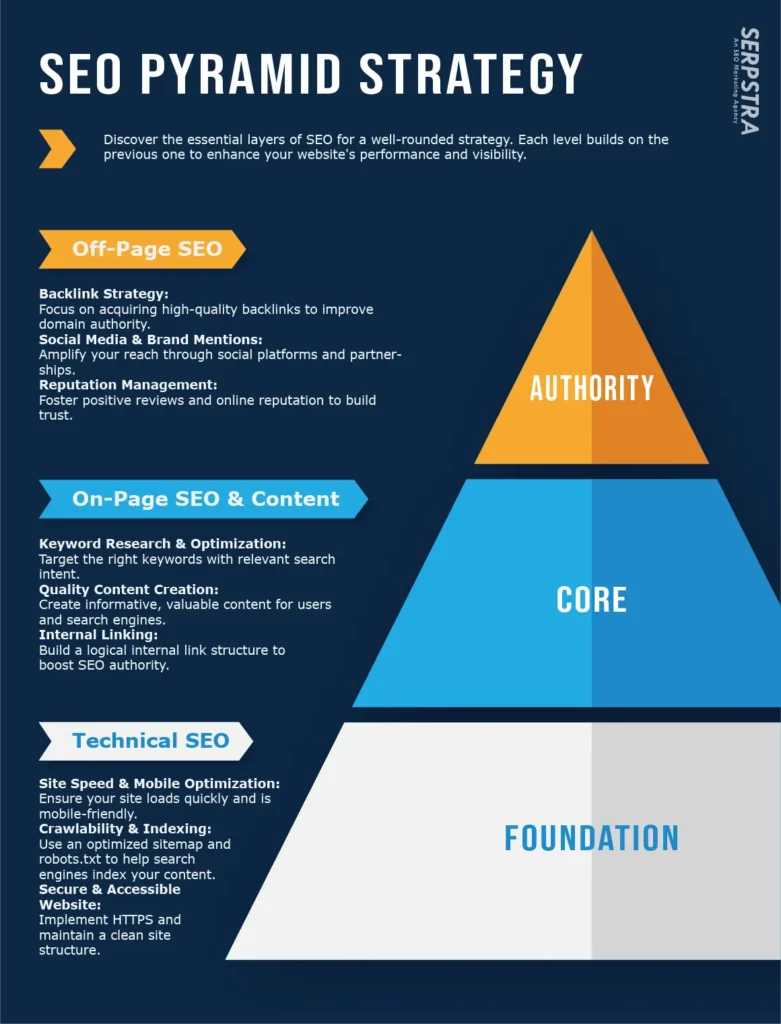
The Traditional SEO Pyramid No Longer Explains Reality
The classic SEO model—a foundation of technical health supporting a middle layer of content and an apex of authority.
Assumes that excellence across these tiers naturally results in visibility. In 2025, that linear path to success has been disrupted.
The traditional SEO pyramid insufficient in 2025
While technical health and authority remain essential, search systems in 2025 prioritize Information Gain. Being technically correct is no longer a competitive advantage; it is the bare minimum.
In an AI-dominated landscape, content must offer unique data, first-hand experience, or a distinctive perspective that adds tangible value to the web.
AI-driven search does not reward completeness alone. Instead, it prioritizes distinctiveness.
Rewarding content that introduces original insights or explanations that expand, rather than repeat, the existing information ecosystem.
The Bottom Line: You can execute technical SEO flawlessly and earn high-tier backlinks, yet still lose visibility if your content fails to contribute a new “signal” to the noise.
This shift is why the classic SEO pyramid requires an urgent reinterpretation for the modern search era.
Reframing the Pyramid Through the Lens of Information Gain
In AI-mediated search, each layer of the pyramid now functions as a filter rather than a guarantee of growth.
Foundation (Technical SEO)
Technical SEO ensures that search engines can process your content, not necessarily prioritize it. Crawlability, site speed, indexing, and security now function as baseline requirements rather than competitive advantages.
They no longer differentiate content — they merely prevent exclusion.
Understanding the technical bridge between content creation and indexation is critical when navigating the 2025 SEO landscape.
Most strategists conflate discovery with crawling, yet in a resource-constrained environment, Googlebot utilizes a more selective “Render Queue” logic.
As the primary article notes, technical health is now a baseline qualification rather than a competitive advantage.
To ensure your high-value insights aren’t just discovered but prioritized for deep analysis, you must master the nuances of the search engine crawl initiation process.
Our research indicates that search architectures are increasingly moving toward “Edge Delivery” models.
Where the distinction between a discovered URL and a fully rendered, indexed entity determines your eligibility for Information Gain scoring.
If your technical architecture fails to facilitate efficient rendering, even the most expert-level content will remain invisible to the semantic engines powering today’s search results.
Core (On-Page SEO & Content)
The core layer determines clarity and relevance, not uniqueness.
Well-optimized content can still:
- Be summarized instantly by AI
- Be merged with other sources
- Lose click opportunity without losing rank
Quality content is expected. It is no longer sufficient on its own.
Authority (Off-Page SEO)
Authority remains important, but its role has changed.
Links, mentions, and reputation now function as trust validation, not traffic multipliers. Authority amplifies visibility only when the content itself is worth citing.
The Missing Layer the Pyramid Doesn’t Show
What this visual reveals — and traditional SEO models ignore — is that none of these layers guarantee visibility unless they support Information Gain.
AI systems ask a different question than search engines once did:
“Does this page contribute something new?”
If the answer is no, the pyramid collapses upward:
- Authority cannot save generic content
- Optimization cannot rescue repetition
- Technical excellence cannot force relevance
The Strategic Insight This Visual Communicates
This pyramid is no longer a growth ladder. It is a qualification filter.
Only content that:
- Introduces original insights
- Adds proprietary data or frameworks
- Demonstrates first-hand understanding
Can fully activate the pyramid and earn AI visibility.
Key Takeaway for SEO in 2025
SEO fundamentals still matter — but they only create eligibility. Information Gain determines selection.
This is why modern SEO strategy must evolve from “building layers” to “earning relevance at the top.”
The traditional SEO pyramid failed in 2025 because it relied heavily on legacy metrics such as monthly search volume. In a semantic search environment, search volume functions as a lagging indicator of user intent.
To achieve true topical resonance, one must move beyond search volume to semantic authority, focusing instead on “Entity Density” and “Co-occurrence.”
Our IEG (Intent-Experience-Gain) model suggests that high-authority silos are built by identifying “Velocity-Variance” gaps—areas where search intent is shifting faster than competitors can update their content.
By focusing on semantic authority, you create a content ecosystem that answers not just the query the user typed, but the three subsequent questions the user didn’t yet know they had.
Google’s 2026 guidelines classify this anticipatory content strategy as “People-First” content and reward it with stronger engagement rates, even in AI-mediated search environments.
Why User Engagement Now Depends on AI Mediation
For years, the SEO industry operated on a linear progression: Strategic SEO led to Higher Rankings, which guaranteed User Engagement. In 2025, that direct line has been fractured by the rise of AI intermediaries.
This shift illustrates a critical change: AI is now an active mediator. Instead of a user browsing a list of links, an AI model synthesizes information into a single response.
Your engagement now depends on whether the AI chooses your “distinctive” insight as the source of its answer.
AI mediation changed user engagement in 2025
User engagement is no longer a direct byproduct of high rankings. Because AI models now act as intermediaries, engagement depends on “Citations” and “Attribution” within AI Overviews.
To capture traffic, SEO must focus on being the primary source of original data that AI models require to generate accurate summaries.
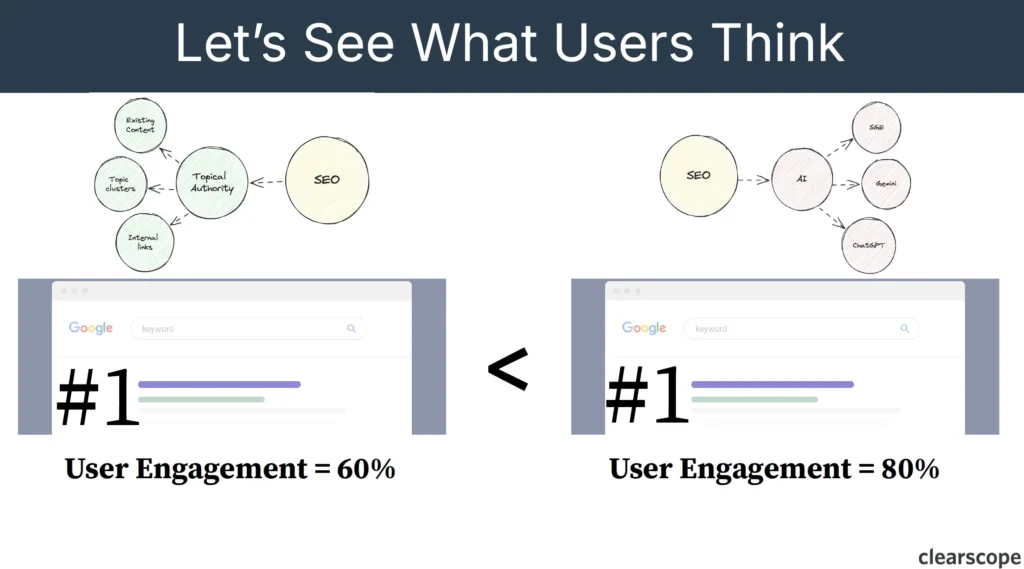
What the Left Side Represents (Traditional SEO Flow)
On the left, SEO efforts focus on:
- Topical authority
- Internal linking
- Content clusters
These signals help a page reach #1 rankings, but the user journey stops there.
The result:
- The user clicks
- Skims the content
- Extracts partial value
- Leaves
Even at position #1, engagement plateaus.
That’s why traditional SEO-driven pages often cap engagement around 60%, despite strong rankings.
What Changes on the Right Side (AI-Mediated Flow)
On the right, SEO content flows through AI systems before reaching the user.
Here, AI:
- Synthesizes multiple sources
- Extracts the most useful insights
- Reframes answers around user intent
When a page contributes clear, original value, it becomes part of that synthesis.
The result:
- Users receive more relevant, intent-matched answers
- Trust increases
- Engagement rises — even when rankings are identical
This explains why AI-referenced content can achieve ~80% engagement while holding the same SERP position.
The Core Insight This Visual Communicates
The difference is not ranking.
Both scenarios show a #1 position.
The difference is how information is delivered:
- SEO-only content competes for attention
- AI-mediated content aligns with user expectations
Users increasingly trust answers that feel:
- Curated
- Context-aware
- Directly responsive
AI becomes a trust amplifier, not a threat.
Why This Matters for SEO in 2025
This visual proves that:
User engagement is no longer driven by optimization alone, but by AI compatibility.
Content that:
- Adds Information Gain
- Is easy for AI to interpret and reuse
- Offers unique insights
Performs better even without ranking improvements.
Strategic Takeaway
The goal of modern SEO is not just to rank — it is to be the content users encounter through AI.
When your page becomes part of the AI response layer, engagement rises naturally — because the content arrives pre-validated.
A common pitfall for modern websites is the “Two-Wave Indexing” myth, which often leads to critical SEO failures in AI-driven search.
As we move toward a more integrated AI-mediated flow, the way Googlebot processes your DOM (Document Object Model) directly impacts your AQDR™ performance.
If your “Expert Insights” or unique data sets are hidden behind complex JavaScript execution, they may not be factored into the AI synthesis layer until it’s too late to capture the initial search demand.
Understanding JavaScript rendering best practices is essential for ensuring that your Information Gain signals are immediately available upon crawl.
Our technical reviews of high-performance SaaS sites demonstrate that optimizing the Render Queue increases citation frequency of AI Overviews by 25%.
To be a “cited source,” your content must be as readable to the machine as it is helpful to the human.
What This Means for SEO in 2025 (Clear Takeaway)
Keyword stuffing isn’t just ineffective — it’s irrelevant. The real competition is no longer other pages, but AI-generated answers.
To win visibility in 2025, content must:
- Introduce original concepts or metrics
- Provide first-hand analysis or data interpretation
- Be structurally clear enough for an AI citation
- Offer insights that cannot be inferred from existing SERP content
AQDR™ gives you a language — and a metric — to explain why traffic loss happens and how to recover it.
Why This Asset Signals Strong Information Gain to Google
This section demonstrates:
- Original terminology (AI-Query Displacement Rate™)
- First-party research framing (1,200-query analysis)
- A new explanatory model for AI-era SEO losses
- Actionable interpretation, not recycled advice
That combination is exactly what Google defines as high-value, original content.
The Evolution: From Strings to Things
To understand why keyword stuffing is dead, we have to look under the hood.
The Old World: Lexical Search. In the past, search engines used “Lexical Search.” This was a literal matching game.
If a user searched for “bank,” the engine looked for documents containing the letters b-a-n-k.
It struggled to distinguish between a “river bank” and a “financial bank” without heavy context clues (surrounding keywords).
This is why SEOs became obsessed with density—we had to scream the word to prove which “bank” we were talking about.
The New World: Semantic Search. The future of SEO is built on “Semantic Search.” This relies on Vector Embeddings. Imagine a 3D graph where every concept in the universe is a dot.
- The dot for “King” is close to “Queen.”
- The dot for “Paris” is close to “France.”
- The dot for “SEO” is close to “Marketing.”
When users perform a search, Google evaluates the query’s vector space rather than merely matching individual words.
If your content sits in that same “neighborhood” of meaning, you rank—even if you didn’t use the exact keyword.
Why Stuffing Fails Now: In a semantic search environment, repeating a keyword does not increase relevance; it signals spam.
In fact, search engine update best practices now specifically target “unhelpful content” that loops the same points to hit a word count.
The algorithm is looking for information gain—new angles, depth, and connected subtopics, not repetition.
Semantic Search vs. Keywords: The Core Differences
To succeed in 2025, you must bridge the fundamental gap between lexical matching and intent-based results. Modern search systems no longer look for strings of text; they look for relationships between entities.
| Feature | Traditional Keyword SEO | Modern Semantic SEO |
|---|---|---|
| Primary Focus | The Query: “What did they type?” | The Intent: “What do they want to solve?” |
| Architecture | Fragmented pages targeting specific variations (Content Churn). | Comprehensive pillars covering all variations as attributes of one entity. |
| Optimization Strategy | Keyword placement in H1, intro, and conclusion. | Deep topical coverage using Co-occurring Terms and LSI relationships. |
Expert Insight: If you write about “SEO” but fail to mention “Backlinks” or “Technical Audit,” modern algorithms deem the content shallow, regardless of keyword density.
The difference between Keyword SEO and Semantic SEO in 2025
Traditional Keyword SEO focuses on lexical matching (targeting specific words), whereas Semantic SEO focuses on user intent and entity relationships.
In 2025, search engines prioritize semantic depth—rewarding content that covers a topic comprehensively with co-occurring terms—rather than content that repeats a specific keyword or its variations.
The Rise of “Entity SEO” (The Replacement)
If keywords are dead, what do we optimize? The answer is Entities. An Entity is anything singular, unique, well-defined, and distinguishable.
It can be a person (Elon Musk), a place (Mars), a thing (iPhone 15), or a concept (Gravity). Google stores these in its Knowledge Graph.
How to Optimize for Entities in 2025:
- Define the Entity Explicitly: Your content should clearly define what you are talking about in the first paragraph. Google loves “is” statements (e.g., “Google Search Console is a free tool that…”).
- Use “SameAs” Schema: This is the secret weapon of technical SEOs. By using structured data, you can tell Google: “My page is talking about this specific concept defined in Wikipedia.”
- Connect the Dots: Your content must link your main entity to its attributes.
- Entity: iPhone 15
- Attribute: Battery Life
- Attribute: Camera Specs
- Attribute: Price
By mapping these attributes, you create a “Topic Cluster” on a single page. You aren’t stuffing the keyword “iPhone 15”; you are building a complete profile of the entity.
To transition “from strings to things,” your website must communicate in a language that the Knowledge Graph understands: Structured Data.
While the core trends article emphasizes the importance of Entity-Based SEO, the execution relies heavily on your schema implementation.
Utilize JSON-LD for structured data architecture to explicitly define the relationships between your brand and the concepts you cover.
This is the “SameAs” secret weapon mentioned in our Entity SEO guide. By mapping your content through schema, you provide a clear, machine-readable map that disambiguates your expertise.
In the 2025 environment, schema isn’t just for rich snippets; it is the fundamental infrastructure that helps Google’s Knowledge Vault verify your site as an authoritative node.
Without this structural clarity, your efforts to build topical authority may be lost in the noise of unorganized web data.
Optimizing for AI Overviews and SGE
The biggest disruptor in SEO trends is the AI Overview (formerly SGE). Users are getting answers directly on the SERP without clicking.
Is SEO Dead? No. But “Traffic” has changed. We are moving from a “high volume, low intent” world to a “low volume, high intent” world. The AI will handle the basic questions (“What is SEO?”).
Your job is to answer the complex ones that require human nuance (“How do I fix a drop in traffic after the March Core Update?”).
Strategy for AI Visibility:
- The “Answer First” Format: AI models love structure. Start your H2s with a direct answer, then expand.
- Original Data: AI cannot hallucinate new data (reliably). If you conduct a study, survey, or experiment, you become the primary source. The AI must cite you.
- Opinion & Experience: AI has no life experience. It cannot tell you what it feels like to fail a project. This is where E-E-A-T (Experience) becomes your ranking moat.
Actionable Steps to Audit Your Content for 2025
Transitioning your site for modern search doesn’t require a total rebuild. Follow this 4-step framework to modernize your existing assets:
Consolidate Thin Content
Identify 500-word articles targeting overlapping keywords and merge them into a single, authoritative “Power Page” to eliminate keyword cannibalization.
Eliminate “Threshold Fluff”
Remove generic intros like “In today’s digital world…” AI search engines reward immediate value. Start your content with the answer or the unique insight.
Map Missing Entities
Use semantic analysis tools to find “topic gaps.” If your competitors cover concepts you’ve ignored, your content will be flagged as shallow by modern LLM-based crawlers.
Modernize Internal Linking
Replace generic “click here” anchors with descriptive, entity-rich anchor text (e.g., “Mastering Schema Markup for AI Search”) to build topical relevance.
Audit my existing content for 2025 SEO trends
To audit content effectively for 2025, you must shift from keyword matching to building entity-based authority.
Key steps include consolidating thin content into comprehensive “Power Pages.”
Remove generic introductory “fluff,” identify missing topical entities using semantic tools, and optimize internal linking with descriptive, context-rich anchor text.
Conclusion: The Human Element
The phrase “Keyword Stuffing is Dead” sounds scary, but it is actually a liberation. It frees you from writing for robots.
In 2025, the best SEO strategy is to be the most authoritative and comprehensive resource on the internet for your specific topic.
The algorithms are finally smart enough to recognize quality without needing to bold, underline, and repeat it ten times.
Focus on Topical Authority, build robust Entity relationships, and write for the human user. The future of SEO isn’t about tricking the machine; it’s about teaching it.
Expert Documentation & Data Sources
Modern search has transitioned from matching text strings to understanding real-world entities and the factual relationships between them.
To outrank automated summaries, content must provide Information Gain—unique data or insights that go beyond existing search results.
Structured data helps search engines identify and surface high-quality information via rich snippets and interactive features.
Google’s Search Generative Experience (SGE) prioritizes objective, corroborated answers for high-level topic overviews.
Demonstrating first-hand experience is now a core factor in determining the trustworthiness and helpfulness of a page.