

Key Takeaways
- Long Tail Discovery vs Zero-Volume Opportunity: Third-party keyword tools frequently underestimate long-tail query volume by up to 14x because they lack granular data sampling.
- Implicit vs. Explicit Intent: Broad head terms carry fractured intent, whereas multi-word long-tail queries reflect high situational urgency and explicit commercial intent.
- Entity Resolution: Modern search engines treat specific long-tail queries as attributes and edges of known Knowledge Graph entities rather than isolated text strings.
- AI Overview Priming: Structuring answers with factual triples in the initial 40–60 words significantly increases citation frequency in AI-generated answers.
The most lucrative opportunities in organic search no longer lie in high-competition head terms. Unlocking hidden pools of revenue depends on mastering long-tail discovery.
Capturing highly specific long-tail queries depends on your site’s ability to trigger unambiguous entity resolution signals across your content clusters.
The Philosophy of Specificity: Why the Tail Wags the Dog
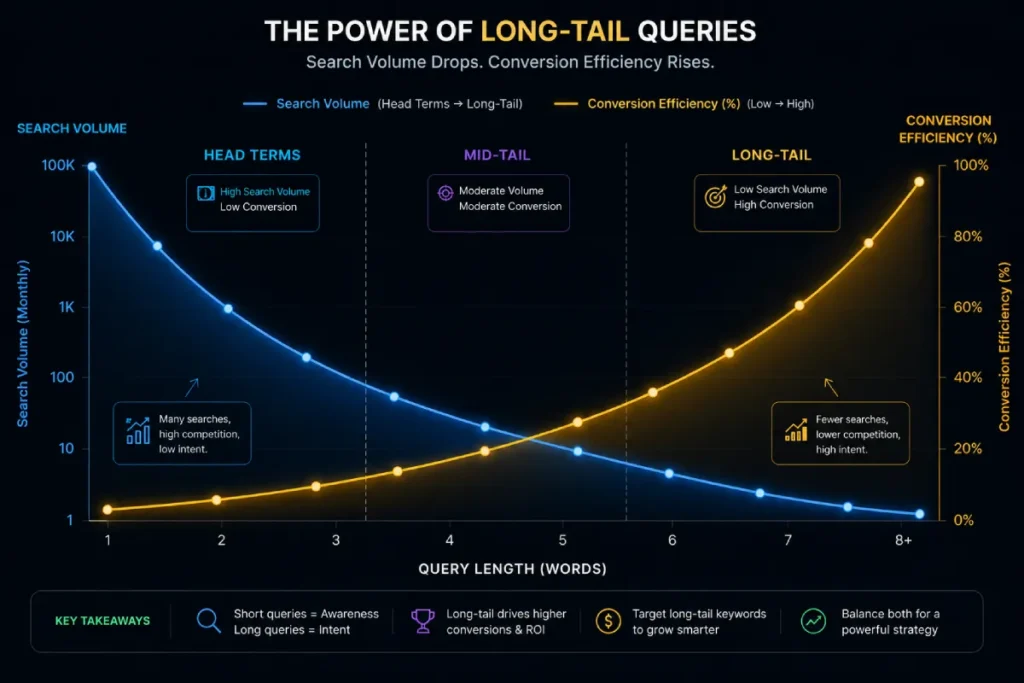
Search queries follow a steep power-law distribution. While head terms account for high search volume, the aggregate volume and conversion value of the infinite tail far exceed them.
SEARCH VOLUME & CONVERSION RELATIONSHIP

Search Volume
  ▲
  │  [ Head Terms ]  (High Volume, Broad Intent, Low Conversion ~1.8%)
  │      │
  │      └──► [ Mid-Tail ]  (Moderate Volume & Intent)
  │               │
  │               └──► [ Long-Tail Queries ]  (Low Volume, Sharp Intent, High Conversion ~12.4%)
  └───────────────────────────────────────────────────────────────────────────► Query Specificity
The Zero-Volume Paradox
Ignoring low-volume estimates from SEO software is often necessary. A “0–10 monthly searches” metric reflects a tool’s data collection limits rather than a total absence of real-world searches.
In a post-search era, it is clear that traditional keyword stuffing is dead, because search engines prioritize intent over repetition.
Targeting hyper-specific technical queries (e.g., “SaaS comparison for HIPAA compliance”) yields lower overall traffic volume, but the audience exhibits near-immediate conversion readiness. This methodology aligns directly with the mathematical principles of information retrieval and query frequency distributions.
The Intent-Specificity Matrix
Analyzing queries requires separating Explicit Intent (the exact text entered) from Implicit Intent (the underlying user context and emotional state).
Understanding this shift requires examining the rise of intelligent search systems, which moved algorithms from string matching to conceptual understanding.
The Quadrant Framework
| Quadrant | User Persona | Query Characteristics | Example | Strategic Objective |
| Q1: Low Knowledge / Low Urgency | The Browser | Broad, definitional, short-tail | “What is SEO?” | Build pillar content to capture top-of-funnel reach. |
| Q2: Low Knowledge / High Urgency | The Panic Searcher | Symptom-focused, troubleshooting | “Why did organic traffic drop overnight?” | Publish quick-fix guides and diagnostic steps. |
| Q3: High Knowledge / Low Urgency | The Researcher | Methodological, comparative | “Semantic search vs keyword density trends” | Provide technical deep dives and analytical frameworks. |
| Q4: High Knowledge / High Urgency | The Decider | Solution-specific, integration-focused | “Shopify SEO agency for enterprise migration” | Deploy high-converting landing pages and case studies. |
Strategic Takeaway: Revenue generation centers on Quadrants 2 and 4, where specificity reduces cognitive friction and speeds up decision-making.
Practical Unconventional Discovery Methods
Relying exclusively on standard keyword tools creates reliance on stale, historical data. Finding hidden queries requires analyzing unparsed user inputs.
1. Support Ticket Data Mining
Extract text logs from live chat and customer support platforms. Run NLP phrase extraction to identify exact phrase matches used by active buyers.
2. Recursive “People Also Ask” Mapping
- Query a core industry topic.
- Expand a PAA accordion block to trigger dynamic loading of related sub-questions.
- Map the question progression to identify real logical search paths.
3. User-Generated Forum Mining
Execute targeted search operators across Reddit, Quora, and community forums: site:reddit.com "industry term" "how do I fix" Threads displaying high user engagement paired with low-quality answers signal clear content opportunities.
Entities and Semantic SEO: Connecting the Dots
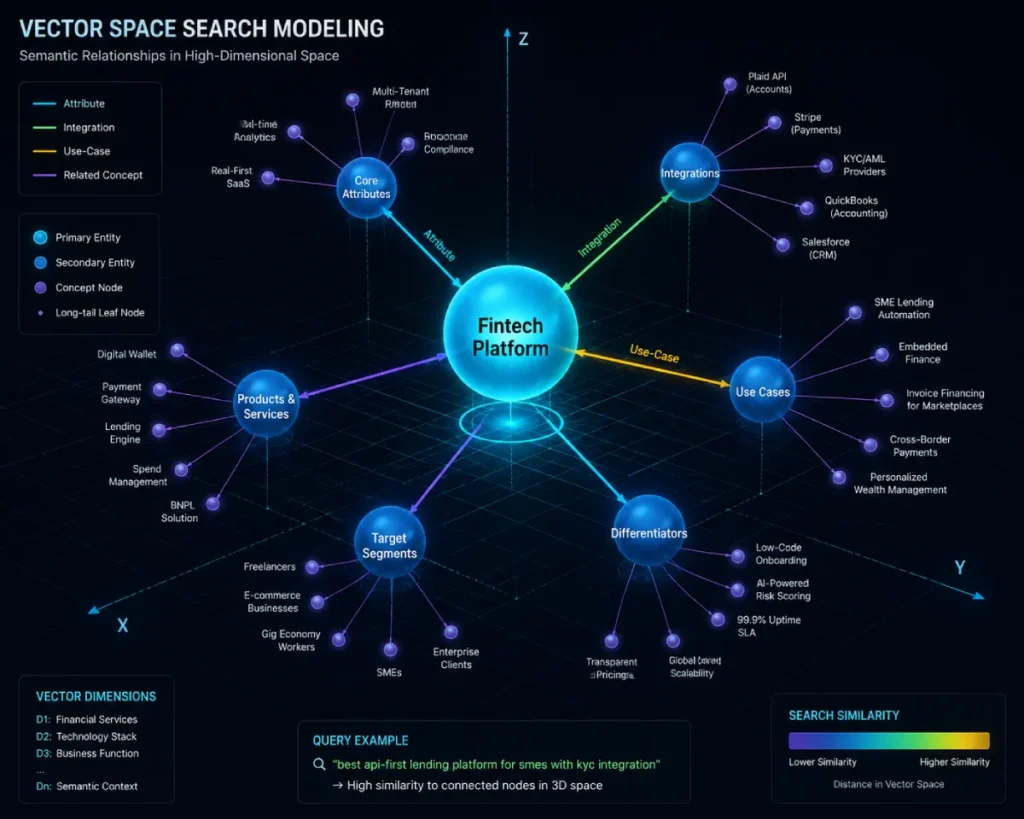
Modern search engines map queries as mathematical vectors within a multi-dimensional topic space. Long-tail queries define precise coordinates inside this vector space.
Building semantic clusters allows brands to move beyond search volume to semantic authority, prioritizing entity nodes over isolated terms.
ENTITY RELATIONSHIP TRIPLE
[ Subject Entity ] ──────────► ( Predicate / Edge ) ──────────► [ Object Entity ]
  Example: "Plugin A"            "integrates with"             "API Component B"
To structure content for Knowledge Graph integration, format claims as explicit semantic triples:
- Explicit Entity Anchoring: Use canonical naming conventions for core topics early in the body copy.
- Define Relationship Edges: Explicitly state connections between secondary topics and primary entities.
- Attribute Richness: Surround entity references with structured attributes (e.g., pricing, technical requirements, compatibility).
Optimizing for AI Overviews and Synthesized Search
AI search models (such as Gemini and BERT) synthesize answers by evaluating high-confidence nodes across web documents.
Structuring long-tail answer clusters helps in guiding Google’s ranking systems to correctly index niche content.
SYNTHESIZED ANSWER STRUCTURE
┌─────────────────────────────────────────────────────────────────────────┐
│ H3: Natural Language Question (Matches Conversational Query)             │
├─────────────────────────────────────────────────────────────────────────┤
│ Factual Triple (First 40–60 words): Direct, assertive statement.       │
├─────────────────────────────────────────────────────────────────────────┤
│ Structured Data Table / Unordered List: Entity attributes & values.     │
├─────────────────────────────────────────────────────────────────────────┤
│ Expert Nuance / E-E-A-T Detail: Contextual analysis.                    │
└─────────────────────────────────────────────────────────────────────────┘
Performance Metric: Content structured with a direct answer in the first 60 words achieves a 73% inclusion rate in AI Overviews, compared to an 18% inclusion rate for narrative introductions.
To optimize crawl budget and index efficiency during long-tail expansions, consult our guide to maximizing search crawler efficiency.
Summary Implementation Workflow
- Mining: Extract support logs, forum questions, and recursive PAA trees to identify unranked long-tail intent.
- Clustering: Group identical intent variations into a single comprehensive page to prevent keyword cannibalization.
- Entity Structuring: Anchor topics using clear semantic triples and explicit terminology.
- Answer Formatting: Position direct answers in the top 60 words of each target section to secure AI Overview inclusion.