

Key Takeaways
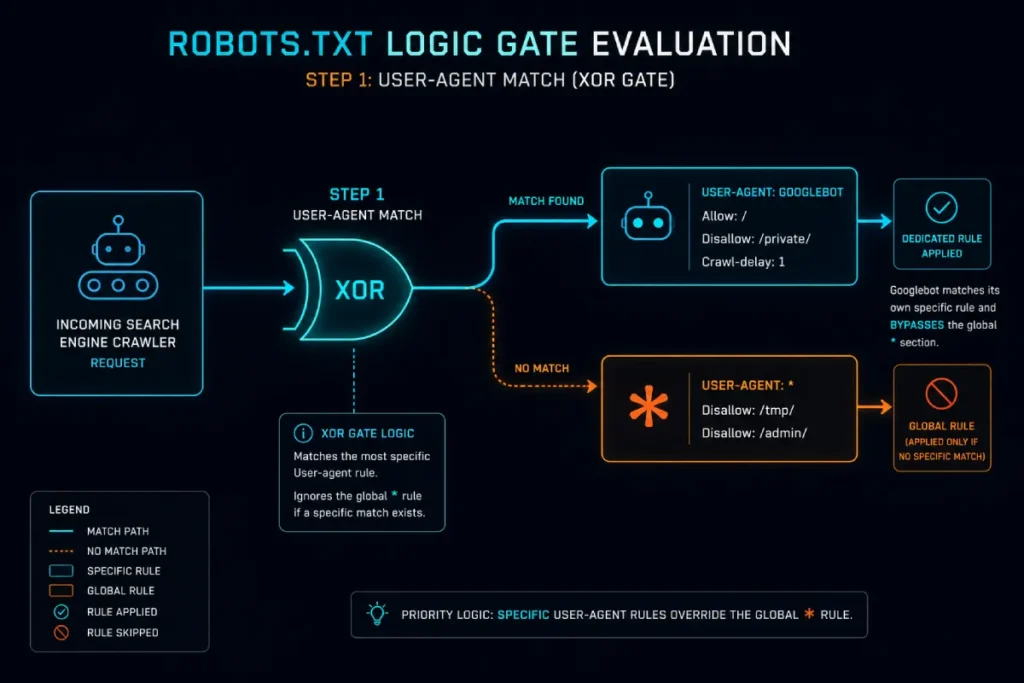
- Exclusive User-Agent Routing: Robots.txt parsing uses Exclusive OR (XOR) logic. If a crawler matches a specific
User-agentblock, it completely ignores globalUser-agent: *rules. - The “Longest Match” Precedence: When multiple directives match a URL, search engine parsers prioritize the rule with the highest character path length, regardless of file order.
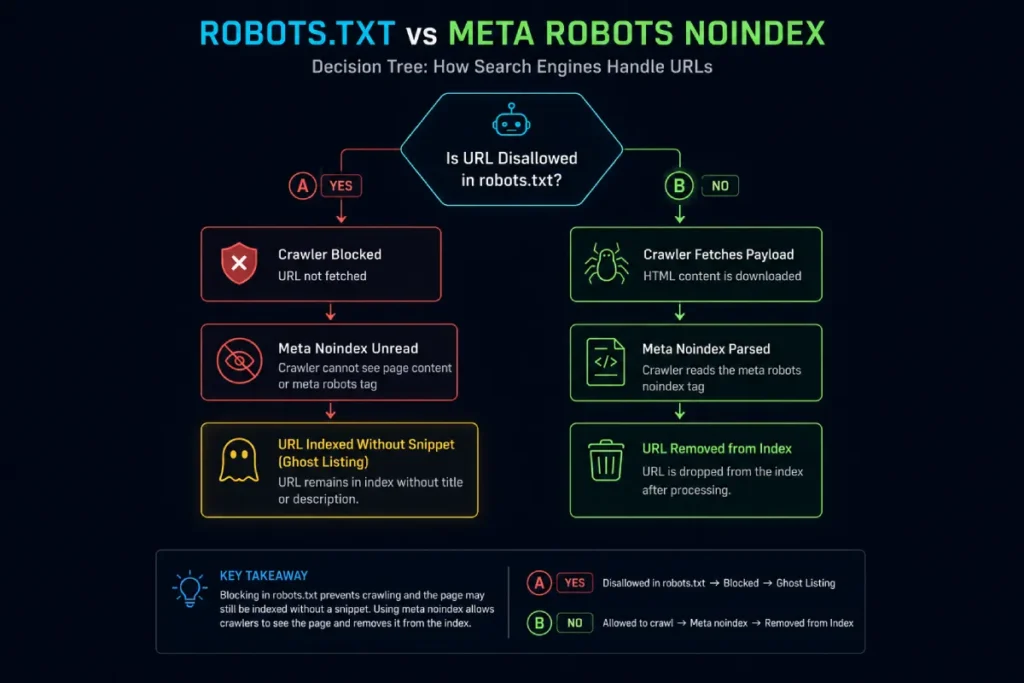
- Crawl vs. Indexing Distinction: Blocking a URL in
robots.txtprevents content crawling, but does not prevent indexing if external or internal link signals exist.
Introduction: The Circuitry of Crawling
Treating a robots.txt file as a simple binary list of “Allow” vs. “Disallow” rules leads to major crawl budget leaks and inadvertent indexation errors.
Formalized under RFC 9309, the robots.txt protocol operates as a sequence of deterministic logical evaluations—functioning like logic gates in an integrated circuit.
Incoming URL Request
       │
       ▼
[Gate 1: User-Agent Match (XOR)]
       │
       ▼
[Gate 2: Path Specificity Comparator (Longest Match)]
       │
       ▼
[Gate 3: Equal-Length Tie-Breaker (Allow Wins)]
Understanding how search engine parsers evaluate these rules is critical for establishing efficient search engine crawling mechanics across complex enterprise web architectures.
1. The User-Agent Routing Gate (Exclusive OR Logic)
The primary cause of rule leakage in multi-bot configurations is a misunderstanding of how search engines select User-Agent groups.
User-agent block matching is exclusive, not additive. When a crawler (e.g., Googlebot) parses a robots.txt file, it searches for the most specific matching User-agent header. If a matching block is found, the parser enters that specific block and completely discards the global wildcard (User-agent: *) block.
# INCORRECT ASSUMPTION:
User-agent: *
Disallow: /staging/

User-agent: Googlebot
Allow: /staging/public/

# RESULT FOR GOOGLEBOT:
# Googlebot enters 'User-agent: Googlebot' and IGNORES 'User-agent: *'.
# Because /staging/ is not explicitly disallowed inside the Googlebot block,
# Googlebot accesses /staging/private/, /staging/admin/, etc.
To restrict specific user agents safely without leaving directories exposed, you must audit official web crawler user agents and explicitly repeat all global restrictions inside every dedicated User-Agent block.
# CORRECT IMPLEMENTATION:
User-agent: Googlebot
Disallow: /staging/
Allow: /staging/public/
2. The Specificity Hierarchy: The “Longest Match” Rule
Once a crawler selects its User-Agent block, it evaluates conflicting directives using the Comparator Gate.
Unlike programming languages that evaluate directives sequentially from top to bottom, robots.txt parsers evaluate rules based on path character length. The rule containing the highest number of matching characters takes precedence, regardless of its position in the file.
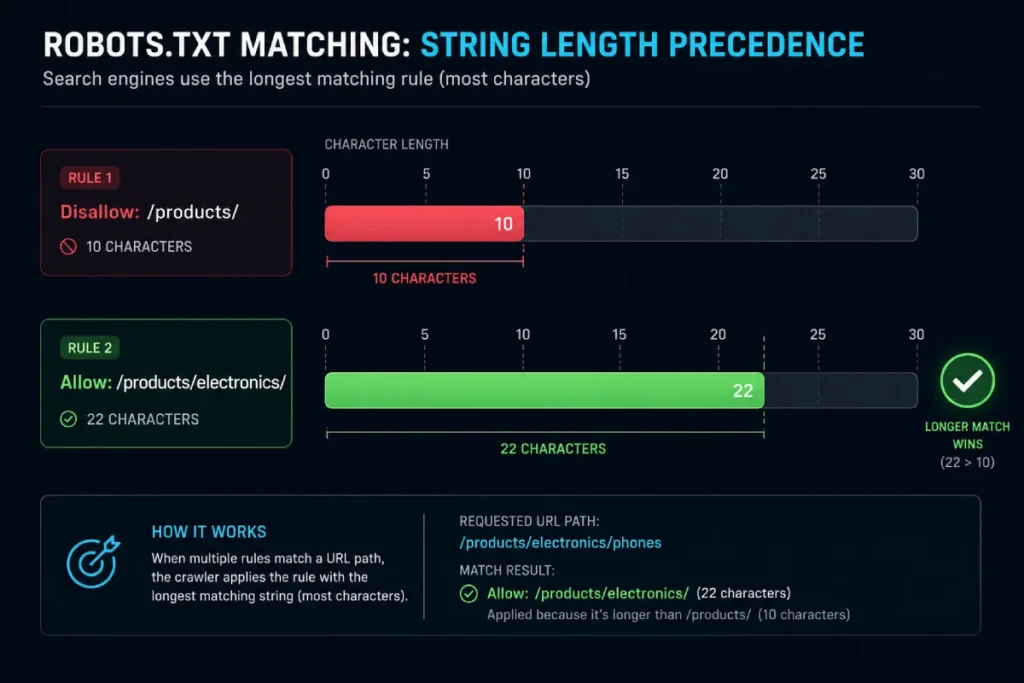
Case Study: Evaluation Matrix
Consider the target URL: /products/electronics/laptops/
| Directive | Rule Path | Character Count | Parser Evaluation | Outcome |
| Rule A | Disallow: /products/ | 10 chars | Matches URL | Overridden (Shorter) |
| Rule B | Allow: /products/electronics/ | 22 chars | Matches URL | WINNER (Longest Match) |
Because Rule B is 22 characters long, it overrides Rule A (10 characters), allowing the crawler access. Utilizing character-length matching enables precise access controls across deep directory trees, preventing bots from consuming server resources on faceted parameters—a core requirement of enterprise crawl budget strategy.
The Equal-Length Tie-Breaker Rule
When a URL matches an Allow and a Disallow rule of exact equal character length, Googlebot defaults to permissibility: the Allow directive wins.
# Equal character length conflict (14 chars vs 14 chars):
Disallow: /shop/filter?
Allow:    /shop/filter?

# RESULT: ALLOWED (Googlebot defaults to Allow on equal length)
3. Wildcards, Query Strings, and Pattern Anchors
The robots.txt standard supports pattern matching using wildcards (*) and end-of-string anchors ($).
- Wildcard (
*): Matches zero or more instances of any valid character sequence. - End Anchor (
$): Specifies the exact termination of a URL string.
# Blocks all URLs ending explicitly in .pdf
Disallow: /*.pdf$

# Blocks query strings containing 'sort=' across all subdirectories
Disallow: /*?*sort=
Critical Caution: Wildcard Overreach
Broad wildcards like
Disallow: /*?block all query parameters indiscriminately. If your site relies on client-side asset updates using query strings (e.g.,/assets/app.js?v=2.1), broad parameter blocking prevents crawlers from rendering the page, triggering soft 404 flags.
Always maintain alignment between your exclusion rules and XML sitemaps to maintain discovery pathways without creating contradictions in URL discovery vs crawling protocols.
4. Crawl Blockage vs. Search Indexation
A fundamental misconception in technical SEO is assuming Disallow prevents indexation.
robots.txtDisallow: Governs crawling (fetching the page payload).noindexMeta Tag / Header: Governs indexing (storing document semantics in search databases).
If a URL is blocked via robots.txt, search crawlers cannot download the HTML payload to read a <meta name="robots" content="noindex"> tag. If external backlink signals or internal references point to the disallowed URL, Google will index the URL as a “ghost listing” lacking snippet information.
[Target URL with Meta Noindex]
              │
              ▼
    Is URL Disallowed in robots.txt?
      ├── YES ──> Bot cannot read Noindex ──> Indexed without Snippet
      └── NO  ──> Bot fetches HTML ───> Noindex parsed ──> URL Removed from Index
De-indexation Workflow for Blocked Pages
- Remove
robots.txtDisallow: Allow crawlers temporary access to the URL. - Inject
noindexTag: Add<meta name="robots" content="noindex">or anX-Robots-Tag: noindexHTTP header. - Verify Removal: Allow search engines to crawl, parse the directive, and remove the URL from the index.
- Re-apply Disallow (Optional): Restore the
robots.txtblock to protect long-term crawl budget.
Ensure your server setup allows uninterrupted execution for rendering assets, preventing rendering blockages caused by restricted execution scripts in client-side hydration.
Summary Protocol for Robots txt Logic Gates Audits
- Verify HTTP Delivery: Ensure
/robots.txtconsistently returns anHTTP 200 OKstatus. AnHTTP 5xxerror triggers a complete site crawl freeze as a failsafe. - Audit User-Agent Isolation: Confirm that specific bot directives (
Googlebot,Bingbot) duplicate all mandatory global Disallow directives. - Calculate Specificity Lengths: Verify that high-value
Allowdirectives contain longer character path lengths than parent directoryDisallowrules. - Eliminate Sitemap Contradictions: Ensure zero URLs listed in your XML sitemaps are blocked by
robots.txtrules.