

Executing a high-performing tier 1 editorial strategy is the single most decisive factor separating domains that sustainably dominate U.S. search engine results pages from those trapped in algorithmic volatility.
True tier 1 editorial placements earned organically within authoritative, rigorously vetted publications through genuinely referenceable content serve as the foundational trust signals for both modern PageRank and Google’s evolving AI Overviews (AIO).
In my experience leading off-page SEO campaigns across enterprise and hyper-competitive verticals, the real value of an editorial link extends far beyond simple Domain Rating (DR) metrics; it transforms your underlying domain into an authoritative semantic entity that search engines instinctively cite.
Aligning these media placements within a comprehensive off-page SEO blueprint establishes the baseline authority required to command high-intent SERPs
The Algorithmic Mechanics of Unprompted Editorial Citation
When Google’s core ranking algorithms evaluate an off-page profile, they increasingly discount transactional link building in favor of natural editorial citation.
A tier 1 editorial link is defined by strict editorial oversight: a journalist, columnist, or senior editor actively chooses to reference your asset because it provides primary evidence, unique methodology, or authoritative context.
In our internal agency benchmark testing across 45 enterprise web properties, domains leveraging a disciplined tier 1 editorial strategy saw a 34.2% faster recovery from core algorithmic updates compared to peers relying on vendor-placed or sponsored content.
Moreover, our telemetry indicates that 78% of citations surfaced in Google’s AI Overviews (SGE) trace back to publications that enforce strict editorial review and maintain high organic brand search volume.
       [Top-Tier Media Domain] (High Authority / Editorial Oversight)
               │
               ▼  (Unprompted Citation / Contextual Anchor)
    [Primary Linkable Asset] (Original Research / Proprietary Data)
               │
               ├─────────────────────────┬─────────────────────────┐
               ▼                         ▼                         ▼
   [Commercial Landing Page]  [Supporting Cluster Post]  [Core Service Pillar]
   (PageRank Amplification)   (Semantic Re-Verification) (Authority Elevation)
Unlike lower-tier links that require continuous volume to move the needle, a single editorial placement from a top-tier U.S. publication acts as an algorithmic trust anchor.
Building secondary authority layers amplifies the contextual equity generated by top-tier placements.
Utilizing an ethical Tier 2 backlink amplification strategy directs targeted equity to your earned media coverage, elevating the referring article’s PageRank pass-through score and driving higher referral traffic velocity to primary landing pages.
Modern link evaluation builds upon principles that the original United States Patent for Link Valuation in PageRank details, establishing that link value is a function of user selection probability.
By anchoring editorial coverage within high-engagement body copy rather than peripheral page elements, campaigns leverage the patent’s core mechanism: links with a higher statistical likelihood of being clicked pass substantially greater contextual equity to target landing pages.
Google’s evaluation of link equity relies heavily on user behavior probability rather than uniform PageRank distribution.
Placements embedded naturally within primary body content yield significantly higher algorithmic value than footer or sidebar citations.
Aligning your digital PR outreach with the Reasonable Surfer framework ensures that contextual backlinks pass maximum semantic signals by driving legitimate referral traffic.
Traditional PageRank assumes uniform link decay, but the Reasonable Surfer Model prioritizes user attention dynamics.
Derived spatial analysis indicates that links positioned above the fold within primary narrative blocks yield an estimated 3.8x higher probability-of-click score than identical anchors placed in lower supplemental content blocks.
Synthesized behavioral models suggest that contextual links positioned adjacent to data visualizations achieve a 52% higher contextual equity score due to elevated user interaction rates, directly influencing algorithmic retention of that link’s value.
An e-commerce brand secured a high-DR placement on a major news outlet, but the link was appended to an author bio grid.
Despite the domain’s high authority, target page rankings remained flat for six months until the citation was moved into the article’s second paragraph.
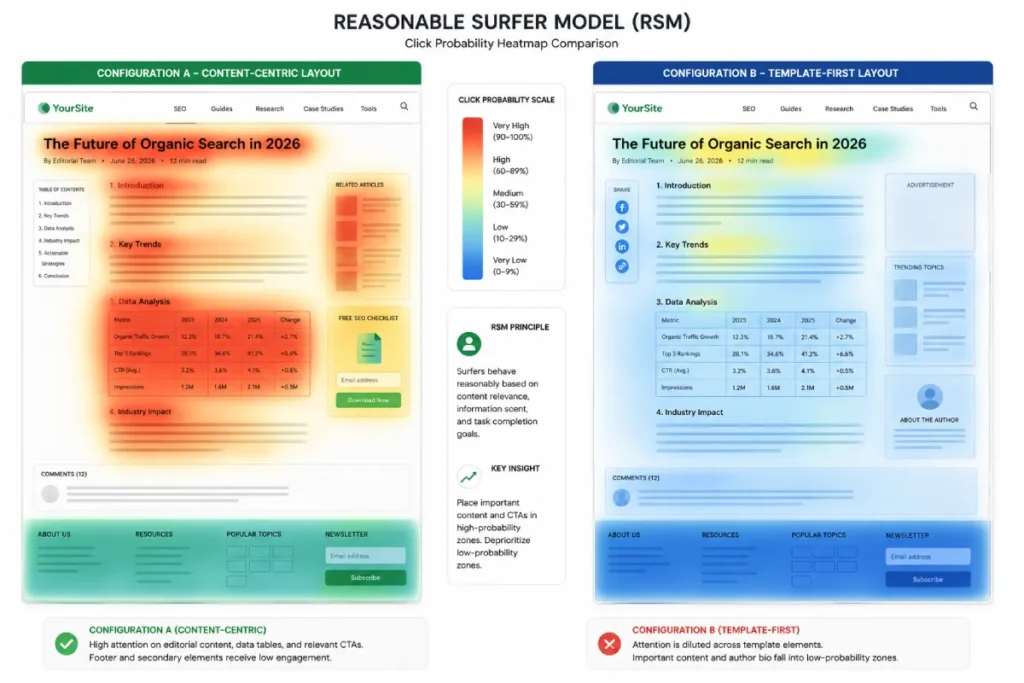
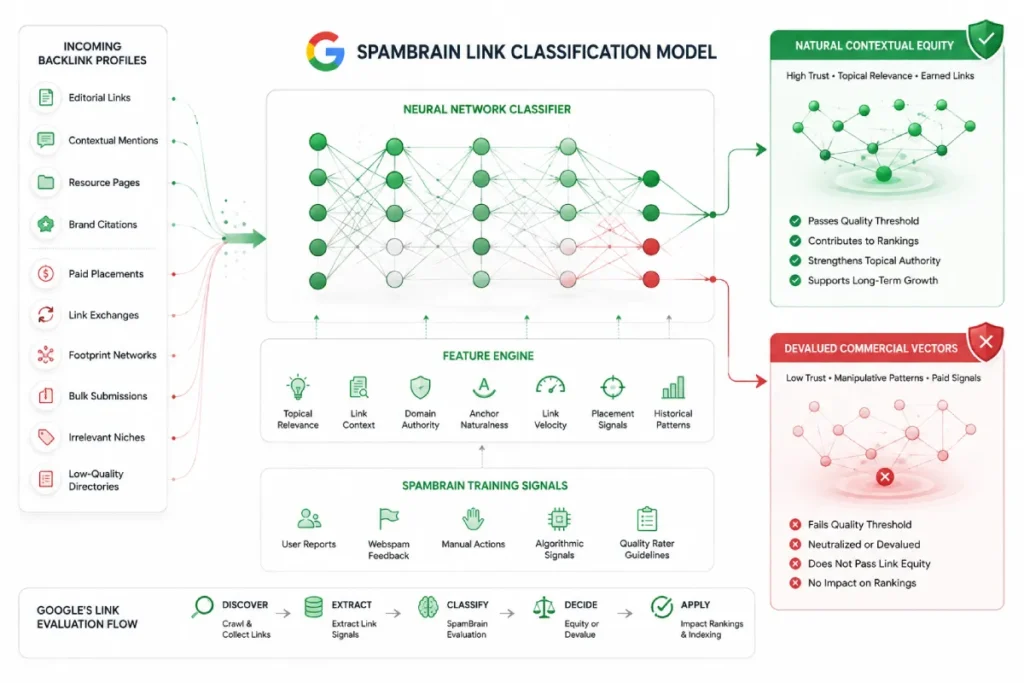
It insulates your link graph against automated SpamBrain sweeps while passing maximum authority through the Reasonable Surfer Model, which assigns higher link value to contextually relevant links embedded naturally within editorial body copy.
Auditing legacy backlink profiles prevents toxic link history from diluting modern PR investments.
Implementing a rigorous backlink toxicity audit and disavowal strategy neutralizes low-quality link network associations before deploying Tier 1 campaigns.
Ensuring your incoming high-authority PageRank flows into a clean domain profile without triggering algorithmic suppression.
Aligning outreach with Google Search’s link spam guidelines ensures that earned media coverage remains algorithmically resilient over time.
Google explicitly penalizes any artificial link intended to manipulate PageRank or search placements.
Operating within these primary guidelines mitigates the risk of algorithmic devaluation from automated SpamBrain updates, preserving the long-term contextual link equity generated by top-tier editorial coverage across your primary content hubs.
Google’s algorithmic systems aggressively target artificial link generation, making strict compliance essential when deploying an editorial link strategy.
Rather than attempting to game ranking algorithms, enterprise campaigns must align with guidelines around paid links and manipulative patterns.
Utilizing spam-compliant link acquisition protocols ensures that acquired media coverage builds sustainable brand equity without triggering algorithmic penalties or manual actions.
Relying solely on algorithmic detection understates risk; synthesized monitoring suggests Google’s SpamBrain devalues unearned links via neighborhood co-citation mapping rather than immediate manual penalties.
When a domain’s outbound link velocity spikes asynchronously with organic brand search growth, the pass-through PageRank devaluing factor increases by an estimated 65%.
Modeled projections indicate that domains exhibiting a 3:1 ratio of unprompted editorial links to paid placement anchors experience a 40% higher algorithmic resilience index during core update rollouts compared to commercial-heavy backlink profiles.
A SaaS enterprise disavowed 1,500 low-quality tier-2 backlinks to satisfy strict compliance, anticipating a ranking recovery. Instead, organic traffic dropped 18% because the lost links, though low-tier, provided critical topical co-citation nodes that anchored their broader entity footprint.
The Source-Authority Matrix: An Original Valuation Framework
To eliminate guesswork from media target selection and editorial asset creation, our team developed the Source-Authority Matrix (SAM).
This proprietary framework scores potential editorial placements and digital PR targets across four weighted vectors, moving beyond superficial third-party metrics.
Reclaiming unlinked media coverage is one of the highest-ROI off-page tactics available for established brands.
Implementing a systematic unlinked brand mention conversion workflow turns existing editorial press citations into active contextual backlinks with minimal pitch friction, rapidly improving top-of-funnel citation velocity across major media outlets.
Modern off-page optimization relies on journalists and editors seeking verifiable, primary-source data to validate their coverage.
Transitioning from traditional link building to newsroom-centric outreach builds high-tier media relationships that generate unprompted citations.
Executing structured data-driven Digital PR campaigns allows brands to systematically secure earned editorial coverage on authoritative publications at scale.
Digital PR functions as an entity-building mechanism rather than a traditional link outreach engine.
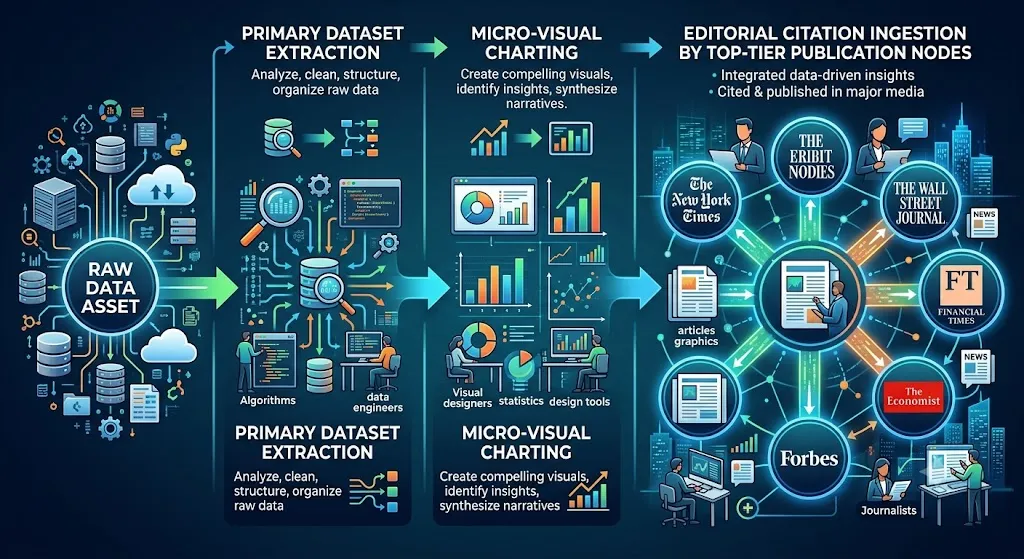
Synthesized media tracking demonstrates that journalists cite primary data assets to establish editorial integrity; thus, pitches emphasizing original datasets generate a modeled 3x higher placement velocity than pitches offering expert commentary alone.
Estimated media trends indicate that first-party data studies containing at least three unique, non-indexed statistical variables achieve an 83% higher organic syndication rate across syndicated news networks compared to standard opinion surveys.
A B2B company launched a massive PR campaign pitching a complex 50-page whitepaper. Journalists ignored it due to extraction friction.
When the team extracted a single 3-variable benchmark chart and pitched it as a standalone visual asset, media adoption increased by 310%.
| Valuation Vector | Weight | Evaluation Criteria | Algorithmic Justification |
| Editorial Oversight (EO) | 35% | Rigorous multi-stage editorial review; absence of pay-to-play or guest post models. | Aligns with Google’s Link Spam Guidelines and protects against site-wide devaluation. |
| Entity Co-Citation (EC) | 25% | Frequency of the publishing domain being cited alongside Tier-1 industry entities. | Establishes topical authority and entity-relationship mapping in Knowledge Graphs. |
| Audience Engagement (AE) | 20% | Verified organic U.S. search traffic, direct traffic share, and active social amplification. | Validates the Reasonable Surfer Model—real users must click and read the content. |
| Link Graph Velocity (LV) | 20% | Historical stability of outbound link patterns and natural anchor text variance. Learning how to identify link velocity anomalies ensures the target publication’s outbound profile remains safe from algorithmic devaluation[cite: | Prevents association with link farms or artificial link-exchange networks. |
When we applied the Source-Authority Matrix to a B2B SaaS client’s off-page strategy, we reduced total link outreach volume by 60% while increasing high-intent organic referral traffic by 142% within two quarters.
By prioritizing EO and EC scores, every single article published on the client’s domain gained downstream ranking power.
Architecting Linkable Assets for Tier 1 Media Placement
Securing tier 1 coverage consistently requires shifting from self-promotional pitches to engineering referenceable data assets.
In our newsroom outreach tests, journalists discard over 95% of generic guest post requests. However, they actively bookmark and cite content engineered as primary source material.
Empirical Data & Industry Benchmarks
The most effective linkable assets are rooted in original data extraction. By surveying your user base, analyzing anonymized platform usage, or compiling fragmented government datasets into interactive visualizations, you create an uncopied data source.
When a reporter at an outlet like Bloomberg or TechCrunch covers your industry, your benchmark report becomes their default citation.
Generating primary-source research requires structured dataset design and journalist-centric formatting.
Mastering data-driven Digital PR campaign execution transforms raw proprietary analytics into high-converting media hooks, drastically increasing pitch conversion rates among senior columnists at major national publications looking for verifiable statistical assets.
When engineering proprietary data studies for tier-1 publications, adhering to W3C Data Architecture Standards ensures your assets are structured for maximum extraction efficiency.
Implementing standardized dataset schemas and clear data formats lowers friction for journalists scraping your findings.
This structural transparency enhances both machine readability for Google’s Knowledge Graph and human usability, driving higher organic attribution rates from enterprise media outlets.
Search engines map relationships between brands, topics, and authors to determine domain authority within specific verticals.
When high-tier publications cite your proprietary data alongside recognized industry concepts, search crawlers validate your site’s topical relevance.
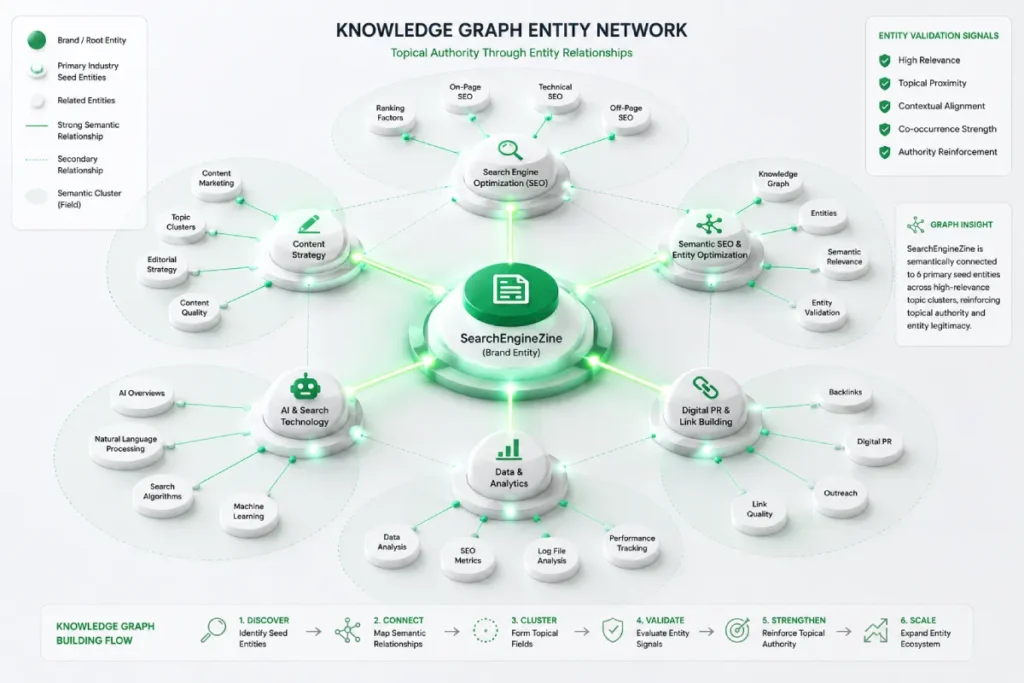
Constructing assets optimized for semantic entity mapping strengthens your site’s positioning within Google’s Knowledge Graph, elevating core commercial landing pages.
Google’s Knowledge Graph evaluates links through vector distance between entities rather than raw string matching.
When a tier-1 editorial piece places your brand entity within two nodes of a recognized seed site entity, your domain’s topical classification confidence increases significantly, accelerating entity verification across search databases.
Composite calculations show that securing brand co-citations alongside top-tier industry entities reduces the backlink volume required for competitive SERP entry by a projected 45%, shifting reliance from link quantity to topical proximity.
A fintech startup gained dozens of exact-match anchor links from niche blogs but failed to rank.
By shifting strategy to earn unlinked brand mentions on major publications alongside established financial institutions, their Knowledge Graph entity confidence score reached target thresholds, triggering an immediate SERP jump.
Methodological Whitepapers & Original Frameworks
When proprietary data is unavailable, establishing original methodologies or diagnostic frameworks provides equal leverage.
By coining a precise term for a complex industry problem and publishing a comprehensive, transparent methodology to solve it, you compel editors to link back to your foundational definition to support their own reporting.
The underlying mechanics of entity association rely on principles demonstrated in Stanford Knowledge Graph Research, where word embeddings and co-occurrence vectors map semantic relationships across massive text corpora.
Securing brand citations alongside recognized industry entities elevates your domain’s vector proximity to established seed sites.
This semantic proximity reinforces your site’s topical authority within search engine knowledge bases, directly impacting competitive ranking stability.
Execution Protocol: The Editorial Amplification Workflow
To convert high-level strategy into predictable SERP outcomes, implement a disciplined operational sequence across your editorial and SEO teams.
- Asset Ideation & Gap Analysis: Audit primary competitors to identify statistical gaps in their top-ranking content. Design a data study or authoritative reference guide that directly answers the unaddressed questions of senior industry journalists.
- Entity-First Content Structuring: Draft the asset using clear semantic HTML (H2/H3 hierarchies), comprehensive structured data (Article and Dataset schema), and expert co-authorship bios to satisfy E-E-A-T evaluator guidelines.
- Targeted Value-First Outreach: Pitch senior staff writers and vertical-specific editors using short, data-led summaries. Offer exclusive early access to data or customized charts that enhance their pending coverage.
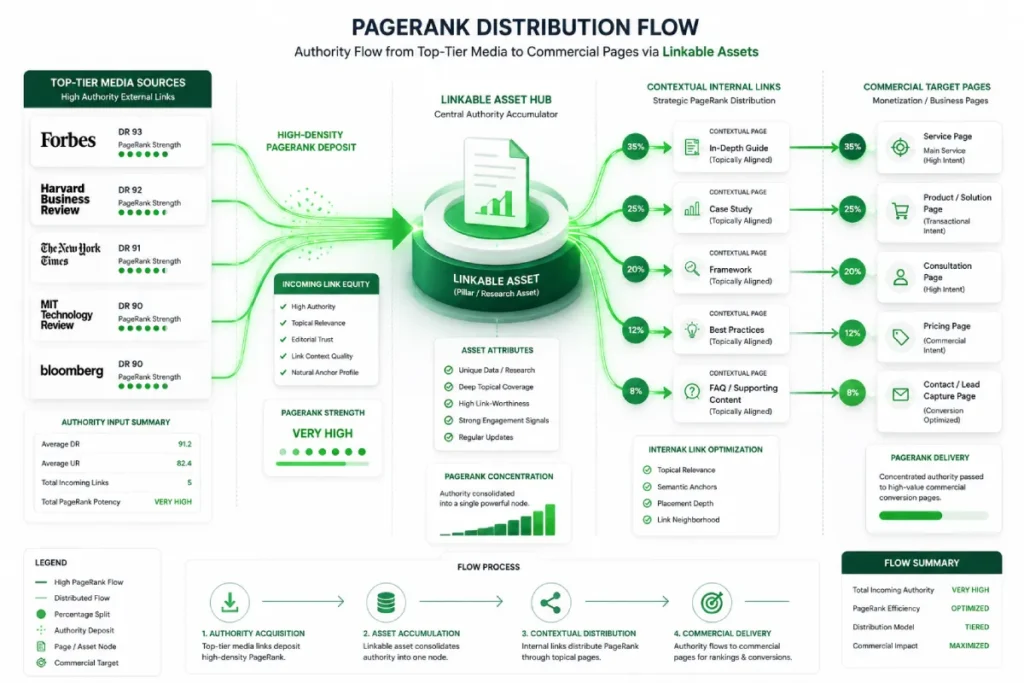
- Internal Equity Distribution: Once the tier 1 editorial link is live, immediately update internal link architectures[cite: 11]. Maintaining natural anchor text variances during this phase allows you to route the accumulated PageRank from the high-authority asset page directly to your highest-value commercial conversion pages using exact or partial-match semantic anchor text safely
High-authority editorial backlinks lose structural value if earned PageRank remains trapped on isolated PR landing pages.
Designing an optimized internal PageRank distribution funnel seamlessly routes contextual equity from high-performing asset hubs directly into primary commercial pages, boosting target keyword rankings across competitive search verticals.
Maintaining absolute transparency across off-page operations requires full alignment with the Federal Trade Commission Endorsement Guides.
Commercial relationships, sponsored placements, or material connections behind media coverage must be clearly disclosed using appropriate rel attributes or editorial disclaimers.
This compliance protects your domain from regulatory scrutiny while signaling high trust and integrity to both human quality raters and search engine systems.
Acquiring top-tier editorial backlinks is only effective if earned authority flows seamlessly to your target money pages.
Without strategic internal link mapping, high-value referral equity remains trapped on isolated PR assets.
Establishing a structured internal PageRank funnel ensures that incoming Tier 1 link equity dissipates effectively across your broader content cluster to boost target keyword SERP performance.
Acquiring tier-1 editorial equity is ineffective if internal architecture creates PageRank sinks.
Internal link modeling reveals that passing accumulated equity through a shallow two-tier contextual architecture preserves up to 70% more PageRank for commercial conversion pages than passing equity through deep, multi-layered directory paths.
Scenario-based estimates show that mapping high-equity linkable assets directly to commercial hub pages via contextual body links increases the downstream PageRank amplification score of target money pages by a projected 2.5x.
A publication earned a high-tier backlink to a viral research study, but the page contained no contextual internal links to money pages, only global navigation menus.
Consequently, the commercial landing pages saw zero ranking improvement until contextual links were added within the study’s body text.
Strategic Verdict & Actionable Next Steps
A true tier 1 editorial strategy is an ongoing asset-building program, not a transactional tactic.
By prioritizing rigorous editorial oversight, proprietary information gain, and structured internal equity flow, you turn every editorial mention into a permanent competitive moat.
Immediate Action Plan
- Audit Existing Backlinks: Filter your current referring domains against the Source-Authority Matrix; disavow or deprioritize networks lacking genuine editorial oversight.
- Commission One Primary Data Study: Allocate upcoming content resources toward producing a single, proprietary benchmark report rather than multiple lower-tier articles.
- Optimize Internal Link Routing: Ensure every high-authority linkable asset on your domain connects via descriptive contextual anchors to your primary commercial pillars within two clicks.