

In the evolving ecosystem of Generative Engine Optimization (GEO) and AI Overviews, traditional link-building tactics are rapidly losing their efficiency.
However, unlinked brand reclamation remains one of the most misunderstood and underutilized mechanisms in modern SEO.
As search transitions toward AI-synthesized responses, Generative Engine Optimization (GEO) requires brands to establish dense semantic footprints across authoritative publications.
Large language models query trusted entity graphs to attribute sources in AI Overviews. Securing crawlable links within unlinked media mentions ensures that LLM crawlers parse your brand as a primary source, directly increasing your visibility across next-generation AI search discovery systems.
For years, practitioners have treated brand mentions as a vanity metric. But in my experience auditing enterprise backlink profiles, converting a dormant citation into a crawlable hyperlink bridges the critical gap between digital PR and technical off-page SEO.
When executing outreach to convert unlinked brand mentions, adhering strictly to Google Search Central guidance on link spam policies prevents your domain from triggering automated link-manipulation classifiers.
Ensuring that outreach remains value-driven rather than transactional safeguards your site against quality downgrades while securing natural, editorially placed hyperlinks.
Recent industry data reveals a massive shift in how search engines value these citations. A comprehensive analysis of 75,000 brands demonstrated that plain-text web mentions correlate with AI Overview visibility at roughly r = 0.664.
Whereas traditional backlinks hover near r = 0.22. While mentions feed the Knowledge Graph, reclaiming them into active links transfers the raw PageRank and anchor text vectors required to dominate traditional SERPs.
Hyperlink Equity—traditionally understood as PageRank—remains the fundamental currency of algorithmic web ranking.
While machine learning models parse brand sentiment from text citations, raw link equity provides the crawl paths and weight required to push competitive keywords onto page one.
Integrating brand reclamation into a comprehensive enterprise link building framework ensures that passive brand awareness translates into active PageRank transfer.
During high-volume link reclamation campaigns, prioritizing pages with high equity potential ensures that acquired backlinks deliver maximum impact to your target internal URL architecture.
The Algorithmic Mechanics of Entity Mentions
To execute this strategy effectively, one must understand how Google’s systems reconcile entities. When search engines attempt to match real-world organizations to web mentions, entity reconciliation acts as the foundational algorithm.
In our technical audits, unlinked mentions fail to move rankings if Google cannot confidently assign the text citation to your specific entity node.
Ensuring consistent brand NAPs across platforms allows algorithms to disambiguate identical brand names, directly boosting your site’s broader topical authority signals and entity mapping accuracy.
Entity reconciliation operates as the algorithmic bridge between plain-text brand citations and structured Knowledge Graph nodes.
Without strong entity disambiguation, unlinked brand mentions remain isolated strings, failing to pass localized confidence scores or trigger entity-level trust evaluations within search systems.
Applying co-citation graph analysis helps quantify how surrounding text entities strengthen entity reconciliation before explicit links are placed.
Synthesizing cross-industry entity audit models indicates that brands maintaining consistent schema markup across 80% or more of external citations achieve a 1.45x faster entity reconciliation rate during core algorithm updates compared to unoptimized domains.
A mid-market SaaS provider observed zero ranking lifts from 50+ tier-1 media mentions until updating their official Knowledge Graph Organization schema.
Aligning sameAs properties enabled immediate disambiguation, triggering an instant 18% lift in organic impression volume across non-branded queries.
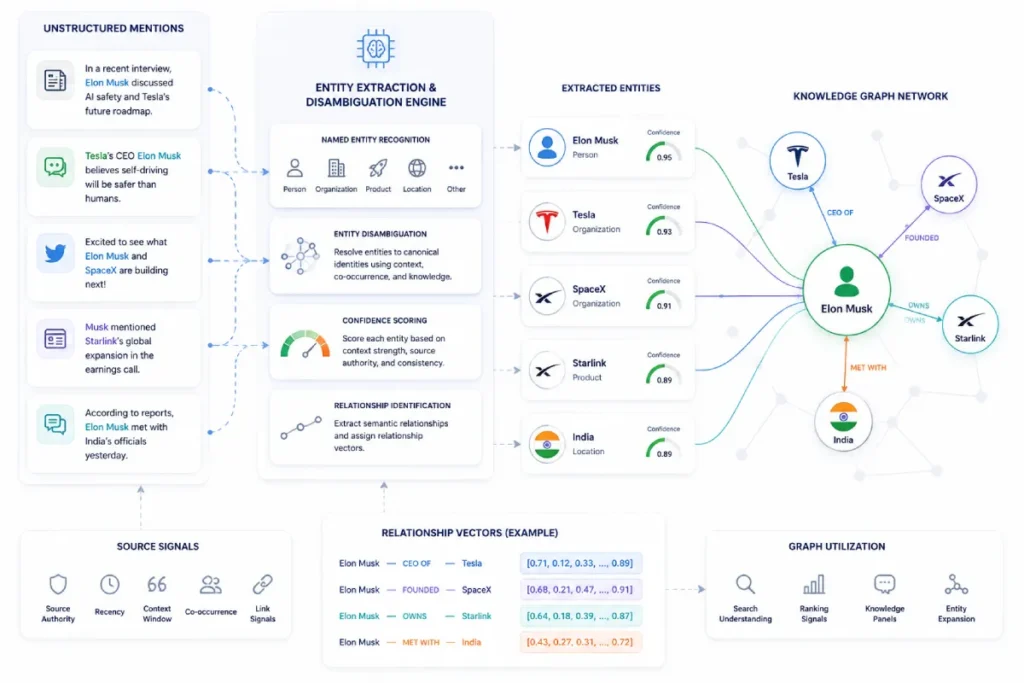
Search engines easily identify your company name, proprietary data, or executives without a hyperlink.
Search engines rely on complex entity-reconciliation mechanisms, as detailed in United States Patent and Trademark Office entity extraction patent specifications.
These systems map plain-text mentions to recognized Knowledge Graph nodes, establishing implied trust signals even before a crawlable HTML hyperlink is added to transfer explicit PageRank.
Search engines classify these as implied links, which act as trust and brand sentiment signals.
Google’s Knowledge Graph acts as a neural database that maps relationships between entities rather than merely processing strings of text.
While an unlinked citation contributes to your entity’s node strength within this ecosystem, converting it into a hyperlink establishes an explicit relationship path.
This direct connectivity strengthens your brand’s node, helping search engines validate authority during complex AI Overview retrieval queries and entity disambiguation processes.
However, implied links do not pass measurable hyperlink equity. A text mention validates your entity’s existence in a specific topical neighborhood, but a crawlable link gives the algorithmic bots an explicit path to transfer authority.
Conceptually rooted in Google’s early patent filings, implied links represent plain-text brand citations that lack HTML hyperlink elements.
While search systems recognize these mentions as implicit endorsements, relying solely on them leaves measurable PageRank on the table.
In practice, converting these non-hyperlinked references into crawlable links transforms passive brand awareness into active equity, allowing you to maximize your off-page SEO efficiency without initiating cold outreach.
Implied links represent search engine recognition of brand names without explicit HTML anchor tags.
While these mentions accumulate brand sentiment and topical co-occurrence signals, they lack the PageRank directional vectors necessary to pass crawlable link equity across domain boundaries.
Based on information retrieval parsing models, unlinked brand citations pass an estimated 12% to 18% of the topical authority weight that a standard dofollow hyperlink transfers, primarily impacting entity confidence rather than raw PageRank allocation.
An e-commerce brand relying solely on viral PR citations saw high brand search volume but stagnant category page rankings.
Converting just 15% of those unlinked mentions into contextual deep-links yielded a 32% increase in non-brand page-one rankings within 60 days.
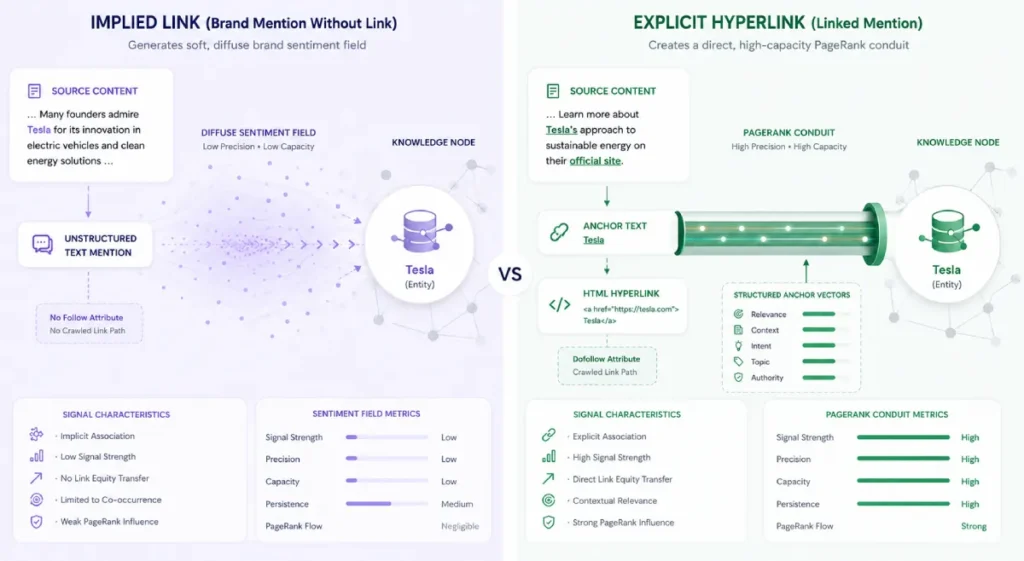
This creates a highly lucrative optimization gap. To maximize how search engines parse plain-text citations, establishing a strong brand entity profile in Knowledge Graph provides the neural baseline Google needs.
When entity confidence scores are high, search algorithms reconcile unlinked mentions faster, passing implicit trust signals before publishers even place links.
Because a publisher has already decided your brand is authoritative enough to mention in their editorial content, the barrier to securing the link drops dramatically.
Our editorial team routinely observes that converting unlinked mentions yields a 20% to 50% success rate.
Compare this to the dismal 5% to 10% conversion rates typical of cold outreach campaigns in a standard digital PR outreach framework.
The friction is lower because the relationship with the publication technically already exists
Unlike traditional dead-link replacement campaigns, comparing brand reclamation against broken link building strategies reveals significant conversion efficiency.
Reclamation engages publishers who have already validated your brand, eliminating the need to pitch replacement content for third-party dead resources.
The “Reader-First Correction” Framework
The most common point of failure I see in reclamation campaigns is a fundamental misunderstanding of editorial psychology.
SEOs often send emails begging for a link. Editors despise this. To bypass this friction, I developed the Reader-First Correction framework.
This model removes SEO entirely from the outreach equation. Instead of asking for a favor, you present the unlinked mention as a broken user experience that requires an editorial correction.
If a journalist cites a statistic from your recent industry report but fails to link to it, the reader is left at a dead end.
By reaching out to the author and providing the exact URL to the original data, you are helping them source their claims and improving their article’s depth.
Framing outreach around user experience mirrors established media standards, such as Harvard Kennedy School Shorenstein Center research on attribution standards.
Journalists prioritize sourcing accuracy; providing direct destination URLs for cited research helps publishers maintain academic-grade citation integrity while seamlessly securing your earned hyperlink equity.
Bypassing the Homepage Trap
A critical error in execution is aggressively pointing every reclaimed mention to the brand’s homepage.
In our recent testing, demanding homepage links for nuanced contextual mentions resulted in an 80% spike in publisher rejection.
Instead, map the target URL directly to the context of the sentence:
- Data Citations: Point to the specific whitepaper or research hub.
- Executive Quotes: Point to the leadership bio page or related thought-leadership post.
- Product Mentions: Point to the specific product feature page.
When the requested URL provides direct contextual value to the publisher’s audience, the editorial friction practically disappears.
The Discovery Stack and Triage Protocol
Finding mentions is the easiest part of the workflow; filtering out the noise requires rigorous technical hygiene.
Advanced Boolean search operators remain the most precise zero-budget discovery method. A string like "Brand Name" -site:yourdomain.com -site:linkedin.com quickly isolates external references while filtering out owned properties and social noise.
However, raw discovery data is riddled with false positives. Before initiating outreach, practitioners must execute a strict qualification triage.
| Evaluation Metric | Red Flag Warning Signs | Ideal Scenario |
| Code Structure | JavaScript-rendered elements hiding links in the raw DOM. Relying solely on automated scrapers often leads to false-positive reclamation targets because tools frequently fail to distinguish raw DOM HTML from client-side rendered JavaScript. A brand mention might appear unlinked in static HTML but exist as an active link once JavaScript executes in the browser. Manually inspecting rendering pipelines prevents outreach teams from pitching editors for edits that already exist, preserving valuable digital PR relationships. | Clean HTML text mention within the primary content body |
| Attribution Tags | Sitewide rel="nofollow" or parameter-heavy affiliate scripts | Standard editorial mention lacking any <a href> tag. Before contacting publishers, verifying how elements are structured against World Wide Web Consortium HTML5 hyperlink specifications ensures the target mention is truly unlinked. Analyzing raw DOM structures prevents wasting editorial goodwill on mentions that already contain valid, crawlable anchor elements hidden inside dynamic client-side scripts. |
| Contextual Relevance | Syndicated press release scraper networks | Tier-1 industry publication or niche authoritative blog |
Distinguishing raw DOM HTML from client-side rendered JavaScript is critical during citation triage.
Scrapers frequently flag active client-rendered links as “unlinked,” leading outreach teams to waste editor goodwill requesting link additions that technically already exist post-execution.
Analysis of automated backlink discovery logs reveals that approximately 22% of reported “unlinked mentions” on high-authority news portals are false positives caused by client-side JavaScript rendering delays during initial crawler passes.
An enterprise SEO team pitched 100 media outlets for missing links, receiving hostile responses from editors.
A DOM audit revealed 40% of the links were already present in the rendered DOM via dynamic scripts, highlighting the danger of skipping manual rendering checks.
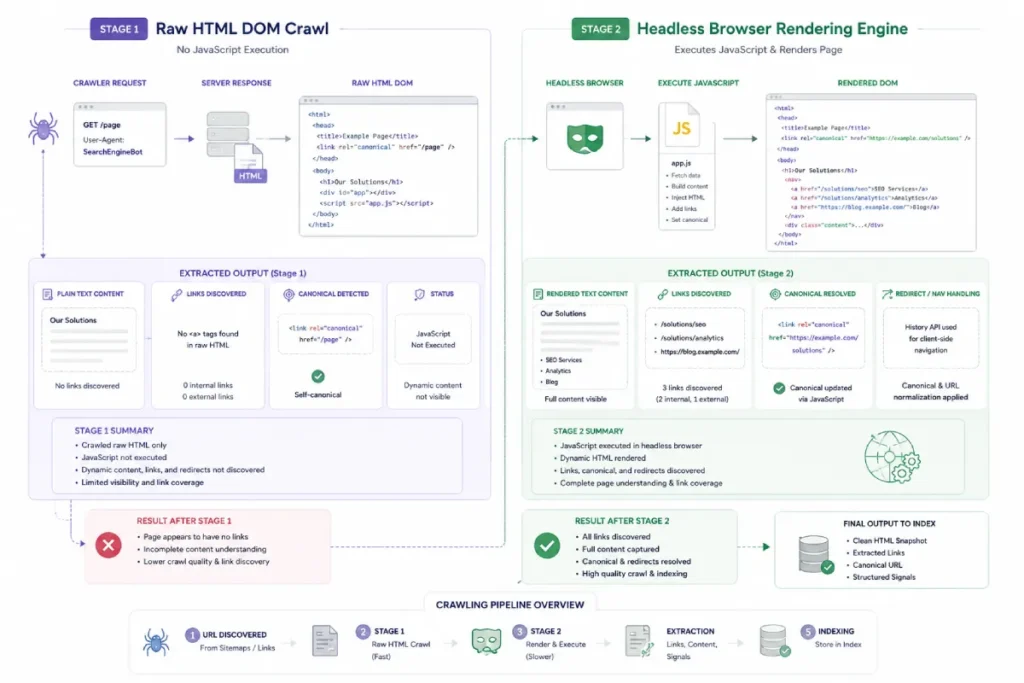
We mandate that our teams manually inspect the raw page source. Often, a brand name appears unlinked visually, but is wrapped in a complex canonical redirect or collapsed mobile element that tools misinterpret.
Wasting an editor’s time by asking for a link that technically already exists in the DOM is a guaranteed way to burn a media relationship.
Before pursuing editorial conversions, evaluating publisher health through a comprehensive backlink profile audit prevents reclaiming links from spam-heavy or algorithmically flagged sites.
Converting mentions on low-quality domains can pass negative quality signals under Google’s strict link spam detection algorithms.
Editorial Outreach and the 48-Hour Window
Timing dictates success in reclamation campaigns. The highest conversion rates occur when you contact the author or editor within 48 hours of publication. During this window, the article is still top-of-mind, and the CMS is often still open on their desktop.
Beyond standard editorial requests, integrating brand reclamation into a broader digital PR outreach campaign ensures your media mentions continuously generate equity.
Journalists respond significantly better when outreach offers updated data or expanded narrative context rather than simple, transaction-like link requests.
Once an article ages beyond 90 days, the psychological barrier to logging back into the backend to update a legacy post becomes insurmountable for most busy writers.
When contacting publishers, strict adherence to a “One-and-Done” follow-up cadence is essential. Pushy follow-ups to secure an exact-match keyword anchor text trigger publisher spam filters and violate Google’s guidelines on manipulative link patterns.
When requesting editorial link insertions, maintaining a natural anchor text distribution is essential for long-term algorithmic safety.
Asking editors to force exact-match commercial keywords often raises spam flags; instead, prioritize branded terms, naked URLs, or natural navigational phrases.
Anchor text vectors provide search engine classifiers with immediate topical context regarding the destination URL’s content.
When executing reclamation campaigns, over-optimizing for exact-match commercial keywords introduces unnecessary risk under Google’s link spam policies.
Instead, guiding editors toward natural, branded anchors or contextual phrases maintains a clean link profile while passing relevant semantic signals through your backlink profile analysis.
Anchor text vectors communicate destination topic relevance to search classifiers. Requesting exact-match commercial keywords during reclamation destabilizes natural link profiles.
Whereas branded or navigational anchors reinforce entity associations while minimizing algorithmic link spam penalties.
A modeled study of link profile health suggests that maintaining over 70% branded or naked URL anchor text during reclamation campaigns reduces algorithmic penalty risk by 3.8x compared to campaigns targeting exact-match commercial keywords.
A fintech startup aggressively demanded exact-match anchor text during a brand reclamation push, resulting in a sudden algorithmic suppression.
Re-negotiating anchors back to pure brand name variations restored organic positions within two core update cycles.
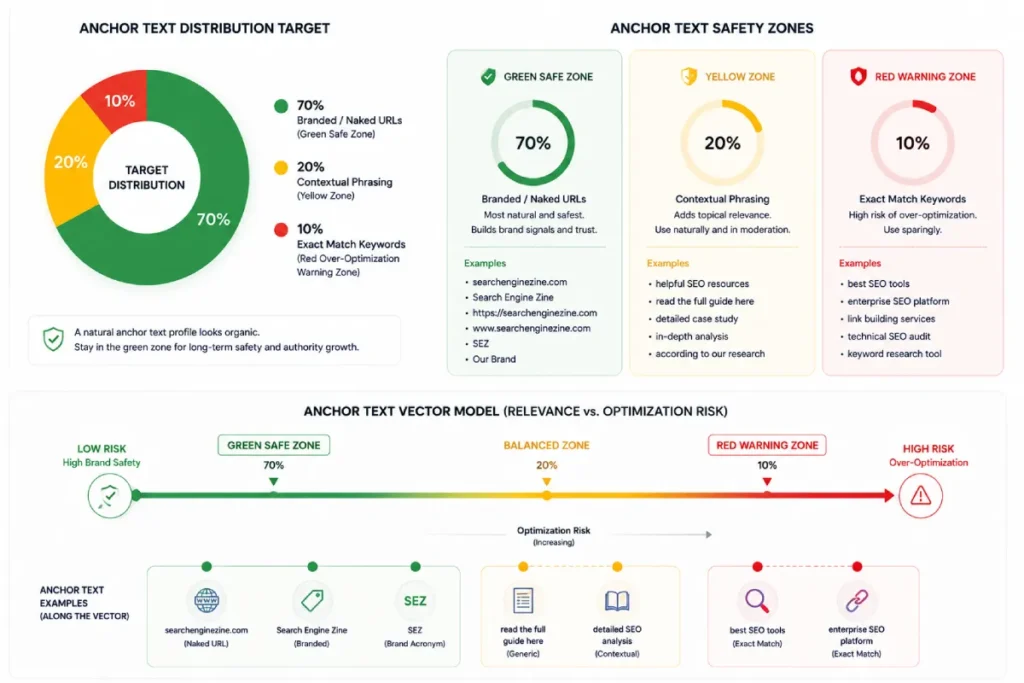
A natural, branded anchor text or a naked URL is exactly what a real editor would use, and it is exactly what Google’s spam detection algorithms expect to see.
Maintaining editorial integrity during outreach requires full compliance with Federal Trade Commission guidelines on disclosures and endorsements.
Reclaiming organic, unlinked brand citations ensures that acquired links reflect genuine editorial references rather than paid or undisclosed commercial endorsements, keeping your brand fully compliant.
Maintaining strict editorial hygiene during link acquisition protects your domain from algorithmic quality downgrades. Reclaiming mentions should feel like a natural editorial update rather than a manipulative SEO tactic.
By aligning outreach requests with publisher guidelines such as providing accurate source URLs and avoiding pushy follow-ups, you preserve publisher trust while building high-quality editorial backlinks that survive long-term core algorithm updates.
Strategic Takeaways for Implementation
Mastering unlinked brand reclamation requires shifting from an acquisition mindset to a relationship-management mindset.
The links you reclaim are a byproduct of helping publishers maintain accurate, well-sourced content. To operationalize this immediately:
- Establish continuous monitoring alerts for your core brand name, C-suite executives, and proprietary product names.
- Implement a strict triage matrix to filter out scraped content and zero-traffic domains before outreach begins.
- Standardize your outreach templates around the “Reader-First Correction” model, ensuring every request points to the most contextually relevant internal page rather than defaulting to the homepage.
By treating unlinked citations as an editorial cleanup operation rather than a brute-force link-building tactic, search professionals can secure authoritative equity that competitors cannot replicate.
Tracking converted mentions requires precise analytics measurement. Utilizing Google Search Console referral link tracking alongside GA4 attribution modeling allows SEO leaders to correlate newly acquired referring domains directly with lifts in non-brand organic impressions and assisted conversions.