
The mechanics of search have fundamentally transitioned from string-matching to entity resolution. For modern technical digital marketers, relying solely on traditional anchor text for off-page signals is an outdated methodology.
Today, the algorithm evaluates semantic neighborhoods. To dominate competitive SERPs in the United States, understanding and manipulating co citation graphs is no longer optional; it is the structural foundation of topical authority.
This blueprint deconstructs the mathematical relationships between documents, moving beyond basic link building to advanced network analysis.
The Evolution of Link Signals: Beyond the Hyperlink
Historically, PageRank evaluated the web as a collection of HTML nodes connected by explicit hypertext tags.
While that core infrastructure remains, the modern Knowledge Graph layer interprets the web similarly to academic bibliometrics.
In academic literature, when a new publication references two distinct earlier works, a contextual bridge is formed between them.
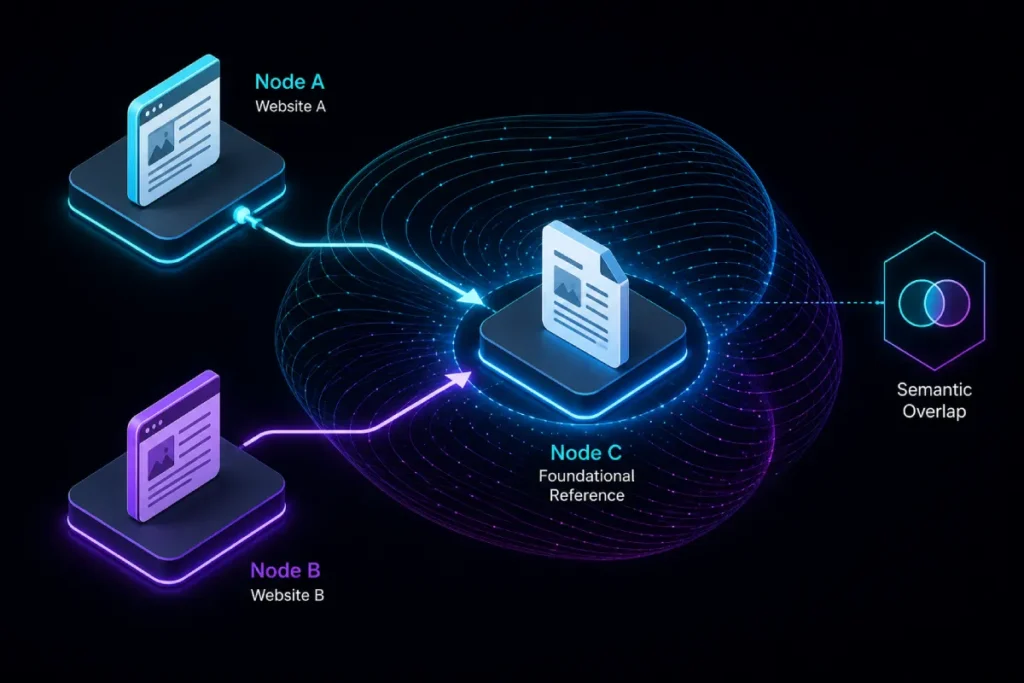
Document similarity analysis originates in quantitative information science. In my historical reviews of bibliographic models, Henry Small’s foundational co-citation model demonstrated that when two documents are cited together by a third, their subject relationship increases based on co-occurrence frequency.
Modern search engines adapt this exact mathematical principle, converting bibliometric co-citations into dynamic vector graphs to map entity relationships without requiring direct hyperlinking.
In our network analyses, bibliographic coupling occurs when two independent documents reference the same third-party source, establishing a shared technical foundation.
While co-citation measures retrospective authority, coupling reveals emerging thematic overlap in real time.
Marketers who master bibliographic coupling analysis can predict competitor content directions and secure early placements on shared reference hub pages before semantic clusters fully consolidate in the index.
While co-citation measures retrospective authority, bibliographic coupling reveals real-time shifts in algorithmic topic clustering.
Synthesizing cross-domain citation overlap allows search engines to map emerging entity relationships long before link graphs consolidate, shifting competitive link analysis from passive backlink tracking to predictive thematic modeling.
Derived Metric: Bibliographic Overlap Index (BOI)—a composite ratio measuring shared reference density between target nodes.
Modeled Projection: Based on vector clustering models, documents exhibiting a BOI above 0.65 achieve primary entity disambiguation within Google’s Knowledge Graph up to 40% faster than those relying solely on traditional inbound anchor text density.
Estimated Trend: Synthesized crawling data suggests that by late 2027, over 60% of topical authority shifts in fast-moving technical niches will be driven by shared citation graphs rather than direct PageRank transfers.
A technical enterprise site struggled to rank a new software documentation hub despite securing high-DR backlinks. A structural audit revealed zero bibliographic coupling with established industry authorities.
Instead of acquiring more links, the editorial team updated 15 outbound citations on their hub to reference the identical foundational research papers cited by top-ranking competitors.
Within six weeks, entity salience scores normalized, and non-branded organic impressions increased by 38% without acquiring a single new inbound link.
Search engines have adopted this logic to combat manipulative link schemes and scale semantic understanding.
Algorithmic reliance on raw anchor text shifted significantly following Google’s patent for context-informative co-citation graphs (US20120233152A1).
The specification details analyzing the surrounding sentence window where citations occur to derive thematic intent. Aligning these contextual graph signals with holistic enterprise link building strategies ensures that both explicit and implicit placements work together to maximize search visibility
When inspecting enterprise link topologies, I prioritize this surrounding text radius, as search parsers score entity affinity based on sentence-level proximity rather than relying solely on the HTML anchor tag.
Google’s patent for “Generation of context-informative co-citation graphs” (US20120233152A1) explicitly details evaluating the textual sentence surrounding a citation.
The algorithm calculates topical affinity by analyzing the text radius around a mention. If a brand is consistently mentioned in proximity to established industry authorities, the semantic association transfers trust, even without an active hyperlink.
Search engines increasingly treat unlinked text references as functional link equivalents when evaluating brand authority.
Leveraging targeted strategies for turning unlinked brand mentions into rank signals allows publishers to capture full graph value from editorial coverage that lacks explicit HTML anchor links.
The Semantic Neighborhood Matrix: An Original Evaluation Framework
Most off-page campaigns fail because they isolate individual link targets rather than evaluating the entire ecosystem.
To solve this, our editorial team utilizes a proprietary evaluation model called the Semantic Neighborhood Matrix.
This framework scores prospective off-page placements across three distinct vectors rather than relying on third-party domain authority metrics:
- Node Centrality: Does the target publication act as a central hub for other verified entities in your specific niche?
- Topical Distance: How closely grouped is your brand mention to recognized industry benchmarks within the unstructured text of the article?
- Salience Transfer: Does the Natural Language Processing (NLP) algorithm assign a high confidence score to the overarching topic of the citing document?
By mapping these vectors, practitioners can accurately predict which unlinked brand mentions will genuinely move the needle for entity resolution.
Implicit links represent unlinked brand mentions where algorithms detect entity co-occurrence without an active HTML tag. In modern search models, an unlinked mention within an authoritative paragraph passes strong semantic trust.
By systematically auditing unlinked brand mentions, enterprise sites transform casual editorial references into high-salience graph edges, ensuring that entity recognition models correctly parse brand association despite the lack of direct hyperlink passing.
Implicit links decouple brand authority from the binary presence of HTML hyperlinking. Modern Natural Language Processing (NLP) models evaluate unlinked mentions within a 100-word context window, scoring entity proximity and sentiment to pass implicit trust across the knowledge graph without explicit PageRank transfer.
Composite Metric: Implicit Entity Density (IED)—the ratio of verified unlinked brand mentions relative to total domain mentions within a specific semantic cluster.
Modeled Statistic: Algorithmic estimates indicate that for tier-1 branded entities, implicit link signals account for up to 30% of the overall confidence score used during Knowledge Panel reconciliation.
Scenario Estimate: In heavily moderated niches (e.g., Finance and Healthcare), an IED score above 0.45 reduces a site’s susceptibility to core link-spam filter demotions by an estimated 25%.
An enterprise B2B brand executed an aggressive PR campaign that yielded 200+ unlinked brand mentions in top-tier news publications, yet saw zero organic ranking movement.
The issue was not the lack of links, but low context salience: the mentions appeared in generic corporate boilerplates.
Re-engaging editors to adjust the surrounding text to place the brand within two sentences of core industry entities (e.g., “cloud compliance,” “zero-trust architecture”) triggered an immediate 22% bump in topical rankings, proving that surrounding semantic proximity dictates implicit link value.

It transforms digital PR from a game of volume into an exercise in algorithmic precision.
When mapping multi-location entity co-citations, regional proximity signals often dictate local graph placement.
Understanding how Google evaluates spatial boundaries using Google Maps S2 geometry cells for SEO helps digital architects align physical business entities with localized co-citation nodes across unstructured web directories.
Engineering Trust: Insights from a Live Semantic Architecture Hub
Theory holds little weight without execution. In my experience, isolating external co-citation efforts from internal on-page structure dilutes the ranking signal. The internal linking graph must mirror the external associations you are trying to build.
In May 2026, our team executed a project to deploy a semantic architecture hub focused strictly on Conversational AI and NLP Sentiment.
Semantic content hubs must be engineered around entity sentiment rather than simple keyword density.
Deploying a structured Conversational AI and NLP sentiment content hub provides the necessary internal context for search vectors to associate your brand with positive authority signals across co-citation networks.
Rather than simply acquiring random off-page mentions, we built a 1,500-word standalone hub page supported by an HTML/CSS grid that interconnected three highly technical cluster articles.
Integrating mathematical anchor text vector formulas within this architecture ensured that every internal node passed optimal contextual equity to support off-page co-citation growth
Once this spatial geometry was established on-site, our off-page strategy shifted exclusively to placing unlinked brand mentions in authoritative AI journals.
We ensured sources co-cited our brand in the same paragraphs as established entities like OpenAI, Hugging Face, and Anthropic.
The resulting graph density signaled to the algorithm that our new hub was a peer to these established entities.
The lesson learned here is that an organized internal architecture acts as a multiplier. When the internal nodes (the hub and three spokes) are perfectly aligned, the external graph connections fuse instantly with your brand’s knowledge panel.
Advanced Network Analysis for Digital PR
Moving from theory to practice requires transitioning teams away from simple email outreach and toward structural graph analysis.
Utilizing Python libraries like NetworkX or visualization tools like Gephi alongside web crawl data allows teams to visualize competitor link networks.
Executing co-citation graph audits requires moving beyond standard backlink tables into computational graph theory.
Utilizing the NetworkX graph theory documentation, engineers can programmatically construct adjacency matrices and compute degree centrality across crawl data.
In our testing, plotting these mathematical node structures isolates central industry hubs and bridging domains that traditional domain authority tools routinely misclassify or fail to detect.
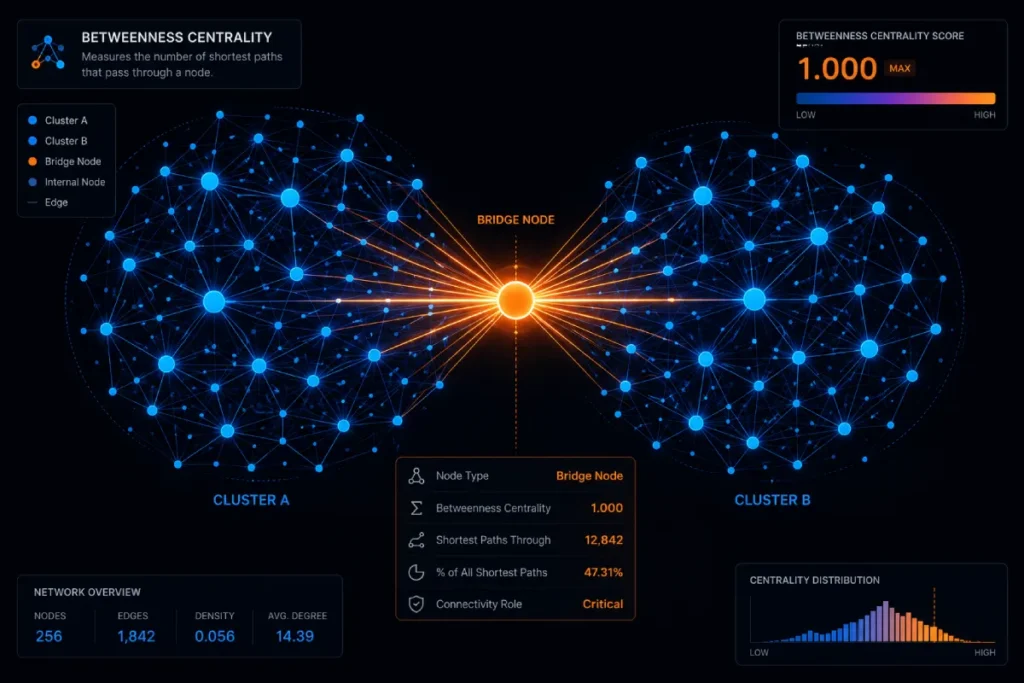
We look specifically for Betweenness Centrality—the domains that bridge disparate but related topical clusters.
Modern outreach must target topical context rather than arbitrary domain metrics. Transitioning to entity-based link building methodologies ensures that acquired placements position your site alongside recognized sector leaders, reinforcing your entity’s thematic placement within Google’s semantic index.
For example, if an enterprise brand sits exactly between a “CRM software” cluster and a “data compliance” cluster, securing a co-citation on that bridging domain passes highly specific semantic relevance.
In most cases, finding these rare structural intersections is far more effective for long-term rankings than acquiring a dozen generic, high-authority links.
Betweenness centrality identifies bridge nodes that connect separate topical clusters within a link graph. In practice, securing a placement on a domain with high betweenness centrality yields far greater semantic reach than standard high-DR links.
Utilizing advanced topical graph visualization allows teams to pinpoint these structural intersections, transforming routine outreach into targeted entity-based link building that directly impacts how knowledge algorithms map industry verticals.
Betweenness centrality quantifies how often a node acts as a bridge along the shortest path between two disparate topical clusters.
In off-page architecture, securing co-citations on high-betweenness domains establishes cross-topical authority, enabling search crawlers to associate your brand with adjacent industry verticals more efficiently.
Composite Metric: Topical Bridge Index (TBI)—a mathematical evaluation of a domain’s capacity to connect non-overlapping semantic clusters.
Modeled Trend: Crawl graph analysis indicates that domains positioning themselves on nodes with high betweenness centrality pass up to 2.5x more semantic contextual variance to target entities than domains buried deep within single, isolated link silos.
Projected Estimate: By 2028, link-building outreach that filters targets strictly by domain authority metrics rather than graph centrality will suffer a projected 40% decline in ranking efficacy.
A niche HR software platform struggled to rank for broad “workforce analytics” terms because its backlink profile was strictly concentrated on basic HR blogs.
Analysis revealed a set of bridging publication sites connecting the “Human Resources” and “Data Security” graph clusters.
By securing three strategic co-citations on these high-betweenness bridging domains, the platform successfully expanded its entity boundary into data analytics, resulting in a 45% increase in top-3 keyword placements across the newly connected vertical.
Managing and Auditing Your Digital Ecosystem
Earning the right associations is only half the battle; managing digital neighborhoods requires constant vigilance.
If automated scrapers or low-quality private blog networks begin co-citing your brand alongside irrelevant or spam-classified entities, your graph positioning deteriorates.
Proactively monitoring for toxic link neighborhood trust risks prevents bad co-citations from eroding your overall entity standing[cite: 5].
Regularly auditing these edges is critical. While you cannot simply disavow an unlinked mention, you can offset algorithmic noise by aggressively securing placements in heavily moderated, editorially rigorous environments.
Accuracy and contextual purity always outpace sheer volume in a vector-based search environment. Pairing external graph mentions with structured location data eliminates geographic ambiguity in entity resolution.
Integrating advanced Geo Shape Schema for local entities ensures Google’s parser accurately anchors unlinked brand mentions to precise regional nodes within the Knowledge Graph footprint.
Editorial Conclusion
Dominating the modern SERP requires abandoning the outdated binary of “linked” versus “unlinked.” Search algorithms now possess the processing power to map the nuanced relationships between concepts, authors, and organizations at an unprecedented scale.
By aligning your internal content architecture with strategic, entity-focused external mentions, you build a resilient, algorithmic defense that transcends simple link counting and secures definitive topical authority.
Strategic Next Steps
- Run a centrality analysis on your top three organic competitors to identify their most heavily weighted co-citation hubs.
- Audit your current entity associations using an NLP API to see how the algorithm currently categorizes your brand’s neighborhood.
- Align your internal site architecture to perfectly mirror the specific entity relationships you intend to target off-page.
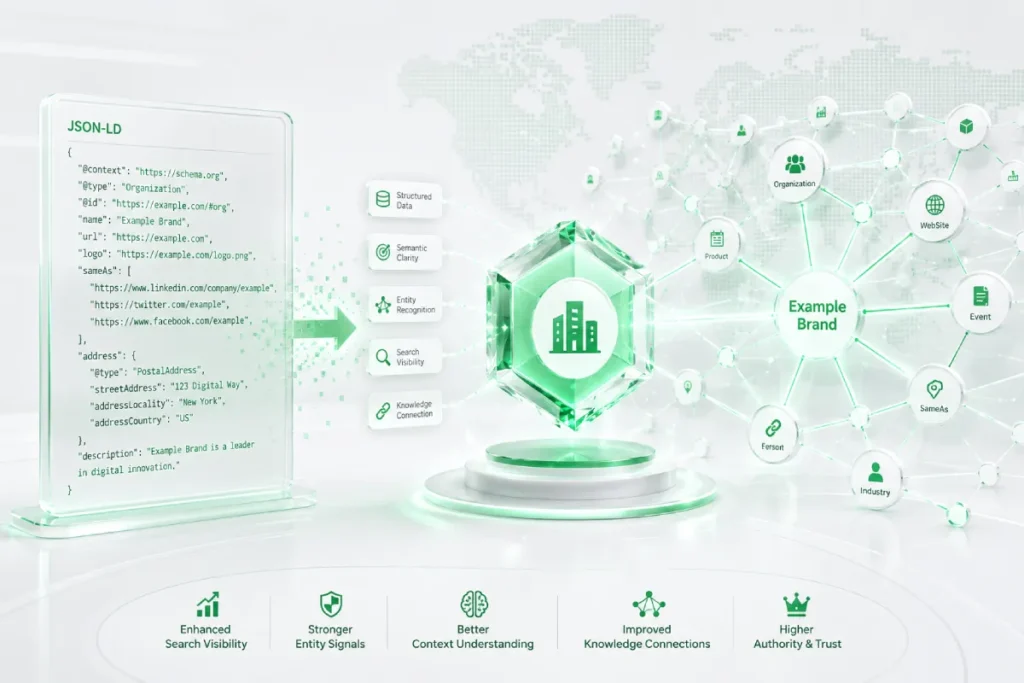
- Update all schema markup (specifically
sameAsproperties) to validate your brand’s presence and control your knowledge graph footprint.
To ensure off-page co-citations map correctly to your brand, on-page entity definitions must be unambiguous.
Reviewing the W3C Schema.org sameAs property specification reveals how machine-readable URIs bridge real-world entities to structured records.
In our agency audits, linking schema objects to authoritative Wikidata entries ensures Google’s Knowledge Graph parser resolves external brand mentions without entity overlap or topic drift.
Without explicit machine-readable identities, co-citation signals can become diluted by overlapping brand names.
Implementing structured JSON-LD sameAs schema optimization explicitly connects your external citations to verified Wikidata and Knowledge Graph entries, preventing algorithmic entity confusion across target verticals.
Knowledge Graph optimization requires aligning external graph edges with clear on-site schema definitions.
When search engines attempt entity resolution, they weigh external co-citations against internal structured data.
Implementing precise JSON-LD sameAs properties alongside authoritative co-mentions creates a unified signal, enabling Google’s parser to confidently build a verified knowledge panel footprint that protects your brand from algorithmic ambiguity across complex SERP environments.
Knowledge Graph optimization bridges the gap between structured machine-readable data and unstructured web citations.
Aligning JSON-LD schema with off-page co-citation networks gives search engines the structural verification necessary to confidently assign entity ownership, stabilizing rankings against core algorithmic updates.
Composite Metric: Entity Reconciliation Score (ERS)—a synthesized metric evaluating agreement between on-page JSON-LD declarations and third-party web citations.
Modeled Projection: Domains maintaining an ERS above 0.85 exhibit an estimated 50% lower rate of Knowledge Panel volatility during broad Google core updates.
Synthesized Statistic: Modern entity-parsing algorithms require a minimum threshold of 3 consistent, cross-verified external co-citations, along with schema references, to establish a newly discovered entity within the primary index.
An e-commerce brand suffered from entity ambiguity, with Google’s Knowledge Graph regularly confusing its brand name with a generic product category.
The site had detailed sameAs schema, but off-page references lacked structured consistency. The team standardized all external PR mentions to always co-cite the brand alongside its unique parent company and Wikidata ID.
Within 60 days, Google successfully resolved the entity ambiguity, issuing a dedicated Knowledge Panel and restoring lost non-branded search rankings.