
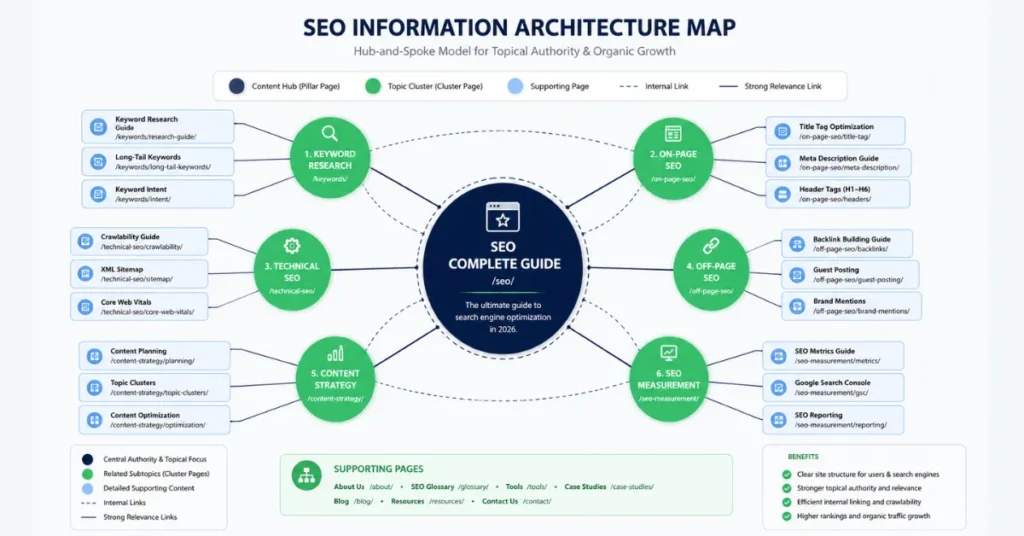
Content silo mapping is the process of assigning related topics, search intents, pages, and internal-link relationships to a deliberate website architecture.
The goal is not simply to place articles into categories. It is to determine which page should satisfy which intent, which pages belong together, and how those pages should connect.
For an SEO professional, a useful content silo map therefore has four layers:
- Core topic — the subject the site wants to establish depth around.
- Search-intent groups — distinct user needs within that subject.
- Page assignments — the URL responsible for each intent.
- Internal-link relationships — contextual connections between the pages.
This distinction matters because Google recommends a logical site structure and relevant internal links, but does not document “content siloing” itself as a ranking factor. Google specifically recommends linking important pages from relevant pages and using concise, relevant anchor text.
Google’s SEO Starter Guide on site organization
What Content Silo Mapping Actually Maps
A common mistake is to treat a silo as a folder structure:
Category → Subcategory → Article
That is only one possible representation of a site’s architecture.
A stronger silo map connects intent and relationships, not just URLs.
| Layer | Question to answer | Example |
|---|---|---|
| Core topic | What broad subject are we covering? | Content silos |
| Subtopic | What major concept belongs underneath it? | Silo architecture |
| Intent | What does the searcher want to accomplish? | Build a content silo |
| Page | Which URL should satisfy that intent? | /content-silo-guide/ |
| Supporting page | What narrower problem deserves its own page? | Internal linking in silos |
| Relationship | Which pages should connect? | Pillar ↔ supporting pages |
This is why content silo mapping is closer to information architecture than keyword grouping.
SearchEngineZine’s existing keyword research framework similarly emphasizes mapping intent and keyword clusters to clearly defined pages to reduce duplication and improve topical organization.
Content Silo Mapping vs. Keyword Mapping
The two processes overlap, but they solve different problems.
Keyword mapping asks:
Which keyword or keyword group belongs to which URL?
This is where an intent-driven keyword strategy becomes useful: it helps distinguish search demand and intent before those concepts are assigned to individual pages.
Content silo mapping asks:
How should the URLs, topics, intents, and relationships fit together?
For example, suppose the core topic is technical SEO.
A keyword map might assign:
- technical SEO →
/technical-seo/ - crawl budget →
/crawl-budget/ - robots.txt →
/robots-txt/ - XML sitemap →
/xml-sitemap/
A silo map goes further:
Technical SEO
→ Crawl & indexing
→ Robots.txt
→ XML sitemaps
→ Crawl budget
→ Rendering
Then it determines which pages should link to one another and why.
The second map describes the knowledge structure, not merely the keyword inventory.
How to Build a Content Silo Map
1. Define the Core Topic
Start with the subject that deserves concentrated coverage.
Do not begin with hundreds of keywords. Begin with the knowledge domain.
For example:
Core topic: Content Silo Mapping
Possible subtopics:
- content silo architecture
- topic clusters
- keyword-to-page mapping
- search intent mapping
- internal linking
- silo auditing
- cannibalization
- content gaps
The core topic should be narrow enough to maintain meaningful relationships but broad enough to contain multiple distinct user needs.
2. Group Queries by Search Intent
Next, separate queries that look similar but represent different tasks.
For example:
| Search need | Page role |
| What is content silo mapping? | Definition / foundational guide |
| How to build content silos | Implementation guide |
| Content silo vs topic cluster | Comparison |
| Content silo examples | Examples |
| How to map keywords to pages | Supporting guide |
| How to audit content silos | Audit guide |
The important rule is:
Do not create a new page simply because a new keyword exists.
Create a new page when the query represents a sufficiently distinct information need.
That approach reduces the risk of producing several URLs that compete for essentially the same intent.
3. Assign One Primary Job to Each URL
Every important URL should have a clearly defined job.
A practical mapping sheet can use:
| URL | Primary topic | Primary intent | Page role | Parent |
/content-silo-mapping/ | Content silo mapping | Informational | Hub | — |
/content-silo-architecture/ | Silo architecture | Informational | Cluster | Hub |
/keyword-to-content-mapping/ | Keyword mapping | Informational | Cluster | Hub |
/internal-linking/ | Internal linking | Informational | Supporting | Related |
/content-silo-audit/ | Silo auditing | Informational | Cluster | Hub |
The underlying principle is keyword-to-page mapping: each distinct intent should have a clearly defined content destination rather than being distributed across several competing URLs. This makes the architecture explicit before more content is published.
4. Map Relationships, Not Just Parents
A silo should not become an isolated box.
The strongest internal-link relationships are contextual. That is the same principle behind contextual internal linking: the relationship between the source and destination should make sense before the link is added.
For example:
Content Silo Mapping
↕
Keyword Mapping
↕
Search Intent
↕
Topic Clusters
↕
Internal Linking
A page about keyword mapping may naturally link to the silo-mapping guide because keyword-to-page assignment is one component of the larger architecture.
This relationship can be evaluated more systematically using semantic internal-link relationships rather than relying on keyword overlap alone.
Google’s documentation recommends using internal links to help people and Google understand relationships between pages, while ensuring that important pages are linked from relevant pages.
5. Separate Necessary Links From Decorative Links
Not every page needs to link to every other page.
A useful decision test is:
Would this link help the reader understand the current concept or complete the next logical task?
If yes, link it.
If the only reason is to increase the number of internal links, don’t.
This is particularly important when building large content clusters. Excessive cross-linking can turn a carefully designed architecture into an indiscriminate network.
The Most Useful Content Silo Structure
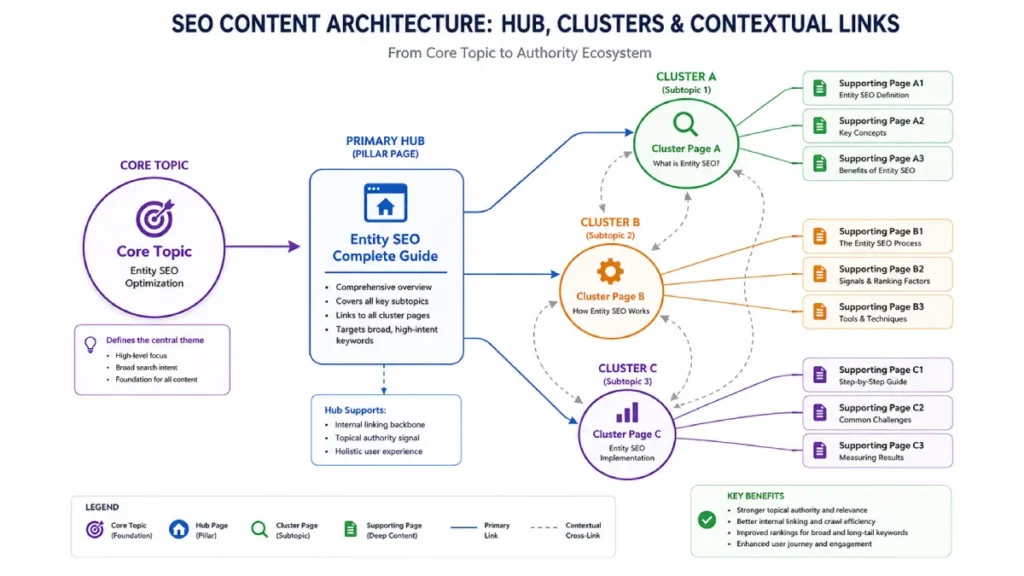
For many informational SEO sites, a practical model is:
CORE TOPIC
│
├── PRIMARY HUB
│   │
│   ├── CLUSTER PAGE A
│   │   ├── SUPPORTING PAGE
│   │   └── SUPPORTING PAGE
│   │
│   ├── CLUSTER PAGE B
│   │   ├── SUPPORTING PAGE
│   │   └── SUPPORTING PAGE
│   │
│   └── CLUSTER PAGE C
│       ├── SUPPORTING PAGE
│       └── SUPPORTING PAGE
│
└── RELATED TOPICS
    └── Contextual cross-links
The important feature is not the diagram itself. It is the hub-and-cluster architecture behind every connection.
It is the logic behind every connection.
SearchEngineZine’s existing Topic Cluster Model uses the same broad hub-and-spoke concept, while its internal-linking research emphasizes semantic relevance rather than simply matching shared keywords.
A Critical Mistake: Turning Silos Into Walls
The word silo can create the wrong mental model.
A useful SEO silo should organize related information without preventing legitimate relationships between subjects.
For example:
SEO
→ Keyword research
→ Technical SEO
→ On-page SEO
→ Internal linking
These areas are distinct, but they are not independent.
A keyword-mapping article may legitimately connect to internal linking. A technical SEO article may legitimately connect to crawlability. A topic-cluster article may legitimately connect to keyword mapping.
The objective is therefore not:
Keep every silo completely isolated.
It is:
Keep topical relationships intentional.
This distinction is also visible in the current search landscape. One supplied competitor, Topical Map AI, explicitly warns against over-compartmentalization and recommends cross-silo links where genuine topical overlap exists.
Do You Need Hierarchical URLs?
Not necessarily.
A URL such as:
/seo/content-silos/internal-linking/
can communicate hierarchy to humans, but URL folders alone do not create a content silo.
You can have perfectly structured directories with poor internal relationships, or relatively flat URLs with excellent contextual linking.
Google recommends logical, understandable URL structures, but its SEO documentation also cautions against reorganizing an existing site solely because of URL structure.
Therefore:
URL hierarchy = useful structural context
Content silo mapping = broader information architecture
Do not confuse the two.
How to Audit an Existing Content Silo
For an existing site, start with the URLs rather than immediately publishing more articles.
For every page, record:
- primary topic
- search intent
- target audience
- page purpose
- parent/hub
- supporting pages
- incoming internal links
- outgoing internal links
- potential cannibalization
- content gaps
Then look for four structural problems.
Orphaned Pages
Pages with no meaningful internal references may be disconnected from the site’s broader architecture.
Google recommends that important pages be linked from other relevant pages and states that every page you care about should have at least one internal link from another page.
Duplicate Intent
If two URLs satisfy essentially the same search need, the problem may not be insufficient content.
It may be overlapping content allocation.
Missing Parent
A group of related articles may exist without a strong overview or hub page connecting the subject.
Missing Contextual Links
The pages may technically link to one another, but the links may not explain why the relationship matters.
The solution is not necessarily more links. It is better links.
The Practical Content Silo Mapping Workflow
For an SEO professional, the workflow can be reduced to seven steps:
- Define the core topic.
- Collect related queries and concepts.
- Group them by search intent.
- Assign each distinct intent to a URL.
- Identify hub, cluster, and supporting-page relationships.
- Add contextual internal links between genuinely related pages.
- Audit for duplication, orphaning, and missing relationships.
The final map should answer one question for every important page:
Why does this page exist, and how does it fit into the site’s broader knowledge structure?
If that question cannot be answered clearly, the architecture probably needs refinement.
Final Takeaway
Content silo mapping is not simply putting articles into categories. It is the deliberate mapping of topics, search intents, URLs, page roles, and internal relationships into a coherent information architecture.
The strongest implementation combines:
- intent-based page assignment;
- clear topic boundaries;
- hub-and-cluster relationships;
- contextual internal linking;
- logical navigation;
- deliberate cross-topic connections;
- regular cannibalization and orphan-page audits.
Google’s own guidance supports the underlying principles—logical site organization, crawlable links, relevant anchor text, and meaningful internal connections—but does not establish a proprietary “content silo” system as a ranking factor.
That distinction is important. Build silos to make the site’s information easier to understand and navigate, not because the word “silo” itself is a ranking signal.