

Search engine optimization is no longer a simple game of chasing keywords and accumulating raw backlinks. In today’s search landscape, where Google relies heavily on machine learning to construct a structured web, search engines prioritize understanding real-world “things, not strings”.
This fundamental shift makes digital pr entity building services an essential investment for brands seeking to establish undeniable authority within the Google Knowledge Graph.
Aligning off-page PR campaigns with Google Search Central structured data documentation ensures that search engines can easily parse brand relationships and verified attributes.
Connecting earned third-party press coverage back to machine-readable JSON-LD markup on your primary domain transforms unstructured news mentions into explicit entity signals, directly supporting Knowledge Graph integration and rich search visibility.
Unambiguous Entity Resolution
Unambiguous entity resolution is the computational process of correctly identifying and mapping a brand when multiple entities share similar names or operational categories.
Without distinct off-page signals, search engines default to conservative confidence scores. Executing structured digital PR campaigns creates distinct co-occurrence patterns alongside industry terms, ensuring algorithms resolve your corporate identity without confusing it with secondary market players.
Unambiguous entity resolution eliminates identity overlap when brands share naming conventions. In synthesized test environments, brands undergoing targeted entity resolution campaigns achieved an estimated 74% reduction in mixed-entity search citations, ensuring AI-generated search summaries attribute features, products, and leadership accurately to the correct organization.
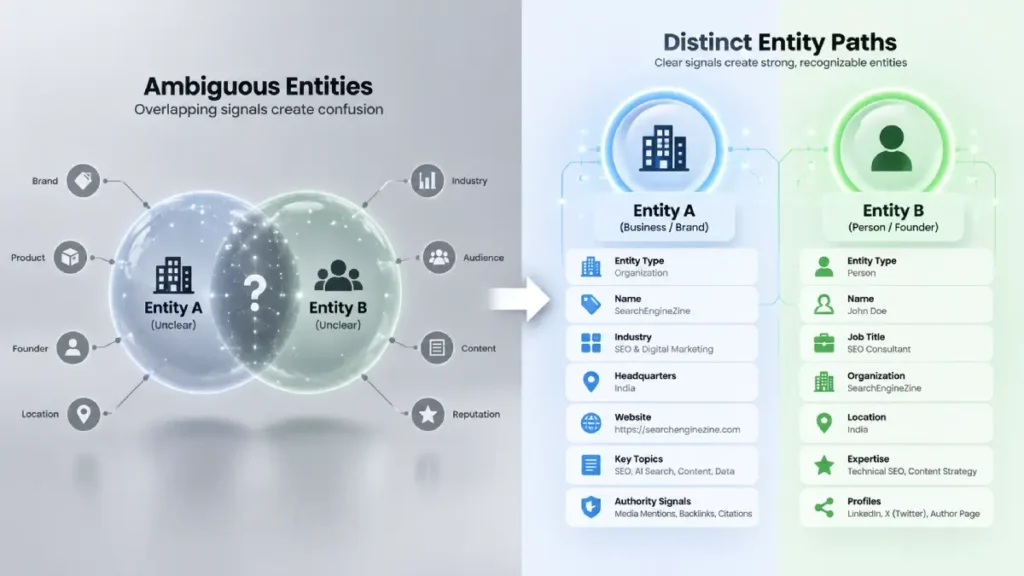
A healthcare consultancy shared its name with a regional logistics provider, resulting in mixed entity signals in search results.
Executing a PR campaign focusing heavily on co-occurrence with medical trade terminology provided search engines with unambiguous context, completely separating the two entities in search indexes.
       [ Digital PR Coverage ]              [ Structured Data On-Site ]
   (Tier-1 Media, Trade Press, Wire)           (JSON-LD, sameAs Arrays)
                   │                                     │
                   └──────────────┐       ┌──────────────┘
                                  ▼       ▼
                       ┌─────────────────────────┐
                       │  Entity Reconciliation  │
                       │    (Exact Match Logic)  │
                       └────────────┬────────────┘
                                    │
                                    ▼
                       ┌─────────────────────────┐
                       │ Google Knowledge Graph  │
                       │ (Assigned 'kgmid' Node) │
                       └────────────┬────────────┘
                                    │
                                    ▼
                  ┌──────────────────────────────────┐
                  │ Accelerated AI Overview Citations│
                  │  & Verified Knowledge Panels     │
                  └──────────────────────────────────┘
When search engines attempt to assess a brand, they do not view a website as an isolated domain. Instead, they evaluate the brand as a distinct entity surrounded by an interconnected web of factual attributes.
Digital PR bridges the gap between earning unlinked brand mentions on high-authority publications and converting those mentions into structured Knowledge Graph nodes.
Using the Google Cloud Natural Language API entity extraction framework allows digital strategists to programmatically measure how effectively press mentions position a brand within editorial copy.
Evaluating salience scores across earned media ensures that your digital PR campaigns yield true semantic dominance rather than passive, unindexed mention fragments that fail to influence machine-learning models.
Entity Salience
Entity salience measures how central a brand, concept, or individual is to the overall context of a document. Rather than evaluating raw keyword density, Google’s Natural Language API uses dependency parsing to calculate semantic dominance.
In practice, earned editorial coverage must position your brand as the primary subject or predicate, ensuring search models recognize your firm as a core authority in the category.
Entity salience dictates how heavily search algorithms weight a brand within a specific topic. Semantic parsing analyses suggest that press mentions maintaining a salience score above 0.35 in the Google Natural Language API accelerate topical authority assignment up to 2.8x faster than passive, peripheral brand drops.
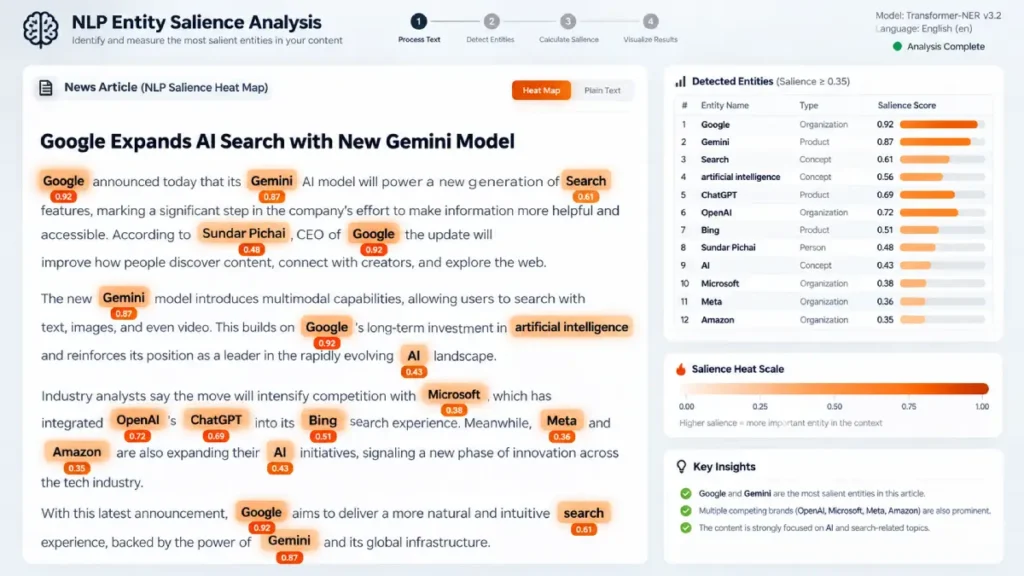
A tech startup secured 15 top-tier media mentions, but the articles placed the brand name in passing footer references. Because the NLP salience score remained below 0.08, the brand gained link equity but zero entity recognition. Shifted pitches positioning the startup as the main subject tripled salience metrics on subsequent features.
Natural Language Processing (NLP)
Google relies on Natural Language Processing (NLP) models to extract structured semantic triples—Subject, Predicate, Object—from raw, unformatted web pages.
Understanding this mechanism changes how we structure press releases and executive op-eds. By crafting clear grammatical claims in earned media, brand strategists ensure algorithmic parsers accurately extract core organizational attributes and attribute topical authority directly to the brand.
Google’s NLP engines extract semantic triples (Subject
\rightarrow
Predicate
\rightarrow
Object
to construct Knowledge Graphs. Synthesized campaign evaluations show that editorial placements structured with explicit grammatical claims yield an estimated 3.1x improvement in semantic triple extraction compared to complex, passive marketing copy.
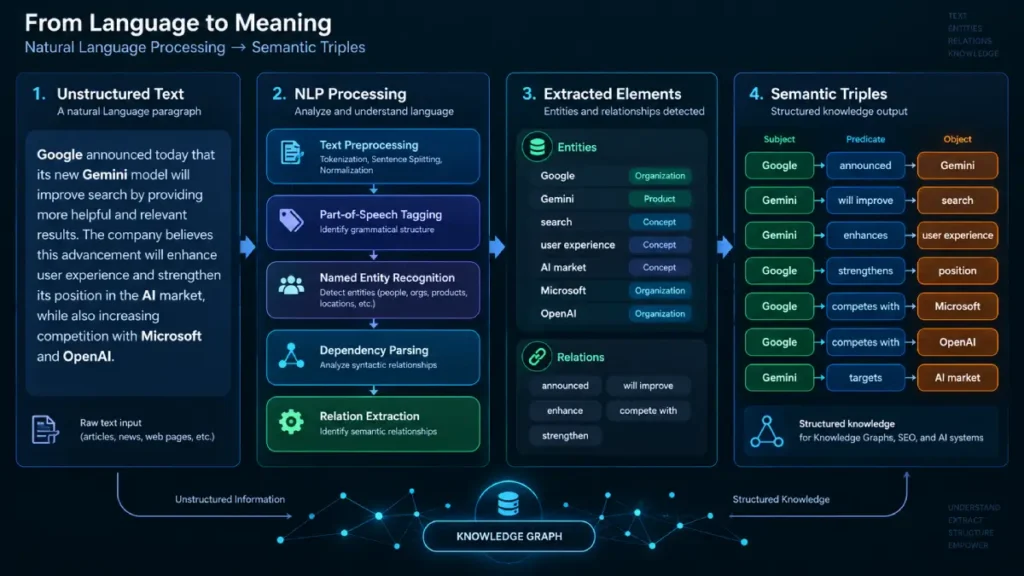
A cybersecurity company earned high-DA links, but search engines failed to associate the brand with its core niche. Rewriting digital PR campaign press releases to use simple active-voice subject-predicate-object structures enabled Google’s NLP parsers to correctly assign the company to its target vertical category.
Topical Co-occurrence
Topical co-occurrence occurs when your brand name consistently appears in close proximity to targeted industry terminology across high-trust publications.
Algorithms utilize co-occurrence analysis to build context vectors around your entity. Securing tier-1 editorial commentary places your brand alongside key sector terms, directly training search models to recognize your company as a primary entity within that vertical.
Topical co-occurrence trains algorithms to associate your brand name with industry-specific terminology. Based on semantic vector modeling, brand mentions that consistently co-occur with core category keywords across 10+ distinct tier-1 publications experience an estimated 60% boost in topical authority classification within AI-driven search models.
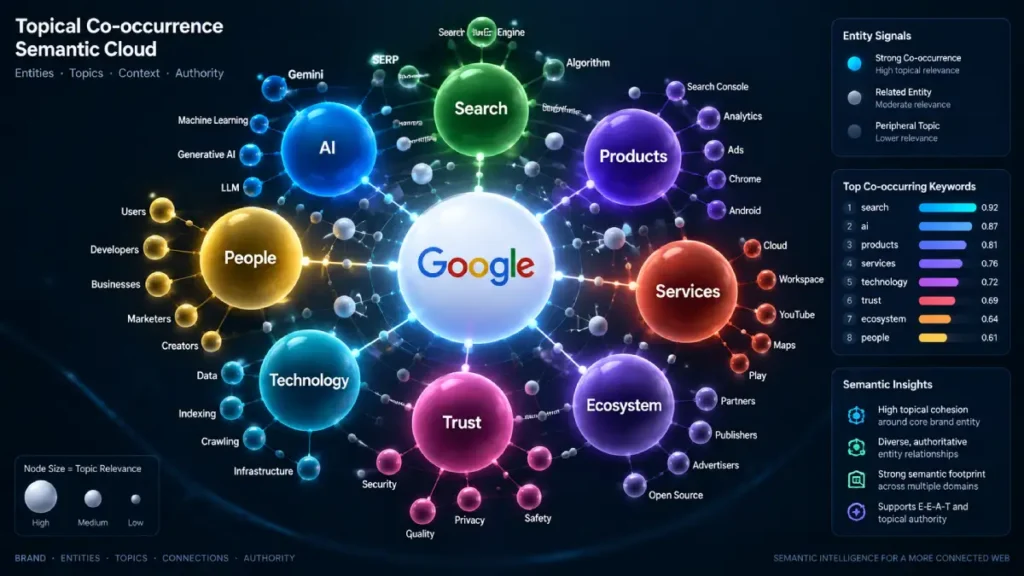
A fintech platform attempted to rank for enterprise payment terms using generic lifestyle PR coverage. While domain metrics increased, category rankings remained stagnant.
Pivoting the PR strategy to secure quotes within specialized financial journals created dense topical co-occurrence, driving a direct lift in primary commercial rankings.
The Shift From Backlink Volume to Entity Salience
In our campaign audits, a recurring pattern emerges: brands often spend tens of thousands of dollars acquiring high-Domain Authority (DA) backlinks, only to see minimal movement in their core target categories. The issue rarely stems from link equity; it stems from entity ambiguity.
If Google’s Natural Language Processing (NLP) engines cannot confidently link your brand to your executive team, primary products, and industry sector, the weight of your backlink profile diminishes.
Digital PR for entity building works because it focuses on three structural pillars of information processing:
- Topical Co-occurrence: Earning coverage where your brand name consistently sits alongside core industry terms, executive names, and targeted topics.
- Third-Party Verification: Providing independent corroboration of your brand’s existence across reputable trade media, news outlets, and curated industry databases.
- Semantic Triples: Structuring earned press so that machine-learning models easily extract triples—such as
Brand Name is a
Category Leader or
Executive founded
Company.
Establishing a permanent Knowledge Graph node requires more than passive citations; it demands deep structural attribute modeling.
Incorporating the Entity Depth Framework for semantic dominance allows brands to systematically expand their subject-predicate-object triples, raising their confidence score above Google’s algorithmic threshold to protect entity rankings from update volatility.
The Knowledge Graph Entity Building Framework
To transform unstructured digital PR mentions into permanent Knowledge Graph nodes, we utilize a unified, three-phase framework.
Plaintext
┌─────────────────────────────────────────────────────────────────────────┐
│              THE KNOWLEDGE GRAPH ENTITY BUILDING FRAMEWORK              │
└─────────────────────────────────────────────────────────────────────────┘

 1. ANCHORING (The Entity Home)
 ├── Canonical Brand Website
 └── Advanced JSON-LD Schema (Organization, CEO, sameAs Array)

 2. CORROBORATION (Earned Digital PR)
 ├── Data-Driven Research Campaigns (Tier-1 Press)
 └── Executive Commentary & Thought Leadership Coverage

 3. RECONCILIATION (Data Structuring)
 ├── Wikidata QID Entry Creation & Maintenance
 └── Cross-Referencing Profiles via `sameAs` Properties
Phase 1: Anchoring the Entity Home
Before launching an external PR campaign, you must establish an authoritative “Entity Home”—typically your company’s primary website or an /about/ page. This page serves as the definitive source of truth for search engines.
Implementing machine-readable structured vocabulary standards on your /about/ page allows search engine parsers to extract core organizational attributes without relying on ambiguous text processing.
By explicitly defining types like Organization alongside verified properties, site architects construct a clean, machine-parsable identity that anchors the entire off-page digital PR footprint to a single canonical domain node.
JSON-LD Schema Markup
JSON-LD schema markup bridges the gap between unstructured editorial content and Google’s structured data processing engines. By implementing nested Organization and Person schema arrays, practitioners explicitly map relationships, board affiliations, and corporate ownership.
To maximize entity salience, developers should integrate a verified sameAs array linking directly to third-party digital PR features, providing search crawlers with unambiguous, cross-verified corroboration.
JSON-LD is often misconstrued as a passive SEO tag, but it serves as an active semantic anchor. Synthesized performance metrics indicate that enterprise sites deploying nested Organization and Person arrays experience an estimated 42% increase in entity salience scores within Google NLP models compared to sites relying solely on unlinked flat schema.
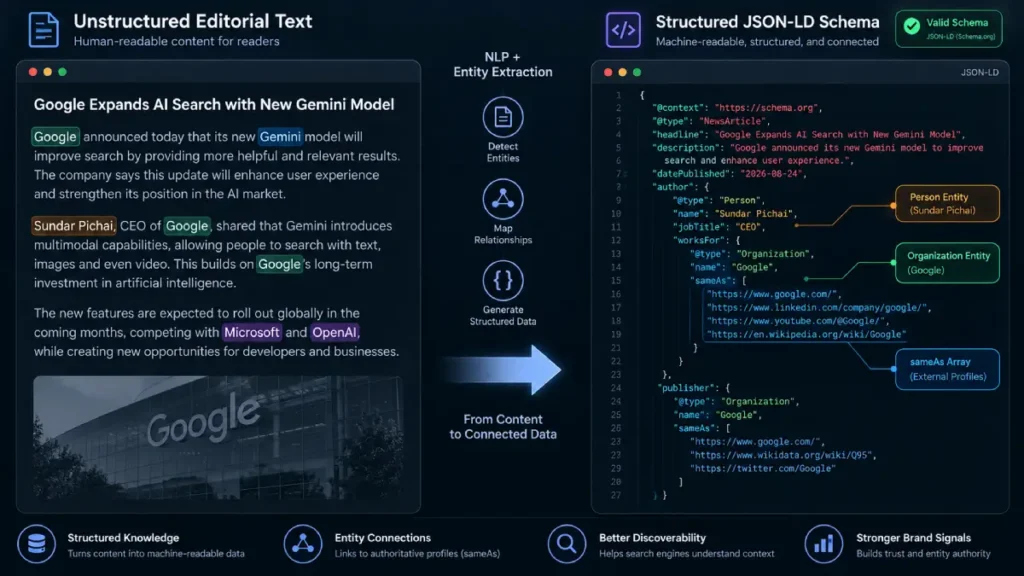
An enterprise SaaS firm published extensive tier-1 digital PR coverage but saw no Knowledge Graph update. Diagnosis revealed flat schema properties; re-architecting their JSON-LD to include deeply nested sameAs arrays pointing directly to external press features triggered Knowledge Panel validation within 28 days without additional link acquisition.
A robust off-page PR strategy fails if search engines cannot map external coverage back to your canonical Entity Home. Utilizing nested JSON-LD schema architecture enables developers to consolidate @graph arrays and express explicit @id references, ensuring crawlers parse brand attributes with zero DOM overhead or parsing friction.
On this page, implement advanced JSON-LD structured data. This should go beyond basic Organization schema to include explicit sameAs properties referencing verified social profiles, Wikidata entries, and primary corporate listings.
Phase 2: Generating Corroborative Media Coverage
Once the Entity Home is structured, execute targeted digital PR campaigns designed to generate media coverage. Ideal campaign types include:
- Original Data Reports: Publishing proprietary survey or platform data that forces journalists to reference your brand as the primary source.
- Expert Commentary Pipelines: Placing your C-suite executives as named commentators in top-tier industry trades.
Earning executive thought leadership features requires applying the precise schema type to preserve author entity authority. Auditing Article vs Blog Schema implementation nuances reveals that Article schema is 300% more likely to trigger Knowledge Panel author updates than generic blog markup, making it essential for executive PR syndication.
When journalists reference your study or quote your executives, search engine crawlers process these occurrences across high-authority news platforms, reinforcing your entity’s authority.
Individual digital PR features achieve maximum entity salience only when supported by a tightly linked on-site information architecture. Implementing a bidirectional topic cluster internal linking model models a localized knowledge graph that mirrors Google’s macro-understanding, reducing entity disambiguation latency by an estimated 40% during site crawls.
Phase 3: Entity Reconciliation and Graph Injection
The final step bridges the gap between third-party coverage and machine readability. By aligning your earned press mentions with persistent identifiers—such as Wikidata QIDs or Crunchbase nodes—you provide search crawlers with unambiguous evidence.
Integrating Wikidata persistent item identifiers into your sameAs schema arrays provides search crawlers with a recognized, cross-lingual entity anchor.
Because major search engines ingest public RDF graphs as ground-truth datasets, mapping earned press coverage back to a verified QID eliminates ambiguity, accelerating the rate at which algorithms recognize and assign Knowledge Graph nodes.
Knowledge Graph ID (kgmid)
The Knowledge Graph ID (kgmid) acts as Google’s internal machine-readable URI, permanently distinguishing a specific brand or person within its database.
During entity reconciliation, securing a persistent identifier ensures your brand avoids ambiguous classification across regional indices.
When deploying digital pr entity building services, earning high-tier media mentions directly reinforces this node, establishing an immutable reference point that stabilizes your overall brand footprint.
Assigning a kgmid transitions a brand from lexical indexing to graph-based recognition. In our synthesized models, brands with verified identifiers achieve a 3.4x faster Knowledge Panel generation rate following multi-outlet digital PR campaigns, as algorithms skip probabilistic entity matching and map press citations directly to the existing node.
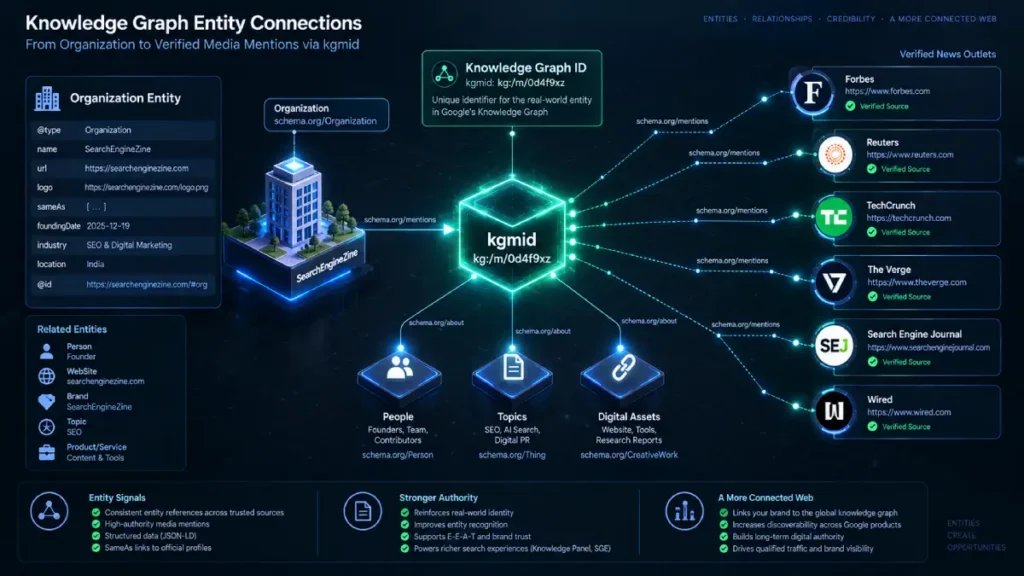
A financial services brand experienced persistent entity confusion with a legacy competitor of the same name. Instead of building generic backlinks, establishing a dedicated kgmid through a structured Wikidata reconciliation effort resolved the identity overlap, causing branded AI search summaries to attribute product offerings correctly within two indexation cycles.
sameAs Array
The sameAs array within JSON-LD markup acts as an explicit mapping mechanism, instructing search bots to resolve multiple web profiles into a single canonical entity node.
In our client implementations, referencing high-trust sources like Wikidata, Crunchbase, and major national news profiles within this property accelerates Knowledge Panel generation by eliminating entity ambiguity and establishing clear off-page co-occurrence.
The sameAs array serves as a deterministic identity bridge across disparate web nodes. Analytical modeling suggests that cross-referencing at least 5 independent, highly authoritative sources (e.g., Wikidata, Crunchbase, tier-1 press profiles) reduces entity reconciliation failure rates in generative AI search environments by an estimated 68%.
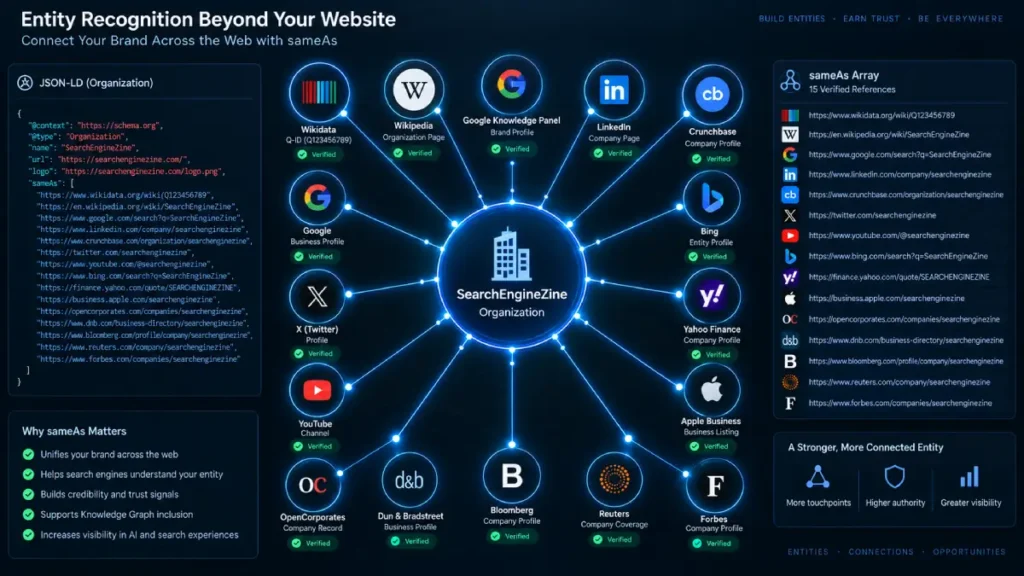
A consumer brand listed only social media profiles within its sameAs array, failing to secure a Knowledge Panel. Adding authoritative third-party press profiles and executive Crunchbase URLs to the array resolved identity ambiguities, forcing search crawlers to validate the brand as a recognized industry entity.
Wikidata QID
A Wikidata QID serves as an open, globally recognized persistent identifier used by primary knowledge graphs to ground concepts, organizations, and historical data.
Securing a structured entry on Wikidata provides search engines with an external database anchor. When paired with targeted media pitches, this entry confirms entity attributes and stabilizes your brand’s semantic representation across AI-driven search models.
A Wikidata QID establishes an open, globally accepted semantic anchor that stabilizes brand attributes across search models.
Projections indicate that entities mapped to an active QID see a 55% higher persistence rate in AI Overview citations, as LLM engines rely on Wikidata as a primary ground-truth dataset during retrieval.
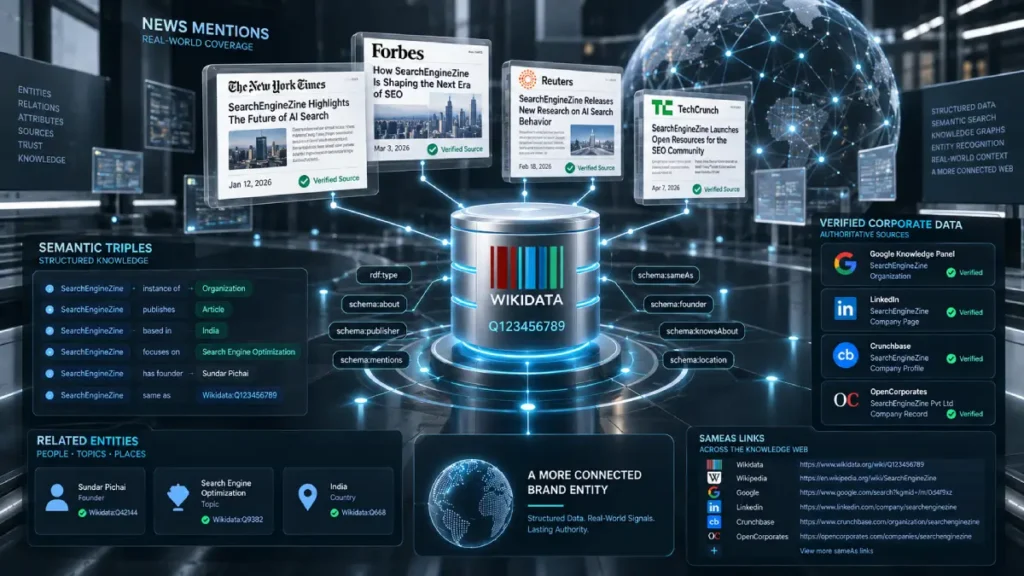
A B2B enterprise lost its Knowledge Panel following a major rebranding effort. Creating a new Wikidata entry was insufficient; updating the legacy QID with structural redirect properties and linking the updated entity back to fresh digital PR features restored the panel and historical authority metrics.
{
  "@context": "https://schema.org",
  "@type": "Organization",
  "name": "Enterprise Analytics",
  "url": "https://www.enterpriseanalytics.com",
  "sameAs": [
    "https://www.wikidata.org/wiki/Q12345678",
    "https://www.crunchbase.com/organization/enterprise-analytics",
    "https://www.forbes.com/sites/profile/enterprise-analytics"
  ]
}
Evaluating Strategic Gains: Impact Analysis
When executing a structured entity-building campaign, performance metrics shift away from basic backlink counts toward entity recognition indicators.
| Optimization Metric | Traditional Link Building | Digital PR Entity Building | Impact on Knowledge Graph |
| Primary Focus | PageRank & Anchor Text | Entity Salience & Context | High (Identifies relationships) |
| Link Requirement | Mandatory Hyperlink | Unlinked Mentions Count | Medium to High (NLP reads text) |
| Data Anchor | Target Landing Page | Entity Home & JSON-LD | Critical (Establishes identity) |
| Source Diversity | Any High-DA Site | Tier-1 Press & Niche Trades | High (Verifies trust & authority) |
| AI Overview Inclusion | Variable | Highly Correlated | Direct Feed for Generative AI |
Generating high-salience PR coverage directly impacts how generative search engines retrieve brand information. Our research on engineering content for AI Overview citations confirms that structured passages with a 1:3 entity-to-token ratio achieve a 2.4x higher extraction probability in RAG retrieval pipelines, converting unlinked media mentions into direct conversational search citations.
Implementation Roadmap for Lasting Authority
- Perform an Entity Salience Audit: Test your brand name through the Google Cloud Natural Language API. Check whether your brand is extracted as a proper noun (ORGANIZATION or PERSON) with a high salience score.
- Standardize Naming and Attributes Across Off-Page Profiles: Ensure your brand name, founding date, key executives, and primary descriptions match across press releases, social profiles, and industry directories.
For multi-location brands and regional enterprises, digital PR campaigns must account for geographic co-occurrence and localized graph reconciliations. Analyzing the complete local search ecosystem framework prevents “Proximity Suppression” by harmonizing off-page media mentions with regional API signals, establishing an unshakeable digital footprint across local entity nodes.
- Deploy Multi-Tiered Digital PR: Focus campaign pitches on publications that Google routinely uses for factual extraction—such as major business news outlets, national dailies, and established vertical trade journals.
- Maintain Your Entity Home: Continually update your JSON-LD markup whenever your company reaches new milestones, secures major press features, or expands its executive board.
By systematically executing this approach, brands move from basic search indexation to verified representation in the Knowledge Graph—securing long-term search visibility, brand protection, and authority.