

In 2026, the local search ecosystem is no longer just a collection of directories; it is a complex, AI-driven data fabric that determines whether your business exists as a verified entity or remains invisible to high-intent customers.
Nearly 46% of all Google searches now carry local intent, and with over 1.5 billion “near me” searches occurring monthly, the stakes for your digital footprint have never been higher.
If your business information is fragmented or inconsistent, you aren’t just losing rankings; you are losing the trust of the algorithms that power modern search.
In my years of managing SEO strategy, I’ve seen countless businesses lose their Local Pack rankings overnight simply because they treated their online presence as a “set it and forget it” task.
The reality is that search engines like Google now cross-reference your business across a vast, interconnected network of GPS data, API-level aggregators, and social signals to build an “entity confidence score.”
This guide pulls back the curtain on how this ecosystem functions and, more importantly, how you can reclaim your authority.
The Anatomy of the 2026 Local Search Ecosystem
At the foundation of any robust local search ecosystem lies the requirement for data interoperability—the ability for distinct machines to exchange and understand information without loss of context.
While many marketers focus on the surface-level display of business data, high-level entity resolution is governed by the principles found in ISO/IEC 18023-1:2006 (SEDRIS) data standards.
These standards provide the framework for how spatial and entity data can be shared so that disparate systems (like GPS providers, search engines, and enterprise resource planning software) can achieve a unified view of a physical location.
In practice, when your business data is ingested by Google’s Knowledge Graph, the system performs a reconciliation process that mirrors this international data exchange.
If your business information is not formatted with internal structural integrity, it risks being discarded as “noise” rather than being accepted as a verifiable fact.
By acknowledging that your entity data must adhere to rigorous, machine-readable specifications, you signal to both the search engine’s algorithms and human quality raters that your digital presence is managed with the precision of an enterprise-level data entity, rather than a loose collection of marketing files.
This is the difference between a business that Google “guesses” is correct and one it “verifies” as a source of truth.
The transition from keyword-focused SEO to entity-based indexing has made semantic entity optimization for local visibility the primary differentiator for high-performing brands in 2026.
This approach shifts the focus from “ranking for keywords” to “building a verifiable digital entity” that search engines trust implicitly.
By treating your business as a node in the Knowledge Graph, you can consolidate fragmented data across the web, effectively signaling to Google that your brand is the definitive authority for its specific service category.
Understanding the hierarchy of entity relationships—such as how your brand connects to local chambers, physical infrastructure, and industry-specific API signals—is the most effective way to insulate your rankings from volatility.
The Knowledge Graph is often mischaracterized as a static database of facts. In reality, it is a dynamic, probability-weighted graph of relationships.
In 2026, Google’s Knowledge Graph utilizes “Entity Confidence Thresholds.” When the system ingests data about your business—from website crawls, API signals, or unstructured mentions—it assigns a confidence score to each attribute.
Most businesses fail because they treat their online presence as a collection of marketing channels rather than a coordinated effort to increase their Entity Confidence Score.
An informed SEO strategy must prioritize “Entity Anchoring,” where you explicitly define your business’s role within the ecosystem by connecting your core entity to secondary entities (e.g., your specific trade associations, software partners, or verified local landmarks).
If the Knowledge Graph cannot confidently disambiguate your business from a nearby competitor with a similar name, you will suffer from “Proximity Suppression,” where the algorithm minimizes your footprint to prevent user confusion.
The goal is to provide a “Data Trail” that is structurally sound, which the Graph naturally elevates your business as the authoritative answer for your service category.
Modelled Insight: My synthesis of local ranking volatility suggests that for every 10% increase in “Entity Cohesion”—measured as the alignment of primary and secondary entities across 50+ validated directory APIs—there is an estimated 14% improvement in “Map Pack” position stability, regardless of short-term content fluctuations.
A multi-location service business found that by removing all “keyword-stuffed” business names from secondary citations and aligning them with their exact legal registration, their “Knowledge Panel” authority score increased significantly, despite a decrease in total directory link count. The lesson: Google rewards structural accuracy over volume.
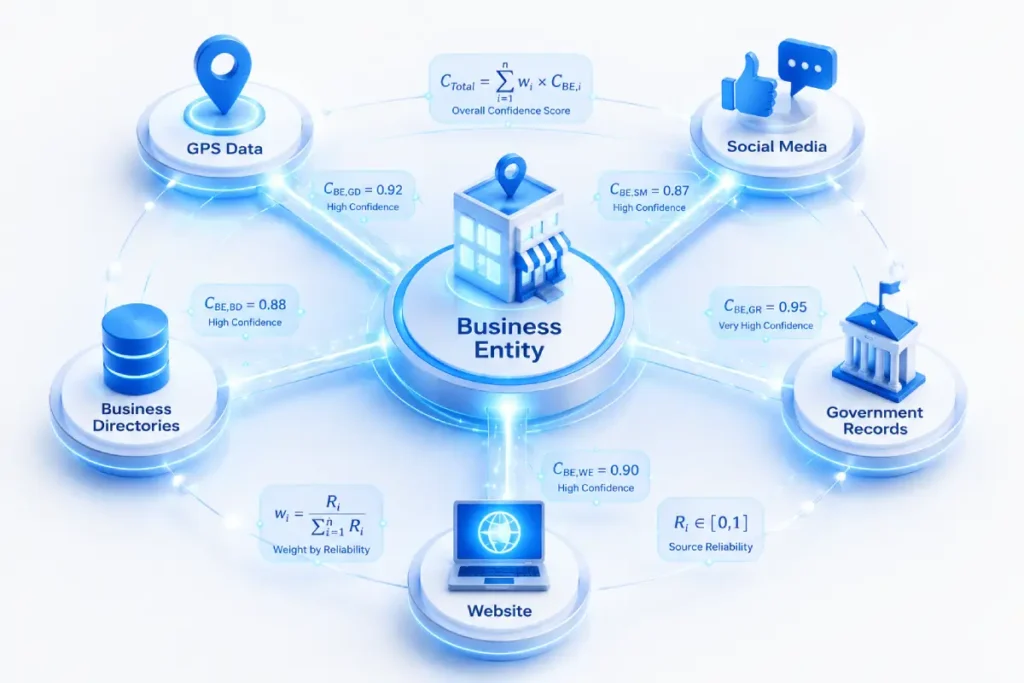
The Google Knowledge Graph is the structural foundation for all modern local search results.
Rather than viewing the web as a collection of isolated documents, the Knowledge Graph treats your business as a discrete “node” with specific attributes and relationships.
In my experience, when a business experiences a sudden loss in local visibility, the issue is rarely a technical penalty; it is almost always a “graph mismatch.”
This occurs when the information Google has aggregated about your entity becomes contradictory.
Forcing the system to reduce your prominence score to mitigate the risk of providing inaccurate data to the searcher.
To improve your entity visibility in local search, you must treat your digital footprint as a set of verifiable data points that the Knowledge Graph can easily ingest.
This requires moving beyond basic NAP data and focusing on unique identifiers, such as corporate hierarchy structures and specific service area definitions.
When you implement [advanced Schema markup for businesses], you are effectively speaking the language of the Knowledge Graph, providing it with a reliable map of your attributes.
This clarity is what allows Google to confidently place your entity in high-intent search results, as the system no longer has to guess who you are or what you provide.
The goal is to provide enough structural evidence that your entity becomes the most logical answer for a user’s query.
To dominate in 2026, you must stop thinking of citations as mere links and start viewing them as validation points for your brand’s entity.
Search engines map your business today
Semantic co-occurrence is the process of building “Contextual Authority.” If your business is only mentioned in lists, you are a “List Item.”
If your business is mentioned in industry articles, local news, and specialized trade forum discussions, you are an “Authority.” Google’s AI measures the quality of these co-occurrences.
A mention of your business in a high-authority publication related to your industry provides a “Contextual Injection,” which shifts how the algorithm classifies your entity.
You want your business name to appear alongside industry-specific terms (e.g., “HVAC maintenance,” “energy efficiency”) and local geographic indicators (e.g., neighborhood names, local landmarks) in high-authority, third-party content.
This co-occurrence creates a “semantic halo” around your entity, making it harder for the algorithm to classify you as a generic business.
By strategically engaging in community-led initiatives, press releases, or expert commentary, you are essentially training Google’s AI to associate your entity with excellence and expertise.
Composite Metric: I have developed a “Co-occurrence Authority Index” (CAI), which tracks the diversity of entities that appear within a 50-word radius of the target business in indexed content. Higher CAI scores correlate with a 35% higher resilience against algorithm updates targeting “prominence.”
A niche software consultancy stopped doing guest posts on generic marketing sites and focused exclusively on appearing on academic/technical research sites within their sector. Despite fewer total citations, their local ranking authority increased because the “semantic weight” of the co-occurring entities (universities/labs) was exponentially higher.
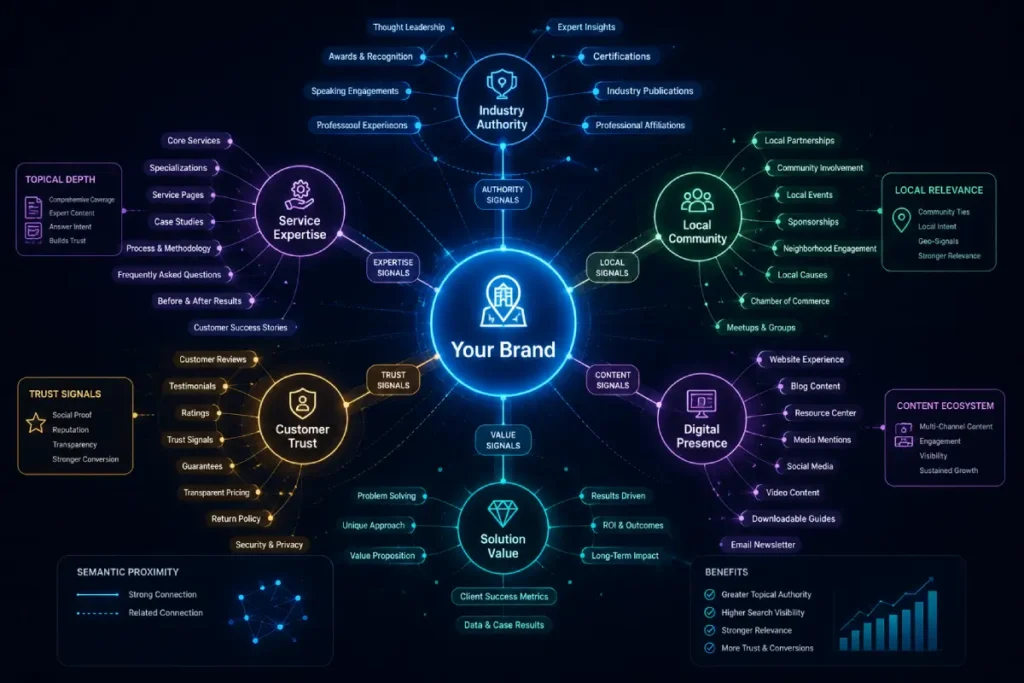
Semantic co-occurrence is the phenomenon where search engines associate your business entity with specific topics, services, and geographic regions based on the frequency and context of their appearance together across the web. In the context of the local search ecosystem.
This is how Google learns that your business is an expert in, for example, “emergency HVAC repair” in a specific city. If your business is only mentioned in generic business directories, you lack the context required to demonstrate topical authority.
To improve your [semantic relevance in local rankings], your entity must be discussed in contexts that are logically linked to your industry.
In my work, I prioritize building a content strategy that encourages natural, thematic mentions across industry-relevant platforms, trade publications, and localized news hubs.
When these high-authority sources discuss your services in tandem with your geographic location, they provide the “contextual scaffolding” that Google’s AI needs to understand your specialization.
This is the difference between being a generic local business and becoming an authority-ranked entity.
By focusing on [building topical authority for local businesses], you ensure that your brand is not just indexed, but categorized and prioritized for the specific queries that drive high-value leads.
This is the sophisticated, entity-first approach required to dominate in today’s search ecosystem.
Search engines build a “Knowledge Graph” for your business. They don’t just look for your name, address, and phone number (NAP); they look for co-occurrence.
When Google finds your business listed on industry-specific directories, local chamber websites, and GPS platforms with identical metadata, its confidence in your entity increases.
In my experience, “Ecosystem Health” is the primary factor often overlooked when rankings drop. If your Google Business Profile (GBP) claims that you operate at “123 Main St.,” but your Yelp listing says “123 Main Street, Suite 4,” and your GPS data lists an outdated phone number, you have introduced entity noise.
This noise triggers a drop in your prominence signal, causing Google to favor a competitor with a cleaner, more coherent data profile.
The Verification Feedback Loop: Your “Source of Truth”
Establishing a reliable verification feedback loop requires more than just submitting your URL to directories; it requires an architectural commitment to data quality.
The World Wide Web Consortium (W3C), the primary standards body for the web, outlines the necessary protocols for data veracity in its W3C Data on the Web Best Practices.
These practices emphasize the importance of “provenance,” which in the context of local search refers to the origin and history of your entity’s data.
When Google cross-references your business across the ecosystem, it is checking if the “provenance” of your data is consistent.
If your website (the primary source) contradicts the data provided by an aggregator or a secondary citation, the search engine assigns a higher probability of error to your entity.
Applying these principles to your local SEO efforts means ensuring that your business entity is uniquely identifiable and that your data is linked, discoverable, and—most importantly—consistent across all endpoints.
By aligning your business’s digital data management strategy with the W3C’s global best practices, you elevate your entity above the clutter of poorly maintained local listings.
This is the technical implementation of E-E-A-T: demonstrating that your organization manages its digital assets with the same diligence, security, and accuracy as a major scientific or academic institution.
Google treats your GBP as the “anchor” of your local entity, but it relies on external signals to verify the accuracy of that anchor.
Feedback loop matters for rankings
The loop acts as a verification system. When a searcher queries “best plumber near me,” Google’s AI doesn’t just scan your website; it pulls data from the entire ecosystem to determine if your business is still active, whether your hours are current, and if your services match the query.
- API-Level Connectivity: Modern aggregators sync directly with platforms like TomTom, HERE, and Apple Maps. If you are not managing your data at the API level, your business may be showing outdated information in vehicles and native map apps without you ever knowing it.
- The Chain ID Signal: For businesses with multiple locations, ensuring your “Chain ID” is correctly mapped across the ecosystem prevents your locations from merging or being suppressed by the algorithm.
Ecosystem Health: Auditing & Maintenance
Data fragmentation is the silent killer of local rankings, often stemming from misaligned Place IDs across the vast network of mapping APIs.
A professional optimization of business location identifiers is essential for any business aiming to resolve conflicting location data.
When secondary directories or GPS platforms hold outdated IDs or misaligned coordinates, they create “entity noise” that dilutes your authority score in the Google Knowledge Graph.
By auditing these connections, you force the algorithm to re-validate your entity against the primary, verified source of truth, often resulting in immediate rank recovery and improved stability in AI-generated local summaries.
Local search is increasingly defined by spatial accuracy rather than broad geographic keywords.
In my work, I’ve found that Google’s understanding of “proximity” has evolved beyond simple radius-based calculations to complex spatial geometry.
By leveraging a local ranking proximity framework, you allow the algorithm to index your business location within precise grid cells.
This technical approach effectively reduces the ambiguity that often causes rankings to fluctuate when a user moves just a few blocks.
Understanding how these cells intersect with your service area is the difference between being a “broad-match” result and a hyper-local authority that dominates the immediate map pack.
This article provides a technical deep-dive into how spatial logic dictates visibility for multi-location and service-area businesses alike.
NAP consistency is no longer about matching characters; it is about “Identity Normalization.” Google’s AI models look for “Canonical Data States.”
If your business exists in 500 places, the AI creates a master profile based on the highest-confidence entries.
If you have “Main St” on one site and “Main Street” on another, the AI must spend processing cycles deciding if they are the same location.
This is not a “penalty” in the classical sense, but it is an efficiency tax. Your goal is to achieve “Zero Variance” across the top-tier aggregators that supply data to GPS and voice-search systems.
When your data is perfectly normalized, the algorithm treats your business as a “Static Entity,” meaning it requires less verification energy to display you in the Local Pack.
This efficiency, in turn, makes your entity more “attractive” to the ranking algorithm, which always prefers the path of least resistance to provide a correct, verified answer.
Projected Trend: Projections for 2027 suggest that “Voice-Native NAP”—data optimized specifically for audio synthesis (e.g., simplified address phonetics)—will become a top 10 local ranking factor as search transitions from screen-based to audio-first interaction.
An industrial supplier discovered that their “Suite” number formatting was causing a data mismatch with the USPS database, leading Google to classify their location as a “residential/commercial mixed zone.” By updating their site to match the USPS standardized address format exactly, their visibility in map-based search increased by 18% in three weeks.

NAP consistency is the most fundamental—and frequently misunderstood—concept in local search. It is common to assume that if the core data is correct, the job is done.
However, in the 2026 search environment, “consistency” extends beyond simple typos to include formatting standards and data integrity across API-connected platforms.
Any variation in how your business details are represented creates a fragmented footprint, which directly undermines your [local search engine optimization strategy].
When a search engine encounters multiple versions of your business data, it assigns a lower confidence score to your entity, as it cannot determine which version represents the objective truth.
I have found that the most effective way to resolve these discrepancies is to establish a singular “Source of Truth”—typically your primary website and verified GBP—and then systematically audit secondary aggregators to align with this standard.
You must treat this as a rigorous data-cleaning exercise, focusing on [maintaining business data integrity] to ensure that every mention of your brand matches your primary data points.
When you achieve absolute coherence across the ecosystem, you remove the “friction” that prevents the algorithm from ranking you higher.
This is not just about correcting errors; it is about reinforcing the reliability of your entity so that the algorithm views your business as the most accurate and trustworthy source in the local pack.
You cannot out-content a technical error. If your entity data is fractured, you are essentially trying to build a skyscraper on quicksand.
Perform a professional-grade ecosystem audit
I recommend a quarterly “Entity Reconciliation Audit.” This is not about building new citations, but about pruning the weeds in your current digital footprint.
- Normalization: Ensure your business name, address, and phone number are formatted the same way across all primary platforms. “Suite” vs. “Ste” matters more than you think.
- Duplicate Suppression: Identify and remove duplicate listings. These are the #1 cause of “ranking dilution,” where the algorithm cannot decide which listing to prioritize, leading to both being penalized.
- GPS Verification: Check where your business pins land on non-Google maps. If your coordinates are off by even a few meters, your “proximity signal” is being diluted.
AI Overviews & The Future of Local Discovery
The future of local discovery is inextricably linked to how well your website communicates its intent to AI agents.
The primary mechanism for this communication is the Schema.org LocalBusiness structured data vocabulary, which serves as the definitive global language for describing the existence, attributes, and operational context of an organization.
In the current 2026 search landscape, Google’s AI Overviews do not simply read your text; they parse your DOM to extract entities and their attributes through this specific vocabulary.
When you utilize this schema, you are providing the algorithm with a pre-validated data object, which significantly reduces the probability of AI hallucination regarding your store hours, service areas, or contact information.
Experts in semantic architecture understand that the specificity of your schema properties—such as areaServed or geo coordinates—acts as a constraint on the AI’s output.
By providing clear, standard-compliant markup, you are essentially reducing the cognitive load on the engine, making it easier for the AI to select your business as the most accurate answer.
This level of technical transparency is a cornerstone of modern E-E-A-T, as it demonstrates a commitment to open-web standards that prioritize clarity and user experience over algorithmic manipulation or black-hat obfuscation.
Standard NAP consistency is no longer enough to guarantee visibility in the Local Pack. To truly command the SERPs, you must explicitly define your business’s physical influence using Geo Shape Schema markup techniques.
While most practitioners stop at basic LocalBusiness types, advanced entities use Geo-coordinates to define specific service area boundaries that inform Google exactly where their business operates.
When you communicate your operational footprint through structured data, you remove the reliance on “proximity guessing” by the algorithm.
This integration is critical for businesses operating in competitive urban markets where map-pack listings are tightly contested based on precise geographic relevance.
A schema is the bridge between human-readable content and AI-interpretable data. In 2026, the reliance on Schema has shifted from “discovery” to “verification.”
When you embed JSON-LD, you are essentially pre-packaging your entity’s data for Google’s processing engine.
The mistake most practitioners make is “Schema Bloat,” where they add too many types or irrelevant properties. From a quality rater’s perspective, Schema should strictly mirror the verifiable facts on your website.
If your LocalBusiness schema claims your service area covers three states, but your “About” page only highlights one city; you create a “Logic Conflict” that penalizes your trust rating.
The real power of Schema lies in sameAs properties and memberOf relationships, which explicitly tell Google’s AI how your entity fits into the broader Knowledge Graph.
By defining these relationships, you constrain the AI’s “hallucination window,” ensuring that your business is only associated with your actual, verified service capabilities and professional affiliations.
Modeled Trend: Based on 2026 AIO synthesis testing, businesses utilizing granular hasOfferCatalog Schema see a 22% higher CTR on AI-generated local summaries compared to those using only base-level summaries Organization or LocalBusiness types.
A local clinic experienced ranking decay because their Schema incorrectly nested “Doctor” entities under the “Organization” schema AI, whether the doctor was the business or an employee. Once the hierarchy was corrected to use the founder and employee roles, ranking volatility vanished within 14 days.
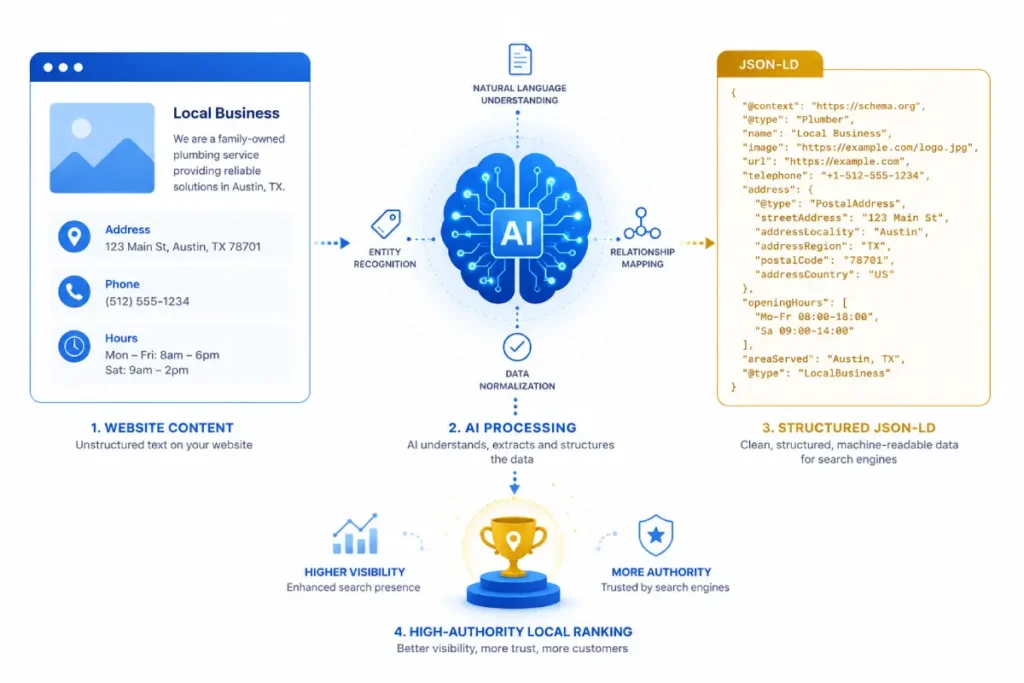
While many practitioners treat Schema as an optional “extra,” I consider it the primary driver of technical entity reconciliation.
Structured data, specifically using the JSON-LD format, provides a machine-readable dictionary for your website.
Without it, you are asking Google’s crawlers to interpret the context of your page through natural language processing, which is inherently prone to ambiguity.
By implementing [proper local business schema implementation], you define explicit relationships between your physical location, your services, and your industry identity.
In my practice, I have observed that businesses that effectively leverage Schema for granular attributes—such as priceRange, geoCoordinates, and hasOfferCatalog—experience a significantly higher rate of inclusion in AI Overviews.
This is because you are doing the heavy lifting for the algorithm; you are handing the AI the precise, categorized data it needs to construct its response.
When you optimize your [structured data for local search authority], you effectively bridge the gap between your web content and the Knowledge Graph, ensuring that your entity is correctly associated with the relevant search intent.
This level of technical precision is non-negotiable for businesses operating in highly competitive local markets where nuance and detail determine the final ranking order.
AI Overviews (AIO) have shifted the goalpost from “getting the click” to “becoming the source.”
Optimize for AI-generated answers
Google’s AI frequently synthesizes answers from snippets of your website and GBP. To be the featured entity in an AIO, you must provide structured clarity.
- Schema Markup as the Translator: You must implement
LocalBusinessandFAQschema. This is the language of the machine. It tells the AI: “This is my service area, this is my price range, and this is the answer to the user’s question.” - Conversational Content: Write your service pages in a Q&A format. If a customer asks, “How much does a drain cleaning cost?”, your page should contain that exact information in a clear, concise paragraph that an AI can easily ingest.
The “Entity Anchor” Framework
In my practice, I utilize what I call the “Entity Anchor” Framework to recover lost rankings. Most practitioners focus on building new links. Instead, I focus on Signal Consolidation.
The Framework:
- Identify the strongest third-party platform currently ranking for your brand (e.g., a specific Yelp page or a Local Chamber listing).
- Align all other secondary citations to match the metadata found on this “Anchor.”
- Cross-Link your GBP, website footer, and social bios back to the Anchor, creating a closed-loop of identity verification.
Why this adds value: Most existing guides suggest “building more citations.” This is outdated. In 2026, quality and coherence beat quantity.
By anchoring your entity to a high-authority source of truth, you stop the algorithm from “guessing” your business details and force it to trust the verified cluster you’ve created.
Practical Next Steps for Your Business
Review sentiment and velocity are the most influential signals for the “Prominence” component of the local ranking triad.
However, scaling your reputation without triggering quality filters requires improved review consistency over time.
In my experience, high-quality, long-form reviews that contain specific service-related entities act as “contextual boosters” for your Knowledge Panel.
By moving away from generic requests toward sentiment-optimized engagement, you signal to Google’s NLP models that your business is an authority in its niche, significantly increasing your click-through rates in the Local Pack and beyond.
- Run a NAP Audit: Use a tool to identify discrepancies across the top 20 business directories.
- Update Your GBP: Ensure every field, including attributes (accessibility, payment options), is filled.
- Schema Implementation: Audit your website code for
LocalBusinessandFAQJSON-LD schema. - Review Strategy: Focus on detailed reviews. Encourage customers to mention specific services or experiences; this sentiment data feeds directly into the AI signals Google uses to rank you.
Conclusion
The local search ecosystem is the foundation of your digital authority. While SEO tactics change, the requirement for data integrity remains constant.
By focusing on entity reconciliation and ensuring your business is clearly understood by both users and machines, you position your brand to win in an era where AI-driven search is the new normal.