

An E-E-A-T audit service for YMYL websites should do more than assign a numerical score to author bios, HTTPS, or contact pages. It should examine whether users can reasonably verify who created the information, why they are qualified, how claims are supported, who is accountable for the website, and whether the content could cause harm if inaccurate.
This distinction matters because YMYL (Your Money or Your Life) topics can affect people’s health, financial stability, safety, or well-being. Google explicitly identifies YMYL as a category requiring particularly careful attention to strong E-E-A-T and information quality
Google’s documentation also explains that its Search Quality Rater Guidelines can help publishers self-assess content quality, although rater assessments themselves are not direct ranking inputs
For YMYL websites, the most useful audit is therefore a trust and evidence diagnostic, not an automated checklist alone.
What an E-E-A-T Audit Service Should Cover
A professional YMYL E-E-A-T audit should investigate four connected layers.
| Audit Layer | Core Question |
|---|---|
| Content | Is the information accurate, supported, current, and appropriate for the topic’s risk level? |
| People | Can users identify the authors, reviewers, editors, and responsible organization? |
| Website | Does the site provide transparency, accountability, policies, and accessible ownership information? |
| Reputation | Is there evidence beyond the website supporting the organization’s or contributor’s credibility? |
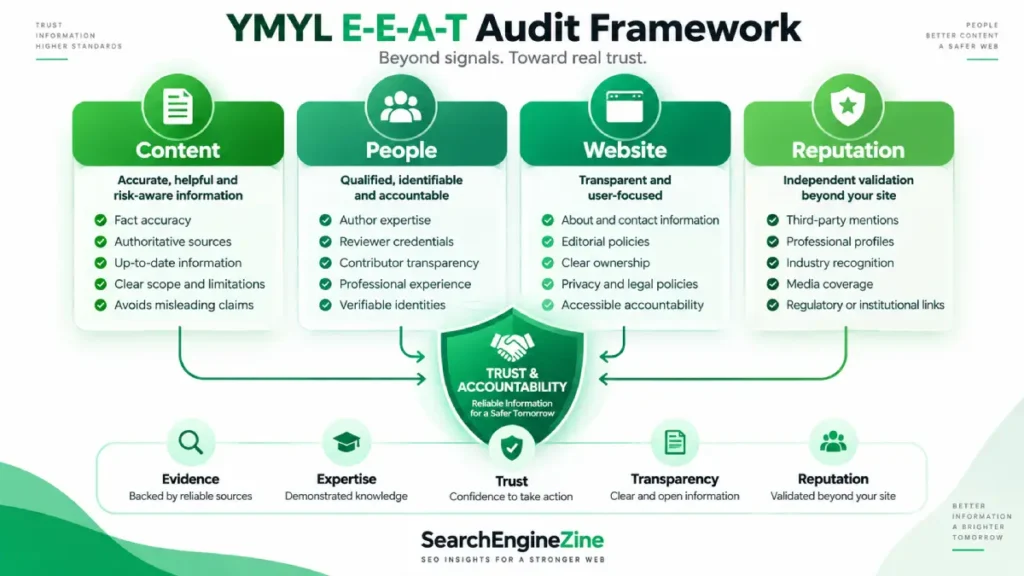
The important point is that these layers cannot be evaluated independently. A qualified author does not automatically make unsupported information trustworthy. Likewise, excellent citations cannot compensate for an anonymous organization operating a high-risk financial or medical website.
The YMYL E-E-A-T Audit Framework
1. Content Risk and Accuracy
The first question should be: what could happen if this page is wrong?
Higher-risk pages deserve deeper review. For example, a page offering general lifestyle information should not necessarily be audited using the same evidence threshold as a page recommending medical treatment, investment decisions, or legal action.
The audit should examine:
- factual claims and their supporting sources;
- use of primary or authoritative evidence;
- publication and update dates;
- outdated recommendations;
- missing qualifications or limitations;
- potentially harmful simplifications;
- separation between information and commercial persuasion.
For YMYL content, an audit should flag claims that appear authoritative but provide no clear path to verification.
2. Author and Reviewer Accountability
A visible author name alone is not a complete E-E-A-T solution, , particularly because first-hand experience and formal expertise can represent different forms of credibility
The audit should determine whether visitors can understand:
- who created the content;
- that person’s relevant qualifications or experience;
- whether specialist review was necessary;
- who reviewed high-risk information;
- whether contributor identities can be independently verified.
This is particularly important when content requires professional expertise. The appropriate evidence will vary by subject, particularly when publishers need to demonstrate genuine subject-matter experience rather than simply display credentials. A medical article, financial analysis, and legal guide may each require different levels and types of demonstrable expertise.
Google recommends considering the Who, How, and Why behind published content when evaluating whether it is people-first and reliable.
3. Editorial and Evidence Governance
This is where many automated E-E-A-T audits become superficial.
A serious audit should examine the publishing system behind the page:
- Are editorial standards publicly explained?
- Are sources checked before publication?
- Is specialist review used where appropriate?
- Are corrections possible?
- Are substantial updates recorded?
- Are conflicts of interest disclosed?
- Is sponsored or commercial content clearly distinguished?
These questions evaluate the repeatability of trust rather than simply the appearance of trust signals, particularly when organizations need to demonstrate how information quality, objectivity, and transparency are maintained which is why a documented editorial governance framework can be more meaningful than a collection of isolated trust badges.
For example, SearchEngineZine publishes an Editorial Policy describing its E-E-A-T publishing standards and editorial oversight. A YMYL organization should consider whether it can demonstrate comparable accountability appropriate to its own subject area.
4. Organizational Transparency
Users should be able to determine who is responsible for a YMYL website.
An audit should review:
- organization identity;
- About page accuracy;
- ownership transparency;
- contact mechanisms;
- customer or editorial accountability;
- privacy and legal policies;
- applicable regulatory disclosures.
The goal is not to collect every possible trust badge. The goal is to reduce uncertainty about who operates the website and who is accountable when information affects users—a principle closely related to transparency and organizational accountability. including how the organization establishes a consistent machine-readable identity across the web.
5. External Reputation and Corroboration
E-E-A-T cannot be evaluated entirely from on-page elements.
A broader audit may investigate whether relevant external evidence exists, including:
- professional profiles;
- recognized publications;
- institutional affiliations;
- independent expert references;
- legitimate media coverage;
- industry recognition;
- appropriate regulatory registrations where applicable.
This requires judgment. A new specialist organization may have limited online reputation but still demonstrate genuine expertise through identifiable credentials and transparent evidence.
Therefore, a good audit should avoid simplistic rules such as:
“More backlinks = more E-E-A-T.”
Authority and trust depend heavily on context, relevance, and verifiability.
What Automated E-E-A-T Tools Can and Cannot Do
Automated tools can be useful for identifying missing signals quickly. Current tools commonly scan for items such as author information, contact pages, policies, HTTPS, citations, and visible trust indicators.
However, automation has an important limitation: it can detect the presence of a signal more easily than its credibility.
| Automated Check | Human Audit Question |
|---|---|
| Author bio exists | Does the author actually demonstrate relevant expertise? |
| Citation exists | Does the source genuinely support the claim? |
| About page exists | Does it establish meaningful organizational accountability? |
| Content is recently updated | Was the information actually reviewed and substantively updated? |
| Expert mentioned | Can the expert relationship and credentials be verified? |
This is the main distinction between an E-E-A-T scanning tool and a professional audit service.
A Better Priority Model for YMYL Websites
Instead of treating every missing trust signal equally, prioritize findings according to potential harm.
Critical
Issues that could directly undermine user safety or informed decision-making:
- unsupported medical, legal, or financial claims;
- anonymous authors on specialist advice;
- misleading credentials;
- outdated high-risk information;
- undisclosed commercial conflicts.
High
Issues significantly reducing accountability:
- unclear organizational ownership;
- missing reviewer information;
- weak sourcing on important claims;
- inaccessible policies;
- unclear editorial responsibility.
Medium
Issues affecting trust clarity:
- incomplete author profiles;
- inconsistent publication dates;
- weak update transparency;
- missing explanatory context around sources.
Low
Presentation improvements that may improve usability but do not independently establish trust.
This risk-based approach is particularly valuable because not every E-E-A-T issue deserves the same remediation priority.
What Should a Professional E-E-A-T Audit Deliver?
A useful service should produce more than a score.
The final deliverable should ideally include:
- YMYL risk classification for the website and major content types.
- Evidence and claim analysis for high-risk pages.
- Author and reviewer accountability review.
- Editorial governance assessment.
- Organizational transparency review.
- External reputation assessment.
- Prioritized remediation roadmap.
The roadmap should distinguish between changes that improve user trust immediately and structural improvements requiring longer-term organizational work.
For example, adding an author bio is an implementation task. Establishing a credible expert-review process is an operational change. Treating both as identical “E-E-A-T fixes” creates a misleading audit.
The Most Important E-E-A-T Audit Question
The strongest question for a YMYL website is not:
“What is our E-E-A-T score?”
It is:
“Can a reasonable user independently understand why this information should be trusted before acting on it?”
That question forces an audit beyond surface-level SEO signals and toward evidence, accountability, transparency, and appropriate expertise.
For broader context on YMYL terminology, see SearchEngineZine’s definition of YMYL and why high-risk topics require stronger trust standards.
Final Thoughts
An E-E-A-T audit service for YMYL websites should not promise a ranking score or claim to measure Google’s internal algorithms.
Its real value is diagnostic.
The best audit identifies where users and search-quality evaluators may encounter uncertainty about expertise, evidence, identity, accountability, or information safety—and then prioritizes those weaknesses according to the potential consequences of being wrong.
For YMYL publishers, trust should be treated as an operating system, not a checklist.