
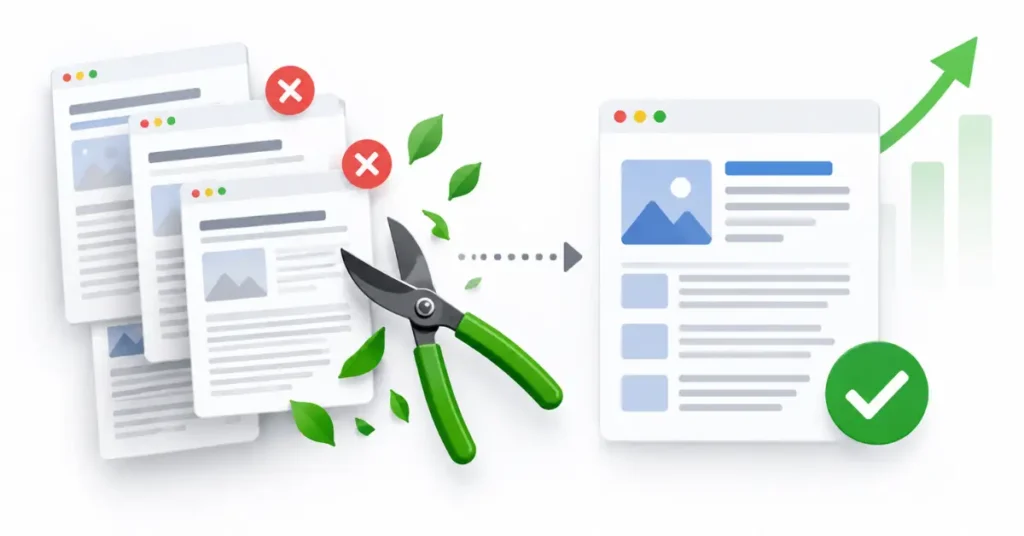
Cannibalization Pruning is the process of identifying overlapping pages that target essentially the same search intent and deciding whether to merge, update, redirect, or remove them.
However, deleting pages is not automatically the solution—the correct action depends on what each URL contributes. For keyword cannibalization, the usual sequence is:
Identify overlapping URLs → verify that the intent is genuinely the same → choose a primary page → consolidate overlapping content → redirect retired URLs when appropriate.
If a page has a distinct search intent but is simply outdated or weak, update it instead of merging it. If a page has no meaningful user value, no useful replacement, and no important signals to preserve, removing it may be appropriate.
Google describes canonicalization as a way to select a representative URL among duplicate or very similar pages, while redirects and rel="canonical" are signals rather than absolute commands to Google.
The important principle is therefore simple: prune based on evidence and intent, not because a URL is old or underperforming.
What cannibalization pruning actually means
Content pruning is the systematic review of existing URLs to decide whether each page should be:
| Decision | Use it when |
|---|---|
| Keep | The page has a distinct purpose and still satisfies users |
| Update | The page has a legitimate purpose but is outdated, incomplete, or weak |
| Consolidate | Multiple URLs substantially overlap in topic and search intent |
| Redirect | A retired URL has a clear replacement worth sending users to |
| Noindex | The page needs to remain accessible but should not appear in search |
| Remove | The page has no meaningful value and no appropriate replacement |
This is why content pruning is broader than deleting articles.
Google’s documentation says that duplicate content is common and not, by itself, a spam-policy violation. When Google encounters substantially similar pages, it clusters them and selects a canonical representative.
When does content pruning solve keyword cannibalization?
The strongest pruning case occurs when several URLs have both:
- substantial topical overlap, and
- substantially the same search intent.
For example:
/seo-content-audit//content-audit-seo//seo-content-pruning-audit/
If all three pages answer essentially the same question, maintaining three competing URLs may create unnecessary duplication.
But shared keywords alone are not enough.
Two pages can rank for many of the same queries while serving different purposes. A beginner’s guide, an implementation tutorial, and a commercial service page might share vocabulary without representing a genuine cannibalization problem.
A useful test is:
If you had to choose one URL to answer the searcher’s question completely, would the other URL still have a distinct job?
If the answer is no, consolidation becomes a strong candidate.
For broader page-to-intent planning, SearchEngineZine’s keyword intent analysis framework and content silo mapping guide provide useful supporting frameworks.
How to diagnose cannibalization before pruning
Do not begin by deleting URLs. Start with evidence.
1. Build the competing URL set
Group pages that appear to target the same topic.
Then compare:
- primary search intent
- ranking queries
- impressions
- clicks
- organic traffic
- conversions
- backlinks
- internal links
- content quality
- topical uniqueness
- historical performance
Google Search Console can help compare the queries associated with individual URLs, while SEO platforms can provide broader keyword-overlap views.
2. Inspect the actual SERP
Search the important query and examine which pages Google currently surfaces.
Look for whether:
- the same URL consistently appears;
- different URLs appear for different query variants;
- multiple pages from your site appear together;
- the SERP reveals genuinely different intents.
A keyword overlap report is a diagnostic signal, not proof of cannibalization.
3. Compare the pages by intent
Use a simple matrix:
| Question | Page A | Page B |
|---|---|---|
| Same primary topic? | Yes | Yes |
| Same search intent? | Yes | Yes |
| Same audience? | Yes | Yes |
| Unique information? | Low | Low |
| Different business purpose? | No | No |
When most of the answers indicate duplication, consolidation is easier to justify.
When the pages have distinct jobs, keep them separate and improve their differentiation.
What should you do with the overlapping pages?
Once the overlap is confirmed, choose the action based on the evidence.
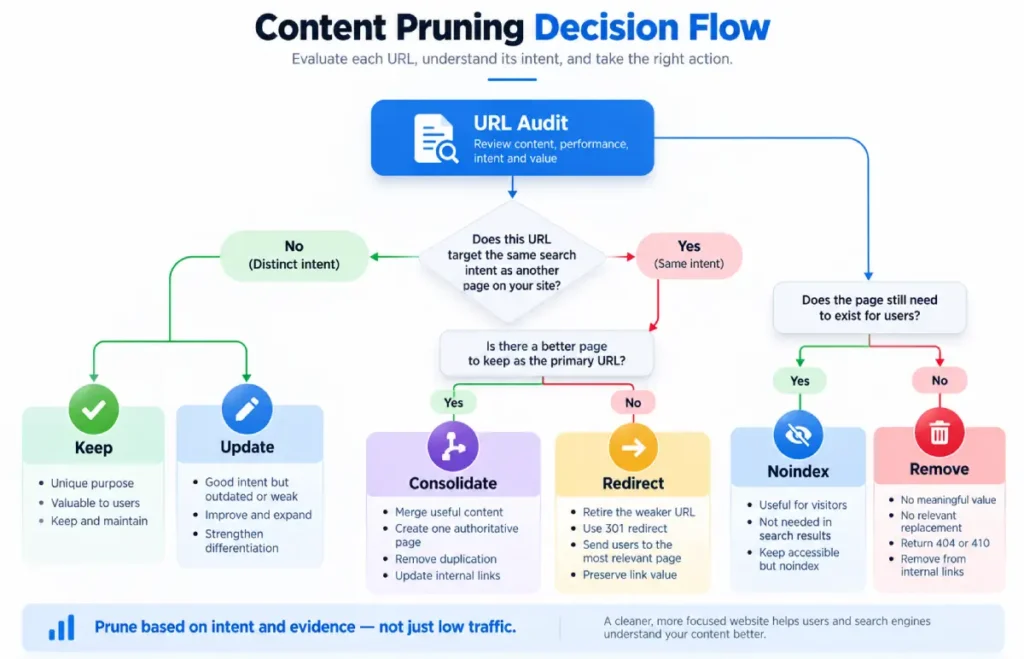
Consolidate genuinely overlapping pages
Combine the strongest information into one definitive URL.
The surviving page should contain the useful material from the retired pages rather than simply becoming a longer article.
Then:
- select the strongest URL;
- merge genuinely useful information;
- remove duplication;
- update internal links;
- redirect retired URLs when there is a clear replacement;
- monitor the consolidated URL.
Google states that redirects are a strong canonicalization signal, while rel="canonical" is also a strong signal; sitemap inclusion is weaker. Google’s guidance on canonical URLs and duplicate pages
Update pages that have a distinct purpose
Do not consolidate a page merely because it receives little traffic.
If its intent is distinct, the better response may be to:
- improve its answer;
- update outdated information;
- strengthen its unique value;
- clarify its target intent;
- improve internal linking.
This distinction is particularly important for older evergreen content. SearchEngineZine’s copy refresh lifecycle covers the broader process of evaluating and updating existing content.
Remove pages with no useful destination
If a page has no meaningful value, no important links or traffic to preserve, and no relevant replacement, removal may be appropriate.
Google recommends returning a 404 or 410 when content has been removed, and there is no replacement. If the content has moved to a clear replacement, Google recommends a permanent 301 redirect. Google’s documentation on redirects and removed pages.
Use noindex for pages that still need to exist
Some URLs remain useful to visitors but are not appropriate search results.
In those situations, noindex can prevent the page from appearing in Google Search while keeping the page accessible to users. Google notes that the crawler must be able to access the page to see the noindex directive. Google’s noindex documentation
A safer pruning decision framework
Before changing a URL, classify it using four questions:
Does it have a distinct intent?
- Yes: keep or improve it.
- No: continue.
Does another page satisfy the same intent better?
- Yes: consider consolidation.
- No: investigate further.
Does the URL have valuable signals or a useful replacement?
- Yes: consolidate or redirect as appropriate.
- No: continue.
Does the page provide meaningful value to users outside search?
- Yes: consider keeping it or using
noindex. - No: removal may be appropriate.
This avoids one of the biggest content-pruning mistakes: treating low traffic as equivalent to low value.
The critical mistake: pruning by metrics alone
A page with zero or low organic traffic is not automatically a bad page.
It may:
- support another page through internal links;
- generate conversions despite low search traffic;
- rank for valuable long-tail queries;
- contain backlinks;
- serve an important audience segment;
- support a broader topic cluster;
- be temporarily affected by seasonality.
Google’s current guidance emphasizes helpful, reliable, people-first content rather than producing pages primarily to manipulate search visibility.
That makes the real pruning question:
Does this URL still deserve to exist in the site’s information architecture?
Traffic is one input—not the decision itself.
A practical pruning workflow
For a professional SEO audit, use this sequence:
- Inventory the URLs.
- Group pages by topic and search intent.
- Identify genuine overlap.
- Compare GSC and organic-performance data.
- Check backlinks and internal links.
- Inspect the current SERP.
- Assign each URL: keep, update, consolidate, redirect, noindex, or remove.
- Merge content where consolidation is justified.
- Redirect only to a genuinely relevant replacement.
- Update internal links to the surviving URL.
- Monitor indexing and organic performance after implementation.
The important point is that the audit comes before the deletion.
Google also recommends focusing on important content when dealing with very large sites or sites containing substantial duplicate or less-important content, while providing several mechanisms for controlling what appears in Search.
The simplest rule to remember
Same keyword does not automatically mean cannibalization. Same intent + substantial overlap is the stronger signal.
When genuine cannibalization exists, consolidation can turn several competing URLs into one clearer resource. When the pages serve different needs, pruning them together can destroy useful search coverage.
So the goal of content pruning is not to make a website smaller.
The goal is to make every remaining URL earn its place.