
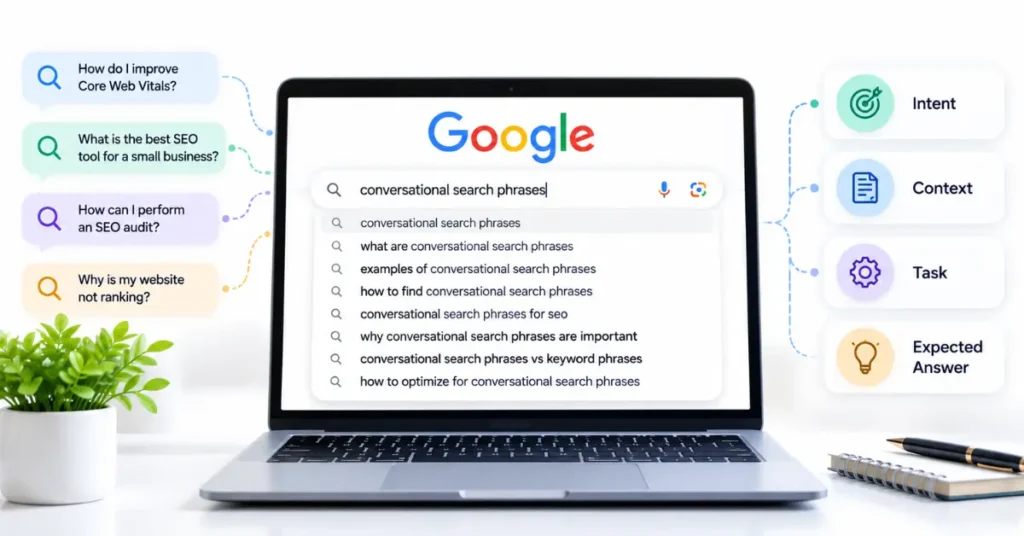
Conversational search phrases are natural-language queries that express a complete question, problem, or request rather than a short collection of keywords. Examples include “how do I improve Core Web Vitals on WordPress?” and “what is the best SEO tool for a small SaaS company?”
For SEO professionals, their value is not simply that they are longer. A conversational phrase often exposes the user’s task, context, constraints, and expected outcome more clearly than a short keyword.
That makes these phrases useful for understanding search intent, discovering long-tail opportunities, building content briefs, and identifying questions that existing keyword databases may underrepresent.
Modern search interfaces increasingly support natural-language questions and follow-up interactions. Google describes AI Mode as an experience where users can ask questions and continue with follow-ups, while current research from Adobe and other search-industry sources describes conversational search as increasingly contextual and iterative.
The practical objective, therefore, is not to insert conversational phrases into content mechanically. It is to discover the real information needs behind those phrases and build pages that satisfy them.
What Are Conversational Search Phrases?
A conversational search phrase is a search query written in the way a person would naturally ask another person for information. It generally contains more context and intent than a short collection of keywords. HubSpot’s definition of conversational queries
| Traditional keyword | Conversational search phrase |
|---|---|
| SEO audit | How do I perform an SEO audit for a SaaS website? |
| Core Web Vitals | Why is my WordPress LCP still poor after image optimization? |
| email marketing tools | Which email marketing tool is best for a small SaaS business? |
| competitor analysis | How can I analyze my competitors’ organic keywords? |
| keyword cannibalization | How do I find pages competing for the same search intent? |
The distinction is important because the conversational version usually contains additional information about intent and context.
A short query such as “keyword cannibalization” tells you the topic.
A question such as “how do I find pages competing for the same search intent?” also indicates the user’s desired task: diagnosis and resolution.
HubSpot similarly defines conversational queries as natural, everyday-language searches that tend to be more complete and context-rich than traditional keyword fragments.
Why Conversational Phrases Matter for SEO
Conversational queries can reveal information that conventional keyword research may hide.
A useful distinction is:
Keyword research asks:
“What terms are people searching?”
Conversational research asks:
“What are people actually trying to ask, solve, compare, or accomplish?”
That second question can expose:
- specific problems
- use cases
- constraints
- comparisons
- follow-up questions
- objections
- implementation requirements
- different interpretations of the same topic
This makes conversational research particularly useful when developing content around long-tail queries and complex search intent.
SearchEngineZine’s existing keyword research workflows similarly identify questions, conversational phrasing, context-rich queries, and problem-focused language as important inputs for modern keyword research.
7 Ways to Find Conversational Search Phrases
1. Mine Google Search Console
Google Search Console can reveal the actual queries that generated impressions and clicks for your site.
Look for queries containing natural-language patterns such as:
- how
- why
- what
- which
- when
- can
- should
- does
- is
- best way to
- how can I
The most useful discoveries are often not the highest-volume queries. A query receiving impressions can reveal a specific information need that your existing page is already being associated with.
This makes GSC particularly useful for discovering conversational variations from your own search audience rather than from a keyword database alone.
2. Mine People Also Ask and Related Questions
Search a broad topic and examine the questions Google presents around it.
For example, starting with:
SEO competitor analysis
may reveal questions concerning:
- how to analyze competitors
- which competitor metrics matter
- how to find competitor keywords
- how to compare ranking pages
- how to identify content gaps
These questions can become inputs to a content brief rather than automatically becoming separate articles.
The important step is to group questions by underlying intent. Several differently worded questions may represent the same user task.
3. Use Reddit and Community Discussions
Forums and community discussions can reveal how people describe problems in their own language.
The value is not simply finding keywords. It is observing:
Problem → language used → context → attempted solution → unresolved question
That sequence can expose conversational phrasing that conventional keyword tools may not surface.
SearchEngineZine’s own Reddit research methodology describes community discussions as a source for discovering the entities, modifiers, and natural language structures people use when describing real problems.
4. Analyze Search Suggestions
Autocomplete suggestions can reveal how a broad topic develops into a more specific question.
For example:
technical SEO → technical SEO for SaaS → how to do technical SEO for SaaS → how to audit technical SEO for a SaaS website
The progression is useful because it shows how a topic can move from subject → context → task.
Do not treat every suggestion as a separate keyword target. Cluster suggestions according to the information need they represent.
5. Study Customer and Sales Questions
For businesses with access to customer conversations, support tickets, sales calls, live-chat transcripts, or product feedback, these sources can be particularly valuable.
Look for repeated formulations such as:
“Can I…?”
“How do I…?”
“What’s the difference between…?”
“Which one should I use if…?”
These are often stronger content signals than artificially generating questions from a keyword list because they originate from real user problems.
6. Mine Long-Tail and Zero-Volume Queries
A conversational phrase may have little or no measurable search volume in third-party keyword databases.
That does not automatically mean it has no value.
SearchEngineZine’s research on no search volume keywords opportunities notes that conversational and question-based queries can reveal highly specific information needs that conventional SEO platforms may underrepresent.
The correct response is not to assume that every zero-volume phrase deserves its own page.
Instead, ask:
Does this phrase represent a distinct information need, or is it simply another wording of an existing intent?
That distinction prevents unnecessary content expansion and cannibalization.
7. Use Existing Queries to Build Intent Clusters
Once conversational phrases are collected, group them according to the task behind them.
For example:
| Conversational phrase | Underlying task |
|---|---|
| What is keyword cannibalization? | Understand |
| Why are two pages ranking for the same query? | Diagnose |
| How do I find cannibalizing pages? | Diagnose |
| How do I fix keyword cannibalization? | Resolve |
| Should I merge competing pages? | Decide |
These phrases are related, but they do not necessarily require five separate URLs.
Intent-based clustering helps determine whether multiple questions belong on one comprehensive page or represent genuinely different content opportunities.
SearchEngineZine’s intent-mapping work similarly emphasizes identifying the user’s goal before mapping entities, attributes, relationships, and required information to content.
How to Turn Conversational Phrases Into Content
Finding the phrases is only the first step.
A useful workflow is:
Conversational phrase → User task → Intent → Required information → Content format → URL
For example:
“How do I find pages competing for the same search intent?”
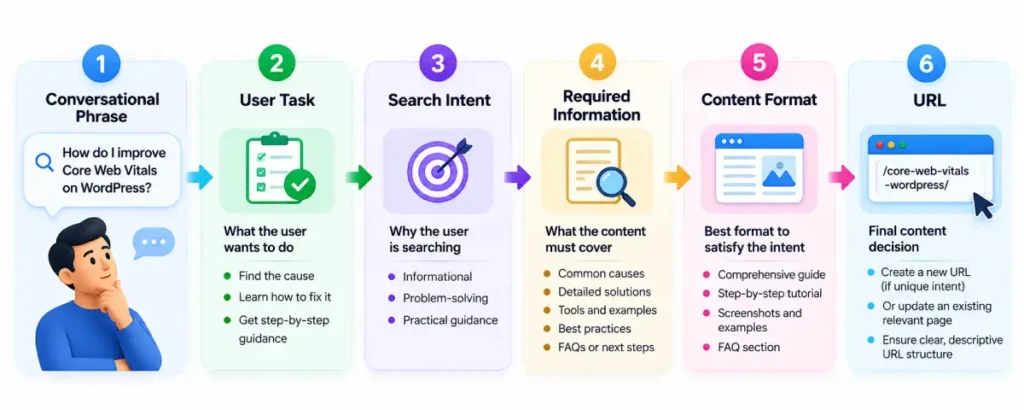
can be translated into:
- User task: diagnose competing pages
- Intent: informational + procedural
- Required information: definitions, identification method, evidence, resolution options
- Content format: practical guide
- URL: one dedicated resource if the intent is sufficiently distinct
This approach prevents the common mistake of creating content simply because a question contains a slightly different keyword.
SearchEngineZine’s recent work on search-intent cannibalization makes the same underlying distinction: different wording does not necessarily mean different search intent.
How to Write for Conversational Search
Do not turn an article into a collection of awkward questions.
Instead, use conversational phrasing where it improves clarity.
A strong structure is:
- State the answer immediately.
- Explain the relevant context.
- Address the practical task.
- Cover important variations or edge cases.
- Provide the next logical action.
For example, instead of opening a page with several paragraphs defining LCP, a page targeting:
“Why is my WordPress LCP still poor after image optimization?”
should answer that specific problem immediately and then investigate other potential causes.
Adobe’s current guidance similarly emphasizes direct answers, logical hierarchy, layered information, entity relationships, and question-led content for conversational search environments.
Conversational Search Is Not the Same as Voice Search
The two concepts overlap, but they are not identical.
Voice search describes the input method: the user speaks a query.
Conversational search describes the broader interaction: the system interprets natural-language requests, maintains context, and can support follow-up questions.
A user can therefore type a conversational query without using voice.
Conversely, a spoken query does not automatically create a conversational search experience.
Zoovu’s explanation makes a similar distinction, describing conversational search as an interactive dialogue rather than merely an alternative input mechanism.
The Most Important SEO Principle
Do not optimize a page around a conversational phrase simply because the phrase sounds natural.
Optimize around the information need represented by the phrase.
Consider these three queries:
- “what is semantic search?”
- “how does semantic search work?”
- “how do I optimize content for semantic search?”
They share vocabulary, but their tasks differ:
Definition → Explanation → Implementation
A single page may satisfy all three if the intent is sufficiently connected. Alternatively, a broader topic architecture may be appropriate if the implementation task requires substantial independent depth.
The decision should be based on intent and information requirements—not on the number of keyword variations discovered.
A Practical Conversational Search Workflow
For SEO professionals, the process can be reduced to seven steps:
1. Collect
Gather natural-language questions from GSC, SERPs, communities, customers, support data, and keyword research.
2. Normalize
Remove superficial wording differences.
3. Cluster
Group phrases according to their underlying information need.
4. Classify
Identify whether the user wants to understand, find, compare, diagnose, implement, or act.
5. Map
Assign each distinct intent to an appropriate existing or new URL.
6. Answer
Structure the page around the user’s actual task, with the direct answer near the beginning.
7. Recheck
Use performance data and new query discoveries to identify unanswered questions and content gaps.
This turns conversational search research from a keyword-collection exercise into an information-need discovery process.
Final Takeaway
Conversational search phrases are valuable because they expose more of the user’s information need than short keyword fragments often do.
For SEO professionals, the opportunity is not simply to collect longer keywords. It is to understand the questions, constraints, context, and tasks hidden inside natural-language searches.
The most effective workflow is therefore:
Discover the phrase → understand the intent → identify the required information → map the right content → answer the task directly.
As search interfaces increasingly support natural-language questions and follow-up interactions, conversational research can become an important layer of modern keyword and content strategy.
Google currently describes AI-powered Search as supporting more natural questioning and follow-up exploration, while current industry guidance emphasizes context, intent, structure, and direct answers.
The objective is not to write for a phrase. It is to write for the person asking the question.