
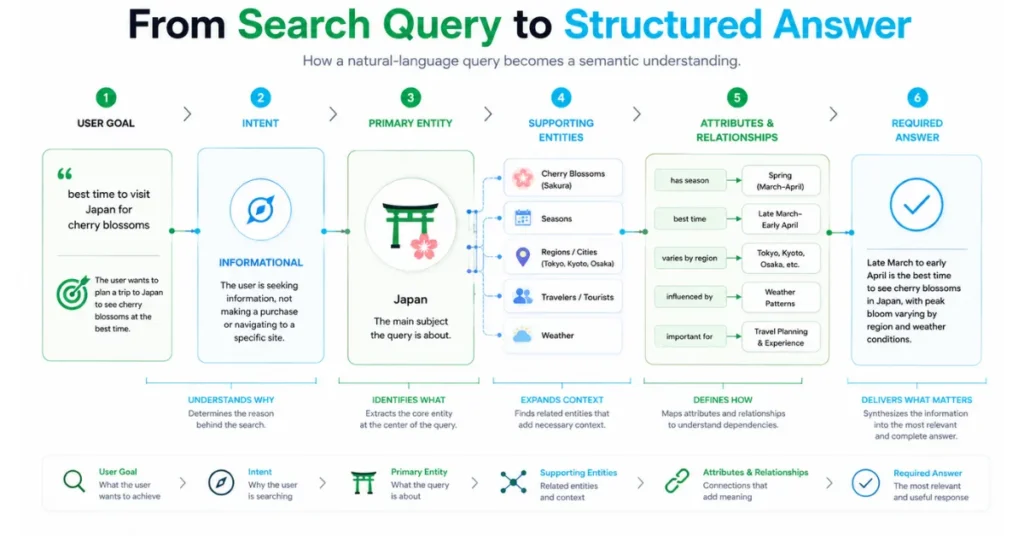
Intent Entity Mapping LLMs connects what a user wants to accomplish with the entities, attributes, and relationships relevant to that goal.
For example, in the query “best SEO software for enterprise ecommerce,” the intent is commercial investigation. The central entity is enterprise SEO software, while ecommerce, pricing, integrations, and reporting can become supporting entities or attributes.
The distinction is important:
- Intent: What does the user want to accomplish?
- Entity: What identifiable thing, concept, person, product, organization, or place is involved?
- Attribute: Which characteristic of that entity matters?
- Relationship: How are the entities connected?
Google’s Dialogflow documentation illustrates this separation in a conversational system: an intent represents an end user’s intention, while entity types define information extracted from the user’s expression.
For SEO, however, intent-entity mapping should be treated as a semantic analysis framework, not as a claim that Google has publicly documented a specific ranking algorithm called “intent entity mapping.”
What Is Intent Entity Mapping LLMs?
Intent entity mapping connects a user’s goal with the semantic objects needed to understand or fulfill that goal.
A useful model is:
Search query → User goal → Intent → Primary entity → Supporting entities → Attributes → Relationships → Required answer or action
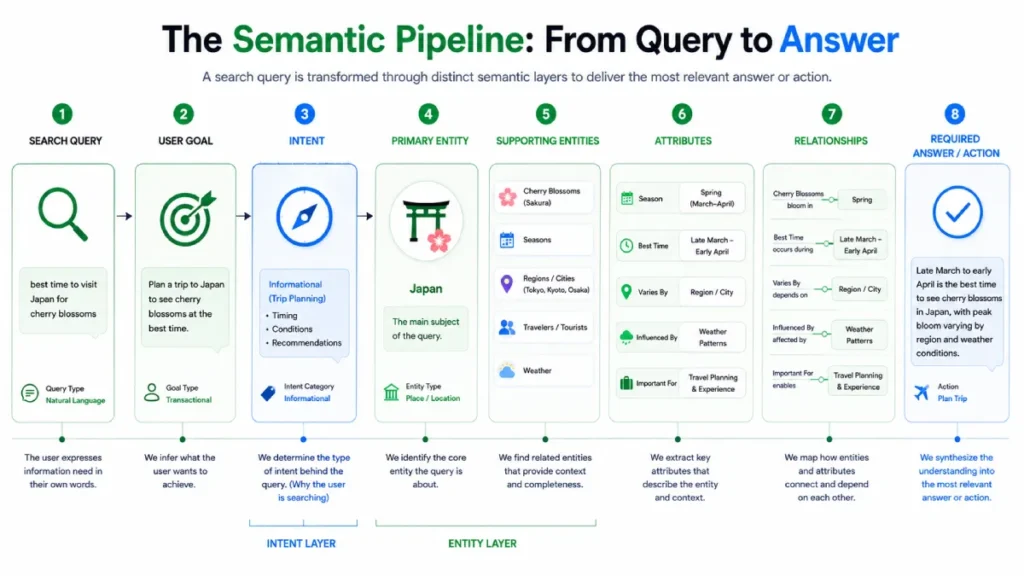
This goes beyond traditional keyword mapping.
Keyword mapping asks:
Which keyword or keyword group belongs to which URL?
Intent-entity mapping asks:
What is the user trying to accomplish, what entities are involved, and what relationships and information are necessary to satisfy that task?
For a broader treatment of intent analysis, see SearchEngineZine’s Keyword Intent Analysis framework.
Google Cloud describes semantic search as focusing on contextual meaning and intent rather than literal keyword matching alone, including relationships between words, phrases, and entities.
How LLMs Map Intent to Entities
There is no single publicly established pipeline that every LLM follows internally. Different systems use different models, prompts, retrieval mechanisms, tools, and orchestration layers.
A useful conceptual process is:
1. Interpret the query
The system processes the natural-language request and determines what the user is asking for.
Consider:
“How much does enterprise SEO software cost?”
The important signal is not simply the individual words. The query expresses an information need about pricing for a particular software category.
2. Determine the intent
The likely intent is:
Commercial investigation/pricing research
Intent classification is an established pattern in conversational systems. Google’s Dialogflow documentation describes intent as categorizing an end user’s intention for a conversation turn and matching an end-user expression to an intent.
This demonstrates the distinction between intent and extracted information, but it should not be treated as documentation of how every modern LLM internally reasons.
3. Identify relevant entities
The system can then identify semantic objects such as:
- Primary entity: enterprise SEO software
- Supporting entity: enterprise organization
- Attribute: price
- Supporting attributes: plans, users, features, limits
4. Identify relationships
The entities are not useful merely as a list.
The system also needs relationships such as:
enterprise organization → uses → SEO software
and:
SEO software → has → pricing
This relational layer turns entity extraction into contextual interpretation.
5. Determine the required answer or action
The interpreted intent and structured information can then guide the next operation.
In an application, that might mean querying a database or calling an API. Research has also explored LLM-based systems that progressively decompose high-level user intents into executable policies and map those policies to APIs.
That research concerns application management rather than web search, so it demonstrates a possible LLM-based intent-decomposition pattern, not a description of Google’s search architecture.
The key distinction is therefore:
Intent describes the goal. Entities and relationships describe the objects and information involved in fulfilling that goal.
Intent vs. Entity vs. Attribute vs. Relationship
| Concept | Question it answers | Example |
|---|---|---|
| Intent | What does the user want? | Compare SEO software |
| Primary entity | What is the central subject? | Enterprise SEO software |
| Supporting entity | What other entity matters? | Ecommerce business |
| Attribute | What characteristic matters? | Pricing, integrations |
| Relationship | How are the entities connected? | Software → serves → ecommerce business |
Google’s conversational-agent documentation provides a concrete example of this separation: intents classify user intentions, while extracted information can be used to perform the requested task.
For SEO, the practical lesson is:
Do not treat every important word as an entity, and do not treat every entity as the user’s intent.
A page can mention dozens of relevant entities and still fail to satisfy the searcher’s actual task.
Intent-to-Entity Mapping Examples
Consider three different queries:
| Query | Intent | Primary entity | Supporting entities/attributes | Required information |
|---|---|---|---|---|
| “What is crawl budget in SEO?” | Informational | Crawl budget | Googlebot, crawling, URLs, server resources | Definition + mechanism + implications |
| “Best enterprise SEO software for ecommerce” | Commercial investigation | Enterprise SEO software | Ecommerce, pricing, crawling, reporting, integrations | Comparison criteria + evidence + trade-offs |
| “How to fix slow LCP in WordPress” | Problem-solving | LCP performance | WordPress, Core Web Vitals, images, JavaScript, hosting | Diagnosis + causes + implementation steps |
Notice what changes.
The first query primarily requires understanding.
The second requires evaluation and comparison.
The third requires diagnosis and implementation.
The entities change with the task as well. That is why collecting semantically related keywords is not equivalent to mapping intent to entities.
Entity misalignment
Suppose a page targeting:
“How to fix slow LCP in WordPress”
contains extensive definitions of Core Web Vitals and LCP but provides almost nothing about diagnosing or fixing the problem.
The page may contain highly relevant entities while still being intent-misaligned.
A useful diagnostic is:
User intent → expected entities/information → actual page coverage → alignment
The objective is not to maximize the number of entities mentioned. It is to ensure that the entities support the user’s actual task.
How Intent Entity Mapping Applies to SEO
Intent-entity mapping can complement traditional keyword mapping.
A practical SEO workflow is:
1. Identify the user’s goal
Ask:
What is the searcher trying to accomplish after reading the result?
Classify the dominant task as informational, navigational, commercial investigation, transactional, problem-solving, or another appropriate category.
2. Identify the primary entity
Determine the central subject of the query.
For:
“best keyword gap analysis tools”
the primary entity is the keyword gap analysis tool category.
3. Identify supporting entities
Determine which entities are necessary to understand or evaluate the primary entity.
These might include:
- competitor domains;
- keyword databases;
- keyword gaps;
- SERPs;
- filters;
- reporting;
- pricing.
4. Identify attributes
Ask which characteristics matter to the user’s decision.
For a commercial query, these could include:
- price;
- database size;
- accuracy;
- integrations;
- workflow;
- limitations.
5. Map relationships
Do not stop at a list.
Determine relationships such as:
tool → analyzes → competitor keywords
tool → identifies → keyword gaps
tool → provides → reports
6. Translate the map into content requirements
The final step is the most important for SEO.
The entity map should tell you what the page needs to explain, compare, demonstrate, or help the reader do.
That is consistent with the broader concept of semantic search, where contextual meaning, intent, entities, and relationships can be considered rather than relying solely on literal keyword matching.
When this mapping becomes part of site architecture, SearchEngineZine’s Content Silo Mapping Strategy provides a related framework for connecting topics, pages, search intents, and internal links.
Where Intent-Entity Mapping Can Fail
Intent-entity mapping is useful, but it has limitations.
Ambiguous entities: A word or phrase can refer to different entities depending on context.
Multiple intents: A single query can contain more than one underlying task.
Implicit entities: Users do not always name every entity required to understand their request.
Context dependence: The interpretation of an expression can depend on surrounding conversational context. Dialogflow explicitly documents context as relevant to intent handling.
Model variability: Different LLMs and applications can interpret the same input differently because their models, prompts, context, tools, and surrounding systems differ.
Most importantly, do not turn this framework into an unsupported Google ranking claim.
Google Cloud’s semantic-search documentation discusses contextual meaning, intent, entities, and relationships, but that does not establish that Google Search ranks pages according to a publicly documented formula called “intent entity mapping.”
Likewise, adding more entities to a page is not, by itself, a demonstrated ranking strategy.
The goal is semantic relevance and task satisfaction—not entity density.
A Practical SearchEngineZine Intent-Entity Mapping Framework
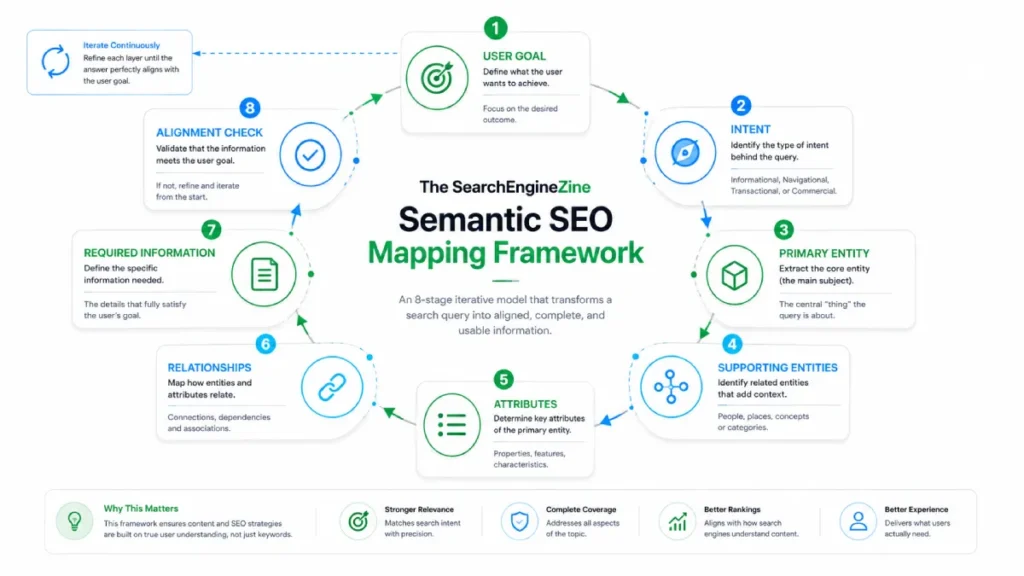
For SEO analysis, the framework can be reduced to eight steps:
- Identify the user goal — What outcome does the searcher want?
- Classify the intent — What type of task is being performed?
- Identify the primary entity — What is the central subject?
- Identify supporting entities — What other entities are necessary?
- Identify important attributes — Which characteristics affect the user’s decision or task?
- Map relationships — How do those entities and attributes connect?
- Define the required information — What must the page provide to satisfy the intent?
- Check alignment — Does the planned content actually serve that intent through the right entities and relationships?
The final check is critical.
A strong entity map is not:
More entities = better SEO.
It is:
Correct intent + relevant entities + meaningful relationships + sufficient information = stronger semantic alignment.
That is the practical distinction between entity coverage and entity usefulness.
What This Means for SEO Professionals
Intent-entity mapping should complement, not replace, search-intent analysis.
Start with the user’s goal. Then determine the entities, attributes, relationships, and information required to fulfill that goal. Use those findings to shape the page rather than forcing every related entity or keyword into the content.
For terminology reference, SearchEngineZine’s SEO Glossary Terms provides a broader reference for search and SEO concepts.
Most importantly, keep the evidence boundary clear: a useful semantic framework is not automatically evidence of how Google’s proprietary ranking systems work.
For SEO professionals, the practical value is straightforward:
Map the user’s task first. Map the entities second. Build the content around the relationship between them.