
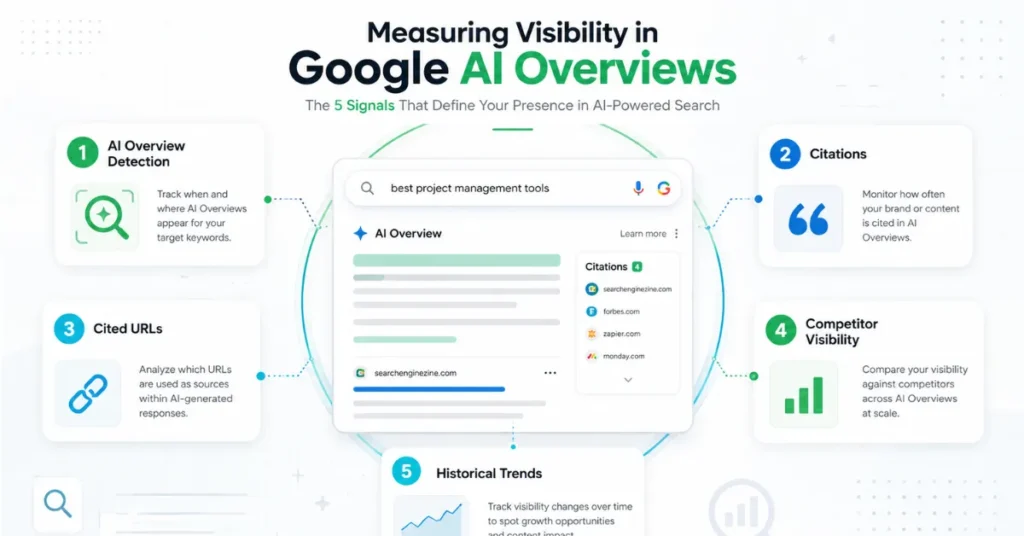
The best AI Overview tracking tools depend on what you need to measure. Semrush is a strong choice for SEO teams that want AI visibility inside an established SEO workflow, while OtterlyAI is better suited to dedicated AI search monitoring. Thruuu is particularly useful for keyword-level Google AI Overview analysis.
Before choosing a platform, check whether it can answer five questions:
- Does an AI Overview appear for the query?
- Is your site cited or used as a source?
- Which URLs appear?
- Which competitors are visible?
- How do results change over time?
That distinction matters because broader AI visibility tools are not automatically the best tools for tracking Google’s AI Overviews. Some monitor multiple AI platforms but provide less depth for Google-specific keyword and citation analysis.
Best AI Overview Tracking Tools Compared
| Tool | Best for | Google AI Overview tracking | Citation/mention analysis | Pricing context |
|---|---|---|---|---|
| Semrush | Existing SEO teams | Yes | Yes | Plan-dependent |
| OtterlyAI | Dedicated AI search monitoring | Yes | Yes | Multiple plans available |
| thruuu | Keyword-level AIO analysis | Yes | Yes | Plan-dependent |
| ZipTie | Multi-engine AI monitoring | Yes | Yes | Check current plan |
| Peec AI | Broader AI visibility analysis | Yes | Yes | Check current plan |
Software pricing, limits, and feature availability can change. Verify the current plan before purchasing.
1. Semrush: Best for Existing SEO Workflows
Semrush AI Visibility is a practical option for SEO professionals already using the platform for rank tracking, competitor research, backlinks, and technical SEO.
Its AI visibility features cover Google AI Overviews alongside other AI search environments. Semrush provides AI visibility benchmarking, competitor analysis, brand visibility data, and information about pages receiving citations, depending on the product and feature used.
The main advantage is consolidation. Teams can investigate traditional organic search and emerging AI search visibility without moving between entirely separate platforms.
Best for: SEO teams already invested in Semrush.
Main limitation: It may provide more functionality than a small website needs if AI Overview monitoring is the only objective.
2. OtterlyAI: Best Dedicated AI Search Monitoring
OtterlyAI is built specifically for monitoring brand visibility across AI-powered search environments.
Its current plans include Google AI Overviews, with regular tracking of selected search prompts. The platform also supports brand reporting and monitoring across other AI search systems.
Best for: Businesses and agencies that want a dedicated AI search monitoring workflow.
Main limitation: The usefulness of the data depends heavily on the quality of the prompts or queries selected. Tracking commercially irrelevant prompts can produce reports that look useful without informing meaningful SEO decisions.
3. thruuu: Best for Keyword-Level AI Overview Analysis
thruuu takes a strongly Google-centric approach.
It can analyze keyword lists, identify which queries trigger AI Overviews, and report brand mentions, domain citations, AI Overview presence, competitor visibility, and trends. Users can configure country, language, device, and recurring monitoring schedules.
That makes thruuu particularly relevant for SEO professionals who want to begin with an established keyword set rather than build an entirely separate list of AI prompts.
Best for: SEO professionals analyzing Google AI Overviews across larger keyword sets.
Main limitation: Users looking for a simple executive-level AI visibility dashboard may find its SERP and content-analysis orientation more detailed than necessary.
4. ZipTie: Best for Flexible Multi-Engine Monitoring
ZipTie monitors visibility across Google AI Overviews and several other AI search environments.
Its reporting model distinguishes between citations, brand mentions, and absence from AI answers, then combines signals into a broader visibility score.
This distinction can be useful because appearing in an AI-generated answer is not necessarily the same as having a page used as a supporting source.
Best for: Teams that want to compare Google AI visibility with performance across multiple AI search systems.
Main limitation: Its broader multi-platform focus may be unnecessary for websites whose only measurement priority is Google AI Overviews.
5. Peec AI: Best for Advanced AI Visibility Analysis
Peec AI is aimed at organizations treating AI search as a broader visibility channel.
Its platform monitors Google AI Overviews and Google AI Mode alongside systems such as ChatGPT, Perplexity, Gemini, and Microsoft Copilot. Its measurement capabilities include visibility, position, mentions, sentiment, competitor benchmarking, and cited sources.
Best for: Larger marketing teams with broader AI search measurement requirements.
Main limitation: It is less tightly aligned with a Google-only monitoring need than a specialist AI Overview tracker.
What to Look for in an AI Overview Tracking Tool
The word “best” is meaningless without evaluation criteria. Compare tools based on the measurement capability you actually need.
AI Overview detection
Can the tool identify which tracked queries trigger an AI Overview?
This establishes how much of your monitored search landscape is affected by Google’s generative results.
Citation and source tracking
A useful platform should distinguish between a general brand mention and a source citation where possible.
These signals answer different questions:
- Mention: Is the brand discussed in the generated answer?
- Citation or source visibility: Is a website or page presented as supporting information?
URL-level reporting
Domain-level data can hide important details.
Where available, URL-level reporting helps identify:
- which pages receive source visibility;
- which competitor pages appear;
- whether individual pages gain or lose presence.
Historical monitoring
A single scan is useful for research. Ongoing monitoring is needed to identify meaningful trends.
Competitor comparison
Monitoring becomes more actionable when you can see which competing domains appear for the same query set.”
Geographic configuration
Search results can vary by market and context. If the United States is your target market, confirm that the platform can collect data relevant to US search results rather than relying on unspecified global reporting.
Methodology transparency
Ask how frequently the platform checks queries and how it defines a citation, mention, or visibility event.
Two tools can report different numbers without either necessarily being defective.
What Should You Actually Track in AI Overviews?
A common reporting mistake is treating every AI visibility metric as interchangeable.
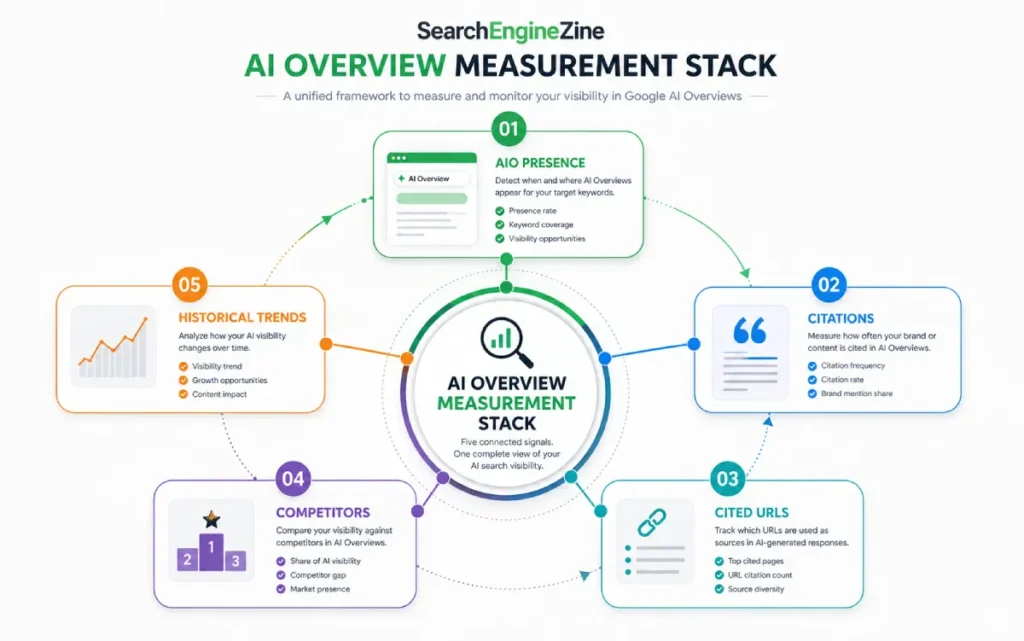
SearchEngineZine recommends separating the following measurements:
| Metric | What it tells you |
|---|---|
| AI Overview presence | How often tracked queries produce an AIO |
| Citation rate | How often your domain or URLs appear as sources |
| Cited URLs | Which individual pages receive source visibility |
| Brand mentions | How often the brand appears in generated answers |
| Competitor visibility | Which competing domains or brands appear |
| Historical trend | Whether visibility changes over time |
SearchEngineZine’s minimum measurement stack
For most SEO teams, the practical minimum is:
- Which important keywords trigger AI Overviews?
- Is your site appearing as a source?
- Which URLs are appearing?
- Which competitors appear instead?
- Is your visibility changing over time?
A platform can support many AI engines and still be a poor fit if it cannot answer these questions for the search market you care about.
Why AI Overview Tracking Data Can Differ Between Tools
Different platforms should not be expected to report identical results.
Google’s AI features do not appear for every query, and generative search experiences can vary according to query and context.
Third-party platforms can also differ because they may:
- check queries at different times;
- use different locations or configurations;
- monitor at different frequencies;
- define citations and mentions differently;
- use different collection methods.
The practical lesson is to treat third-party reports as measurement systems with specific methodologies, not as perfect replicas of every search result a user might see.
For ongoing SEO analysis, consistency can be more useful than comparing absolute numbers between several platforms. Monitoring the same meaningful query set with the same methodology makes trend analysis more interpretable.
Do You Need a Dedicated AI Overview Tracking Tool?
Not always.
You may not need a separate platform if:
- AI visibility is not yet an important KPI;
- your keyword footprint is small;
- your existing SEO platform already provides sufficient AI reporting;
- you do not need regular competitor or citation monitoring.
A dedicated tool becomes more useful when:
- AI Overview visibility is a recurring reporting KPI;
- you manage multiple websites or clients;
- you need citation-level competitive intelligence;
- you monitor a large keyword or prompt set;
- historical reporting is important.
The key is to avoid buying an AI visibility platform simply because AI search is growing. Buy one when the data will change a real SEO or content decision.
Google Search Console vs Third-Party AI Overview Tools
Google Search Console and third-party tools solve different measurement problems.
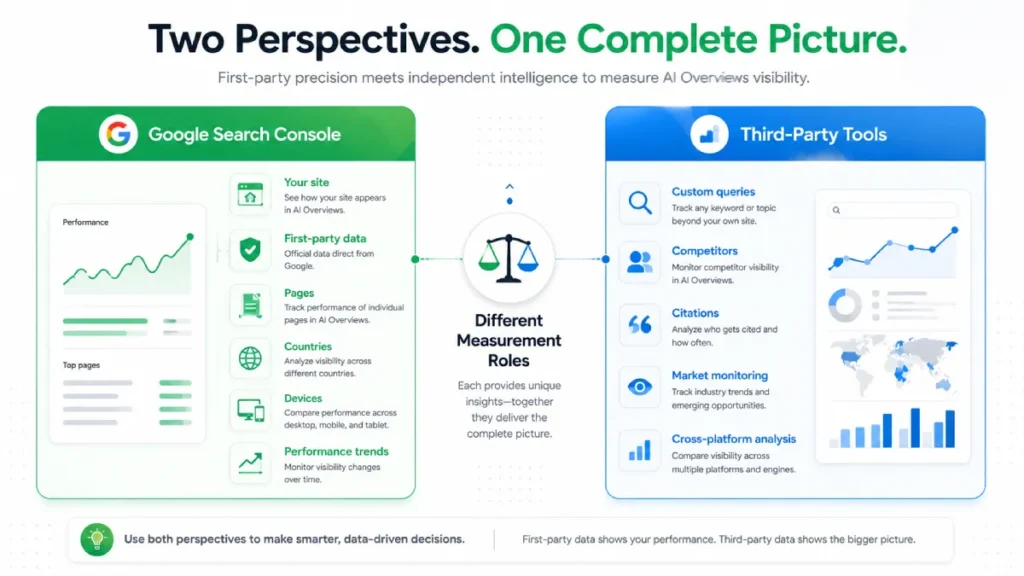
Google’s Generative AI performance report provides data about a site’s performance in Google Search generative AI features, including AI Overviews and AI Mode. The reporting can show performance across dimensions including pages, countries, devices, and time.
| Google Search Console | Third-party tracking tools |
|---|---|
| First-party Google data | Independently collected visibility data |
| Measures your verified property | Can analyze competitors |
| Reports your own performance | Can compare multiple domains |
| Country and device dimensions | Often supports selected query monitoring |
| No additional tracking vendor required | Methodology varies by provider |
For many websites, Search Console should be the measurement baseline. A third-party platform becomes valuable when you need competitor comparison, custom query monitoring, source discovery, or broader AI search intelligence.
How to Choose the Right Tool
Choose Semrush if you already use it for traditional SEO and want AI visibility integrated into the same workflow.
Choose OtterlyAI if dedicated AI search monitoring and regular prompt tracking are your priorities.
Choose thruuu if you primarily want to analyze Google AI Overviews across an established keyword set.
Choose ZipTie if comparing citations and mentions across multiple AI search environments matters.
Choose Peec AI if AI search has become a broader strategic measurement channel for your organization.
Final recommendation
Start with the measurement problem, not the software brand.
The right tool should consistently answer:
- Does this query trigger an AI Overview?
- Is my site visible as a source or citation?
- Which page is visible?
- Which competitors are visible?
- Is the trend improving or declining?
If a platform cannot answer the questions relevant to your SEO decisions, its broader AI dashboard is unlikely to compensate.