
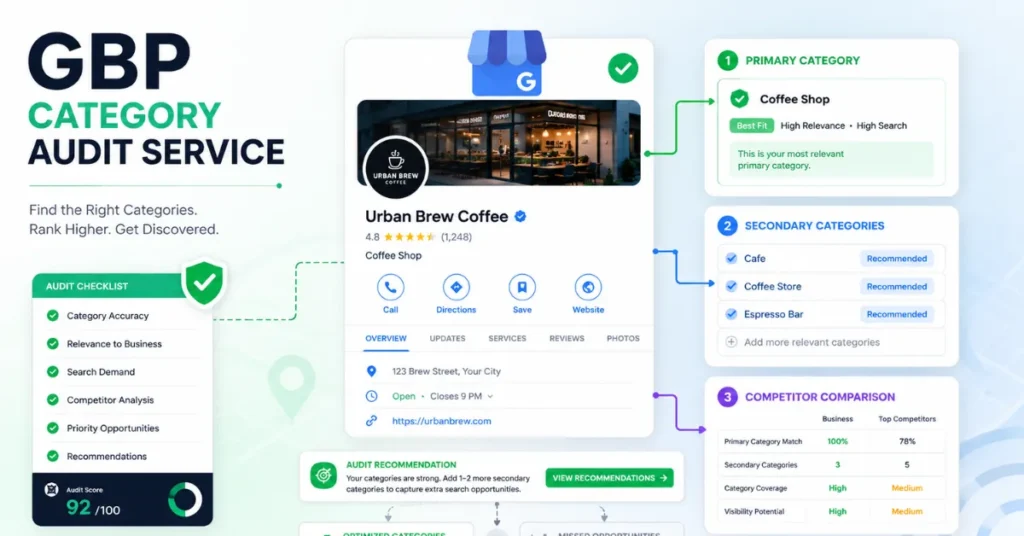
A GBP category audit service evaluates whether your Google Business Profile uses the most accurate primary and secondary categories for the business you actually operate.
A proper audit should not simply copy competitor categories or add every potentially relevant category. It should examine business identity, services, search intent, competitor patterns, and category consistency before recommending changes.
For a broader framework covering how local business entities are evaluated across Google’s ecosystem, see our guide to local entity SEO
This matters because Google says businesses should choose categories that accurately represent their core business, use as few categories as necessary, and select the most specific available category. Categories are also used to help connect businesses with relevant customer searches.
The best GBP category audit service therefore answers one central question:
Does the current category configuration accurately represent the business while supporting its visibility for commercially relevant local searches?
What Is Included in a GBP Category Audit?
A focused category audit should examine five areas.
| Audit Area | What Is Evaluated |
|---|---|
| Primary category | Whether it represents the core business accurately |
| Secondary categories | Whether they support genuine additional business activities |
| Business-to-category fit | Whether categories describe what the business is, rather than every service it offers |
| Competitor category analysis | Whether competing local businesses reveal legitimate category opportunities |
| Website alignment | Whether the website supports the business identity and services represented by the profile |
Google’s own guidance is particularly important here: categories should describe what the business is, rather than everything the business has, sells, or offers. Google also recommends choosing the fewest categories necessary to describe the overall core business.
The Primary Category Audit
The primary category deserves the deepest analysis because it defines the central business classification.
A category audit service should investigate:
- What is the business’s primary commercial activity?
- What generates the largest share of its customer demand?
- How does the business describe itself in the real world?
- Is a more specific Google category available?
- Does the current category accurately represent the business?
- Has the business changed since the category was originally selected?
The goal is not to select the category with the largest apparent search opportunity. The category must remain an accurate representation of the business.
For example, a business should not select a category merely because competitors rank for it if that category does not accurately describe its actual operation.
Google specifically advises businesses to choose a specific category when one is available rather than unnecessarily using a broad classification.
The Secondary Category Audit
Secondary categories require a different test.
The question is not:
“Which additional categories might generate more visibility?”
The better question is:
“Which additional categories accurately describe meaningful parts of this business?”
A professional audit should classify every secondary category as one of the following:
| Classification | Meaning |
|---|---|
| Keep | Clearly represents a genuine part of the business |
| Investigate | Potentially relevant but requires further validation |
| Replace | A more accurate category may exist |
| Remove | Does not accurately represent the business |
Google allows additional categories but advises against selecting categories for every product or service. The category configuration should describe the business holistically rather than function as a list of everything it sells or offers.
Competitor Category Analysis: Useful, But Not a Copying Exercise
Competitor analysis is one of the most useful parts of a GBP category audit.
Tools such as GMB Everywhere allow users to inspect categories and compare category configurations among local competitors. Its current feature set also includes category analysis within broader competitor comparisons.
However, competitor categories should be treated as research evidence—not recommendations by default.
A useful audit compares:
- The client’s current primary category.
- Categories used by consistently visible competitors.
- Categories shared across multiple relevant competitors.
- Categories that accurately describe the client’s business.
- Categories that competitors use but would be inappropriate for the client.
This distinction is critical.
A competitor may rank well while using categories that would misrepresent another business. Copying its configuration blindly creates a category strategy based on imitation rather than business accuracy. The same principle applies when evaluating broader local search competition and local ranking factors
The Missing Layer: Category-to-Website Alignment
Many category audits stop inside the Google Business Profile.
That is incomplete.
A stronger audit also checks whether the business website supports the same commercial identity.
For example:
- Does the primary category align with the site’s main positioning?
- Are important secondary business activities represented on relevant pages?
- Does the website clearly explain the services associated with the business?
- Is there a contradiction between the GBP and the company’s actual website?
Google states that category information can also be detected from a business’s website and mentions of the business elsewhere on the web.
This does not mean creating a service page automatically justifies adding a category. Instead, category selection and website content should represent the same underlying business reality. This broader consistency process is also important when managing local business data across the web
A Practical GBP Category Audit Framework
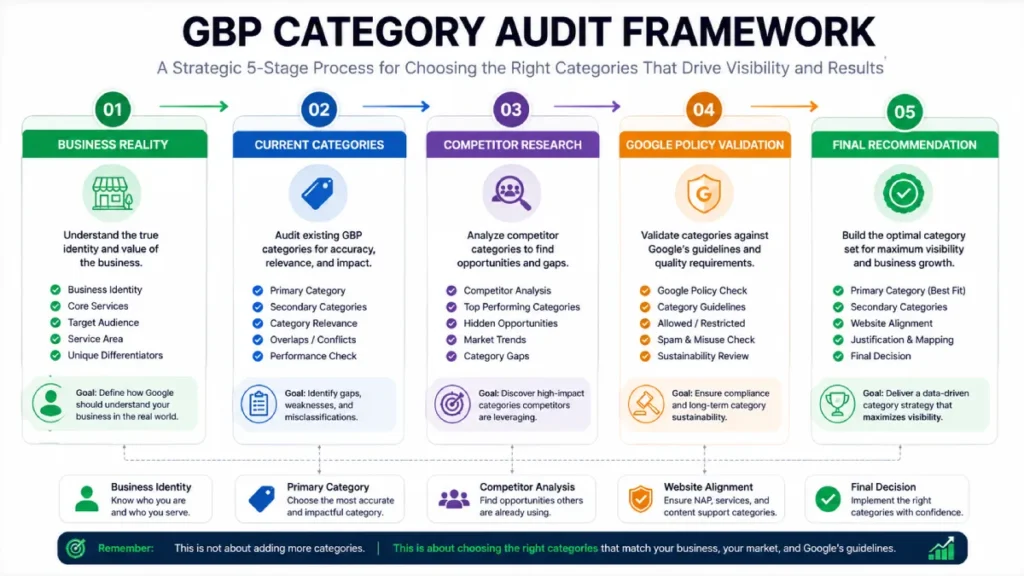
A useful category audit can follow this five-step sequence.
Step 1: Define the Actual Business Identity
Document:
- Core business type
- Primary revenue activity
- Main customer need
- Physical or service-area business model
- Legitimate additional business activities
Step 2: Audit the Existing Category Stack
Review the current:
- Primary category
- Secondary categories
- Potentially outdated categories
- Overlapping categories
- Categories that describe services rather than the business itself
Step 3: Research Relevant Local Competitors
Compare category configurations among businesses competing for the same local customer demand.
Look for patterns—but do not assume every competitor category is appropriate.
Step 4: Validate Against Google’s Category Rules
Every proposed category should pass three tests:
- Is it available in Google Business Profile?
- Is it specific?
- Does it accurately describe what the business is?
Step 5: Produce a Change Recommendation
The final report should clearly separate:
- Categories to keep
- Categories to remove
- Categories to investigate
- Categories recommended for testing or implementation
- Changes requiring business-owner confirmation
What a Professional GBP Category Audit Service Deliverable Should Look Like
A useful service deliverable should be more than a list of categories.
It should include:
| Deliverable | Purpose |
|---|---|
| Current category inventory | Establish the starting configuration |
| Primary category assessment | Evaluate core business relevance |
| Secondary category review | Identify unnecessary or missing classifications |
| Competitor comparison | Surface legitimate category differences |
| Website alignment review | Check business identity consistency |
| Priority recommendations | Identify the highest-confidence actions |
| Risk notes | Flag categories that may misrepresent the business |
The most valuable outcome is not simply “add these categories.”
It is a defensible category decision process that explains why each category should remain, change, or be rejected.
When Should You Order a GBP Category Audit?
A category audit is particularly useful when:
- A business has changed its services or business model.
- Local visibility has declined.
- The profile was created years ago and has never been reviewed.
- An agency is onboarding a new local SEO client.
- Competitors appear consistently for relevant searches.
- The business has accumulated numerous secondary categories over time.
- The website and GBP appear to describe the business differently.
It is also useful before making large-scale profile changes. Category changes should be deliberate because Google may require reverification after certain category edits.
The Bottom Line
A GBP category audit service should not be sold as a simple exercise in finding more categories.
The real value comes from determining whether Google Business Profile categories accurately represent the business, identifying legitimate classification gaps, comparing relevant competitors, and checking whether the website and profile communicate a consistent commercial identity.
The strongest recommendation is usually the one supported by both Google’s category guidance and the real-world business—not the one with the longest list of possible categories.