
What is link equity distribution?
Link equity distribution is the structural mechanism by which PageRank, algorithmic trust, and ranking authority flow from a source page to its target URLs via hyperlinks.
For modern search engines, this distribution determines the relative value, crawl priority, and likelihood of indexing for every page within your site’s architecture.
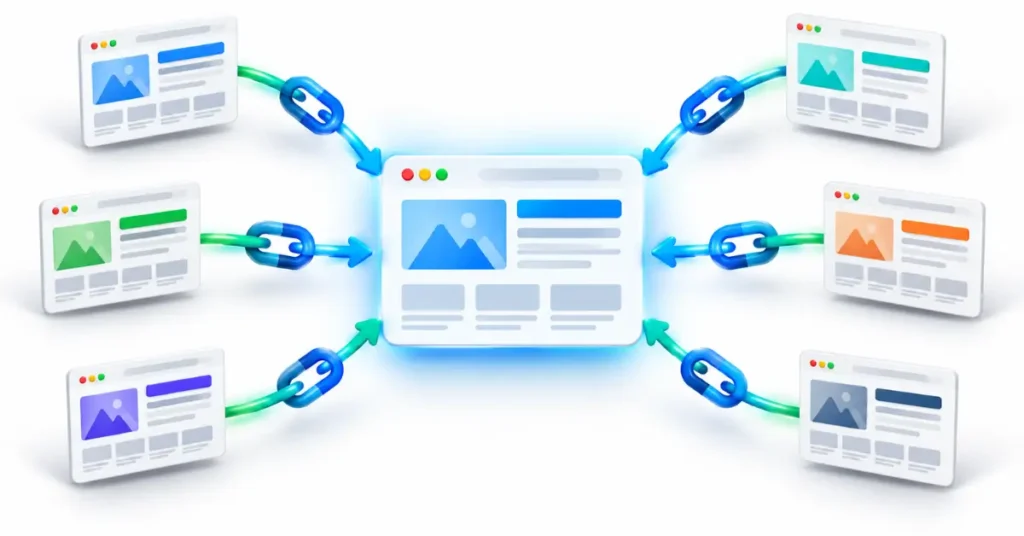
When an authoritative external domain links to your website, that acquired equity does not remain stagnant on the receiving page. Instead, it is divided and passed along through your internal linking architecture to other pages.
Efficient link equity distribution ensures that high-priority commercial and conversion pages receive enough “link juice” to compete in the SERPs, while poor distribution creates orphan pages, dilutes ranking signals, and wastes acquired authority on low-value URLs.
The Mechanics of Modern PageRank Flow
Historically, SEO professionals viewed link equity purely as a numbers game. A link was a vote, and pages with the most votes ranked highest.
Today, the distribution of link equity operates on a highly nuanced, algorithmic model that calculates trust, relevance, and user intent simultaneously.
Every outbound link on a given page acts as a conduit. When a page has accumulated external authority, it distributes a fraction of that authority to every internal and external page it links to.
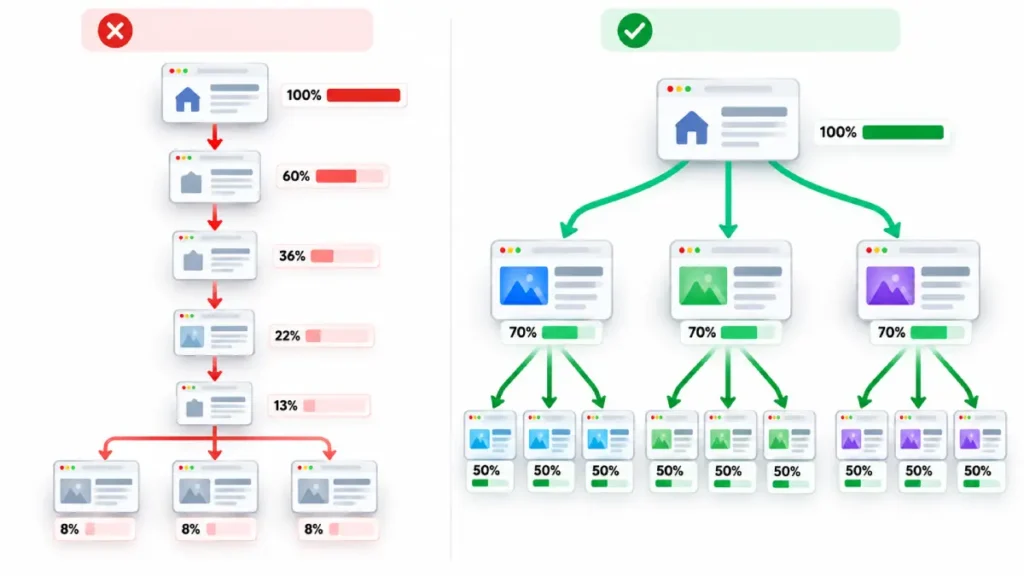
The foundational PageRank formula includes a “damping factor” (historically estimated at 0.85), meaning a small percentage of equity is lost at each hop.
Consequently, a page three clicks away from an authoritative homepage receives exponentially less equity than a page linked directly from the root.
However, Google’s systems no longer treat all links on a page equally. A modern link equity strategy must account for how search engines evaluate the position, context, and semantic relevance of a link before passing authority.
4 Factors That Dictate Equity Allocation
To control how ranking power moves through your site, SEO professionals must understand the variables that determine equity transfer volume.
1. Semantic Relevance and Topic Alignment
Algorithmic trust degrades quickly when equity flows between unrelated topics. Modern link equity is highly contextual. A link passing from a page about “enterprise server migration” to a page about “cloud security protocols” will transfer maximum equity because the topical overlap is strong.
Conversely, passing equity from that same server page to an irrelevant lifestyle blog post will severely restrict the value transferred. Search engines use natural language processing to ensure that authority is primarily distributed among contextually grouped content.
2. Anchor Text and Vector Modeling
Anchor text acts as the routing instruction for link equity. It tells the search engine exactly what the destination page is about, contextualizing the transferred authority.
Utilizing descriptive, varied, and exact-match anchors helps solidify the target page’s relevance for specific queries. By applying advanced anchor text vector modeling, enterprise SEOs can mathematically align the semantic signals of their internal links with their core target keywords, ensuring equity isn’t just passed, but optimized for intent.
3. Link Placement and Prominence
Location matters. Links embedded high within the main body content of a page carry significantly more weight than links buried in global navigation, sidebars, or footers.
The reasonable surfer model suggests that search engines assign more value to links that users are actually likely to click. Consequently, forced contextual links hidden at the bottom of a 3,000-word article transfer less equity than a prominent, highly relevant link in the introductory paragraphs.
4. Outbound Link Volume (The Dilution Effect)
Because a page has a finite amount of authority to pass, the number of outbound links dictates the share each target receives. If a hub page has 15 highly targeted internal links, each destination page receives a robust share of equity. If that same page has 150 internal links, the equity is fragmented into negligible micro-shares.
How to Architect Efficient Equity Distribution
You cannot always control how external domains link to your site, but you have absolute control over your internal distribution architecture. Mastering this phase of SEO requires moving from reactive link acquisition to proactive equity routing.
Identifying Link Sinks and Dilution
A “link sink” is a page that absorbs a massive amount of internal equity but provides no commercial value, organic traffic potential, or onward distribution. Common examples include paginated blog feeds, outdated terms of service pages, and low-value tag archives.
To audit your current distribution flow, you must crawl your site to identify where equity pools. Priority commercial pages should sit at the top of your internal PageRank distribution.
If a low-priority legal disclaimer has a stronger internal link profile than your primary service page, your architecture is actively working against your business goals.
Utilizing a comprehensive internal linking matrix is essential for mapping page-to-page relationships and deliberately connecting hub pages with supporting cluster content.
Consolidating Authority with Canonicals and Redirects
Link equity is frequently wasted through keyword cannibalization and duplicated content. When two or more pages target the same query, internal and external links are split between them, weakening the ranking potential of both URLs.
By implementing strict canonical tags or 301 redirects, you consolidate fragmented equity into a single authoritative URL.
According to Google Search Central documentation on link architectures, establishing a clear, unambiguous canonical version of a page ensures that indexing signals—and the associated link equity—are concentrated exactly where you want them.
Flattening Click Depth
The attenuation effect of the damping factor means that deep pages starve. A core tenet of distribution architecture is keeping high-priority pages within three clicks of the homepage.
If critical topic clusters are buried under six layers of sub-categories, they will never receive enough internal authority to rank for competitive head terms.
Flattening your architecture by creating contextual HTML sitemaps and robust hub pages allows equity to cascade rapidly to deep cluster content before it dissipates.
Advanced Measurement: The Equity Analytics Framework
Relying purely on third-party metrics like Domain Authority (DA) or Domain Rating (DR) creates a false sense of security. These are domain-level approximations that fail to account for how equity actually flows through your unique internal structure.
To accurately measure your distribution, enterprise SEO teams must shift toward page-level link equity analytics. This involves cross-referencing log file data (to verify Googlebot is actually crawling the links) with internal inlink counts and organic traffic performance.
When you align your internal linking strategy with a robust enterprise link-building framework, you create a self-sustaining SEO ecosystem. You acquire external authority through a rigorous enterprise link building strategy, and you maximize the ROI of those links by ruthlessly optimizing how that authority is distributed internally.
Equity distribution is not a passive outcome of site design; it is a highly engineered lever for search dominance. Control the flow, consolidate the power, and route your authority exactly where it drives revenue.