

Technical documentation is rarely viewed as a primary organic search asset, yet it forms the structural backbone of how search engines crawl, parse, and index complex enterprise websites.
For SEO professionals and webmasters, managing a massive repository of developer guides, API references, product manuals, and knowledge bases presents unique indexing challenges.
When documentation is poorly structured, search bots waste valuable crawl budget on deeply nested, low-value pages, while duplicate code snippets and thin release notes trigger keyword cannibalization and dilution.
Technical documentation directly influences organic search performance by establishing a clear hierarchical information architecture, minimizing crawl friction, preventing duplicate content through strategic canonicalization, and supplying rich semantic context that helps search engines understand specialized industry entities.
Whether you are migrating a legacy developer portal or optimizing an existing help center, treating documentation as a core technical SEO asset is essential for capturing high-intent developer and technical search traffic.
Why Technical Documentation Matters for Search Engines
Search engines evaluate websites based on clarity, authority, accessibility, and user intent fulfillment. Documentation sites—such as those built on ReadMe, Docusaurus, GitBook, or custom static site generators—often contain thousands of interconnected pages with rapidly changing parameters, versioning variants, and localized translations.
Without deliberate optimization, these environments create severe indexing roadblocks. Search crawlers encounter infinite pagination loops, fragmented breadcrumbs, and orphaned pages that lack internal link equity.
Furthermore, technical audiences use precise, long-tail query formulations. If your documentation lacks proper semantic markup and contextual clarity, search engines will struggle to match your articles against high-value technical queries.
Implementing a robust technical SEO audit ensures that documentation portals remain crawlable, indexable, and aligned with modern search engine guidelines.
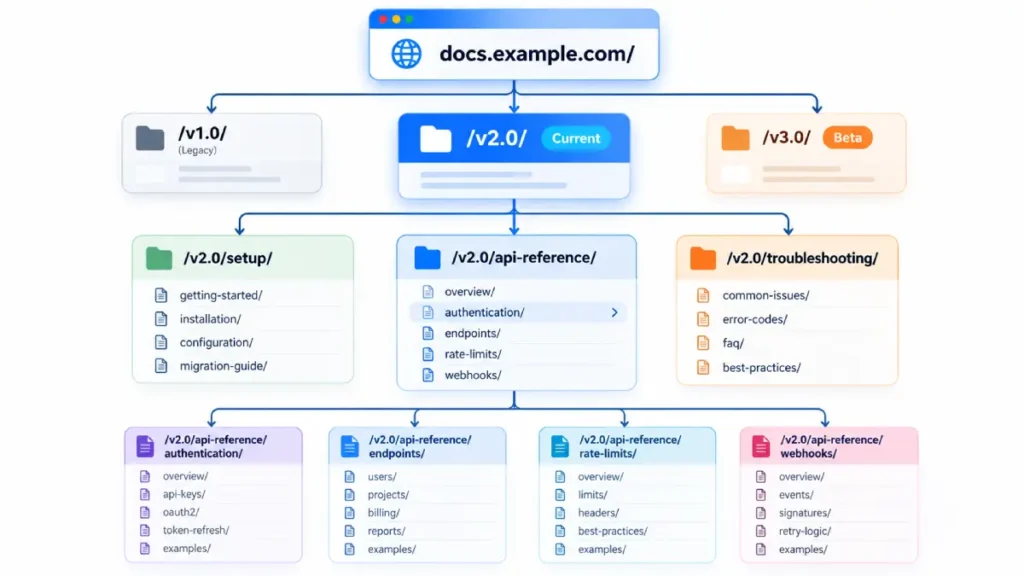
Core Architecture Principles for Indexable Documentation
The structural foundation of a documentation site dictates how efficiently search engines discover and rank your content. A flat or overly convoluted directory tree leads to poor ranking potential for deep-tier reference guides.
URL Structure and Hierarchy
A predictable, human-readable URL structure is critical for both users and crawlers. Documentation URLs should reflect the logical hierarchy of the product or framework:
- Domain Level:
docs.example.com/orexample.com/docs/ - Product/Category Level:
/docs/api/v2/ - Topic Level:
/docs/api/v2/authentication/
Avoid dynamic parameters, session IDs, and excessive subdomains that fragment link equity. Establishing a clean directory structure directly supports efficient crawl budget management across massive knowledge repositories.
Managing JavaScript-Heavy Documentation Frameworks
Many modern documentation platforms rely heavily on client-side rendering frameworks like React, Vue, or Next.js. While these tools provide exceptional user experiences with instant search and dynamic navigation bars, they can introduce rendering latency for search engine crawlers.
Webmasters must implement server-side rendering (SSR) or incremental static regeneration (ISR) so that core documentation text, headings, and code examples are fully rendered in the initial HTML payload.
Refer to official guidelines on JavaScript SEO basics to ensure search bots do not miss critical API endpoints or configuration instructions due to delayed execution.
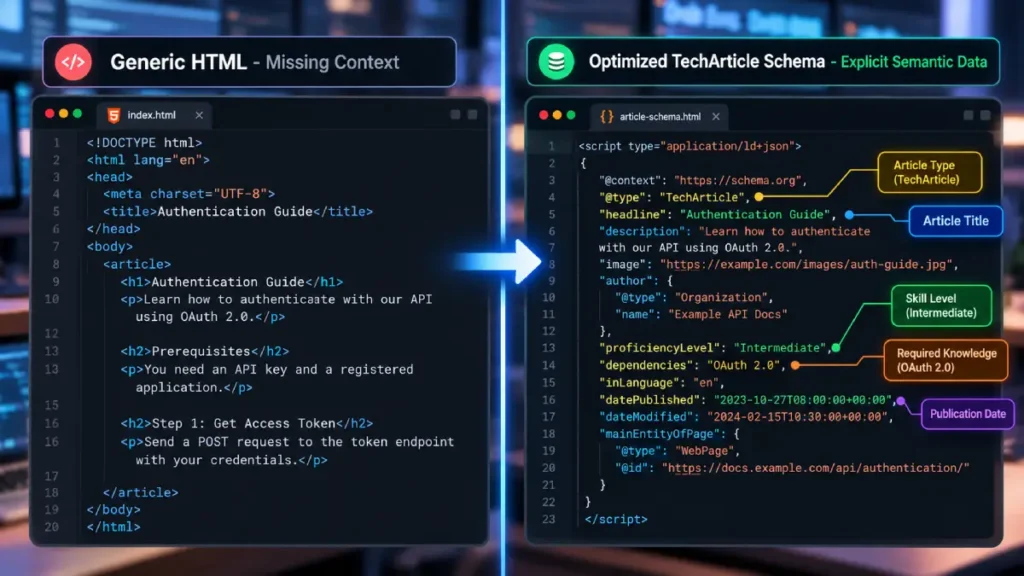
Optimizing Documentation Metadata and Semantic Structure
Writing documentation for developers requires a balance between concise code accuracy and comprehensive explanatory context. Search engines rely on explicit semantic signals to differentiate between conceptual guides, troubleshooting tutorials, and strict API specifications.
Implementing Technical Schema Markup
Enhancing your documentation pages with structured data helps search engines identify specific content types, such as step-by-step troubleshooting instructions or software specifications.
According to Google Search Central documentation on TechArticle schema, applying structured data allows search engines to better understand technical content and present rich snippets in search results.
Every documentation article should feature clean, valid schema that highlights the target framework, prerequisite versions, and last-updated timestamps.
Handling Code Snippets and Duplicate Content Risks
Documentation frequently repeats boilerplate configuration blocks, installation commands, and API headers across multiple sub-pages. This repetition can trigger duplicate content filters, causing search engines to devalue or de-index important reference pages.
To mitigate this risk:
- Utilize canonical tags pointing to the master version of a guide when content is syndicated across multiple product versions.
- Enforce strict noindex directives on archived version directories (e.g.,
/docs/v1/when/v3/is current). - Combine fragmented, single-paragraph release notes into comprehensive monthly update summaries to maintain high informational density per URL.
Additionally, complement your site structure with a well-maintained XML sitemap architecture that explicitly lists active, high-priority documentation landing pages while excluding automated tag pages and search result parameters.
Internal Linking Strategies Within Large Documentation Hubs
Internal linking within documentation is often automated through sidebars and table-of-contents widgets. While navigation trees are helpful for users, they do not replace contextual, editorial internal linking.
Editorial links woven naturally into the body paragraphs guide search bots along thematic paths and distribute PageRank to deeply nested troubleshooting guides.
When linking between articles, avoid generic anchor text like “click here” or repeating exact article titles. Instead, use descriptive semantic anchors that reference specific concepts, such as linking to a rate-limiting guide using the anchor phrase “handling API rate limits and retry logic.”
Furthermore, engaging with industry communities like Write the Docs provides valuable insights into how technical writers and developers organize information architectures for maximum comprehension and searchability.
Measuring Documentation Search Performance and UX
Optimizing technical documentation is an iterative process that requires continuous performance monitoring. Standard organic traffic metrics alone do not tell the full story; webmasters must evaluate how users interact with documentation search bars, copy code snippets, and navigate between reference articles.
- Monitor Search Console Query Reports: Identify exact developer phrasing and long-tail error codes that users type into search engines to reach your site.
- Analyze Bounce and Dwell Times: High bounce rates on API reference pages may indicate missing code examples or broken installation instructions.
- Track Internal Search Queries: Review what terms users type into your documentation’s internal search bar to discover content gaps and missing topics that need to be documented.
By aligning technical documentation structures with search engine crawling requirements and user intent, webmasters can transform a static reference manual into a powerful, high-converting organic acquisition channel.