

A meta description generator is an automated tool or programmatic script that creates, optimizes, or scales HTML snippet descriptions according to standard W3C meta element specifications for web pages to maximize organic click-through rates (CTR).
For enterprise sites managing thousands of programmatic product pages, localized landing pages, or massive publisher archives, manual snippet writing is economically impossible.
Modern SEO professionals rely on advanced generators powered by structured templates, Large Language Models (LLMs), and data-driven prompt engineering to maintain brand voice, incorporate primary keywords naturally, and survive Google’s automated snippet rewrites.
Why Traditional Manual Meta Description Writing Fails at Scale
For small sites with under one hundred URLs, manual writing remains a viable, high-touch tactic. However, as web ecosystems scale past ten thousand pages, traditional approaches break down due to resource constraints and architectural rigidity.
- The Velocity Gap: Content management systems constantly publish inventory faster than human SEO copywriters can draft customized 155-character blurbs.
- Template Drift: Static fallback descriptions often result in generic, repetitive boilerplate copy that fails to match user search intent.
- Contextual Blindness: Manual writers rarely integrate real-time search query variants or semantic entities pulled directly from live search results pages (SERPs).
To solve these scaling bottlenecks, programmatic generation must shift from crude string concatenation to intelligent synthesis.
Modern workflows combine database parameters with contextual natural language processing to ensure every snippet functions as an effective ad copy unit.
Core Capabilities to Look for in a Modern Meta Description Generator
Not all automated snippet tools are built for enterprise SEO requirements. Basic generators rely on rigid placeholders that often trigger truncation or awkward syntax. High-performance tools incorporate specific technical and linguistic layers:
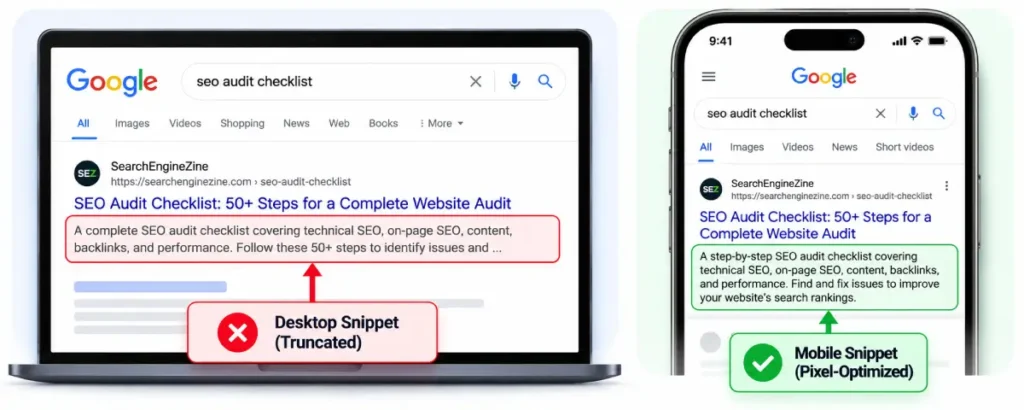
- Character and Pixel-Width Boundaries: While character counts (typically under 155 characters) matter, modern generators calculate pixel width to prevent mobile and desktop ellipsis truncation.
- Dynamic Entity Injection: The ability to pull schema attributes, pricing data, product specifications, or geographic modifiers directly into the snippet string.
- Intent-Matching Taxonomy: Rules engines that route templates based on query classification—such as transactional, navigational, or informational intent.
- API and Headless Integration: Seamless hooks into modern CMS platforms like Next.js, WordPress, or Contentful to deploy descriptions at the edge during builds or publish events.
For broader foundational adjustments to your snippet strategy, review our guide on SERP snippet optimization techniques.
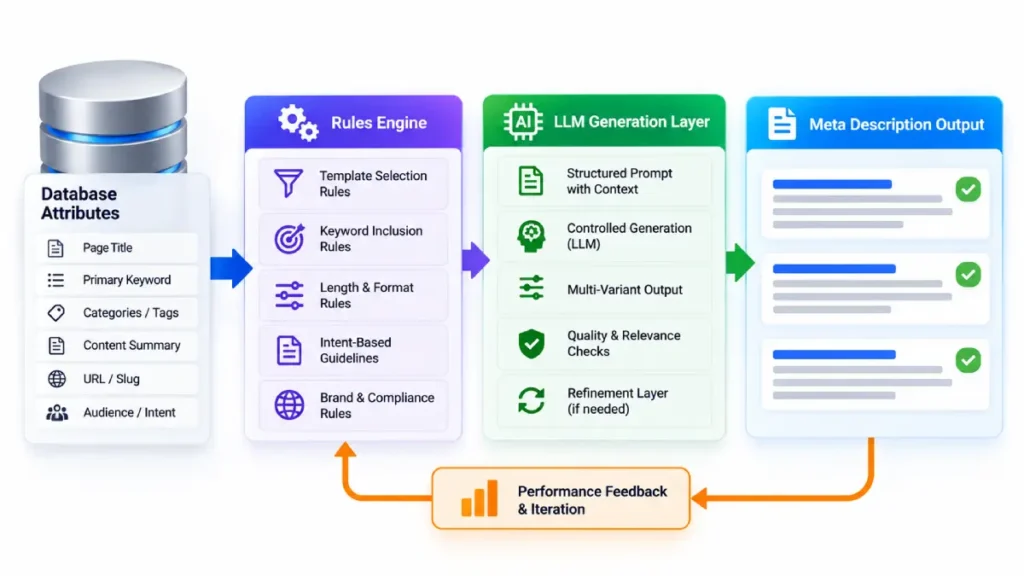
Programmatic Generation Frameworks: Combining LLMs and Template Architecture
Relying entirely on unconstrained generative AI for meta descriptions introduces severe risks, including hallucinated facts, pricing errors, and brand voice drift. The most robust operational framework marries strict conditional templates with controlled LLM variations.
[Database Attributes] + [Brand Guidelines]
         │
         ▼
[Conditional Rule Engine] ──> [Safe Fallback Template]
         │
         ▼
[Controlled LLM / Transformer] ──> [Pixel-Width & Keyword Audit] ──> [CMS Deployment]
By constraining the model with strict system prompts, strict character limits, and mandatory entity inclusion, SEO teams can scale generation without sacrificing compliance.
Furthermore, integrating these workflows with your title tag optimization frameworks ensures visual and thematic harmony across the entire search snippet block.
Mitigating Google’s Automated Rewrites Through Intent Alignment
A persistent challenge for SEO professionals is that Google rewrites meta descriptions over sixty percent of the time, according to various industry studies, following Google Search Central’s automated snippet guidelines.
Rewrites usually happen because the generated snippet fails to answer the user’s specific query or misrepresents the page content.
To minimize algorithmic rewrites and protect your optimization efforts, your generation framework must adhere to strict relevance principles:
- Directly Address the Primary Query: Ensure the opening words of the meta description echo the exact user intent or secondary keywords identified in the content brief.
- Avoid Keyword Stuffing: Unnatural lists of synonyms or repetitive terms trigger immediate algorithmic overrides.
- Incorporate Clear Value Propositions: Use action-oriented verbs and explicit benefits (e.g., “Compare top tools,” “Step-by-step checklist”) that encourage immediate click engagement.
For deeper insights on how AI-driven content expansion impacts organic performance at scale, explore our analysis on generative AI content scaling strategies.
Measuring ROI: CTR Lifts, Impression Dynamics, and SERP Real Estate
Deploying a meta description generator is only the first phase; measuring its impact requires rigorous split-testing and performance tracking. Because meta descriptions do not act as direct ranking factors, their primary value lies in behavioral metrics.
Key Metric Focus: Evaluate performance shifts in Search Console by filtering for high-impression, medium-ranking queries (positions 4 through 10) where minor CTR improvements yield substantial traffic gains.
Monitor average position alongside CTR changes over 30-, 60-, and 90-day cohorts. If a newly generated batch of descriptions correlates with a steady rise in click-through rate without a drop in average position, your programmatic template strategy is successfully capturing user attention on the results page.