

Generative Engine Optimization (GEO) is the practice of improving how a website’s information can be discovered, understood, retrieved, cited, and represented in AI-generated search experiences.
The term has two important meanings. In academic research, GEO was introduced as a framework for improving a website’s visibility inside responses generated by “generative engines.”
A 2024 KDD paper evaluated nine optimization methods across a 10,000-query benchmark and reported that some methods substantially increased source visibility in its experimental setting.
For Google Search, however, GEO is not a separate optimization system with special ranking requirements. Google explicitly says that what is commonly called AEO or GEO should be understood as optimizing for the search experience, with established SEO fundamentals remaining the foundation for visibility in AI Overviews and AI Mode.
For an SEO professional, the practical model is therefore:
SEO makes your content discoverable and eligible; GEO focuses attention on how useful, understandable, retrievable, and citable that information is within generative search experiences.
That distinction prevents GEO from becoming a collection of unsupported “AI hacks.” For broader context on how search behavior is changing toward conversational queries, see our guide to conversational search behavior
What Is Generative Engine Optimization?
GEO focuses on the visibility of information within AI-generated answers rather than only its position in a conventional list of search results.
Traditional SEO primarily deals with a page’s visibility in organic search results. Generative systems can instead retrieve information from multiple sources and synthesize that information into a response, sometimes displaying citations to the underlying pages.
The original GEO research formalized this distinction by measuring factors such as the amount and position of a source’s content in a generated answer, rather than treating conventional ranking position as the sole visibility metric.
The concept was introduced in the research paper GEO: Generative Engine Optimization, which proposed a framework for measuring and improving source visibility in generative-engine responses.
This creates a useful distinction:
| Traditional SEO | Generative-search visibility |
|---|---|
| Organic rankings | Inclusion in generated responses |
| Search impressions | AI-response visibility |
| Click-through rate | Citations, mentions and attributed information |
| Keyword/query targeting | Entity, topic and intent understanding |
| SERP visibility | Representation within an answer |
These are overlapping, not mutually exclusive, disciplines.
Google’s current documentation makes this especially clear: its generative AI search systems rely on the same underlying Search infrastructure, including retrieval from Google’s Search index.
How Does GEO Work?
A simplified generative-search workflow looks like this:
User query → query expansion/retrieval → relevant sources → synthesis → generated answer → citations or links
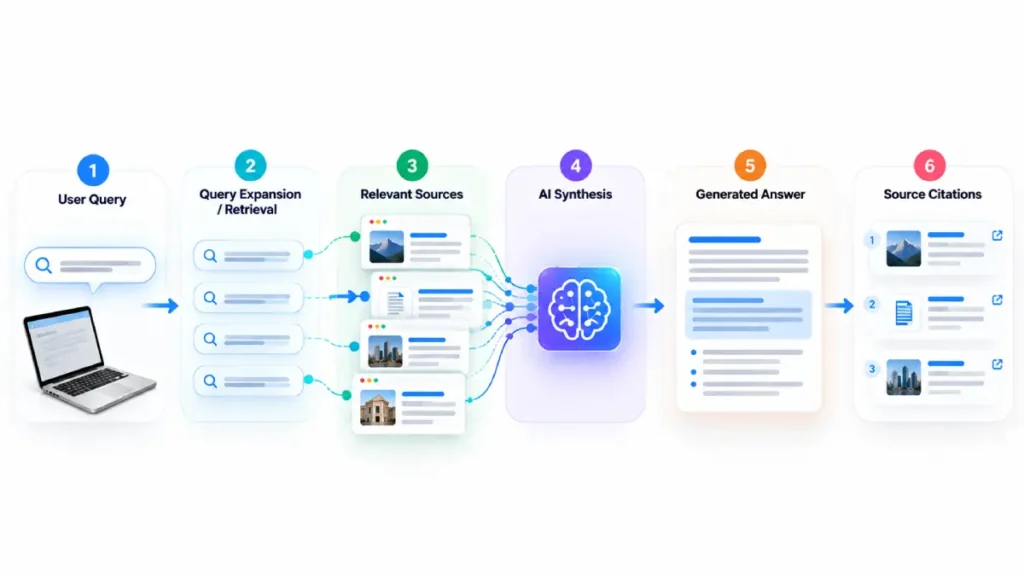
The original GEO research describes generative engines as systems that retrieve relevant documents and then use generative models to construct responses grounded in those sources.
Google describes a related mechanism for its AI Search experiences through query fan-out: the system can generate multiple related searches to gather information for a more complex question.
Google’s official guide to generative AI search explains how retrieval-augmented generation and query fan-out are used in its Search experiences.
This makes understanding the relationship between a query and its underlying information need particularly important; our search-intent mapping framework explores that relationship in greater depth.
This has an important SEO implication.
A page does not need to contain an exact copy of every possible question. It needs to provide useful, well-organized information that can satisfy the underlying information need.
Google specifically warns against creating large numbers of pages merely to target query variations or fan-out searches.
GEO vs. SEO: What Actually Changes?
GEO does not mean abandoning conventional SEO.
Google’s official guidance says pages appearing in generative AI features still need to meet normal Search technical requirements and be indexed and eligible to appear with a snippet.
A practical SEO-to-GEO framework is:
- Make the page discoverable.
Ensure crawling, indexing, rendering, and technical accessibility work correctly. - Match the underlying intent.
Understand what the searcher is actually trying to learn, compare, solve, or accomplish. - Make important information easy to identify.
Use clear headings, focused sections, descriptive language, and logical organization. - Add genuinely useful information.
Do not merely rewrite information already available everywhere else. This principle is closely related to information gain in SEO, where the objective is to contribute information rather than simply aggregate existing material. - Support important claims.
Use authoritative sources where evidence is needed. - Build topical and entity context.
For a deeper treatment of how search intent and entities interact, see intent-entity mapping for LLM search. Connect related pages and establish clear relationships between concepts. - Measure actual visibility.
Where available, examine AI-search visibility rather than assuming that a GEO tactic worked.
Google’s current guidance emphasizes unique, non-commodity content, clear organization, technical accessibility, and established SEO fundamentals rather than a special GEO formula.
What Should SEO Professionals Optimize for?
The most useful GEO strategy is not “write for AI.” It is to make the information easier for both people and retrieval systems to understand and use.
1. Create non-commodity information
Google explicitly recommends valuable, unique, non-commodity content and warns against simply recycling information that could easily be produced elsewhere.
Google’s people-first content guidance provides additional criteria for evaluating whether content is genuinely useful, original, and trustworthy.
That means an SEO professional should look for:
- original analysis
- first-hand observations when genuinely available
- useful examples
- primary-source evidence
- specific comparisons
- clearly explained processes
- meaningful data
- conclusions that go beyond common knowledge
2. Improve information clarity
A generative system cannot reliably represent information that is ambiguous, poorly organized, or buried inside unnecessary text.
Use:
- descriptive headings
- concise explanations
- clear definitions
- tables when comparisons are involved
- explicit relationships between concepts
- direct answers to important questions
Google recommends organizing content with paragraphs, sections, and headings that make pages easier for readers to navigate.
3. Preserve technical SEO
GEO does not remove the need for crawlability, indexing, rendering, accessibility, or sound site architecture.
Google states that its generative AI features depend on the same fundamental Search systems and that pages need to be indexed and eligible for Search to be considered for these experiences.
4. Build evidence into important claims
The original GEO research found that adding citations, quotations, and statistics improved source visibility in its experimental benchmark.
That finding should be treated as research evidence from that specific experimental environment, not as a universal Google ranking rule.
For practical SEO, the stronger lesson is simpler:
When a claim matters, make its evidence easy to identify and verify.
What GEO Tactics Should You Avoid?
A major part of modern GEO is knowing what not to do.
Google currently says there is no requirement to create special AI files such as llms.txt for visibility in Google Search, and it explicitly says Google Search ignores such files. Google also says there is no requirement to break content into tiny “chunks” for generative AI.
Google likewise says there is no special structured-data markup required for generative AI search. Structured data can still be useful for broader SEO purposes, but it should not be presented as a secret GEO requirement.
Avoid therefore:
- keyword stuffing
- creating pages for every imaginable AI query variation
- artificial “AI-friendly” formatting
- unsupported claims about proprietary ranking systems
- treating
llms.txtas a Google requirement - assuming a particular word count guarantees AI citations
- sacrificing human readability to chase AI extraction
The original GEO research itself found that keyword stuffing was not among its high-performing methods in its benchmark.
How Should You Measure GEO?
Measurement should move beyond asking, “Did my page rank?”
Track several layers:
| Layer | What to examine |
|---|---|
| Traditional SEO | Rankings, impressions, clicks, CTR |
| AI visibility | Whether your site is cited or mentioned |
| Citation quality | Which pages and passages are being used |
| Brand representation | How accurately the AI describes the entity |
| Traffic | Visits referred from AI experiences where measurable |
| Search Console | Visibility from Google’s generative AI features |
Google now provides a Generative AI performance report in Search Console for measuring visibility from generative AI features on Google Search and Discover.
That makes first-party measurement particularly important. We also examine the related problem of AI Overview citation visibility when measuring how content appears in AI-generated search experiences.
Third-party GEO tools can provide useful workflow data, but Google warns that third parties do not have access to Google’s internal ranking or AI systems and cannot guarantee performance.
A Practical GEO Workflow for SEO Professionals
A concise workflow is:
Query → Intent → Entity → Information need → Source evidence → Content structure → Technical accessibility → AI visibility measurement
For each important page, ask:
- What question or task is this page actually solving?
- Can the answer be understood quickly?
- What information is genuinely original or useful?
- Which claims require authoritative evidence?
- Are the relevant entities and relationships clear?
- Can search systems crawl and index the page normally?
- Does the page connect naturally to related resources?
- Can its visibility in generative search be measured?
This approach treats GEO as an extension of a broader search strategy rather than a replacement for SEO.
For related work on natural-language search behavior, see SearchEngineZine’s Conversational Search Phrases and its AI Overview Citations resource.
The Bottom Line
Generative Engine Optimization is best understood as optimizing content and digital presence for visibility and useful representation within generative search experiences.
The academic field provides evidence that specific content modifications can influence visibility in controlled generative-engine experiments.
Google’s current position is more conservative: there is no separate GEO checklist that replaces SEO. Its generative search experiences continue to depend on crawling, indexing, Search systems, useful content, technical accessibility, and satisfying the user’s information need.
For SEO professionals, the practical strategy is therefore not to optimize for an imagined AI ranking factor.
Build pages that are technically accessible, semantically clear, evidence-supported, genuinely useful, and strong enough to serve as reliable sources when search systems construct an answer.
That is the most defensible foundation for GEO as generative search continues to evolve.