

Client to server scripting refers to the architectural migration of application logic, data fetching, and DOM rendering from the user’s browser (Client-Side Rendering) to backend servers, cloud functions, or edge workers (Server-Side Rendering and Edge Computing).
For SEO professionals, this transition fundamentally alters how search engine crawlers like Googlebot discover, parse, and index web content.
While client-side scripting relies on executing JavaScript locally—often leading to rendering delays, incomplete initial HTML documents, and wasted crawl budgets—shifting scripts to the server ensures that a fully formed HTML DOM is delivered instantly in the HTTP response.
This architectural shift eliminates dependency on the secondary rendering queue, improves Core Web Vitals metrics such as Interaction to Next Paint (INP) and Largest Contentful Paint (LCP) (web.dev Core Web Vitals Documentation), and guarantees immediate indexation of dynamic content without relying on resource-intensive client execution.
The Core Architectural Divide: Client-Side vs. Server-Side Scripting
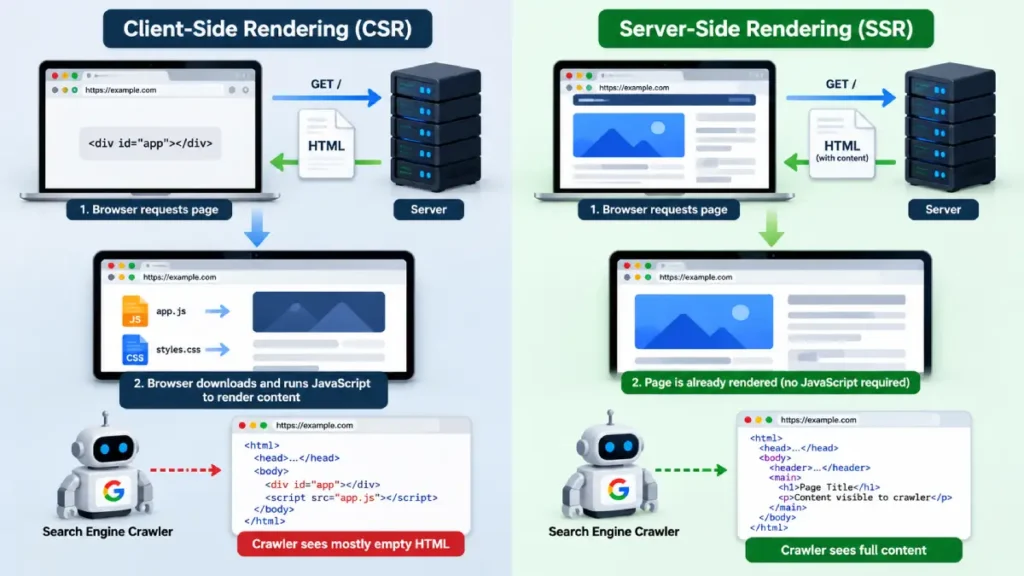
Understanding the technical distinction between client-side and server-side execution is vital for diagnosing indexation bottlenecks in modern web applications built with frameworks like React, Vue, Angular, or custom JavaScript stacks.
Client-Side Scripting (CSS / CSR)
In a pure client-side model, the web server returns a minimal HTML shell (often just a root <div> and script tags). The browser must download, parse, and execute heavy JavaScript bundles before the user or search engine crawler can see any meaningful content.
- SEO Bottleneck: Googlebot utilizes a two-wave indexing process for client-rendered pages. Wave 1 indexes the raw HTML (which is frequently empty or sparse), while Wave 2 queues the page for JavaScript rendering when resources permit (Google Search Central – How Google Processes JavaScript). This introduces latency, delays rankings, and risks dropped content if execution budgets are exhausted.
Server-Side Scripting (SSR & Edge Computing)
In a server-side model, business logic executes on the server or edge network. The server processes database queries, renders templates, executes scripts, and transmits a fully populated HTML document directly to the client and crawler.
- SEO Advantage: Crawlers ingest complete content instantly on the initial HTTP request. There is no waiting for JavaScript execution queues, drastically improving crawl efficiency and ensuring rapid indexation of new or updated pages. For deeper insights into managing technical infrastructure, review our guide on technical SEO audit frameworks.
Technical SEO Implications of Shifting Script Execution
Migrating scripting responsibilities from the client to the server impacts several core pillars of technical search engine optimization:
| Metric / SEO Pillar | Client-Side Scripting Impact | Server-Side Scripting Impact |
| Initial HTML Response | Minimal / Empty shell requiring JS execution | Fully populated DOM ready for immediate parsing |
| Crawl Budget Efficiency | Low (requires processing heavy JS assets) | High (instantaneous text and link extraction) |
| Core Web Vitals (LCP) | Delayed (blocked by bundle download and execution) | Accelerated (server delivers pre-rendered content) |
| Indexation Latency | High (subject to secondary rendering queue delays) | Low (indexed during primary crawl pass) |
| Server Resource Load | Offloaded entirely to user devices | Handled by backend/edge infrastructure |
When optimizing large-scale enterprise websites, reducing client-side JavaScript dependencies helps conserve crawler render budgets, preventing orphan pages and unindexed product or article catalogs.
For strategies on handling complex web environments, refer to our analysis on advanced JavaScript SEO rendering.
Modern Rendering Patterns: SSR, Hydration, and Edge Scripting
Modern web development rarely relies on rigid dichotomies; instead, it adopts hybrid paradigms that blend client and server capabilities. SEO professionals must evaluate these patterns accurately:
1. Server-Side Rendering (SSR) with Hydration
Frameworks like Next.js, Nuxt, and Remix generate HTML on the server for every request. Once the browser receives the static HTML, JavaScript “hydrates” the page, attaching event listeners and enabling interactive features.
- SEO Implication: This is the gold standard for content-heavy sites and programmatic publishers. Search engines receive 100% of the content instantly in the HTML source code, while users enjoy a seamless, dynamic application experience.
2. Incremental Static Regeneration (ISR) and Edge Computing
Moving server logic closer to the user via edge workers (e.g., Cloudflare Workers Documentation, Vercel Edge) allows dynamic scripts to execute globally with ultra-low latency. Pages are pre-rendered and cached at the edge, updating asynchronously in the background.
- SEO Implication: This architecture provides the blistering speed of static sites with the freshness of dynamic databases, drastically improving Core Web Vitals optimization scores, which directly influence algorithmic ranking signals.
Actionable Audit Checklist for SEO Professionals
When auditing a website undergoing a client-to-server scripting migration or evaluating a headless CMS architecture, execute the following diagnostic steps:
- Compare Raw vs. Rendered HTML: Use tools like Screaming Frog or cURL to fetch the raw HTTP response (
View Source). Compare it against the rendered DOM in Google Chrome’s Developer Tools. If critical metadata, headings, or body copy is removed from the raw HTML, the site remains dangerously reliant on client-side execution. - Monitor Google Search Console’s URL Inspection Tool: Test newly published URLs. Check the live test screenshot and rendered HTML tab to confirm that Googlebot successfully executes and indexes the content without timing out or missing asynchronous API payloads.
- Analyze JavaScript Execution Budgets: Ensure that critical content-rendering scripts are not blocked by strict
robots.txtdirectives or slow-loading third-party tags that throttle browser rendering threads. - Evaluate Interaction to Next Paint (INP): Ensure that offloading logic to the server does not overload client-side event handlers during hydration, maintaining smooth user interactions vital for passing modern Core Web Vitals thresholds.
By shifting essential rendering and scripting tasks from fragile client browsers to robust server environments, SEO professionals can eliminate rendering bottlenecks, secure pristine indexation, and build resilient architectures capable of sustaining high organic visibility.