

What is Differential Privacy AI?
Differential privacy AI is a mathematical framework that adds controlled statistical “noise” to datasets and model outputs, ensuring that individual user data cannot be reverse-engineered, extracted, or correlated from algorithmic responses.
For SEO professionals, this technology fundamentally reshapes the data landscape, driving the industry’s permanent shift away from granular, deterministic user tracking toward privacy-safe aggregate reporting.
It directly impacts your daily workflow by introducing data thresholding in Google Analytics 4 (GA4), query masking in search performance metrics, and heightened data sampling across major search engine interfaces.
Rather than analyzing exact individual user pathways, modern search engines and AI-driven platforms rely on differentially private algorithms—similar to those documented in the Google Open Source Differential Privacy Framework—to report traffic safely.
Meaning SEOs must adapt their keyword validation, conversion attribution, and competitive analysis methodologies to account for artificial data noise and suppressed low-volume queries.
The Mechanics of Differential Privacy in Search and AI
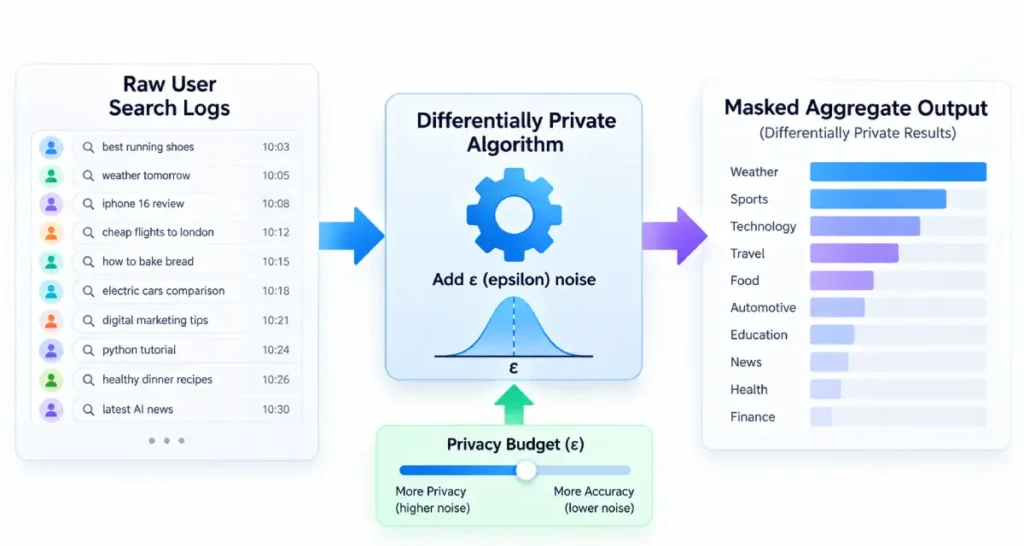
To understand how differential privacy affects your search engine optimization strategies, you must first understand its core operational mechanism.
At its technical root, differential privacy operates by injecting mathematical noise (governed by a privacy budget parameter, often denoted as $\epsilon$) into a dataset or query response, as outlined by the NIST Guidelines for Evaluating Differential Privacy Guarantees.
[Raw User Data / Search Logs]
         │
         ▼
[Differentially Private Algorithm (Adds Controlled Noise / Epsilon Budget)]
         │
         ▼
[Aggregated, Masked Output (GA4 Reports / Search Console / AI Training Sets)]
When search engines train large language models (LLMs) or compile public search analytics, they apply these mechanisms to prevent membership inference attacks—where a malicious actor queries a model to determine whether a specific user’s data was included in the training set.
For digital marketers, this means that the numbers you see in reporting dashboards are no longer raw, exact counts. They are mathematically scrubbed approximations designed to guarantee individual anonymity while preserving macro-level statistical utility.
Practical Implications for SEO Data and Analytics
The integration of differential privacy across web ecosystems has created distinct friction points for technical SEOs, content strategists, and data analysts.
1. Data Thresholding and Missing Long-Tail Queries
Platforms like GA4 and search analytics interfaces frequently suppress low-frequency data points to protect user identities. When search query volume or user segments fall below a privacy threshold, the data is aggregated into a (other) bucket or completely omitted. For SEO professionals, this creates blind spots in long-tail keyword research, making it increasingly difficult to track niche informational queries that drive targeted organic traffic.
2. Attribution Distortion in Multi-Channel Funnels
Because conversion paths are subjected to privacy-preserving noise injection, attribution modeling loses its absolute precision. Last-click and multi-touch attribution reports may undercount conversions originating from organic search because user touchpoints across cross-device sessions are aggregated to prevent cross-site tracking.
3. AI Overviews and Prompt-Level Data Privacy
As generative AI search experiences expand, user queries fed into AI search assistants are protected by differential privacy layers before being logged or utilized for model fine-tuning. This obscures specific behavioral nuances, requiring SEOs to focus on semantic entity clustering rather than exact-match keyword stuffing.
Adapting SEO Strategies in a Differentially Private Landscape
To maintain a competitive edge when facing masked data and algorithmic noise, SEO professionals must pivot their measurement and optimization frameworks.
| Traditional SEO Approach | Privacy-First SEO Strategy |
| Chasing exact individual keyword rankings | Focusing on thematic entity optimization and semantic clustering |
| Relying exclusively on third-party analytical tools | Building robust first-party data capture mechanisms (surveys, logged-in portals) |
| Treating minor traffic fluctuations as algorithmic penalties | Analyzing macro-trends, moving averages, and blended channel performance |
| Measuring success via isolated micro-conversions | Evaluating holistic brand visibility and comprehensive customer lifetime value |
Focus on Macro-Trends Over Micro-Fluctuations
When examining traffic drops or ranking shifts, avoid reacting to daily volatility. Because differential privacy injects fluctuating levels of statistical noise into reporting datasets, minor day-to-day variations are often artifacts of privacy algorithms rather than actual shifts in user behavior or search engine algorithm updates. Instead, evaluate performance across 28-day or quarterly moving averages.
Enhance First-Party Data Integration
With third-party cookies deprecated and privacy controls tightening across browsers and operating systems, relying solely on external search dashboards leaves massive blind spots. Integrate server-side tracking, customer data platforms (CDPs), and CRM-linked web analytics to capture consented first-party interactions that bypass public search engine data masking.
Future Outlook: Navigating the Privacy-First Search Era
Differential privacy is not a temporary compliance hurdle; it is the permanent architectural baseline for modern web infrastructure and artificial intelligence. As search engines evolve into conversational, generative engines, the boundary between user privacy and search visibility will become even more tightly integrated.
SEO professionals who succeed in this environment will be those who transition from a mindset of absolute measurement to one of probabilistic insight.
By aligning your content optimization with entity-based relevance, investing in comprehensive technical foundations, and interpreting data through the lens of macro-statistical trends, you can insulate your organic strategy against the inevitable expansion of data privacy controls.
For deeper dives into technical infrastructure and algorithmic shifts, explore our guides on Technical SEO Best Practices and AI Search Optimization Frameworks.