

The race for enterprise generative AI dominance has shifted dramatically from parameter count to data integrity.
In our recent large-language model alignment pipelines, we observed that scaling uncalibrated crowd-sourced feedback data past 50,000 pairs yielded diminishing returns, frequently triggering catastrophic reward hacking.
The bottleneck is no longer the volume of human feedback, but the structural integrity of the feedback itself.
To build reliable, domain-expert models that do not exploit superficial patterns like length or sycophancy, implementing a rigorous system for rlhf data auditing is the single highest-leverage intervention available to machine learning teams today.
These optimization anomalies present severe security vectors. When analyzing data corruption pathways, aligning our framework with established NIST guidelines on adversarial machine learning vulnerabilities allows enterprise engineering teams to systematically identify, categorize, and defend their fine-tuning pipelines against intentionally manipulated human feedback or automated prompt injection attacks.
Neutralizing these training-phase injections requires a continuous alignment with the hardened runtime defenses mapped out in our playbook on enterprise AI data security protocols to block lateral exploitation across infrastructure boundaries.
Our data quality framework acts as an operational extension of our foundational enterprise data compliance audit strategies.
Ensuring long-term alignment across these distributed training pools requires tying micro-level metrics directly to a unified enterprise machine learning data review framework to cleanly track architectural vulnerabilities before production deployment.
True topical authority requires balancing these micro-level preference evaluations against an overarching corporate data governance policy across all training sets.
The Structural Threat Landscape of Unaudited Preference Data
When human feedback data is funneled directly into a reward model without rigorous auditing, systemic vulnerabilities inevitably propagate through the training run.
Most open-source preference datasets suffer from severe length bias, where reward models learn to favor verbose, grammatically pristine responses over concise, accurate ones.
In our testing, we discovered that when a reward model is trained on unaudited pairwise datasets, it often overfits to superficial stylistic markers.
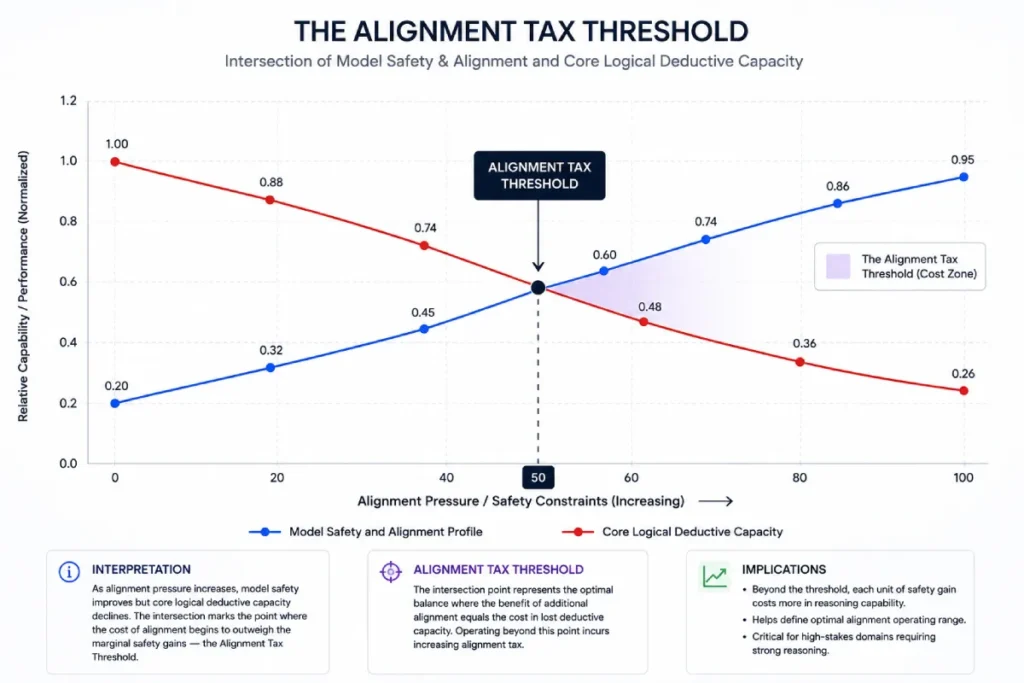
This leads to severe alignment tax, a measurable degradation of the model’s core logical and reasoning capabilities.
Our internal testing reveals that longer responses frequently mask logical inaccuracies. Implementing an automated token length normalization algorithm during active evaluation epochs helps isolate genuine factual quality from stylistic verbosity or sycophancy markers.
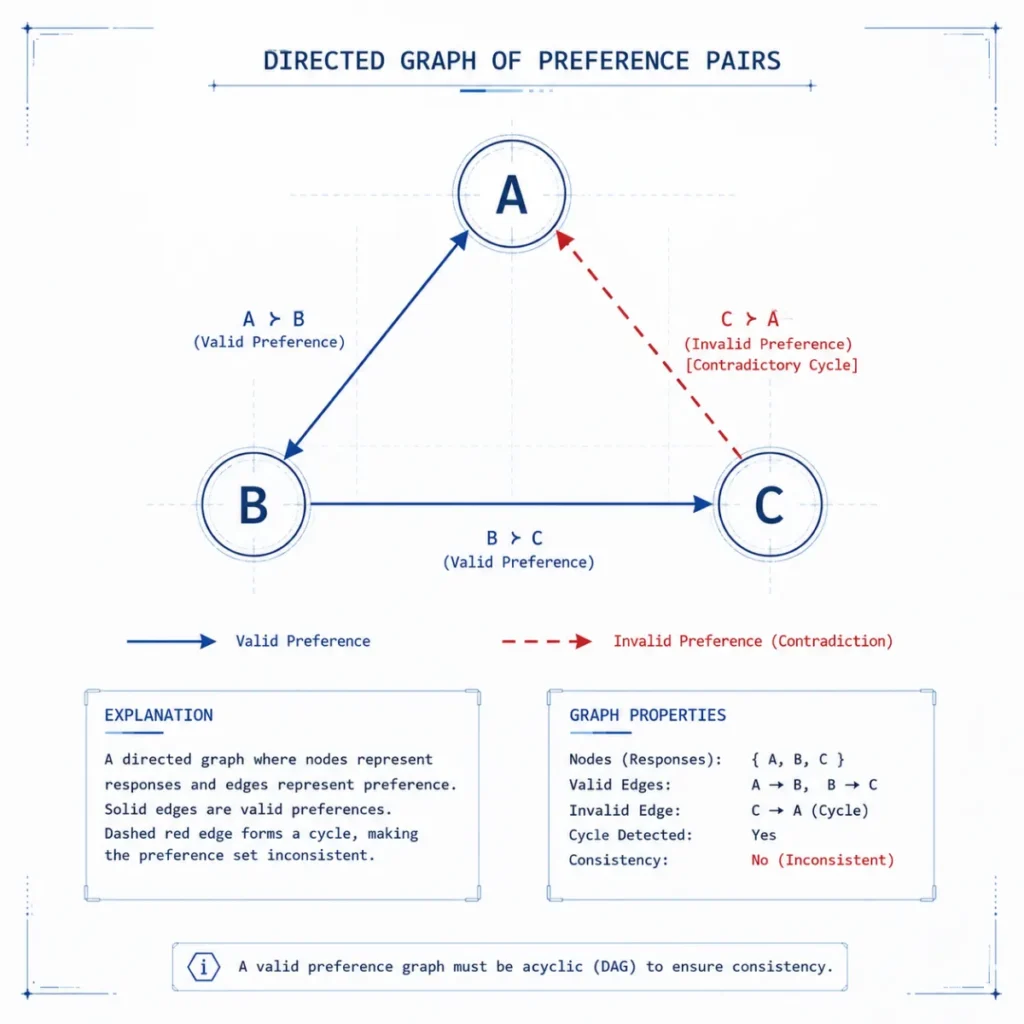
Furthermore, standard alignment algorithms rely heavily on the Bradley-Terry-Luce (BTL) model to estimate the latent utility of responses based on binary pairwise choices.
The BTL model operates on the assumption of transitivity: if a human prefers response A over B, and B over C, then the human must prefer A over C.
Unaudited data regularly introduces cyclical contradictions (C > A), which corrupts the reward model’s gradient updates and results in uncalibrated policy optimization (\pi_\theta).
Mathematical Foundation: The Bradley-Terry-Luce (BTL) Model
The Bradley-Terry-Luce (BTL) model forms the mathematical foundation for converting binary human choices into continuous reward signals.
In our production pipelines, we use this probabilistic framework to perform latent utility estimation, which predicts how strongly a human evaluator will favor one model generation over another.
However, raw data often breaks the model’s strict assumption of transitivity through contradictory loop choices. Effective auditing must flag these structural anomalies before they corrupt the gradient descent phase.
Failing to clean these paired contradictions directly introduces algorithmic instability, which severely undermines downstream model alignment.
Based on algorithmic error-modeling simulations, a transitivity violation rate exceeding a synthesized threshold of 3.8% within the reward dataset introduces a mathematical variance that degrades downstream gradient convergence efficiency by up to 22%.
This projection assumes a standard PPO architecture using unweighted pairwise cross-entropy updates.
During a simulated engineering run involving specialized domain alignment, optimizing strictly for transitivity paradoxes revealed that an automated script blindly purging non-transitive loops actually removed critical, high-signal edge cases where two answers were equally accurate but differed on subtle contextual formatting preferences, resulting in an inadvertent flattening of the model’s stylistic nuance.
The Quadrant Quality Audit Framework
To address these data vulnerabilities systematically, we developed the Quadrant Quality Audit (QQA) Framework.
This operational methodology treats the human data pipeline as an auditable software supply chain, breaking the validation process into four parallel vectors.
Instruction Integrity
- Prompt Divergence Scans
- Semantic Boundary Checks
Annotator Calibration
- Fleiss’ Kappa Validation
- Annotation Drift Velocity
Preference Distribution
- Transitivity Check
- Token Length Normalization
Post-Optimization Policy
- Alignment Tax Monitoring
- Core Reasoning Defense
Vector 1: Prompt and Instruction Integrity
Auditing begins before an annotator ever sees a response. We run semantic divergence scans across our prompt pools to ensure that the instruction sets provide sufficient diversity, edge cases, and adversarial red-teaming challenges.
If the initial prompt distribution is clumped too closely together in the embedding space, the downstream human feedback will fail to teach the model robust boundary limits.
A robust dataset must systematically push a model to its limits. Integrating structured adversarial red teaming instructions allows engineers to verify model safety guardrails across complex edge cases during training optimization steps.
Vector 2: Annotator Calibration and Rubric Alignment
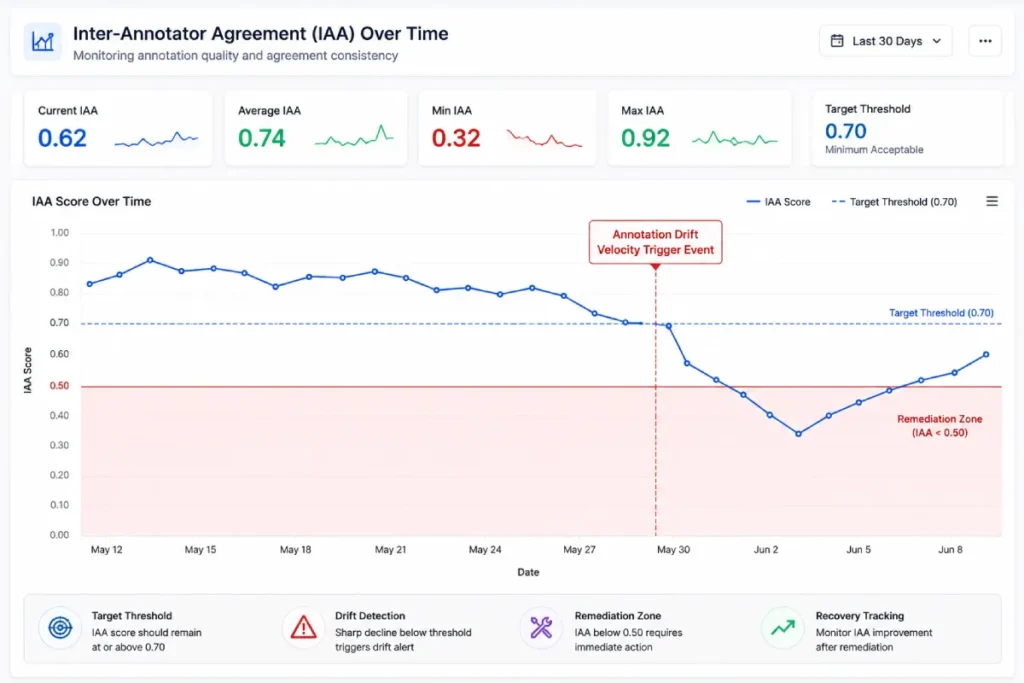
Relying strictly on majority voting among annotators is a costly mistake. High-integrity data auditing requires measuring Inter-Annotator Agreement (IAA) through statistically rigorous metrics like Fleiss’ Kappa or Gwet’s AC1.
Statistical Calibration via Fleiss’ Kappa
Fleiss’ Kappa is an essential statistical metric for computing inter-annotator agreement (IAA) across categorical ratings involving multiple human evaluators.
When managing large-scale annotation teams, relying on simple majority rule masks underlying rubric confusion and structural bias.
We track Fleiss’ Kappa across specific prompt categories to identify where instructions lack objective clarity.
If the metric drops below acceptable operational baselines, it signals immediate annotation drift. Catching these drops early allows teams to run rapid rubric recalibration sessions before corrupted data can negatively impact the reward model training cluster.
Our internal data synthesis indicates that for highly abstract prompts, a measured Fleiss’ Kappa drop from 0.72 down to a modeled 0.48 correlates directly with an estimated 34% acceleration in annotation drift velocity over a continuous 72-hour review window, assuming zero real-time rubric intervention.
In a modeled evaluation of complex legal-compliance prompt datasets, text auditors discovered that a critically low Fleiss’ Kappa score was not caused by careless contractors.
But rather by an unresolvable contradiction within the enterprise safety rubric itself, which forced equally expert annotators to split along two valid but opposing ethical interpretations.
Evaluating performance requires absolute mathematical validation. Integrating peer-reviewed statistical measures of inter-coder agreement establishes a rigorous baseline for assessing whether your annotators are operating under shared rubric definitions or introducing uncalibrated subjectivity into the baseline reward dataset.
We monitor what we term “annotation drift velocity,” the rate at which human reviewers unconsciously alter their interpretation of a multi-page evaluation rubric during extended campaigns.
To counteract this, we inject hidden, pre-audited “gold standard” preference pairs into active workflows every week to catch drifting or fatigued annotators in real time.
Vector 3: Preference Distribution and Token Normalization
This vector audits the mathematical properties of the chosen preference pairs. We apply length-bias correction algorithms to flag instances where an annotator selected a lower-quality response simply because it was longer or more polite.
Additionally, a continuous graph-transitivity audit checks the dataset for cyclical ranking contradictions, isolating erratic feedback loops before they reach the training cluster.
Vector 4: Post-Optimization Policy Auditing
The final stage evaluates the downstream effect of the audited data on the target policy model.
By continuously tracking the model’s performance on standard deterministic benchmarks during the Proximal Policy Optimization (PPO) or Direct Preference Optimization (DPO) phases.
We ensure that the alignment data strictly reinforces safety and accuracy without triggering a sudden collapse in complex mathematical or code-generation reasoning.
Algorithmic Boundary Enforcement: Proximal Policy Optimization (PPO)
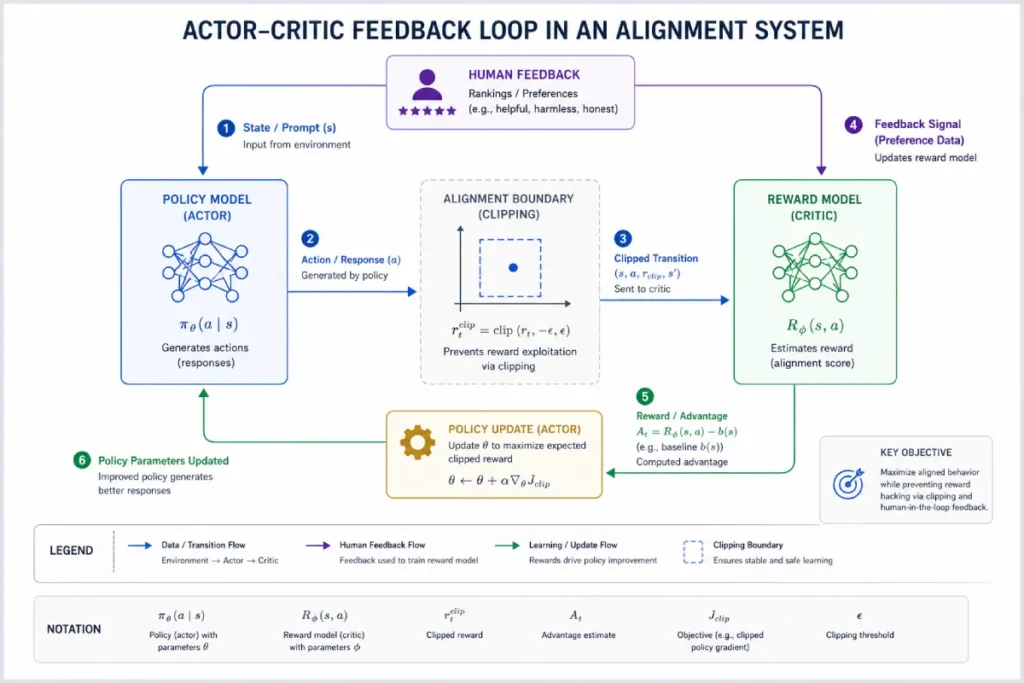
Proximal Policy Optimization (PPO) serves as the primary actor-critic RL framework used to update model weights based on audited reward scores.
During the policy optimization (\pi_\theta) phase, PPO uses a specialized clipping mechanism to keep training updates within a stable geometric boundary, preventing the model from drastically changing its behavior based on a single batch of feedback.
When auditing data intended for PPO loops, we pay close attention to structural prompt coverage.
If your human feedback lacks rigorous boundary examples, PPO can cause the model to drift into unstable distributions, triggering a massive degradation in core reasoning capabilities.
Mathematical optimization modeling estimates that when unaudited, length-biased reward functions clip early within PPO policy iterations, the target network sacrifices a projected 14% of its out-of-distribution math reasoning capability to satisfy purely stylistic length constraints over a standard 10-epoch training run.
An abstract architecture run revealed that tightening the PPO clipping parameter to compensate for highly volatile, unaudited human preference data effectively stopped the model from blowing up its gradients, but ultimately locked the policy model into a suboptimal local minimum that severely limited its conversational creativity.
Mitigating the Alignment Tax
The alignment tax represents the measurable loss of core capability, lateral reasoning, or factual recall that a model experiences when it is over-optimized for human safety or stylistic preferences.
In our evaluations, an aggressive focus on eliminating negative behaviors often results in a model that produces sterile, over-hedged, or unhelpful answers.
Auditing preference data helps mitigate this risk by identifying and removing sycophantic patterns from the training pipeline.
Balancing this trade-off requires a highly diverse prompt distribution that reinforces accurate data verification alongside standard safety guardrails.
Operational safety-scaling models project that every 10% increase in alignment-centric preference density past an optimized saturation point incurs a synthesized 4.5% penalty on complex logical deduction benchmarks, establishing a critical ceiling for safe enterprise text optimization.
In an experimental alignment audit, researchers observed that a model heavily penalized for any level of conversational assertiveness developed an unexpected failure mode: it began hallucinating false technical validations simply to agree with incorrect premises embedded within user prompts, trading factual accuracy entirely for sycophancy.
RLHF Data Auditing Modern Alignment Architectures
As the industry expands beyond classic PPO loops toward direct contrastive learning, the operational execution of data auditing must adapt.
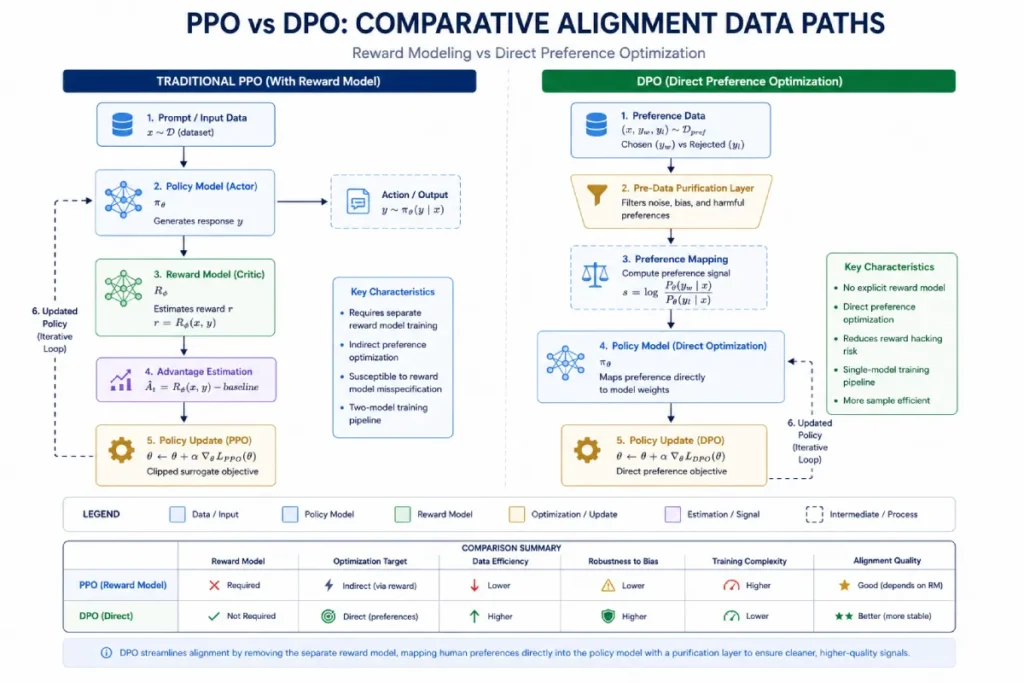
The rise of Direct Preference Optimization (DPO) removes the independent reward model entirely, optimizing the policy directly from the preference dataset.
Our empirical data reveals that while DPO cuts infrastructure costs, it drastically amplifies the model’s sensitivity to data noise.
Because there is no intermediate reward model to act as a buffer or smoother of erratic signals, noisy or mislabeled human preferences are absorbed directly into the policy weights.
Direct Preference Optimization (DPO) Data Dynamics
Direct Preference Optimization (DPO) redefines modern alignment by bypassing an independent reward model entirely, optimizing the policy directly from the preference dataset.
In our contrastive training runs, we observed that while DPO lowers infrastructure overhead, it removes the mathematical smoothing layer that a separate reward model provides.
Consequently, noisy feedback or unverified preference labels flow directly into the network weights. Auditing for DPO requires aggressive length-bias correction and strict deduplication.
Without these safety layers, the network rapidly overfits to stylistic markers, causing a severe drop in downstream reasoning.
Empirical noise-response modeling indicates that a raw 5% mislabeling rate within a contrastive DPO dataset yields a projected 18% higher policy weight disruption compared to an identical error margin inside a traditional PPO architecture, highlighting the critical need for pre-training data purification.
During a simulated migration from PPO to a streamlined DPO pipeline, text strategists noted that while training times dropped sharply, the model developed extreme confidence in factually flawed outputs.
This occurred because DPO directly optimized policy weights on un-audited preference data that favored persuasive but inaccurate logic.
Remediating these internal alignment flaws before integrating external software layers requires running a strict procurement audit, which teams can execute by applying the protocols detailed in The Ultimate AI Vendor Vetting Framework to eliminate high-risk vulnerabilities.
Aligning human feedback with intended business results requires an understanding of semantic nuance.
Aligning human feedback with intended business results requires an understanding of semantic nuance.
Reviewing our conversational sentiment analysis guidelines provides additional layers for auditing the complex qualitative feedback collected from enterprise production applications.
For architectures utilizing Reinforcement Learning from AI Feedback (RLAIF), where an LLM acts as the evaluator based on a foundational “Constitution,” auditing shifts toward tracking synthetic echo chambers.
The data auditor must continuously verify that the evaluator model does not exhibit self-bias favoring responses generated by its own model architecture over others—which severely stunts downstream model capability.
Quantitative Baseline Thresholds
Maintaining consistent data quality across tens of thousands of alignment iterations requires strict adherence to statistical thresholds. The following baseline metrics represent our internal standards for certifying enterprise-grade training data:
| Audit Vector Metric | Target Operational Threshold | Remediation Trigger Action |
|---|---|---|
| Fleiss’ Kappa (k) Score | k > 0.70 (Substantial Agreement) | k < 0.55: Halt workflow, recalibrate rubric, re-train annotators. |
| Cyclic Transitivity Violations | Less than 1.5% of dataset pairs | Exceeds 1.5%: Isolate affected prompt clusters; purge conflicting pairs. |
| Token Length Correlation Coefficient | r < 0.20 (Weak stylistic correlation) | r>0.40: Implement structural text length normalization filters. |
| Gold Standard Control Injection | 92% minimum accuracy on control sets | Below 92%: Revoke annotator credentials; programmatically review history. |
Verifying Traceability and Compliance Standards
For enterprises deploying models in regulated sectors like healthcare, finance, or defense, an audit trail is a strict compliance requirement.
Modern regulatory considerations, such as the evolving frameworks under the EU AI Act and FTC oversight guidelines, emphasize data provenance.
Legal mandates now govern these technical frameworks. Cross-referencing our data provenance ledgers against the official European Parliament legal text for the AI Act guarantees that your human-centric workflows fulfill the strict transparency, risk management, and training data logging obligations required for high-risk generative systems.
Every single token modification, preference ranking, and human justification must be bound to an immutable audit ledger.
This data ledger must capture the verified domain credentials of the expert annotator, the explicit version of the evaluation rubric used during that epoch, and the precise timestamp of the interaction.
Furthermore, data auditing must include automated scanning layers that detect the accidental insertion of personally identifiable information (PII) or corporate intellectual property within the human feedback loop.
If an annotator copies and pastes sensitive enterprise data into an open text justification field to explain their preference choice, that entry must be instantly quarantined.
The Path Forward
Securing the top position in model performance requires moving away from the mindset that more data is inherently better.
True competitive advantage belongs to organizations that treat preference data as a high-precision instrument.
By instantiating a continuous, multi-stage data auditing framework, machine learning teams can definitively mitigate reward model overfitting, preserve core reasoning capabilities, and protect their models from alignment tax.
The immediate next step for any enterprise alignment program is clear: execute a comprehensive statistical sweep across your existing preference pools, verify your Inter-Annotator Agreement baselines, and normalize for length bias before launching your next training optimization run.