

If you want to perform Competitor Search Volume Analysis, the first distinction to understand is that competitors do not have a single “search volume” number.
Search volume belongs to the keywords and queries people search for. Competitor analysis connects those keywords with the domains ranking for them, allowing you to understand the search demand associated with a competitor’s organic visibility.
A useful competitor search-volume analysis therefore answers four questions:
- Which keywords are driving visibility to competing sites?
- How much monthly search demand do those keywords have in the target market?
- What search intent do those queries represent?
- Which of those opportunities are relevant enough to pursue?
Tools such as SpyFu, SE Ranking, and Semrush expose different parts of this data. SpyFu focuses heavily on competitor SEO/PPC intelligence, including keywords competitors rank for and buy.
SE Ranking provides search-volume data and competitor keyword research, while its volume data is based on Google Keyword Planner data. Semrush combines volume with intent, difficulty, CPC, SERP data, and other keyword metrics.
The important point is that search volume should be treated as demand evidence, not as a content-priority decision by itself.
What Does Competitor Search Volume Analysis Actually Mean?
Competitor search-volume analysis is the process of taking a competitor’s ranking keywords and adding search-demand data to determine which queries represent meaningful opportunities.
A basic dataset might look like this:
| Keyword | Competitor Position | U.S. Monthly Volume | Intent | Your Position | Action |
|---|---|---|---|---|---|
| competitor keyword A | 3 | 2,400 | Commercial | — | Investigate |
| competitor keyword B | 7 | 900 | Informational | 18 | Refresh |
| competitor keyword C | 2 | 150 | Transactional | — | Evaluate carefully |
| competitor keyword D | 12 | 70 | Informational | 9 | Monitor |
The volume figure is an estimate of search demand, not a guaranteed number of visitors. Google Keyword Planner describes average monthly searches as an average based on the selected period, location, and Search Network settings.
That distinction matters because a keyword with 10,000 monthly searches can be less useful than a 300-search query if the smaller query has substantially stronger relevance to your business.
Step 1: Start With Competitor Keywords, Not Search Volume
First, identify the keywords for which the competitor already has organic visibility.
This is where competitor research platforms become useful.
SpyFu allows you to enter a domain and examine keywords a competitor ranks for or buys, together with estimated traffic and other competitive information.
SE Ranking’s competitor research can similarly expose competitor keywords with metrics such as search volume, difficulty, intent, and rankings.
The output you want is not simply:
“Competitor X gets 50,000 searches.”
Instead, you want:
“Competitor X ranks for these queries, and these queries have this level of estimated search demand.”
That is a much more actionable dataset. For a broader understanding of how competitor topics, entities, and search relationships can be evaluated together, see our guide to analyzing competitors semantically.
Step 2: Add U.S. Search Volume
For a U.S.-focused SEO campaign, make sure the keyword metrics are specifically associated with the United States.
This matters because search volume varies substantially by location. Semrush explicitly notes that the same keyword can have different search volumes in different countries, while SE Ranking allows country and regional selection for volume checks.
Do not mix:
- U.S. volume
- global volume
- another country’s volume
in the same opportunity analysis without clearly labeling the data.
For example, Semrush distinguishes national and global volume, while its Keyword Overview can also provide local metrics.
Step 3: Separate Search Volume From Keyword Difficulty
Search volume tells you about demand.
Keyword difficulty attempts to estimate ranking difficulty.
They answer different questions.
Semrush, for example, provides Keyword Difficulty on a 0–100 scale and explicitly describes it as an SEO-tool estimate rather than an official Google metric.
So a useful competitor analysis should consider both:
Demand → How many searches are estimated?
Competition → How difficult may it be to obtain visibility?
Do not automatically select the highest-volume competitor keywords.
A better filtering model is:
Relevance × Intent × Demand × Competitive Feasibility
Search volume is one input, not the entire decision.
Step 4: Identify the Keywords Your Competitor Has That You Do Not
This is where competitor search-volume analysis becomes a keyword-gap analysis.
Compare your domain against multiple competitors and classify the resulting keywords.
Useful categories include:
- Missing: competitors rank, but your site does not.
- Weak: your page ranks, but competitors have substantially stronger positions.
- Shared: both you and competitors rank.
- Unique: one competitor ranks for a relevant term that others do not.
SE Ranking’s competitor research supports identifying keywords driving traffic to competitors, while SearchEngineZine’s existing Keyword Gap Analysing strategy article provides a broader framework for turning competitor gaps into content decisions.
The crucial step is not publishing an article for every missing keyword.
A missing keyword can be:
- irrelevant,
- branded,
- too broad,
- a duplicate of an existing topic,
- commercially unsuitable,
- or already covered by an existing page.
Step 5: Check Search Intent Before Acting on Volume
Search volume without intent can yield a misleading list of opportunities.
For example:
| Keyword Situation | Volume | Likely Decision |
|---|---|---|
| Highly relevant commercial query | High | Investigate immediately |
| Highly relevant informational query | Medium | Consider content |
| Weakly related high-volume query | High | Usually exclude |
| Very specific high-intent query | Low | Do not dismiss automatically |
| Competitor brand query | High | Usually exclude from generic content planning |
Semrush’s current keyword tools combine search volume with intent, CPC, difficulty, and SERP information for this reason.
SearchEngineZine’s Keyword Research similarly treats competitor research and gap discovery as one component of a broader framework that also includes search intent, long-tail opportunities, and keyword-to-content mapping.
Step 6: Compare Competitor Volume With Your Existing Rankings
This is one of the most useful steps because it prevents unnecessary content creation.
Suppose a competitor ranks #4 for a 1,000-volume keyword while your existing article ranks #16.
That is not necessarily a “new content” opportunity.
It may be a content-refresh opportunity.
Before creating another URL, check:
- Which of your existing pages ranks?
- What intent does that page target?
- Does the page sufficiently cover the topic?
- Does the competitor satisfy an aspect your page misses?
- Would improving the existing URL be more logical than creating another one?
This also reduces the risk of internal cannibalization.
SearchEngineZine’s existing competitor-gap material recommends cross-referencing discovered gaps against the existing URL inventory before creating new pages.
Step 7: Use Search Volume as a Prioritization Layer
After collecting competitor keywords, create a shortlist rather than publishing from the entire export.
A practical workflow is:
Competitor keywords → U.S. volume → relevance → intent → current ranking → SERP review → content decision
The final decision can then be:
- Create a new page
- Refresh an existing page
- Improve internal linking
- Monitor
- Ignore
This approach is more reliable than using an arbitrary volume threshold.
Google’s own Keyword Planner documentation describes average monthly searches as a historical demand metric, while third-party SEO platforms may use different data sources and methodologies.
SE Ranking explicitly notes that its figures can differ from those of Google Keyword Planner, Semrush, or other tools due to differing sources, sampling, and update cycles.
A Simple Competitor Search-Volume Workflow
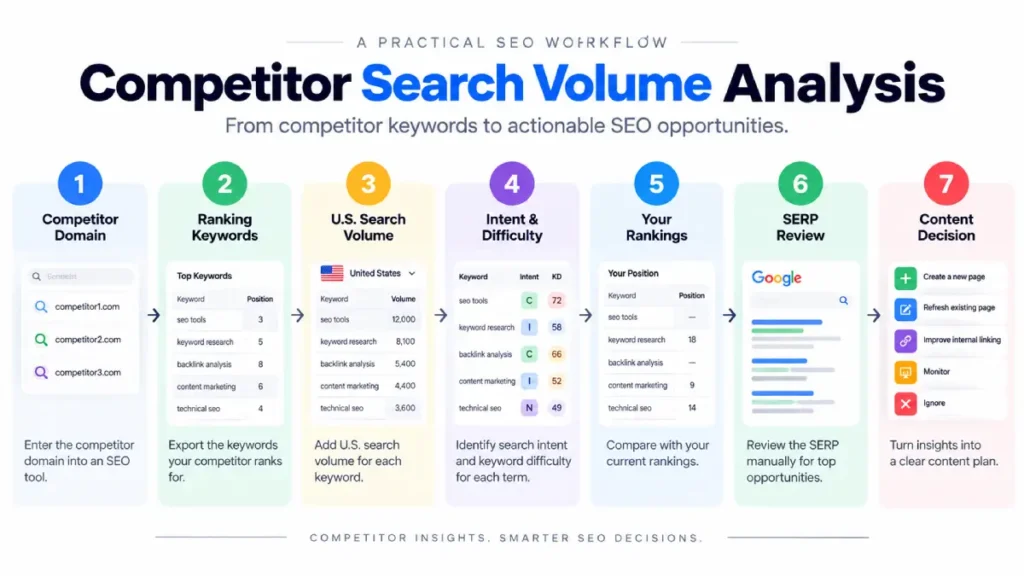
For an SEO professional analyzing a U.S. competitor, the process can be reduced to seven steps:
- Enter the competitor domain into a competitor-research platform.
- Export ranking keywords relevant to the competitor’s organic visibility.
- Filter for the United States and confirm the volume geography.
- Add search volume, intent, difficulty, CPC, and ranking position.
- Compare the dataset against your own ranking keywords.
- Review the SERP manually for the highest-priority opportunities.
- Map each qualified opportunity to an existing URL, a new URL, or no action.
The result is not merely a list of high-volume keywords. It is a competitor demand map connected to actual content decisions.
What Search Volume Cannot Tell You?
Search volume alone cannot tell you:
- how many clicks your page will receive;
- whether the query matches your audience;
- whether the SERP is dominated by ads or other features;
- whether the ranking pages satisfy the same intent;
- whether your site has the topical relevance to compete;
- whether an existing page should be improved instead;
- or whether the traffic would produce business value.
Semrush, for example, notes that search volume is an estimate rather than an official Google search count, and its current tools also expose SERP features and AI Overview information because raw volume does not fully describe click potential.
That is why competitor search-volume analysis should be treated as an evidence-gathering process, not a volume-chasing exercise.
Final Takeaway
The most useful way to analyze competitor search volume is to connect competitor keywords → U.S. search demand → intent → competition → your existing coverage → SERP conditions.
The objective is not to reproduce everything a competitor ranks for.
It is to identify the subset of competitor-driven search demand that is relevant, strategically useful, and realistically actionable for your own site.
That distinction turns a raw competitor keyword export into an SEO decision framework.