

Ecommerce Keyword Research What Actually Mean?
Ecommerce keyword research is no longer a simple matter of matching high-volume seed terms to product pages. Modern search engines rely on semantic understanding, entity graphs, and user intent clusters to serve product listing pages (PLPs) and product detail pages (PDPs).
For SEO professionals managing enterprise or mid-market storefronts, effective keyword research requires aligning your site taxonomy, faceted navigation, and content architecture with how buyers actually articulate commercial intent across different funnel stages.
This article details an advanced, entity-first framework for executing e-commerce keyword research that avoids generic SEO blog tropes, harnesses primary data sources, and scales efficiently across large product catalogs.
1. Mapping Search Intent Across the E-Commerce Funnel
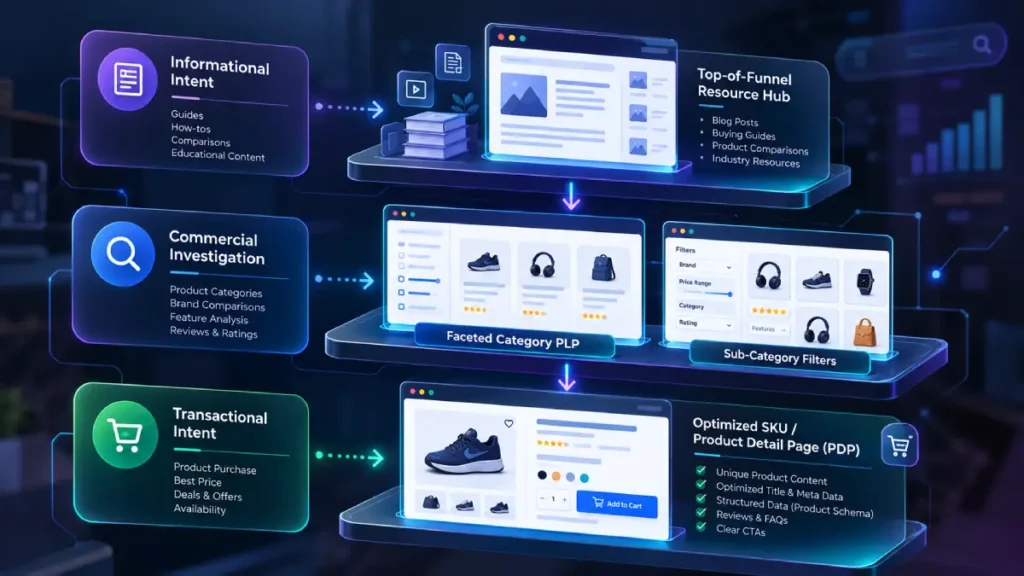
Traditional keyword research tools often conflate informational searches with transactional intent, leading to misguided landing page optimization. In e-commerce, keyword intent dictates architectural placement.
- Informational Queries: Users are in the research phase (e.g., “what is the best material for ergonomic office chairs”). These belong on top-of-funnel resource hubs, buying guides, or blog content that internally links to category filters.
- Commercial Investigation Queries: Users are comparing specifications, features, or brands (e.g., “mesh vs leather ergonomic chair under 500”): these target sub-categories, comparison matrices, and filtered PLPs.
- Transactional Queries: Users are ready to purchase a specific item or SKU (e.g., “Herman Miller Aeron size B refurbished”). These must land directly on optimized PDPs or specific faceted collection pages.
Misaligning intent—such as driving transactional category terms to a blog post—results in poor conversion rates and weak algorithmic signals. To structure your strategy effectively, refer to foundational content strategy principles to ensure every keyword matches the appropriate template type.
2. Leveraging Product Taxonomy and Faceted Navigation
The most common failure in e-commerce SEO is treating keyword research as an isolated spreadsheet exercise rather than a reflection of inventory architecture. Your keyword universe must mirror your product taxonomy.
Parent Categories and Broad Seed Terms
Broad seed terms represent root categories (e.g., “running shoes”). While search volume is high, conversion intent is low, and competition is fierce. These terms belong exclusively to top-level category headers.
Sub-Categories and Modifiers
As you drill down into sub-categories, modifier combinations grow exponentially (e.g., “men’s trail running shoes,” “waterproof trail running shoes for men”).
These modifiers represent the sweet spot for commercial ranking potential. You must mine customer search logs, internal site search data, and filter usage analytics to identify which attribute combinations generate active search demand.
According to research published by the Baymard Institute, users heavily rely on faceted filters to narrow down product options. If your site lacks dedicated crawlable URLs for high-demand facet combinations (e.g., size + color + material), you are leaving significant long-tail traffic on the table.
3. Mining First-Party Data and Transactional Queries

Relying solely on third-party keyword tools creates blind spots because commercial tools estimate volume based on sampled clickstream data rather than direct buyer behavior. To uncover true high-intent opportunities, SEO professionals must tap into internal data streams:
- Internal Site Search Logs: Export queries from your platform’s search bar. Look for terms with zero results (indicating missing inventory or poorly optimized categories) and high-frequency queries that differ from your official product names.
- Customer Support Transcripts: Analyze chat logs and support tickets to identify exact terminology, pain points, and objections used by buyers. Customers rarely use corporate product names; they search by problem or specific feature constraint.
- Log File Analysis: Review how search engine bots crawl your existing product and category pages to identify orphaned pages or underperforming URL variations.
For technical execution guidelines on managing crawl budgets and parameter handling, consult official documentation via Google Search Central.
4. Avoiding Competitor SEO Blog Echo Chambers
A major pitfall in keyword research is circular referencing—copying keyword lists from competing SEO software blogs or generic marketing sites. Competitor SEO blogs often target high-volume vanity terms that yield low conversions.
Instead, build your keyword corpus using an entity-first methodology:
- Identify core product entities and their attributes (material, dimensions, use case, brand, compatibility).
- Use semantic triples (Subject-Predicate-Object) to map out how users describe relationships between products.
- Incorporate structured data markup using standards from Schema.org to reinforce product entities and pricing clarity to search engine crawlers.
This methodology ensures your keyword strategy is built on unique inventory data rather than recycled competitor approximations.
5. Programmatic Keyword Mapping for Large-Scale Catalogs
For stores managing tens of thousands of SKUs, manual keyword mapping is impossible. Enterprise e-commerce SEO requires programmatic keyword generation models.
- Matrix Generation: Combine brand nouns, product types, and modifier adjectives into dynamic URL generation templates.
- Volume Threshold Filtering: Programmatically filter out low-potential permutations where aggregate search volume falls below viable economic thresholds to prevent index bloat.
- Cannibalization Prevention: Ensure that parent categories, sub-categories, and individual PDPs do not target overlapping modifier clusters, maintaining clear topical boundaries across your catalog.
By automating the mapping process while maintaining strict editorial and technical oversight, you can scale organic search visibility across massive product inventories without sacrificing relevancy or user experience.