

Tiered link graph architecture is an enterprise link-building methodology that structures backlinks into hierarchical layers (tiers) to maximize PageRank pass-through while insulating the primary domain from search engine pattern penalties.
Unlike legacy automated tiering—which relied on low-quality Web 2.0 profiles or forum blasts at lower levels—modern link graph engineering constructs clean, multi-layered networks.
Tier 1 consists of high-authority editorial, digital PR, or earned media placements that point directly to money pages. Tier 2 comprises contextual secondary placements (such as niche citations, unlinked brand recoveries, or resource inclusions) that point directly to Tier 1 assets.
Tier 3 leverages natural social syndication, brand co-citations, and organic news pickup. By routing secondary link equity through earned Tier 1 nodes, enterprise SEOs increase the stability of indexation and the overall PageRank output of core backlink assets without triggering algorithmic link-spam filters.
The Physics of Link Equity: PageRank Decay & Node Distance
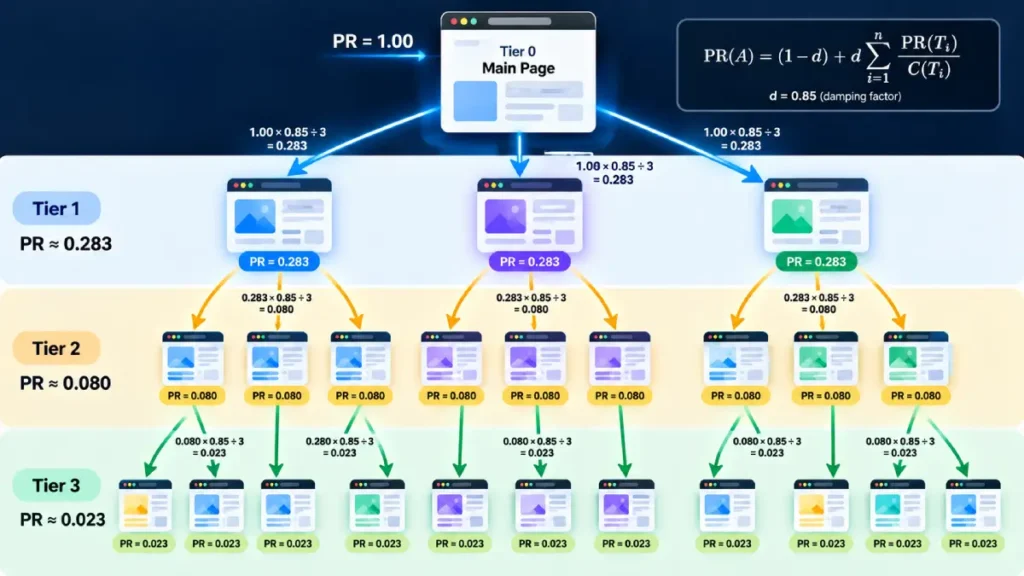
The foundational principle of tiered link graph architecture lies in damped PageRank calculation. Search engine algorithms compute page-level authority using a dampening factor (typically estimated around 0.85), meaning every hop across a node in a link graph reduces the transmitted equity:
Where d is the dampening factor, PR(Ti) is the PageRank of referring node Ti, and C(Ti) is the total outbound link count on that node.
[ Tier 3: Syndication & Social Co-Citations ]
                    │
                    ▼
[ Tier 2: Niche Citations & Resource Nodes ]
                    │
                    ▼
[ Tier 1: High-Authority Editorial Assets ]
                    │
                    ▼
[ Apex / Money Page: Primary Enterprise Domain ]
When a Tier 2 page links to a Tier 1 page, it increases the Tier 1 page’s internal authority metric. When the Tier 1 page subsequently links to your enterprise site, the net PageRank transferred to your domain is significantly higher than if the Tier 1 page remained an isolated node.
However, mathematical decay dictates that a low-authority Tier 2 link passes negligible value if the intermediate Tier 1 node has an excessive outbound link count. To maintain structural efficiency, enterprise SEOs must perform a rigorous link equity analytics framework
to evaluate link decay and verify that intermediate nodes maintain strong topical relevance and low outbound link density.
2026 Algorithmic Pattern Detection: SpamBrain & Link Graph AI
Legacy tiered link building fell out of favor due to aggressive footprint detection. Google’s SpamBrain AI system and updated link spam algorithms analyze backlink profiles as interconnected graphs rather than isolated URLs. Modern search algorithms identify unnatural multi-tiered networks through four primary anomaly vectors:
- Synchronous Link Velocity: Spikes in secondary links appearing within short timeframes around a Tier 1 publication date.
- Anchor Text Homogeneity: Repeated exact-match anchor text across Tier 2 and Tier 3 nodes feeding into Tier 1 anchors.
- Co-Location & Infrastructure Footprints: Shared C-class IP blocks, WHOIS registration clusters, or duplicate CMS templates among supporting nodes.
- Topical Asymmetry: Irrelevant lower-tier content linking to specialized Tier 1 topics (e.g., a commercial casino blog linking to a B2B SaaS editorial).
According to industry research from Reporter Outreach’s Link Building Analysis, over 62% of enterprise SEO specialists prioritize top-tier editorial quality over secondary volume.
Propping up low-quality Tier 1 assets with automated Tier 2 web spam frequently leads to algorithmic neutralization, where search engine parsers ignore the entire downstream graph without passing equity.
Structuring a Non-Spammy 3-Tier Link Network
To construct a resilient link graph, every tier must meet strict quality standards and serve a distinct function within your overall enterprise link building strategy
.
| Network Tier | Core Objective | Primary Source Types | Target Anchor Text Vector | Indexation & Equity Strategy |
| Tier 1 (Direct) | Direct PageRank transfer & target keyword ranking | Tier 1 newsrooms, Digital PR campaigns, HARO placements, industry publications | Branded, URL, & Partial-Match Topical Anchors | Dofollow, high indexation persistence, low outbound link ratio. |
| Tier 2 (Amplifier) | Boost Tier 1 node authority & accelerate index retention | Niche guest posts, resource pages, unlinked brand reclamation, local partner blogs | Article Title, Co-Occurring Phrases, Branded Variations | Dofollow/Nofollow mix, organic velocity curve, contextual topical alignment. |
| Tier 3 (Discovery) | Drive referral crawls & social proof signals | Social syndication, community forums, press releases, content aggregators | Naked URLs, Generic Phrases, Brand Mentions | High crawling frequency, index discovery booster for Tier 2 nodes. |
Technical Anchor Text Vector Distribution Across Tiers
Manipulating anchor text across multiple link layers is one of the fastest ways to trigger search engine spam filters. Natural link graphs exhibit varying anchor density depending on node depth.
TIER 1 ANCHOR PROFILE:
[======================= 70% Branded / Naked URL =======================]
[========= 20% Topical Partial-Match =========]
[=== 10% Exact ===]

TIER 2 ANCHOR PROFILE:
[================================ 85% Page Title / Branded ================================]
[===== 15% Broad Topical =====]
When executing Tier 2 outreach to support your Tier 1 editorial strategy, keep secondary anchors focused on target page titles or natural conversational references.
Detailed analysis of anchor text vector distribution demonstrates that over-optimizing secondary anchors creates an unnatural algorithmic footprint across the entire node graph.
5-Step Operational Execution Framework
Executing an enterprise-grade tiered link graph requires systematic outreach and tracking. Follow this 5-step operational framework to deploy multi-layered link structures safely:
- Identify High-Potential Tier 1 Nodes: Filter existing backlinks for high Domain Authority (DR 60+) and strong topical relevance, but low organic indexation traffic or weak tier-2 support.
- Select Secondary Link Targets: Identify contextual opportunities such as unlinked brand mentions, broken links on related industry resources, or high-quality niche guest blogs.
- Align Secondary Anchors to Tier 1 Targets: Point secondary links directly to the Tier 1 publication URL using natural page-title anchors.
- Initiate Social & Syndication Discovery (Tier 3): Share the Tier 1 and Tier 2 URLs across verified social channels and industry news roundups to establish natural crawl paths.
- Monitor Node Health & Graph Integrity: Track crawl frequency and link retention using Google Search Console and log analysis to ensure Tier 1 pages remain indexed and active.
By building secondary equity directly into earned editorial assets, enterprise websites can sustain high search visibility while keeping their direct backlink profile clean and compliant.