

What is Pivot to Data Journalism?
For SEO professionals, a pivot to data journalism represents a natural evolution rather than a career reinvention. Traditional search engine optimization focuses on optimizing content for algorithmic visibility and user acquisition.
Data journalism harnesses statistical analysis, public data pipelines, and investigative reporting to uncover original stories that command industry authority.
As search algorithms increasingly prioritize unique insights, primary research, and demonstrable expertise under rigorous Google E-E-A-T guidelines, mastering data journalism empowers SEOs to transition from reactive content producers to proactive industry investigators who break news rather than chase keywords.
The Core Intersection: Why SEO Skills Translate to Data Journalism
The foundational skill set of an advanced SEO professional maps directly onto the investigative workflows of a modern data journalist. Both disciplines rely heavily on quantitative analysis, pattern recognition, and audience intent modeling.
| Skill Area | SEO Application | Data Journalism Application |
| Keyword & Query Analysis | Identifying search volume, user intent, and long-tail semantic clusters. | Formulating investigative hypotheses, spotting anomaly trends, and querying public databases. |
| Data Processing | Analyzing crawl logs, GSC performance reports, and backlink graphs. | Cleaning raw CSV/JSON datasets, merging spreadsheets, and running descriptive statistics. |
| Content Structuring | Organizing information via hierarchical headings for scannability and context. | Designing narrative arcs, data visualizations, and interactive scrollytelling formats. |
| Authority Building | Earning backlinks through linkable assets and digital PR campaigns. | Publishing primary source data, investigative scoops, and methodology disclosures that attract citations. |
By recognizing that keyword trends are essentially behavioral data streams, SEOs can easily pivot to extracting macroeconomic, industry, or search-behavior stories that resonate deeply with B2B and consumer audiences alike.
Phase 1: Sourcing and Harvesting Primary Data
Data journalism begins with raw data acquisition. Unlike traditional SEO content that relies on secondary research and competitor paraphrasing, data-driven reporting requires source material. SEO professionals already possess an advantage here through their familiarity with web scraping, API pagination, and public data repositories.
Key Public and Open Data Repositories for SEO & Tech Reporting
- Government & Economic Data: Utilizing datasets from the U.S. Census Bureau, Bureau of Labor Statistics (BLS), and SEC EDGAR filings to analyze macroeconomic shifts affecting digital marketing and commerce through Data.gov.
- Search & Web Behavior: Analyzing macro search trends via Google Trends data, public crawl statistics, and historical index growth metrics.
- Industry Benchmarks: Aggregating data from public tech filings, SaaS pricing indexes, and API usage statistics to report on software adoption rates and market consolidation.
When harvesting data, establish rigorous documentation habits. Maintain a clean, version-controlled repository (such as a GitHub repository or a structured Google Sheets archive) that details your extraction date, API parameters, and raw data transformations to ensure absolute reproducibility.
Phase 2: Data Cleaning, Validation, and Statistical Rigor
Raw data is rarely publication-ready. Inconsistent date formats, missing values, duplicate entries, and outliers can invalidate an entire investigative premise. SEO professionals accustomed to auditing messy technical migrations or unclean Google Analytics properties will find data sanitization familiar.
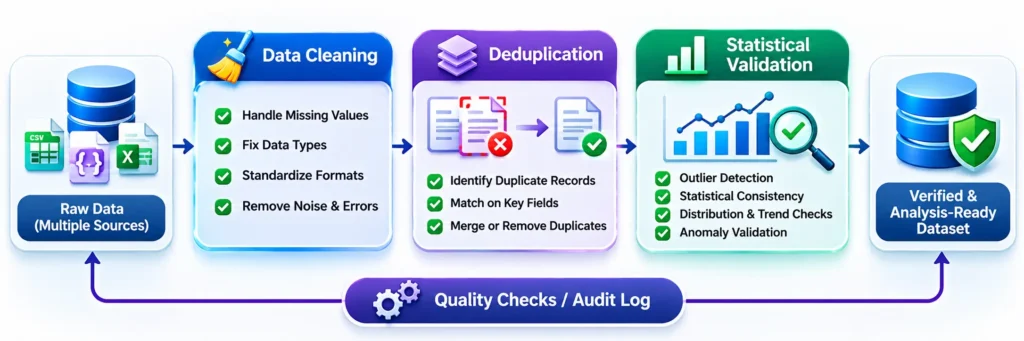
Essential Data Hygiene Steps
- Deduplication and Normalization: Standardize naming conventions, lowercase text strings, and remove duplicate primary keys across merged datasets.
- Handling Missing Values: Document how missing data points are handled—whether through omission, median imputation, or explicit notation in your final report.
- Correlation vs. Causation Audits: Avoid common statistical pitfalls. Just because organic traffic correlated with a specific algorithm update date does not automatically prove direct algorithmic causation without controlling for seasonality, technical site changes, and macro market shifts.
For advanced analysis, transition from basic spreadsheets to data manipulation libraries to handle large-scale datasets efficiently using pandas, ensuring your findings withstand peer review from industry experts.
Phase 3: Translating Numbers into Compelling Narratives
The greatest differentiator between a dry spreadsheet and high-impact data journalism is narrative framing. Data journalists do not just publish charts; they tell human stories hidden within quantitative trends.
To structure your data piece for maximum engagement:
- Lead with the Anomaly: Start your article with the most surprising statistical finding or trend break rather than a generic introduction.
- Contextualize the Impact: Explain what the data means for the reader’s day-to-day operations or industry landscape.
- Incorporate Visual Hierarchy: Pair every major data insight with a clean, minimalist data visualization or summary table. Readers should be able to grasp the core takeaway within seconds of scanning.
For further reading on structuring high-density technical assets, review our guide on Advanced Content Strategy Frameworks.
Phase 4: Ethical Considerations, Attribution, and Methodological Transparency
Data journalism carries a high standard of editorial integrity. Because your findings may influence industry decisions, investments, or brand reputations, transparency is non-negotiable.
- Publish Your Methodology: Always include a dedicated methodology section or link to your raw data source and analysis code. Readers and fellow journalists must be able to verify your claims.
- Protect Privacy: Ensure any scraped or aggregated data complies with privacy standards (such as GDPR and CCPA), avoiding the exposure of personally identifiable information (PII).
- Correct Errors Swiftly: If a calculation error is discovered post-publication, issue a transparent, time-stamped correction note immediately.
By combining the technical agility of SEO with the rigorous ethics and storytelling of investigative journalism, you create content that transcends traditional search marketing and establishes enduring brand equity.