
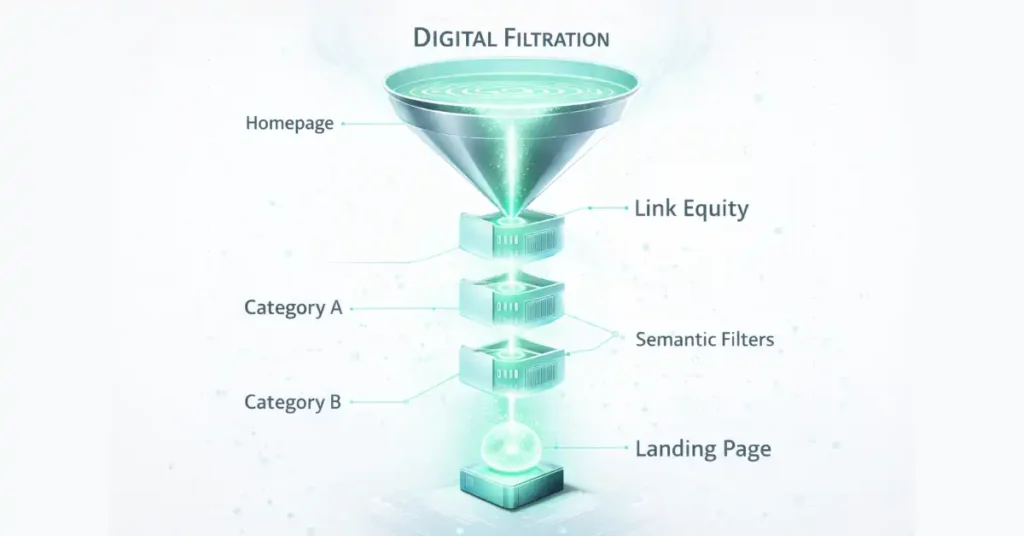
The debate between Folder Logic vs Flat Hierarchy has evolved from a simple URL aesthetic choice into a critical decision for crawl efficiency, data governance, and AI legibility. Choosing the wrong structure creates technical debt and limits search engine visibility.
Balancing clear semantic directory paths with flat file discovery arrays changes how indexing systems map internal authority, a topic explored deeply in our guide to Technical SEO Architecture and Directory Topology.
If search bots or generative AI crawlers cannot intuitively map the relationship between your entities, your topical authority dilutes across disconnected URLs.
When discussing URL integrity, we must look beyond marketing aesthetics and return to the primary engineering definitions established by the IETF URI generic syntax standards (RFC 3986).
RFC 3986 defines the hierarchical nature of URI schemes, noting that the slash (/) serves as a delimiter for hierarchical components.
Sites violating these syntax rules, often by over-complicating flat hierarchies with excessive parameters, frequently trigger soft 404 errors.
This article moves beyond basic URL length advice to examine how site architecture influences modern search engines, simplifies analytics reporting, and powers a hybrid structural framework.
Defining the Core Conflict: The Library vs. The Warehouse
Information Architecture (IA) dictates how users and search engines interpret a website’s scope. IA involves the categorization, labeling, and movement of data across a digital ecosystem.
A hierarchical IA provides a predictable mental model, reducing cognitive load. IA must remain “ontology-first,” defining relationships between objects before establishing URL strings.
A well-executed IA acts as a stabilizer for E-E-A-T signals, demonstrating a methodical approach to subject matter.
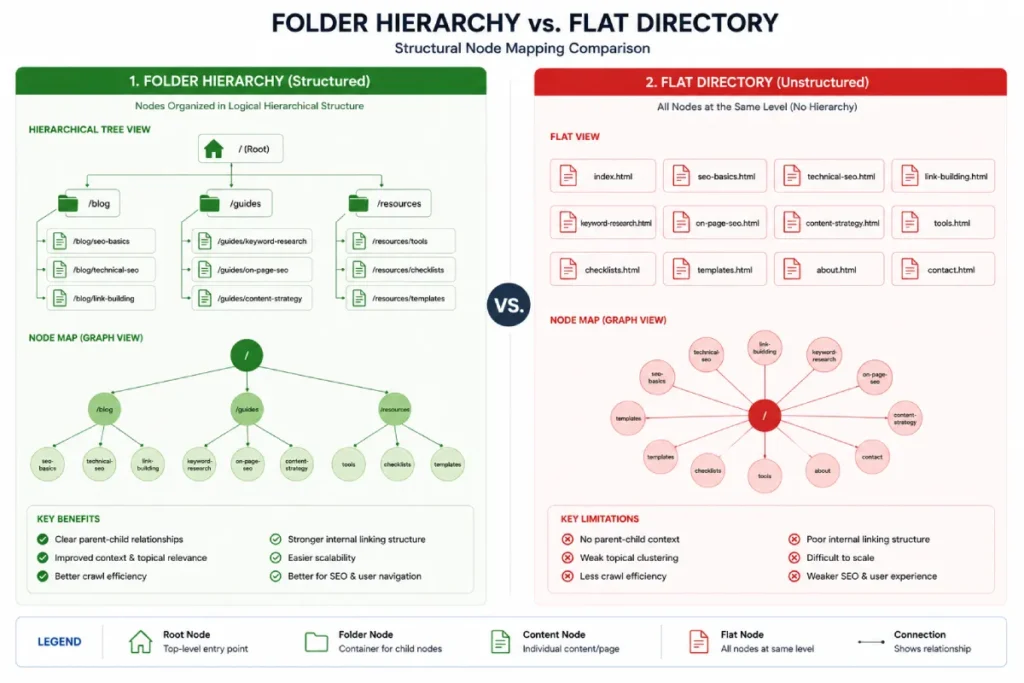
- Folder Logic (Deep Hierarchy): The “Library” model. Every page has a specific directory path (e.g.,
domain.com/solutions/enterprise/cloud-security/). It uses subdirectories to construct explicit parent-child relationships. - Flat Hierarchy (Wide Architecture): The “Amazon Warehouse” model. Content sits one slash away from the root (e.g.,
domain.com/cloud-security/), indexed by unique IDs and mapped via internal links.
IA serves as an explicit context model for search systems. Folder Logic provides a labeled hierarchy that AI crawlers use to weight nodes.
A flat hierarchy forces systems to infer importance based primarily on internal link density.
Crawl Efficiency & Search Engine Processing
Crawl allocation is dictated by server capacity and search engine demand. Deep folder structures can create crawl issues if not managed with precise robots.txt rules or canonical tags.
Conversely, flat hierarchies make pages easy to reach but can dilute contextual priority.
Without directory signposts, crawlers may evaluate low-value utility pages with the same priority as core commercial landing pages.
In a Folder Logic structure, directory-level metadata and Last-Modified headers allow crawlers to optimize resource usage.
If a directory contains hundreds of pages and none have updated, crawlers can skip deep re-indexing sweeps. Flat structures force engines to evaluate every URL individually.
To optimize discovery, review our guide on Discovery vs Crawling: How Modern Search Engines Work.
Furthermore, review Google’s documentation on URL structure best practices. Google explicitly states that descriptive, simple directory structures help search engines crawl sites efficiently.
Topical Authority and Semantic Siloing
Folder Logic enables semantic containerization. Grouping related concepts under a single parent path (e.g., /coffee-machines/manual/ and /coffee-machines/automatic/) explicitly establishes subtype entity relationships.
While flat models pass homepage equity directly to deep pages, directory systems pass topically distilled equity.
When an authoritative category page links to a child sub-folder, it delivers targeted contextual relevance.
Managing internal link equity distribution ensures cornerstone content receives appropriate ranking power without diluting thematic focus.
Nesting content within thematic subdirectories establishes a semantic parent that reinforces long-tail queries.
For example, a page targeting specialized hardware gains contextual authority when positioned within a dedicated /hardware/ directory rather than sitting at the root domain.
To align URL patterns with core search intent, consult our methodology for building a data-driven keyword strategy.
The Reporting & Analytics Advantage
Folder Logic provides major advantages for reporting and data segmentation.
- With Folder Logic: You can use simple regular expressions (e.g.,
^/blog/.*) in Google Search Console and GA4 to isolate content performance instantly. - With Flat Hierarchy: Data segmentation requires manual URL mapping or complex lookup tables.
Isolating directory performance allows teams to identify technical or content decay rapidly.
The Hybrid Architecture Model
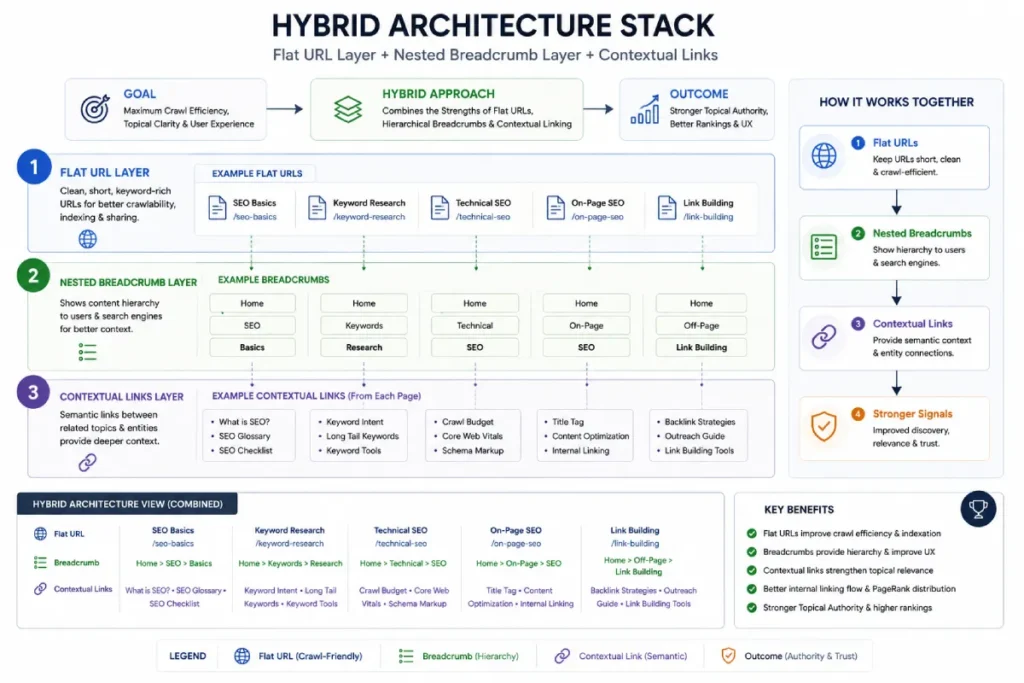
The modern architectural standard combines the strengths of both systems. Hybrid Architecture utilizes flat URLs for permanent link equity alongside hierarchical internal linking, navigation, and schema for topical organization.
This model allows you to update or re-categorize content structures without changing physical URLs or introducing 301 redirect chains.
Adhering to W3C standards for accessible navigation and breadcrumbs ensures structural clarity for users and web crawlers alike.
Implementing BreadcrumbList schema provides search engines with explicit hierarchical data, regardless of physical URL depth.
User Experience and Mobile Performance
Folder logic supports progressive disclosure in user interface design. Displaying high-level categories before sub-categories reduces choice paralysis.
From a mobile performance perspective, flat sites with massive, universal navigation menus introduce heavy DOM payloads that slow down rendering.
Transitioning to directory-aware navigation loads only contextual links relevant to the active silo, reducing DOM node overhead.
For strategies on optimizing layout performance and mobile delivery, explore our framework for improving internal link structure for mobile bots and our guide to improving mobile LCP metrics.
Architecture Comparison & Technical Audit Framework
| Feature | Folder Logic (Deep) | Flat Hierarchy (Wide) |
|---|---|---|
| Topical Authority | High (Strong Siloing) | Moderate (Requires Heavy Internal Links) |
| Link Equity Distribution | Concentrated via Directories | Direct from Root |
| Data Segmentation (GSC/GA4) | Simple (Regex Friendly) | Complex (Manual Tagging) |
| AI & LLM Context | High (Path Disambiguation) | Moderate (Relies on Schema) |
| Scalability (1,000+ Pages) | High (Organized) | Low (Risk of Orphan Pages) |
Technical Audit Appendix: Log File Analysis Framework
Log file analysis provides technical verification of how crawlers navigate site architecture.
1. Key Performance Indicators to Isolate
| Metric | Purpose | Target Benchmark |
|---|---|---|
| Crawl Frequency by Path | Compare crawl hits between /folder/ segments and root pages. | Consistent crawl rates across core silos. |
| Response Latency | Verify whether nested paths introduce server overhead. | < 200ms regardless of path slashes. |
| Status Code Distribution | Identify orphaned flat URLs producing 404 errors. | Zero non-essential 404/5xx errors. |
2. Custom Regex Filters for Log Parsing
- Isolate Folder Logic Performance:
^/(solutions|blog|products)/.*/
Isolates URLs nested two or more levels deep to evaluate crawl depth. - Isolate Flat Hierarchy Performance:
^/[^/]+$
Isolates all pages sitting directly at the root level.
3. Step-by-Step Audit Workflow
- Extract Data: Download 30 days of desktop and mobile search bot log data.
- Calculate Crawl Ratios: Compute total crawls divided by total URLs for both
/folder/and/flat/segments. - Identify Inactive Directories: Flag subdirectories unvisited for over 14 days to resolve structural isolation.
- Remediate Crawl Waste: Prune or consolidate low-performing root URLs receiving bot crawls but zero search traffic.
Strategic Recommendations
For websites under 500 pages, a Flat Hierarchy with strong internal links provides agility.
For enterprise, e-commerce, or publishing sites with over 1,000 pages, Folder Logic or a Hybrid Architecture framework is essential for maintaining index control and topical clarity
Expert Architecture Implementation Checklist