

Google’s SpamBrain has fundamentally transformed how search engines identify, neutralize, and prevent web spam.
Unlike traditional rule-based filters that relied on static keyword checks or rigid link blacklists, SpamBrain operates as an artificial intelligence-based spam-prevention system that learns from patterns across the entire web index.
For SEO professionals, keeping pace with SpamBrain AI updates is essential for protecting site authority, ensuring proper indexation, and navigating the nuances of modern algorithm rollouts.
This guide breaks down the core architecture of SpamBrain, analyzes recent updates targeting generative AI spam and site reputation abuse, and provides an actionable framework for safeguarding your digital properties.
How SpamBrain Works: The Evolution of Google’s AI Spam Detection
Before SpamBrain, Google primarily relied on manual actions and legacy algorithmic filters like Penguin and Panda to catch unnatural links and thin content.
While effective for their time, these systems required constant manual tuning and could be circumvented by sophisticated manipulators who understood the exact threshold parameters.
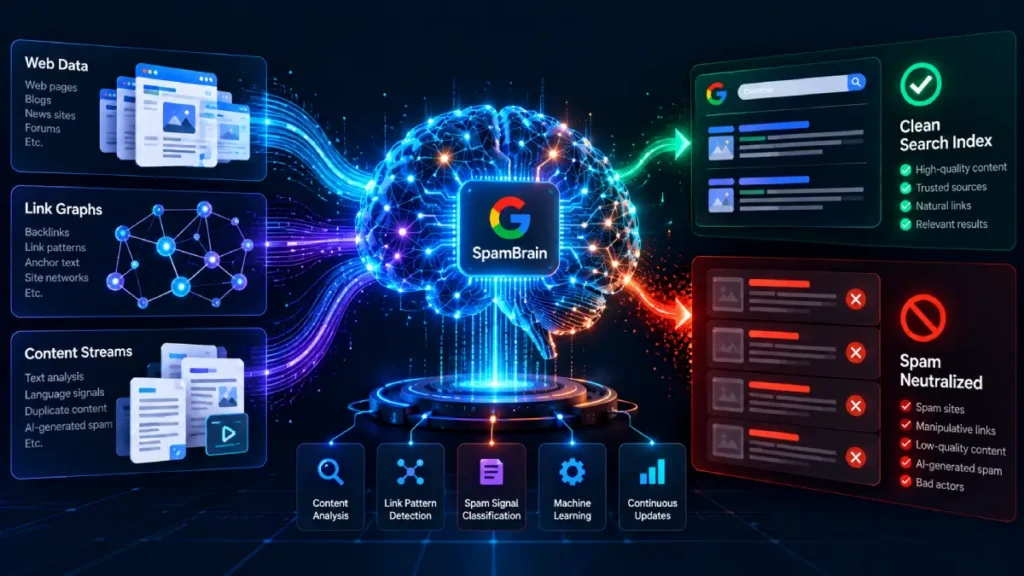
SpamBrain changed this dynamic by introducing continuous, machine-learning-driven detection. Launched in 2018 and significantly scaled in subsequent years, SpamBrain is trained to detect relationships among pages, domains, anchor text, and behavioral signals.
Because it uses AI, the system can generalize from known spam patterns to catch new, previously unseen tactics instantly.
A key advantage of SpamBrain is its ability to neutralize spam rather than just demoting entire sites.
For instance, instead of penalizing a domain for acquiring low-quality backlinks, SpamBrain can independently nullify those links so they pass no equity, rendering manipulative link-building campaigns entirely ineffective without requiring manual intervention.
Key SpamBrain AI Updates and What They Target
Google frequently integrates SpamBrain enhancements into broader spam rollouts and core updates. Understanding the specific vectors targeted by these updates helps SEO practitioners diagnose sudden ranking fluctuations.
1. Link Spam and Neutralization
Link manipulation remains one of the most common black-hat tactics. SpamBrain analyzes the broader context of link networks, guest post farms, and private blog networks (PBNs).
Rather than passing link juice, modern updates detect unnatural acquisition patterns and automatically nullify the links. Maintaining a clean link profile quality is more critical than ever, as toxic links waste crawl budget and signal poor site hygiene.
2. Scaled Content Abuse and Generative AI Spam
With the explosion of affordable large language models, low-effort programmatic content has flooded the web.
Google updated its spam policies and SpamBrain capabilities to target “scaled content abuse”—the practice of generating thousands of low-quality, automated pages designed purely to manipulate search rankings rather than provide genuine value.
SpamBrain assesses content depth, linguistic originality, and user engagement signals to suppress mass-produced thin content.
3. Site Reputation Abuse (Parasite SEO)
One of the most disruptive recent enforcement areas involves site reputation abuse, often colloquially known as parasite SEO.
This occurs when third-party content—such as low-quality coupon pages, sponsored financial reviews, or downloadable software directories—is hosted on an authoritative parent domain to piggyback on its trust and ranking power.
SpamBrain now flags and devalues these unverified third-party inclusions, treating them as spam when they lack editorial oversight or relevance to the primary site’s core mission.
SpamBrain vs. Core Updates: Understanding the Overlap
A common point of confusion among marketers is distinguishing between a Google core algorithm update and a SpamBrain-driven spam update.
- Core Updates: Broad adjustments to how Google assesses overall quality, relevance, experience, and authority standards across the entire web. They often result in sweeping ranking shifts for sites that lack sufficient topical depth or user trust.
- SpamBrain Updates: Targeted interventions specifically focused on policy violations—such as cloaking, hacked content, thin programmatic generation, and unnatural link manipulation.
While core updates can sometimes penalize low-quality sites, SpamBrain operates as a specialized defense layer that runs continuously in the background, supplemented by major standalone spam announcements.
When evaluating a traffic drop, SEO professionals must determine whether the issue stems from a technical policy violation caught by SpamBrain or a broader relevance mismatch addressed by a core algorithm update.
Practical Implications for SEO Professionals
Navigating an algorithmic landscape governed by AI-driven spam detection requires a proactive, compliance-first approach. Here is how SEO teams can adapt:
- Audit Content Production Pipelines: If your organization utilizes automated workflows or generative AI for content creation, ensure there is robust human editing, fact-checking, and original insight added. Publishing raw, unedited AI output at scale invites SpamBrain penalties for scaled content abuse.
- Review Third-Party Partnerships: Publishers must strictly vet guest authors, sponsored sections, and partner subdomains. Allowing external entities to publish low-quality content under your brand umbrella risks triggering site reputation penalties.
- Prioritize User Value over Keyword Metrics: Because SpamBrain evaluates semantic depth and user intent fulfillment, superficial optimization tactics fail. Align every piece of content with the generative content guidelines established by search engines to ensure long-term stability.

Future Outlook: What to Expect from AI-Driven Spam Mitigation
As generative tools become more sophisticated, spam tactics will inevitably evolve. Future SpamBrain updates will likely focus on multi-modal spam detection, identifying manipulated video, audio, and visual assets designed to deceive searchers or bypass standard text filters.
For the SEO industry, the overarching lesson remains consistent: sustainable search performance belongs to websites that prioritize authentic expertise, transparent editorial standards, and genuine utility for the end user.