

What is Faceted Navigation SEO?
Faceted navigation SEO is the strategic practice of optimizing filter-heavy e-commerce and large catalog websites so search engines can efficiently crawl, index, and rank core category pages without exhausting crawl budget or diluting link equity through millions of low-value, thin, or duplicate parameter URLs.
When left unmanaged, faceted navigation triggers parameter explosion—creating combinatorial URL variations (e.g., ?color=red&size=large&sort=price-asc) that trap web crawlers in infinite loops, waste server resources, and dilute keyword relevance.
Solving faceted navigation requires a multi-layered technical framework that combines precise canonicalization, strategic noindex directives, clean URL architecture, and JavaScript-driven state management to balance a frictionless user experience with robust search engine indexation governance.
The Core SEO Failure Modes of Faceted Navigation
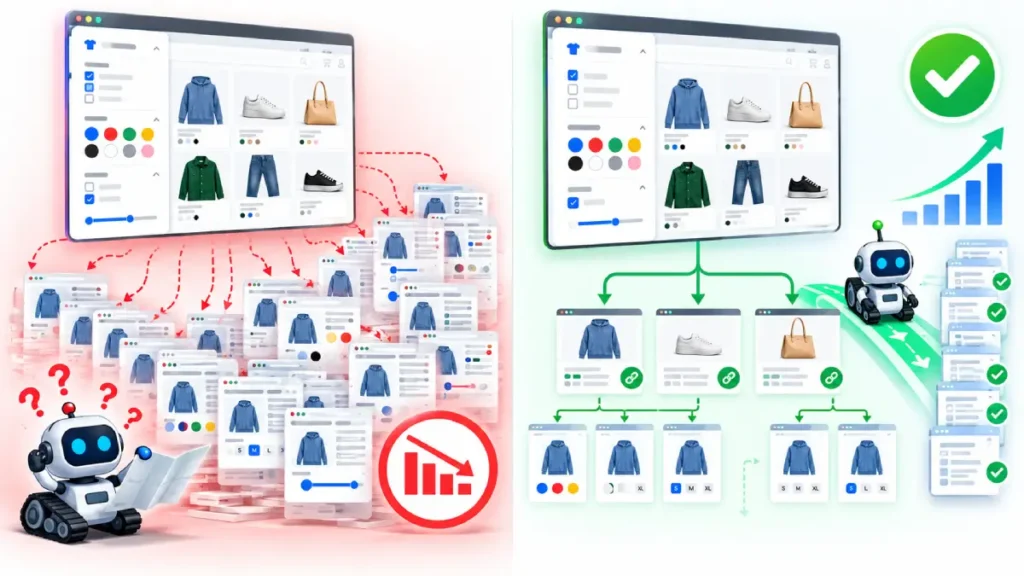
Before deploying technical solutions, SEO professionals must diagnose how faceted navigation damages site health across three critical vectors:
- Crawl Budget Exhaustion: Search engines allocate a finite crawl budget to each domain. When a 10,000-product e-commerce store generates 4.5 million filter combination URLs, Googlebot spends 99% of its crawl time on redundant parameters like sorting orders and secondary attributes rather than discovering new or updated revenue-generating pages.
- Duplicate Content and Cannibalization: Facets frequently generate unique URLs that serve identical content with minor attribute variations. Without explicit consolidation signals, search engines struggle to determine which URL represents the canonical ranking entity, splitting ranking signals across dozens of weak variations.
- Soft 404s and Thin Content Traps: Unfiltered filters often lead to zero-result pages or extremely thin product listings. When users or bots land on these pages, they deliver poor user signals and violate core search quality guidelines regarding valuable, original content.
| Facet Type | Indexation Risk | Recommended Technical Treatment |
| Primary Attributes (e.g., Brand, Core Material) | High (If high search volume exists) | Standalone SEO-friendly static subfolders with unique content. |
| Secondary Attributes (e.g., Color, Size) | Critical (Massive duplication potential) | Canonical to parent category or noindex, follow. |
Sorting & Pagination (e.g., ?sort=desc, page=2) | Moderate | rel="canonical" to page 1 for sorting; proper pagination linking. |
| Multi-Select Combinations (e.g., Red + Leather + Sale) | Severe (Combinatorial explosion) | noindex, follow or robots.txt block combined with canonicals. |
Technical Architecture & Mitigation Strategies
Implementing robust technical controls ensures that search engines index only high-value landing pages while gracefully navigating secondary filters. For a deeper dive into foundational optimization, review our guide on Technical SEO Best Practices.
1. Strategic Canonicalization vs. Noindex Directives
The debate between using rel="canonical" and noindex for faceted navigation hinges on crawl budget severity:
- Canonicalization (
rel="canonical"): Directs search engine equity from parameter-heavy URLs back to the primary category page. This is ideal when you want search engines to pass link equity upstream. However, remember that Google treats canonical tags as hints, meaning bots may still crawl canonicalized URLs if server capacity allows. - Noindex Meta Tags: Explicitly command crawlers not to add the page to the index. When combined with
follow, it ensures link equity continues to flow through filter links without bloating the index. For sites facing extreme crawl budget depletion,noindex, followis often more decisive than canonical tags.
For advanced insights on managing duplicate indexation, consult our resource on Duplicate Content and Consolidation.
2. URL Architecture: Static Paths vs. Parameters
When certain facet combinations attract substantial organic search volume (e.g., “men’s running shoes under $100”), convert those specific facets into static, crawlable subfolder paths rather than dynamic parameters:
- Dynamic Parameter:
example.com/shoes?category=running&price=under-100 - Static Clean Path:
example.com/shoes/running/under-100
Static paths allow for unique title tags, H1 headers, and localized introductory content, transforming a low-value filter into a high-performing landing page.
3. JavaScript-Driven Facets (AJAX & PushState)
Modern single-page applications (SPAs) and AJAX-loaded filters can eliminate indexation bloat. By rendering filter updates dynamically via client-side JavaScript without altering the underlying URL structure (or by utilizing HTML5 history.pushState cleanly), search engines view the base category page as a single stable entity.
- Ensure critical primary content is server-side rendered (SSR) or dynamically rendered so Googlebot can parse initial category inventories effortlessly.
- Restrict internal linking inside facet menus by utilizing JavaScript event listeners rather than traditional
<a href>tags for low-value secondary filters, preventing bots from following thousands of combinatorial rabbit holes.
Advanced Indexation Governance & Internal Linking Control
Controlling how internal links expose faceted URLs is paramount. According to Google Search Central Documentation on URL Parameters, managing crawl parameters effectively prevents server overload and ensures efficient discovery.
Faceted Navigation Internal Link Budgeting
Every link on a page consumes crawl equity. If your sidebar contains 50 filter checkboxes across 5 categories, a single category page links out to thousands of parameterized permutations. To safeguard your crawl budget:
- Use
nofollowSparingly on Facet Links: While historical SEO practice heavily relied onrel="nofollow"for facets, Google now treatsnofollowas a hint. Combinenofollowwithnoindexon destination pages or rely on JavaScript injection for non-indexable filters. - Implement Facet Pagination Limits: Restrict the depth of pagination within faceted views. If a filtered query extends past page 3, automatically apply
noindexto prevent crawlers from indexing deep, low-relevance pagination tails. - Monitor Log Files Weekly: Use server log file analysis to audit how Googlebot and Bingbot interact with your parameter spaces. If bots spend more than 10% of their crawl requests on faceted parameters that yield zero organic traffic, tighten your robots.txt or noindex parameters immediately.
For teams struggling with crawler resource allocation, reference our comprehensive framework on Crawl Budget Optimization Strategies.
Conclusion
Faceted navigation SEO is not about restricting user experience; it is about establishing clear technical boundaries between what users need for discovery and what search engines require for efficient indexation.
By deploying a calculated mix of static subfolder generation for high-intent facets, strict noindex, follow rules for combinatorial bloat, and clean canonicalization, SEO professionals can protect crawl budgets, eliminate duplicate content, and turn complex product catalogs into organic traffic drivers.