
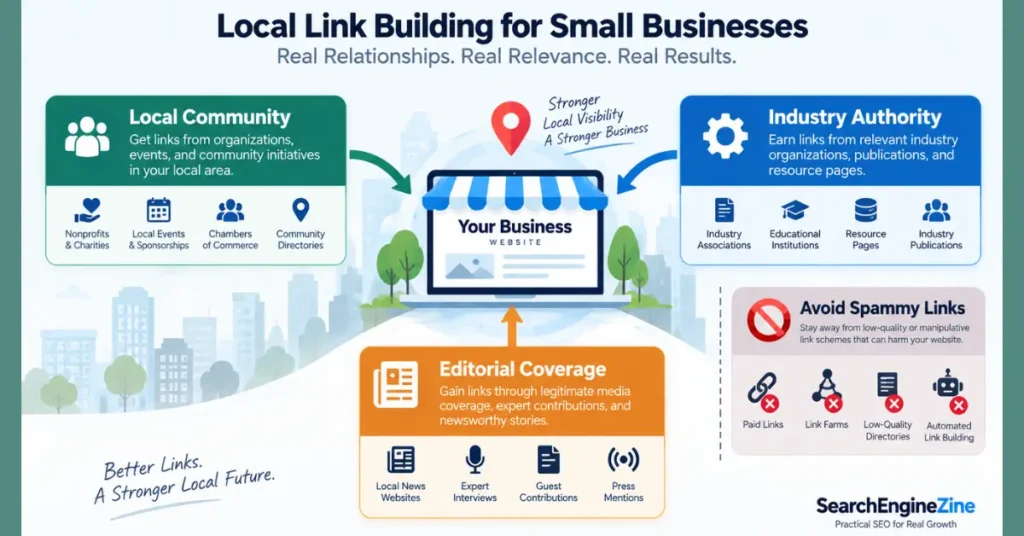
A local link building service for small business should focus on earning relevant links that strengthen the business’s connection to its industry, community, and geographic market—not simply increasing backlink numbers.
The best opportunities are usually local organizations, industry publications, community partnerships, relevant resource pages, genuine local sponsorships, and editorial coverage. A good service should explain why each opportunity is relevant, where the link may be placed, and whether the activity creates value beyond SEO.
This distinction matters because Google explicitly warns against links created primarily to manipulate rankings, including paid links that pass ranking credit, excessive exchanges, automated link creation, and low-quality directory links.
What Should a Local Link Building Service Actually Do?
For a small business, the service should begin with an opportunity audit, not a promise of a fixed number of backlinks.
A practical campaign usually has five stages:
- Audit the existing backlink profile and identify obvious gaps.
- Define the local relevance area—city, metro area, region, or multiple service locations.
- Find relevant organizations and publications connected to the business or community.
- Create legitimate reasons for outreach, such as partnerships, useful resources, events, expertise, or newsworthy activity.
- Evaluate placements for relevance and quality, rather than reporting only link metrics.
Google’s ranking systems still include link analysis systems, such as PageRank, but Google also uses many signals and systems when ranking pages. That means a local business should not treat link acquisition as an isolated shortcut to rankings.
The Most Valuable Types of Local Link Opportunities
| Opportunity | Best use case | What makes it valuable |
|---|---|---|
| Local editorial coverage | Businesses with newsworthy activity | Real audience and geographic relevance |
| Community organizations | Established local businesses | Genuine local relationships |
| Industry associations | Specialized services | Industry relevance and credibility |
| Local partnerships | Complementary businesses | Legitimate commercial or community connection |
| Resource pages | Businesses offering useful expertise | Contextual relevance |
| Events and sponsorships | Active community businesses | Visibility beyond the backlink itself |
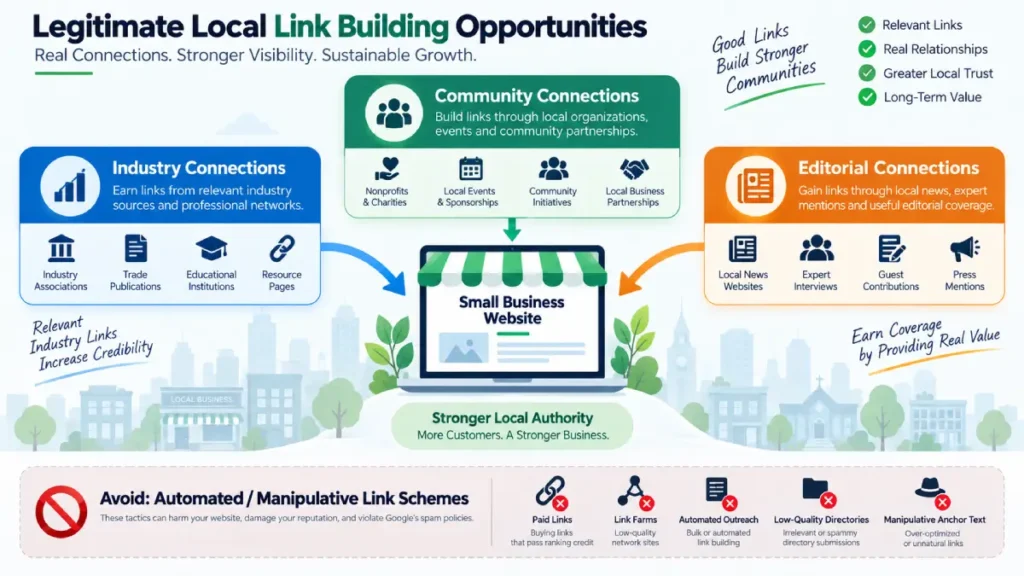
The important principle is simple:
A local link should make sense even if Google never counted it as a ranking signal.
That test helps separate legitimate marketing and relationship-building from campaigns designed purely to manufacture ranking signals. Businesses pursuing media exposure or expert positioning can also explore how editorial relationships contribute to off-page authority.
Local Links Are Not the Same as Citations
Small businesses often confuse local citations with local link building.
A citation generally helps establish business information across relevant platforms, while link building focuses on earning or acquiring hyperlinks from other websites.
Both can be part of a broader local SEO strategy, but they solve different problems within a broader local search strategy
Google also recommends that businesses establish their official business details so they can provide accurate information such as their address, contact details, business type, and photos across Google Search and Maps.
A strong local SEO foundation therefore looks more like this:
Business information → website quality → local relevance → useful content → legitimate mentions and links
—not simply:
Buy backlinks → rank higher
How to Evaluate a Local Link Building Provider
Before hiring a provider, ask these questions.
1. How are opportunities selected?
The provider should be able to explain whether prospects are chosen based on:
- geographic relevance;
- industry relevance;
- audience relevance;
- editorial quality;
- genuine relationship potential.
A large metric such as Domain Rating alone does not prove that a link is useful for a local business. The broader challenge is evaluating whether a placement contributes meaningful relevance rather than simply increasing backlink metrics, which is central to building a sustainable authority acquisition strategy
2. Will you see where the links come from?
Transparency matters.
You should understand the type of websites being targeted and whether the provider is using genuine outreach, partnerships, PR, sponsorship opportunities, or another method.
Be cautious when a service guarantees a large volume of links without explaining the underlying acquisition process.
3. Is the campaign creating links primarily to manipulate rankings?
This is one of the most important questions.
Google’s link spam policies specifically identify several problematic practices, including buying links that pass ranking credit, excessive link exchanges, automated link creation, and low-quality directory links.
A legitimate provider should be able to distinguish between marketing activity that may naturally result in links and a scheme designed primarily to manipulate Google’s ranking systems.
4. Are they measuring business value?
A useful campaign should not report only:
- number of links;
- Domain Rating;
- anchor text.
It should also consider whether placements improve:
- relevant referral visibility;
- local brand awareness;
- topical credibility;
- relationships with useful organizations;
- discoverability of important business pages.
A Better Decision Framework for Small Businesses
Before spending money on local link building, evaluate your business using this simple framework:
Foundation → Relevance → Opportunity → Evidence
Foundation: Is the website technically sound and does it clearly explain the business?
Relevance: Are the target pages genuinely useful for the services and locations you want to reach?
Opportunity: Are there real organizations, publications, events, partnerships, or resources where your business belongs?
Evidence: Can the provider explain why each proposed placement is relevant and legitimate?
If the answer to the first three questions is weak, buying more links is unlikely to solve the underlying problem.
For a broader understanding of how links fit into an SEO strategy, explore SearchEngineZine’s Off-Page Mastery hub and its resources on backlinks. SearchEngineZine’s sitemap also confirms these Off-Page and Local SEO sections as part of its current content architecture.
Red Flags to Avoid
Be particularly cautious when a provider:
- guarantees #1 rankings;
- sells links primarily by DR or DA;
- cannot explain how placements are obtained;
- promises unusually large volumes immediately;
- relies heavily on keyword-rich anchor text;
- uses automated outreach or automated link creation;
- hides the destination websites;
- treats every business in every city with the same campaign template.
Understanding the difference between legitimate acquisition and manipulative activity is particularly important when evaluating potentially harmful backlink patterns and broader off-page SEO risk signals
Google does not provide a formula where a certain number of backlinks guarantees a ranking position. Its ranking systems use many signals, and search results can change for numerous reasons.
What Small Businesses Should Ask Before Starting
A good first conversation with a local link building provider should answer:
- Which pages actually need stronger visibility?
- What geographic market matters most?
- Which local and industry relationships already exist?
- What legitimate opportunities are currently available?
- How will success be measured beyond backlink quantity?
That approach produces a more defensible strategy than purchasing a package simply because it includes a certain number of links.
The Bottom Line
A local link building service for small businesses is worth considering when it helps the business earn legitimate visibility from websites, organizations, and communities that are genuinely relevant to its market.
The strongest provider is not necessarily the one promising the most backlinks. It is the one that can explain why an opportunity matters, how it was earned, and how it fits into the business’s broader local SEO strategy.
Google’s own Search Essentials guidance emphasizes helpful content, crawlable links, and legitimate ways of making people aware of a site—while warning against unnatural link schemes.