
A Google Business Profile GBP category audit is the process of analyzing, benchmarking, and optimizing a local business’s primary and secondary category assignments against top-ranking competitors and Google’s official business taxonomy.
The primary category serves as one of the single most influential foundational signals in Google’s local ranking algorithm, directly dictating whether a profile appears in the coveted Local 3-Pack for high-intent search queries.
A category audit identifies misaligned primary categories, uncovers missing high-converting secondary categories, and eliminates category dilution that throttles geographic reach.
When local businesses struggle to rank despite strong review velocity and localized citations, improper category selection is frequently the root cause.
Executing a thorough GBP category audit ensures your business entity is accurately indexed by Google’s Knowledge Graph while unlocking category-specific attributes, menu features, and transactional CTA buttons that directly drive conversions.
Why Primary Category Selection Dictates Local Pack Rankings
Google treats the primary category as the definitive entity classification for a local business. While Google periodically updates its database of over 4,000 available categories, many local businesses operate with outdated, generic, or misplaced primary classifications.
Changing a primary category produces an immediate, high-impact shift in local search visibility. According to local SEO ranking factor studies and official Google Business Profile Category Guidelines
, primary categories heavily weigh local proximity and semantic relevance algorithms.
+-------------------------------------------------------------------+
|                  GOOGLE LOCAL RANKING FACTOR IMPACT              |
+-------------------------------------------------------------------+
| Primary GBP Category    : High Algorithmic Weight (Core Entity)  |
| Secondary Categories    : Moderate Contextual Expansion          |
| Review Keywords         : Supporting Semantic Reinforcement      |
| On-Page Signals         : Entity Consistency & Grounding         |
+-------------------------------------------------------------------+
Selecting the wrong primary category creates a fundamental disconnect between your profile and user search intent.
For instance, labeling a personal injury law firm as “Lawyer” instead of “Personal Injury Attorney” yields sub-optimal rankings for high-value legal queries in competitive metropolitan areas.
The 5-Step GBP Category Audit Methodology
Executing an actionable category audit requires moving beyond guesswork and analyzing real-time competitive patterns on the Search Engine Results Page (SERP).
Step 1: Competitor Category Extraction via DOM Parsing
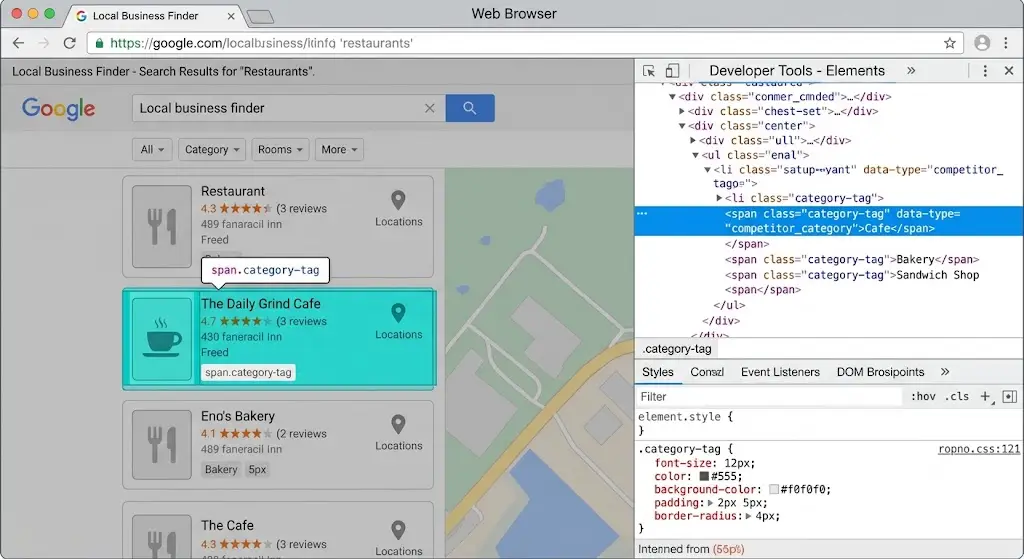
To establish a baseline, inspect the primary and secondary categories utilized by the top 5 ranking competitors in your specific target geo-grid.
- Perform local searches using localized IP proxies or location-spoofing tools (e.g., Chrome Developer Tools sensors).
- Use DOM inspection script snippets via Google Maps or browser extensions to reveal hidden secondary categories on competitor profiles.
- Document the primary-to-secondary category ratio for top 3-Pack performers.
Step 2: Intent-to-Taxonomy Mapping
Evaluate whether your primary category aligns directly with the transactional intent of your highest-revenue services.
- Informational vs. Transactional Alignment: Ensure your primary category reflects what you do, not merely what you sell. For example, an HVAC contractor repairing AC units should prioritize “Air Conditioning Repair Service” over “Air Conditioning Contractor.”
- Search Volume Validation: Cross-reference category names with keyword search volume to identify high-volume taxonomy terms.
Step 3: Secondary Category Expansion & De-duplication
Google permits up to 9 secondary categories, but adding irrelevant categories dilutes entity focus.
- Include secondary categories that represent distinct, high-margin service lines offered at that specific physical address.
- Eliminate overlapping or conflicting categories that cause semantic noise in Google’s Knowledge Graph, similar to managing crawl budget optimization strategies on complex websites.
Step 4: Attribute and Feature Unlock Verification
Specific GBP categories unlock unique interface features in Google Search and Maps:
- Medical/Health: Unlocks insurance accepted fields and online appointment booking links.
- Restaurants: Unlocks menu tabs, online ordering, and reservation integrations.
- Service Area Businesses (SABs): Unlocks service lists and custom quote request buttons.
Auditing your categories ensures you are not missing out on high-converting conversion features reserved for specific taxonomies.
Step 5: Entity Consistency & On-Page Signal Alignment
Google validates GBP category choices against your website’s landing page content and structured data.
- Ensure the target GBP landing page features matching structured schema markups and clear H1/H2 signals reinforcing the chosen primary category.
- Implement rigorous data-driven entity validation across external citations and Knowledge Graph nodes to prevent algorithmic suppression.
GBP Category Audit Decision Matrix
Use this strategic decision matrix during your audit to systematically resolve category conflicts and performance gaps.
| Scenario / Audit Discovery | Root Cause | Recommended Action | Expected Impact |
| Outranked by competitors with fewer reviews | Primary category is too broad (e.g., “Contractor” vs. “Roofing Contractor”). | Update primary category to match top competitor specificity. | Immediate boost in core local 3-pack visibility (1–7 days). |
| High impressions, low conversion rate | Category unlocks incorrect attributes or misrepresents services. | Re-align secondary categories; refine service list & CTA integrations. | Improved click-through rate (CTR) and lead conversion. |
| Sudden ranking drop after profile edits | Re-verification triggered or category dilution from adding >7 secondary categories. | Prune secondary categories down to 3–5 core services; verify NAP consistency. | Entity stabilization and recovery of map pack positions. |
| Website landing page fails to rank locally | Disconnect between GBP category and website on-page technical SEO foundations. | Synchronize schema markup, page title, and main content with primary GBP category. | Stronger organic-to-local hybrid ranking signal. |
Technical Edge-Cases and Re-Verification Risk Mitigation
Modifying a primary category carries inherent risk. In high-spam verticals (e.g., locksmiths, garage door repair, personal injury), updating primary business classifications can trigger Google’s automated re-verification workflow, suspending your profile temporarily.
Risk Mitigation Protocols
- Gradual Adjustments: Avoid changing primary and secondary categories simultaneously alongside phone numbers or physical address edits.
- Document Backups: Take screenshots of dashboard settings, business license verification documents, and utility bills before initiating primary category updates.
- Google API Validation: Reference the official Google Maps API Documentation to confirm official category IDs and localized name variations across regional taxonomies before saving changes.
Executing the Category Optimization Roadmap
- Conduct Benchmark Audit: Document baseline rankings across a 5×5 geo-grid for core transactional queries.
- Apply Category Hierarchy: Assign 1 primary category and 3–5 complementary secondary categories.
- Align On-Page Assets: Update website LocalBusiness schema and landing page content.
- Monitor Geo-Grid Performance: Track rank shifts across 14-day and 30-day windows post-update.
Regularly auditing your GBP categories—at least semi-annually or after major Google local algorithm updates—ensures your business maintains dominant local visibility in an evolving competitive landscape.