

Enterprise crawl budget refers to the allocation of search engine spider resources, predominantly Googlebot—dedicated to discovering, rendering, and re-indexing pages on large-scale websites comprising hundreds of thousands or millions of URLs.
It is governed by two core metrics: crawl rate limit (how many simultaneous requests a server can handle without performance degradation) and crawl demand (how urgently and frequently search engines want to crawl based on URL popularity and update frequency).
For enterprise SEO professionals, crawl budget optimization is not about forcing search engines to crawl more, but about eliminating structural waste so that high-priority, revenue-generating, and fresh content pages receive optimal attention and rapid indexation.
The Dual Pillars: Crawl Rate Limit vs. Crawl Demand
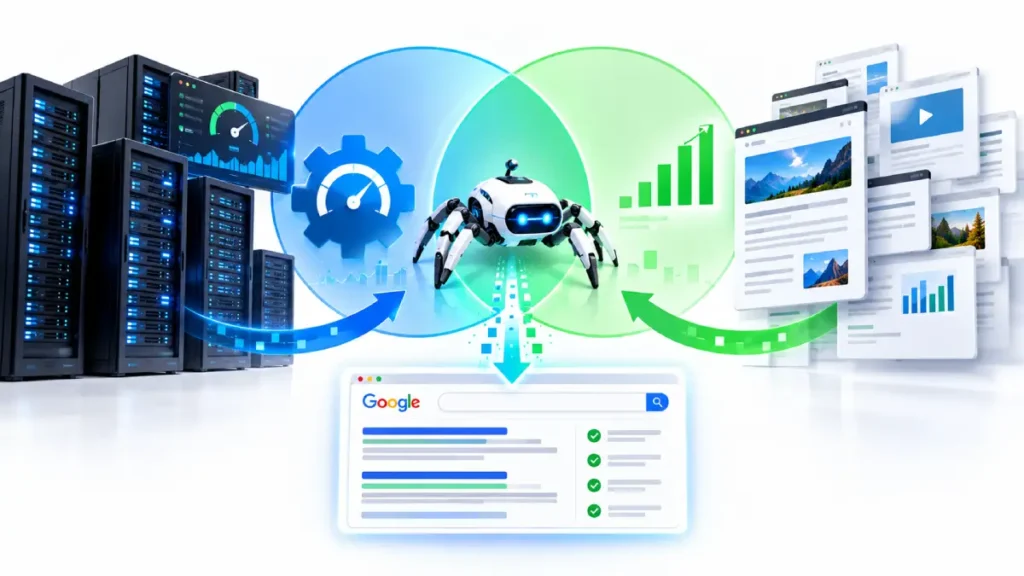
Understanding how search engines allocate resources requires separating server capacity from algorithmic preference. Enterprise sites often misdiagnose crawl issues by assuming Googlebot is ignoring them, when in reality, server throttling or poor architectural signals are restricting discovery.
1. Crawl Rate Limit (Server Capacity & Health)
Google dynamically adjusts its crawling speed based on your server’s health. If response times spike, HTTP 5xx errors increase, or TCP connection timeouts occur during a crawl surge, Googlebot automatically throttles back to protect your infrastructure.
- Server Response Optimization: Maintaining a TTFB (Time to First Byte) under 200ms ensures that crawl slots are fully utilized.
- CDN and Edge Caching: Offloading static assets and serving cached variants via edge networks reduces origin server load, allowing crawlers to process more dynamic pages per minute, as documented in Google Search Central Crawl Budget Management.
2. Crawl Demand (Popularity and Freshness)
Crawl demand is dictated by how often URLs are linked to internally and externally, alongside historical update cadences. Stale pages with zero incoming internal links or declining user engagement see their crawl frequency plummet to near zero. Conversely, high-authority category pages and newly published content see accelerated crawl priority.
Diagnosing Crawl Waste via Log File Analysis
Relying solely on search console metrics leaves a blind spot for enterprise-scale domains. Server log files provide the raw, unfiltered truth of how search engine bots interact with your infrastructure.
Key Log File Metrics to Evaluate:
- Bot Verification: Always cross-reference user-agents with reverse DNS lookups to ensure you are analyzing authentic Googlebot and Bingbot traffic rather than malicious scrapers, following the official Googlebot Verification Documentation
. - HTTP Status Code Distribution: Identify crawl budget bleeding caused by crawlers hitting soft 404s, redirect chains (301/302 loops), and permanent client-side errors (4xx).
- URL Frequency Mapping: Track which sections of the site consume the highest percentage of total crawl hits versus which sections drive organic traffic and conversions.
Expert Insight: If more than 20% of your daily crawler hits are spent on low-value filter combinations, tracking parameters, or pagination traps, your enterprise architecture is suffering from acute crawl waste. Review our comprehensiveTechnical SEO Guidefor advanced diagnostic frameworks.
High-Impact Architectural Frameworks for Crawl Efficiency
Optimizing crawl budget at an enterprise level requires systemic architectural controls rather than piecemeal fixes. Implement these foundational strategies to streamline bot traversal:
1. Advanced Faceted Navigation Management
E-commerce and programmatic directories often generate millions of indexable parameter variations (e.g., ?color=blue&size=large&sort=price). Left unchecked, this creates an infinite combinatorial explosion that exhausts crawl budgets.
- Parameter Handling: Utilize robust rules in search engine webmaster tools or enforce strict canonical tag strategies pointing to primary facet-free category roots.
- JavaScript Hydration for Filters: Load complex secondary facets via asynchronous JavaScript (AJAX) or user-triggered interactions, rendering them invisible to initial crawler discovery passes where appropriate.
2. Strategic Internal Link Sculpting
Bots discover pages by following hyperlinks. If your internal linking hierarchy buries core conversion pages four or five clicks deep, crawl frequency drops dramatically.
- Flattening Architecture: Ensure that all primary revenue pages are accessible within three clicks from the homepage.
- Dynamic Pagination Optimization: Replace deep, multi-page numerical pagination sequences with load-more triggers or structured infinite-scroll architectures, backed by crawlable sub-page URLs.
3. Precision Indexability Directives
Utilize robots.txt, noindex meta tags, and HTTP headers in concert to guide crawlers precisely where desired.
However, avoid blocking pages via robots.txt if you want search engines to read noindex tags residing on those pages; blocking the URL entirely prevents bots from seeing the instruction to de-index according to the IETF Robots Exclusion Protocol (RFC 9309).
For deep dives into traffic management, explore our resource on Enterprise Log File Analysis.
Common Enterprise Crawl Traps and How to Avoid Them
Even sophisticated engineering teams inadvertently introduce architectural patterns that paralyze search engine crawlers. Watch out for these three critical traps:
- Session IDs and Tracking Parameters: Unregulated affiliate IDs, marketing campaign tags (
utm_), and session tokens create duplicate URL instances of identical content. Implement strict canonicalization and parameter exclusion rules immediately. - Orphaned Content Masses: Content management systems often auto-generate landing pages, tag archives, and author feeds without linking back to them from primary navigation. These orphaned URLs waste crawl budget as bots stumble upon them via external backlinks or XML sitemaps.
- Stale XML Sitemaps: Submitting outdated XML sitemaps containing redirected, broken, or low-quality URLs misleads search engine bots and degrades overall crawl efficiency over time. Audit and automate your sitemap generation pipelines weekly.
Summary Checklist for Enterprise Crawl Budget Mastery
- Monitor Server Performance: Maintain sub-200ms TTFB and eliminate 5xx errors to prevent automated bot throttling.
- Execute Regular Log Audits: Isolate Googlebot user-agents in server logs to eliminate crawl waste on parameters, loops, and soft 404s.
- Control Faceted Navigation: Apply strict canonical tags or client-side rendering to combinatorial filter URLs.
- Refine Internal Architecture: Flatten link depths and ensure high-priority assets remain easily discoverable.
For further optimization tactics tailored to large-scale web properties, consult our strategic repository on Internal Linking Architecture.