
Understanding the Modern Keyword Research Framework
A modern Keyword Research Framework is no longer built around isolated keyword collection or simple search volume analysis alone.
Search ecosystems have evolved significantly through semantic indexing, AI-assisted retrieval systems, natural language processing, entity-based interpretation, and increasingly sophisticated user-intent modeling.
As a result, effective keyword research now requires a structured framework that connects user behavior, search intent, topical organization, competitive positioning, and content architecture into a unified SEO strategy.
Traditional keyword research approaches often focused heavily on identifying high-volume phrases and inserting them into content repeatedly in hopes of improving rankings. While keyword relevance still matters, modern search engines increasingly evaluate:
- Contextual meaning
- Search intent alignment
- Semantic relationships
- Topical depth
- Information quality
- User satisfaction signals
- Entity associations
- Content structure and relevance
This shift means keyword research must move beyond collecting phrases and instead focus on understanding how users search, why they search, what information they need, and how content can best satisfy those expectations throughout the entire search journey.
A structured Keyword Research Framework helps solve this challenge by organizing SEO strategy into scalable, measurable, and semantically coherent systems that support both discoverability and long-term topical authority.
Effective keyword research is not about chasing search volume — it is about understanding intent, mapping demand to content, and identifying gaps within competitive landscapes.
Modern search optimization requires aligning content with how users think, search, and make decisions across different stages of the journey.
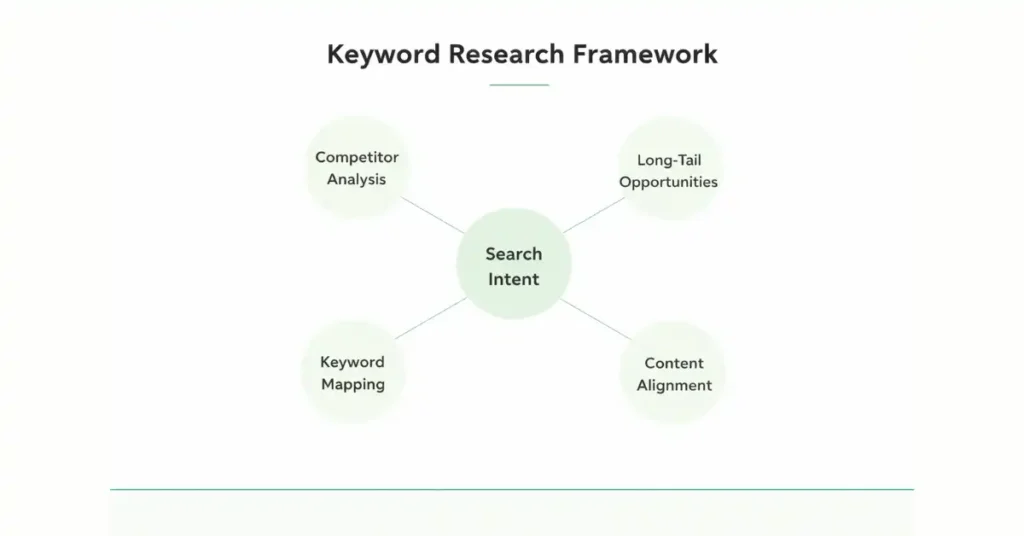
This Keyword Research framework organizes strategy into four essential components: search intent analysis, competitor research and gap discovery, long-tail opportunity identification, and keyword-to-content mapping.
Together, these elements create a structured approach that moves beyond isolated keyword targeting and toward building topical authority.
Search engines evaluate context, entity relationships, and user satisfaction signals — not just exact-match phrases.
By modeling intent correctly and mapping keywords to specific pages, you reduce cannibalization, improve internal relevance signals, and build coherent topic clusters that scale logically.
Whether you are planning new content or refining existing pages, this framework ensures your keyword strategy is grounded in user behavior and measurable search demand — not assumptions.
A Structured Keyword Strategy Covering Search Intent, Competitor Gap Analysis, Long-Tail Opportunities & Keyword-to-Content Mapping
INTENT (5)
- How to Identify High-Volume Low Competition Keywords Systematically NEW
- Informational Intent Nurturing: Structuring Funnel Sequences for Search Authority
- Transactional Intent Mapping: Data Structures for Commercial Page Performance
- Zero Click Search: Identifying Latent Organic Optimization Gaps
- Keyword Intent Analysis: Data Framework for Search Visibility
COMPETITORS (3)
LONG TAIL (4)
A well-structured keyword strategy clarifies content priorities, reduces duplication, and strengthens topical focus across your website.
By aligning search intent with page purpose and competitive positioning, you create a roadmap that supports both visibility and conversion.
Use this hub as your reference when conducting research, auditing content performance, or planning expansion into new search themes. Intent-driven optimization creates clarity for users, coherence for search engines, and sustainable growth over time.
Why Keyword Research Still Matters in AI Search
As AI-driven search systems become more advanced, some marketers mistakenly assume keyword research is becoming less important.
In reality, keyword research remains foundational because search behavior still reflects user demand, informational needs, and intent patterns.
The difference is that modern search engines interpret keywords more contextually rather than literally. Search systems increasingly evaluate:
- Query intent
- Topic relationships
- Search context
- Semantic similarity
- Conversational relevance
- User satisfaction outcomes
Keywords now function as signals within broader semantic ecosystems rather than isolated ranking triggers.
A strong Keyword Research Framework helps identify:
- What users are searching for
- Why are they searching
- Which topics matter most
- How information should be structured
- Where content gaps exist
- Which pages should target specific intents
This creates stronger alignment between user expectations and content architecture.
The Four Core Components of a Keyword Research Framework
An effective Keyword Research Framework is typically organized around four foundational pillars:
- Search Intent Analysis
- Competitor Research & Gap Discovery
- Long-Tail Opportunity Identification
- Keyword-to-Content Mapping
Together, these components help create scalable topical ecosystems that improve relevance, semantic clarity, and long-term search visibility.
Search Intent Analysis
Why Intent Is More Important Than Volume
Modern search optimization begins with understanding search intent. Search engines increasingly prioritize pages that satisfy the underlying purpose behind a query rather than pages that simply contain matching keywords.
Users search with different goals, including:
- Learning information
- Solving problems
- Comparing products
- Finding local services
- Making purchasing decisions
- Navigating to websites
A keyword may appear valuable based on volume metrics, but if the content fails to satisfy user intent, rankings often remain unstable or underperform.
Search intent generally falls into several categories:
Informational Intent
Users seeking knowledge or answers.
Examples:
- “What is semantic SEO?”
- “How AI search works.”
- “technical SEO checklist”
Transactional Intent
Users preparing to take action or purchase.
Examples:
- “Buy SEO audit service”
- “best keyword research tool”
Commercial Investigation
Users are researching options before deciding.
Examples:
- “Ahrefs vs Semrush”
- “best local SEO agencies”
Navigational Intent
Users are trying to reach a specific website or brand.
Examples:
- “Google Search Console login”
- “Search Engine Zine”
Understanding these distinctions allows marketers to align content structure, page purpose, and conversion strategy more effectively.
Why Search Engines Prioritize Intent Alignment
Search engines analyze behavioral signals to determine whether content satisfies users effectively.
These signals may include:
- Click behavior
- Dwell time
- Engagement patterns
- Query refinement behavior
- SERP interaction signals
- Contextual relevance
When content matches intent correctly, search systems may interpret stronger satisfaction outcomes.
A structured Keyword Research Framework helps ensure that:
- Informational keywords map to educational content
- Commercial keywords map to comparison or review pages
- Transactional keywords map to conversion-focused pages
This alignment strengthens relevance and reduces mismatched search experiences.
Competitor Research & Gap Discovery
Understanding Competitive Search Landscapes
Competitor analysis is another critical component of modern keyword strategy. Effective SEO is not simply about publishing more content — it is about understanding where opportunities exist within competitive search ecosystems.
Competitor research helps identify:
- Which keywords do competitors rank for
- Which content themes dominate search results
- Where topical gaps exist
- Which pages attract authority signals
- Which search intents remain underserved
This process helps avoid strategic blind spots and reveals opportunities for differentiation.
Identifying Content Gaps
Content gaps occur when:
- Users search for topics
- Competitors provide relevant resources
- Your website lacks sufficient coverage
A strong Keyword Research Framework identifies these missing opportunities systematically.
Gap analysis may reveal:
- Missing cluster content
- Weak topical depth
- Underdeveloped semantic coverage
- Unaddressed informational queries
- Emerging search themes
By filling these gaps strategically, websites strengthen topical authority and improve contextual relevance.
Why Competitive Analysis Matters for Topical Authority
Modern search engines increasingly reward websites demonstrating:
- Comprehensive topic coverage
- Structured content ecosystems
- Consistent expertise signals
- Semantic completeness
Competitor analysis helps benchmark how effectively your website covers important subject areas compared to other authoritative resources.
Rather than copying competitors directly, the goal is to:
- Identify weaknesses
- Expand topic depth
- Improve clarity
- Create stronger contextual organization
- Deliver more complete user value
Long-Tail Opportunity Identification
Why Long-Tail Keywords Matter
Long-tail keywords often represent some of the highest-value opportunities within modern SEO because they typically reflect:
- More specific intent
- Lower competition
- Higher contextual clarity
- Stronger conversion potential
Examples include:
- “best semantic SEO strategy for publishers”
- “how to structure topical authority clusters.”
- “AI-driven local search optimization framework”
These queries often indicate users who are further along in the informational or decision-making journey.
Long-Tail Keywords and AI Search
Conversational AI search systems increasingly interpret natural language queries rather than short keyword fragments alone.
Users now search using:
- Questions
- Conversational phrasing
- Context-rich queries
- Problem-focused language
This makes long-tail optimization increasingly important.
A structured Keyword Research Framework helps identify:
- Conversational queries
- Supporting semantic variations
- Informational subtopics
- Related intent patterns
This improves alignment with modern AI-assisted search behavior.
Why Long-Tail Keywords Improve Content Strategy
Long-tail keywords help websites:
- Expand semantic depth
- Build supporting topic clusters
- Address nuanced user needs
- Improve topical completeness
- Reduce overreliance on broad head terms
Long-tail content also helps create stronger internal linking ecosystems by connecting highly specific pages to broader hub content.
Keyword-to-Content Mapping
Why Mapping Matters
One of the most overlooked parts of keyword strategy is proper keyword-to-content mapping.
Without structured mapping, websites often create:
- Keyword cannibalization
- Duplicate topic coverage
- Confusing semantic signals
- Weak topical organization
A strong Keyword Research Framework assigns:
- Specific intents
- Specific keyword clusters
- Specific semantic themes
to clearly defined pages.
Preventing Keyword Cannibalization
Keyword cannibalization occurs when multiple pages compete for similar search intent.
This creates:
- Diluted relevance signals
- Confused ranking behavior
- Internal competition
- Weak topical clarity
Proper keyword mapping reduces these issues by ensuring each page serves a distinct purpose within the broader topical ecosystem.
Building Topic Clusters
Modern SEO increasingly rewards websites organized around:
- Pillar pages
- Cluster content
- Supporting educational resources
- Semantic relationships
Keyword mapping helps structure these ecosystems logically.
For example:
Pillar Topic
Semantic SEO
Supporting Clusters
- Entity-based optimization
- NLP in search
- Topical authority frameworks
- Structured data implementation
- AI-assisted retrieval systems
This organization improves semantic coherence and contextual relevance.
The Role of Internal Linking
Keyword mapping also supports stronger internal linking structures.
Effective internal linking:
- Reinforces semantic relationships
- Improves crawl accessibility
- Supports topical authority
- Clarifies page hierarchy
- Improves contextual relevance
Modern search systems increasingly evaluate how pages connect contextually across a website rather than evaluating documents independently.
Why Search Engines Evaluate Context
Search engines increasingly interpret:
- Meaning
- Context
- Relationships
- Intent
- User outcomes
This means SEO strategies built solely around isolated keywords often fail to scale sustainably.
A modern Keyword Research Framework supports:
- Contextual optimization
- Semantic organization
- Intent-focused architecture
- Structured topical ecosystems
This creates stronger long-term search visibility.
Entity Relationships and Semantic SEO
Modern search systems increasingly organize information around entities rather than exact keywords alone.
Entities may include:
- Brands
- Topics
- Concepts
- Locations
- Products
- People
Search engines analyze how these entities relate contextually.
A strong Keyword Research Framework helps identify:
- Related entities
- Supporting concepts
- Semantic relationships
- Contextual topic variations
This strengthens broader semantic optimization strategies.
Why Content Structure Matters
Search engines increasingly evaluate:
- Content hierarchy
- Information architecture
- Semantic organization
- Contextual depth
Keyword strategy directly influences how content should be structured across:
- URLs
- hub pages
- cluster pages
- navigation systems
- internal linking structures
This is why keyword research is no longer isolated from technical SEO and information architecture.
Measuring Keyword Strategy Success
Effective keyword frameworks should measure more than rankings alone.
Important metrics may include:
- Organic traffic quality
- Search visibility growth
- Topical coverage expansion
- User engagement
- Conversion performance
- Internal link depth
- Semantic relevance improvements
A sustainable Keyword Research Framework focuses on long-term visibility and user satisfaction rather than short-term ranking fluctuations alone.
Common Keyword Research Mistakes
Many websites still rely on outdated tactics such as:
- Keyword stuffing
- Exact-match over-optimization
- Thin content creation
- Isolated keyword targeting
- Ignoring intent alignment
- Publishing duplicate topical pages
Modern search systems increasingly penalize weak user experiences and reward semantically organized, high-quality informational ecosystems.
Why Topical Authority Matters
Search engines increasingly reward websites demonstrating:
- Consistent expertise
- Structured educational depth
- Comprehensive topical coverage
- Semantic clarity
A well-designed Keyword Research Framework helps build this authority systematically over time.
Rather than chasing random keyword opportunities, the framework organizes strategy into coherent thematic ecosystems.
Keyword Research and EEAT
Modern SEO increasingly overlaps with EEAT-related quality principles involving:
- Experience
- Expertise
- Authoritativeness
- Trustworthiness
Keyword research supports EEAT by helping websites:
- Understand real user needs
- Address meaningful questions
- Improve informational clarity
- Create more useful educational resources
Search engines increasingly prioritize content that demonstrates real value and contextual expertise rather than content optimized solely for ranking manipulation.
Why Sustainable SEO Requires Structure
Sustainable SEO is not built on isolated tactics.
It requires:
- Structured topical ecosystems
- Semantic consistency
- Intent alignment
- Information clarity
- Technical organization
A modern Keyword Research Framework provides this structure while supporting scalable long-term growth.
Final Thoughts
A modern Keyword Research Framework is no longer simply a process for collecting high-volume search terms.
It is a structured strategic system for understanding users, modeling intent, organizing content ecosystems, identifying semantic relationships, and building sustainable topical authority across evolving search environments.
As search systems continue advancing through AI-assisted retrieval, semantic indexing, conversational search interfaces, and entity-based interpretation models, SEO strategies must evolve beyond isolated keyword targeting toward broader contextual optimization.
By combining:
- Search intent analysis
- Competitor research and gap discovery
- Long-tail opportunity identification
- Keyword-to-content mapping
Websites can create stronger semantic structures that improve discoverability, relevance, and long-term search performance.
Effective keyword research ultimately helps bridge the gap between:
- User behavior
- Search engine interpretation
- Content architecture
- Business objectives
When implemented correctly, a structured Keyword Research Framework creates clarity for users, coherence for search systems, and sustainable organic growth over time.