

GSC query mapping is the systematic process of extracting, cleaning, and aligning raw keyword performance data from Google Search Console (GSC)—via the API or BigQuery—with specific URLs, content hubs, and topical authority structures.
Unlike traditional keyword research that focuses on forecasted volume, GSC query mapping utilizes real-world user interaction data (impressions, clicks, average position, and click-through rates) to diagnose content performance, uncover hidden keyword cannibalization, and bridge intent gaps across enterprise websites.
By mapping actual queries to designated landing pages, SEO professionals can transition from reactive troubleshooting to data-driven content optimization.
The Mechanics of GSC Query Mapping: Data Extraction & Schema Setup
Relying on the standard Google Search Console user interface is insufficient for robust query mapping due to its 1,000-row export limit and lack of automated cross-referencing capabilities.
To build a high-fidelity mapping engine, SEO professionals must pull historical performance data—ideally spanning 16 months—using the Google Search Console API Documentation or a direct BigQuery connector.
Core Data Dimensions and Metrics
| Dimension / Metric | Definition & SEO Significance | Analytical Application |
| Query | The exact string typed by the user. | Identifies long-tail variations, semantic gaps, and natural language nuances. |
| Landing Page (URL) | The specific page serving as the entry point in GSC. | Establishes the baseline mapping relationship between intent and asset. |
| Clicks & Impressions | Total engagement volume vs. total visibility in SERPs. | Calculates true market demand and organic CTR efficiency. |
| Average Position | The weighted average ranking across all queried impressions. | Highlights pages sitting in striking distance (positions 6–20). |
When structuring this data in a data warehouse or advanced spreadsheet environment (such as Python/Pandas or Power BI), the primary objective is to create a flat relational table where every unique query-URL pair is indexed alongside its rolling 30-day performance averages.
For broader architectural insights, align these findings with your Topical Authority Architecture framework to ensure every mapped query reinforces its parent content hub.
Building a Scalable Query-to-URL Matrix
Once raw data is ingested, the next phase involves building a multi-dimensional matrix that maps queries to their corresponding canonical URLs. In complex sites, a single query often triggers impressions across multiple URLs, signaling internal ambiguity or keyword cannibalization.
[Raw GSC API Export (16 Months)]
       │
       ▼
[Data Cleansing & Normalization (Regex grouping)]
       │
       ▼
[Query-to-URL Matrix Engine] ──► [Single-URL Match (Healthy)]
                             ──► [Multi-URL Match (Cannibalization Alert)]
                             ──► [Zero-URL Match (Content Gap)]
Categorizing Mapping States
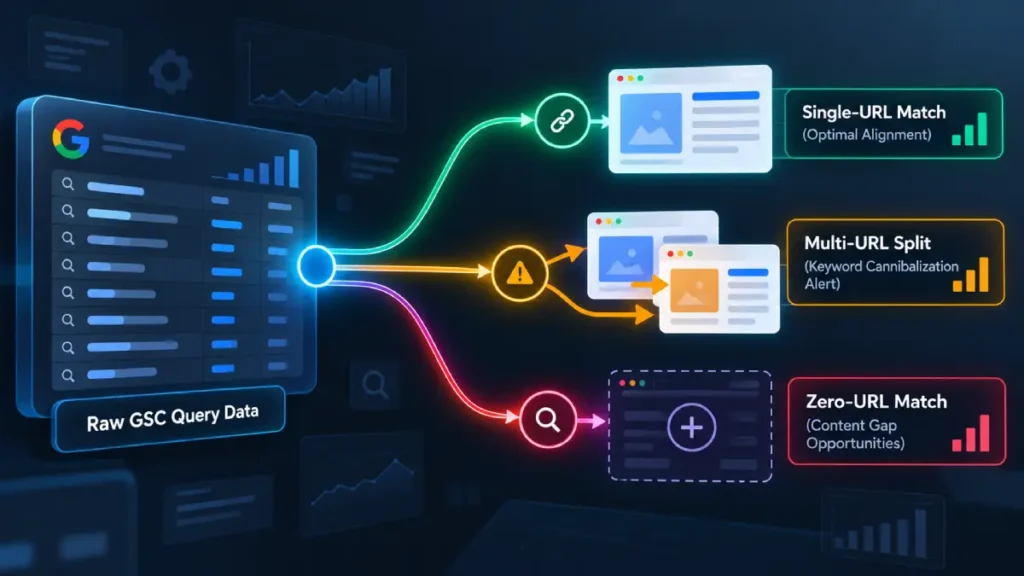
- Primary Intent Match: A single URL captures $\ge 80\%$ of total impressions and clicks for a specific query cluster. This represents a healthy, optimized content asset.
- Cannibalization Split: Multiple URLs share impressions and clicks for the same query cluster, resulting in flattened average positions (typically hovering between positions 11 and 30) because Google struggles to select the definitive landing page.
- Orphaned Queries (Content Gaps): High-impression queries with low click-through rates that do not cleanly align with any existing URL, pointing directly to unmet user intent.
Integrating this matrix creation with your broader Keyword Mapping Framework ensures that newly mapped queries inform upcoming content production sprints rather than remaining static data reports.
Advanced Intent Alignment & Cannibalization Detection
Query mapping moves beyond basic keyword tracking by exposing subtle mismatches between corporate expectations and actual searcher behavior. For instance, a product page might rank for informational “how-to” queries, dragging down conversion rates and signaling an architectural flaw.
Identifying Intent Discrepancies
To systematically flag intent misalignment, segment your mapped dataset by query modifier patterns:
- Informational Modifiers: how, what, guide, example, template
- Transactional Modifiers: buy, price, software, agency, hire
- Navigational Modifiers: login, dashboard, support, brand name
If a transactional URL consistently captures informational modifiers without satisfying the user’s need for deep educational content, bounce rates will spike, and rankings will eventually stagnate. Conversely, when two URLs compete for the same transactional terms, implement a redirection or consolidation strategy. Merge the weaker URL into the primary asset, updating internal link anchors to reinforce the canonical page’s topical relevance.
Actionable Optimization Workflows: From Data to Architecture
GSC query mapping is only as valuable as the execution workflow it drives. Transforming raw matrix insights into tangible organic growth requires a structured, quarterly optimization cycle.
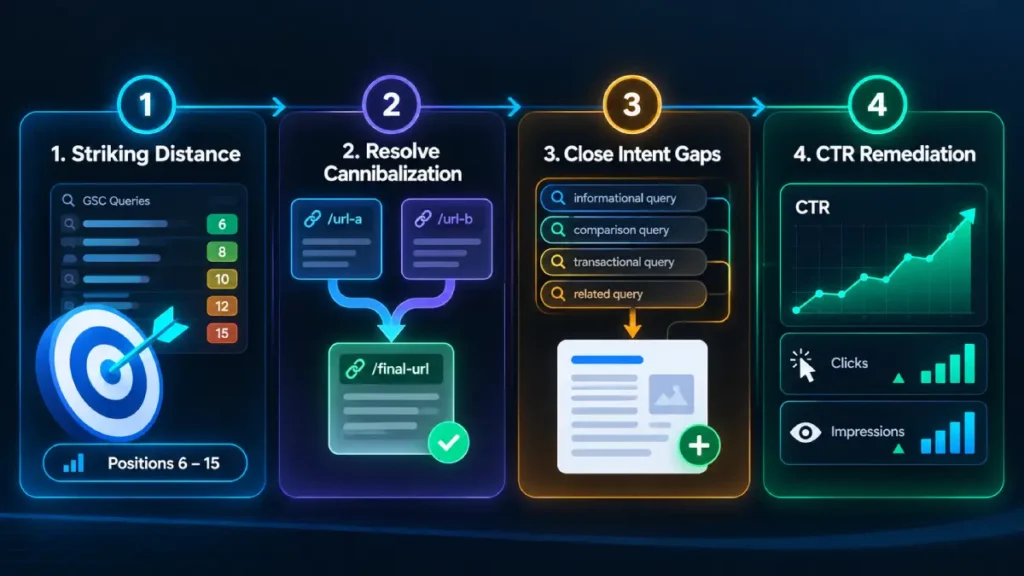
The 4-Step Optimization Protocol
- Step 1: Target Striking-Distance Assets. Filter your query map for queries residing in average positions 6 through 15 with impressions exceeding 500 per month. These pages require minor content expansions, heading optimizations, and enhanced internal linking to break into the top 3.
- Step 2: Resolve Cannibalization Clusters. For queries mapped to multiple URLs, perform a content audit. Either 301-redirect the weaker page to the stronger asset or aggressively differentiate their target subtopics through granular sub-heading restructuring.
- Step 3: Close Intent Gaps. Extract queries with zero dedicated landing pages and feed them into your content calendar or tie them directly into your foundational Google Search Console Guide workflows to capture unserved search volume.
- Step 4: Monitor CTR Anomalies. Identify pages with high impressions and high rankings (positions 1–3) but disproportionately low click-through rates. Rewrite meta titles, test structured data markup (such as FAQ or HowTo schema), and optimize above-the-fold snippet formatting to capture stolen attention.
By treating GSC query mapping as an ongoing architectural feedback loop rather than a one-off audit, enterprise SEO teams can maintain resilient, high-performing digital properties that adapt gracefully to algorithmic shifts and evolving searcher intent.