
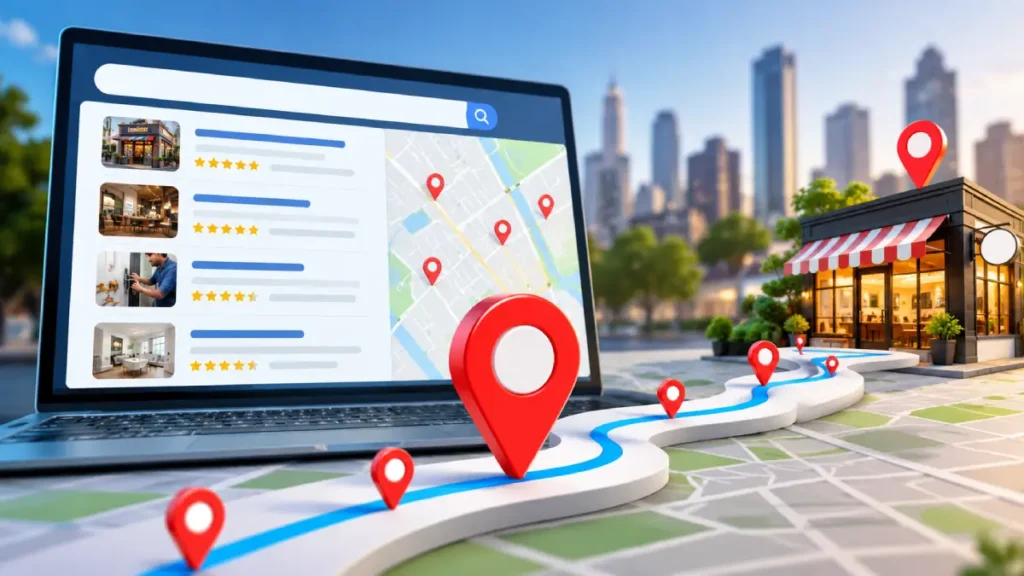
Local long tail SEO is the practice of optimizing digital assets for highly specific, multi-word search queries that combine a product, service, or intent with precise geographic qualifiers such as neighborhoods, zip codes, prominent local landmarks, or colloquial regional terminology.
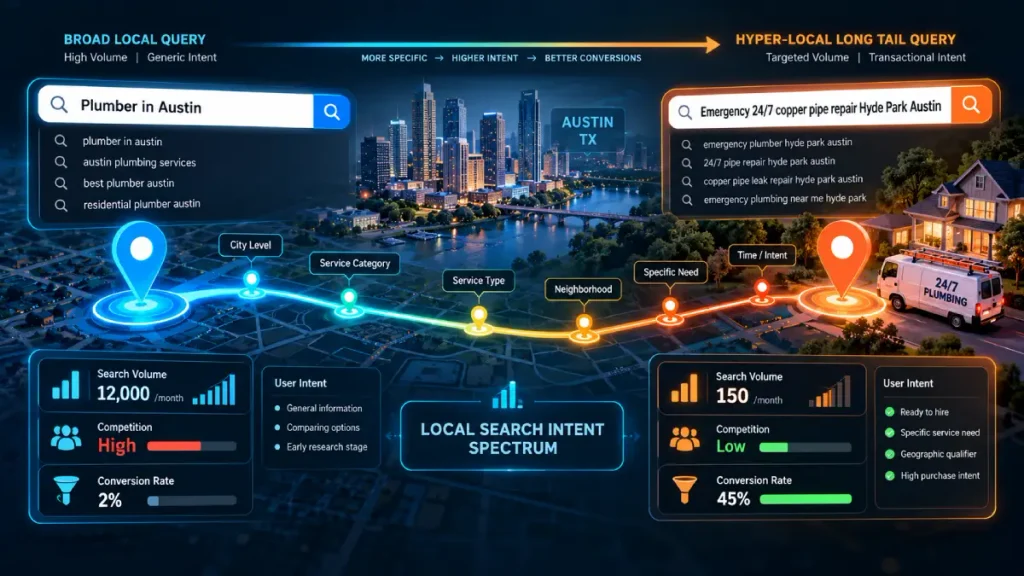
Unlike broad local terms (e.g., “plumber near me” or “Chicago personal injury lawyer”), local long-tail queries (e.g., “emergency 24/7 residential plumber Wicker Park Chicago” or “slip and fall attorney near Millennium Park”) exhibit significantly higher conversion intent, lower competition, and superior predictability.
For SEO professionals managing multi-location enterprises, franchises, or competitive service-area businesses, mastering local long-tail optimization is no longer optional—it is the cornerstone of sustainable organic growth in an era dominated by hyper-localized search personalization and zero-click AI overviews.
The Mechanics of Local Long Tail Search Intent
Search behavior on mobile devices and voice-activated assistants has fundamentally shifted how users articulate their immediate physical needs.
When users enter or speak a local long-tail query, they have typically moved past the initial awareness stage and are actively evaluating transactional or navigational solutions within arm’s reach.
Transactional vs. Informational Geographic Intent
Understanding the dichotomy between transactional and informational local queries dictates how content and technical architecture must be structured.
- Transactional Local Long Tails: These queries feature explicit commercial intent paired with strict proximity constraints (e.g., “same-day HVAC repair technicians in North Austin”). Users expect immediate pricing, service availability, and clear calls to action (CTAs). Optimizing for these requires robust transactional landing pages backed by clear service-area definitions and conversion-optimized form fields.
- Informational Local Long Tails: These queries involve research-driven geographic needs (e.g., “historic preservation zoning regulations for commercial storefronts in downtown Savannah”). While they do not immediately convert into direct sales, capturing these queries establishes topical authority. It feeds upper-funnel organic traffic that can be remarketed or nurtured via localized content hubs.
Micro-Moments in Local Search Queries
Google’s conceptual framework of “micro-moments”—specifically “I-want-to-go,” “I-want-to-do,” and “I-want-to-buy” moments—manifests powerfully in local long-tail searches.
Searchers are operating under tight temporal and spatial constraints. For SEO professionals, this means your content architecture must deliver immediate answers above the fold.
If a user searches for “open late urgent care clinic near Lincoln Square subway station,” they require operating hours, transit directions, real-time wait times, and insurance compatibility instantly, rather than a generic essay about healthcare options.
Advanced Keyword Research Methodologies for Hyper-Local Markets
Relying solely on traditional keyword research tools often fails when targeting local long tails because commercial databases aggregate regional search volume, masking hyper-local nuance. To uncover high-value search phrases that competitors overlook, SEO professionals must employ multi-channel discovery frameworks.
Mining Customer Support Logs, Review Data, and Sales Transcripts
The most authentic source of local long-tail keywords is your client’s existing customer base. Analyze transcripts from customer service calls, live chat logs, and inbound inquiry forms.
Customers naturally use colloquial language, specific neighborhood names, regional phrasing, and exact descriptions of their pain points that never appear in keyword tools.
Similarly, scrutinize Google Business Profile reviews and Yelp testimonials. If dozens of clients mention “parking behind the building on 5th Street” or “bilingual Spanish-speaking consultations,” these phrases represent high-intent semantic modifiers that should be integrated directly into your keyword matrix.
Leveraging Programmatic Variations and Modifier Matrices
For multi-location businesses, manual keyword research for hundreds of branches is inefficient. Construct a programmatic modifier matrix by intersecting core service verticals with comprehensive geographic datasets:
- Service Entities: Emergency roofing, commercial roof repair, shingle replacement.
- Geographic Modifiers: City names, county names, zip codes, prominent neighborhoods, highway interchanges, and local landmarks.
- Intent Modifiers: Cost, near me, 24/7, licensed, certified, best-rated.
By systematically mapping these combinations, you can identify viable long-tail targets that boast cumulative search volume across regional markets while maintaining low individual keyword difficulty scores.
Content Architecture and On-Page Optimization for Local Long Tails
Executing a successful local long-tail strategy requires meticulous on-page structuring to ensure search engines correctly associate your content with specific geographic boundaries without triggering keyword cannibalization or appearing spammy.
Geo-Modifiers Beyond City Names (Neighborhoods, Landmarks, Transit Hubs)
Relying exclusively on city-name insertion (e.g., “Our [Service] in [City]”) is an outdated tactic that often signals low-quality local SEO. Modern search engines evaluate entity relationships and local context. Enhance your on-page copy by weaving in granular geographic entities:
- Neighborhoods and Districts: Reference specific community names, historical districts, and commercial zones.
- Landmarks and Infrastructure: Anchor your business to recognizable local landmarks, sports stadiums, universities, or major transit hubs (e.g., “Conveniently located five minutes from Union Square and the Powell Street BART station”).
- Colloquialisms: Use terms locals actually use rather than strictly bureaucratic municipal names (e.g., referring to the Twin Cities or specific boroughs).
Structuring Location-Specific Landing Pages Without Cannibalization
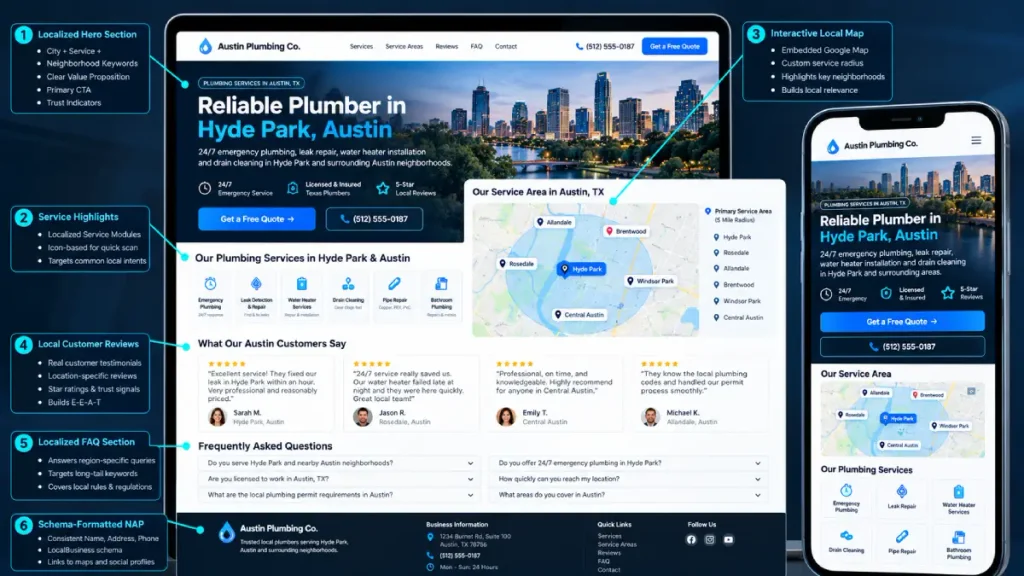
When building out pages for multiple locations or specific service areas, maintaining distinct value propositions is critical. Avoid spinning identical template pages across dozens of URLs, as search engines frequently devalue duplicate localized content. Each location page must feature unique, verifiable local assets:
- Embedded Google Maps focused on the specific physical storefront or precise service radius boundary.
- Locally specific FAQs addressing regional regulations, weather considerations (e.g., winterizing pipes in New England versus sun-shielding roofing in Arizona), or local utility rebates.
- Staff bios, local team photos, and verifiable NAP (Name, Address, Phone Number) data corresponding exactly to the associated Google Business Profile.
Technical & Schema Foundations for Local Long Tail Visibility
Technical SEO acts as the structural bedrock that allows search engine crawlers to parse geographic context unambiguously. Without advanced schema markup and clean technical execution, even the most meticulously written local content can fail to capture coveted local pack placements.
LocalBusiness Schema and AreaServed Granularity
Implementing structured data is mandatory for clarifying geographic intent. Following official Google Search Central guidelines for LocalBusiness markup, utilize LocalBusiness schema (or its more specific subtypes such as Plumber, LegalService, or MedicalClinic) across your site. Utilize LocalBusiness schema (or its more specific subtypes such as Plumber, LegalService, or MedicalClinic) across your site. Ensure that the areaServed property is configured with granular precision, utilizing AdministrativeArea, GeoCircle, or specific postal codes rather than overly broad national designations.
According to the official Schema.org LocalBusiness specification, ensure that the areaServed property is configured with granular precision, utilizing AdministrativeArea, GeoCircle, or specific postal codes rather than overly broad national designations
JSON
{
  "@context": "https://schema.org",
  "@type": "RoofingContractor",
  "name": "Apex Local Roofing Solutions",
  "image": "https://www.example.com/photos/logo.jpg",
  "@id": "https://www.example.com/#roofing",
  "url": "https://www.example.com/",
  "telephone": "+1-555-867-5309",
  "address": {
    "@type": "PostalAddress",
    "streetAddress": "742 Evergreen Terrace",
    "addressLocality": "Springfield",
    "addressRegion": "OR",
    "postalCode": "97477",
    "addressCountry": "US"
  },
  "geo": {
    "@type": "GeoCoordinates",
    "latitude": 44.0462,
    "longitude": -123.0220
  },
  "areaServed": [
    {
      "@type": "AdministrativeArea",
      "name": "Eugene-Springfield Metropolitan Area"
    },
    {
      "@type": "PostalCode",
      "name": "97477"
    }
  ]
}
Geo-Coordinates and Local Entity Associations
Beyond standard schema, ensure your site architecture leverages machine-readable geographic metadata. Incorporate Geo meta tags (geo.position, geo.placename) where appropriate, and ensure that your imagery incorporates EXIF data or descriptive alt text referencing local geographic entities. Connecting your brand entity across authoritative local directories (such as the Better Business Bureau, local chambers of commerce, and industry-specific trade registries) reinforces the semantic entity graph that search engines rely on to verify local authority.
Measuring and Tracking Local Long Tail Performance
Because local search results vary with the user’s GPS coordinates, device type, and personalized search history, traditional national rank-tracking tools yield distorted metrics.
Hyper-Local Rank Tracking Challenges and Solutions
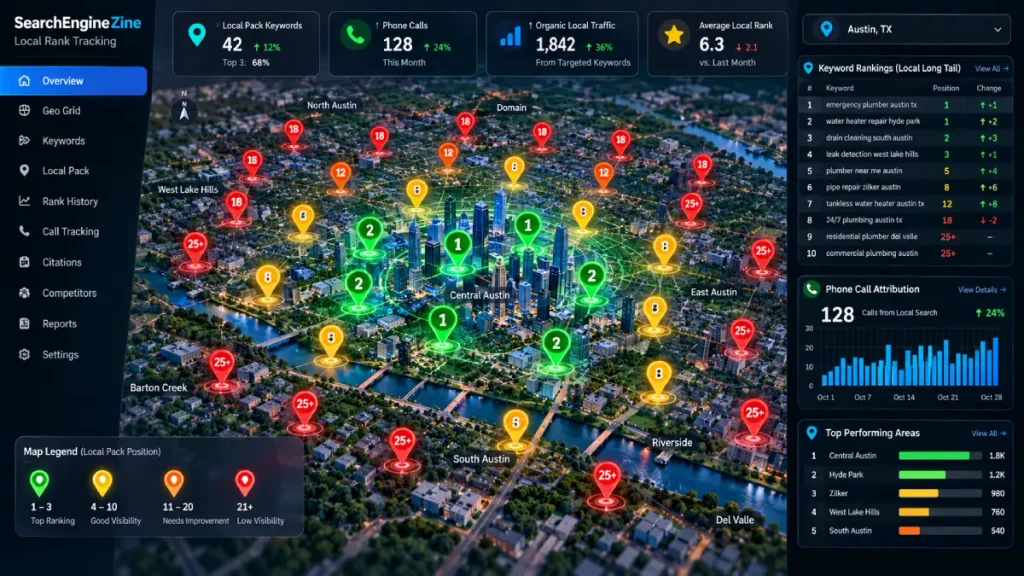
Standard rank trackers configured for a broad city level often miss hyper-local ranking realities where a business ranks #1 in the northern sector of a city but #14 in the southern sector. SEO professionals must utilize grid-based local rank tracking software that simulates search queries from multiple precise geographic pins across a city grid. This reveals true visibility maps and highlights localized ranking decay.
Attribution Modeling for Multi-Location Businesses
Measuring the ROI of local long tail SEO requires connecting organic visibility to downstream revenue. Implement advanced multi-touch attribution models combining Google Analytics 4 event tracking with call tracking software utilizing dynamic number insertion (DNI). By isolating organic traffic arriving via local long-tail landing pages, SEO teams can accurately report on form submissions, click-to-call interactions, and in-store foot traffic derived from organic search efforts.
Future-Proofing Your Local Long Tail Strategy in an AI-Driven Search Landscape
As generative search experiences and AI-powered conversational engines reshape the search results page, the nature of local discovery is evolving rapidly. AI assistants do not merely return a list of ten blue links; they synthesize direct answers drawing from structured entity data, reviews, and highly specific long-tail content.
To future-proof your strategy, focus on establishing deep topical authority combined with undeniable local entity validation. Ensure your content answers natural-language queries comprehensively, maintain pristine structured data, and actively cultivate authentic customer sentiment across review platforms. By bridging granular search intent with rigorous technical execution, SEO professionals can secure enduring visibility across both traditional search engines and emerging generative discovery platforms.