
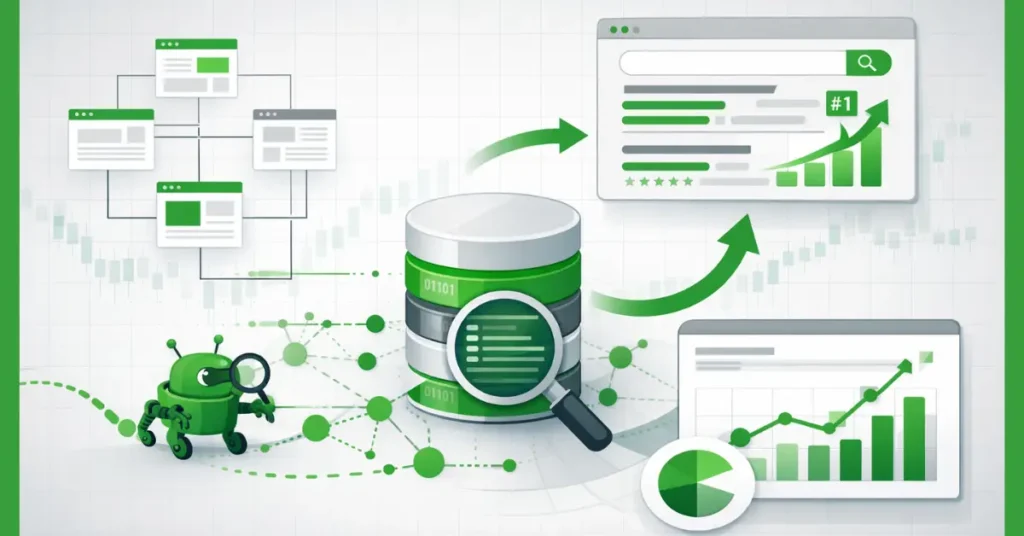
SEO Intelligence Hub
Advanced Search Engine Optimization fundamentals and architectural logic for 2026.
SEO Basics
SEO Logic
Introduction: The Era of “Information Gain”
Welcome to the SEO Fundamentals Hub. If you are looking for a checklist of “meta tags to tweak,” you are in the wrong place. Search Engine Optimization in 2026 has evolved from a game of matching strings to a discipline of engineering authority.
The articles curated in this hub do not just cover the “basics”; they deconstruct the mathematical and psychological logic that governs the modern search engine. From the Intent-Entity-Gain (IEG) model to the Visibility Triage Protocol, this resource is designed for practitioners who need to build infrastructure, not just pages.
Search is no longer about retrieval; it is about generation. As AI Overviews (formerly SGE) dominate the top of the SERP, your goal is no longer just to rank—it is to be cited. This requires a fundamental shift in how we approach Basics, Logic, and Recovery.
1. SEO Basics: The Strategy of Semantics
Mastering the “Why” and “Who” before the “How.”
The foundational layer of SEO is no longer about keyword density; it is about Entity Density. This section explores how to align your content with the cognitive goals of your user and the semantic understanding of the machine.
Keyword Intent Mapping: The Expert Guide to Intent-Based SEO
Ranking is useless if it doesn’t convert. Traditional intent buckets (Informational, Transactional) are now too broad for 2026. This guide introduces the Intent-Friction Matrix, a framework that maps user queries not just to a topic, but to a psychological state of “friction tolerance.”
- The Micro-Intent Spectrum: Why a single keyword like “CRM” has four distinct competing intents and how to identify the “dominant intent” using SERP feature analysis.
- The Friction Framework: Learn why high-intent buyers are willing to endure “high friction” content (whitepapers, deep dives), while top-of-funnel users demand “zero friction” (direct answers).
- SERP as Source of Truth: How to use the presence of “People Also Ask” or “Local Packs” to reverse-engineer the required content format before you write a single word.
Long Tail Discovery: The Science of Specificity in Semantic SEO
The “Long Tail” is not just about low volume; it is about high specificity. This article challenges the “Zero-Volume” myth, proving that queries with no reported metrics often drive the highest revenue.
- The Intent-Specificity Matrix: A strategic tool to categorize queries based on user knowledge and urgency (e.g., “The Panic Searcher” vs. “The Researcher”).
- The “Ghost Traffic” Phenomenon: Why third-party tools underestimate long-tail volume by up to 14x, and how to capture this invisible market.
- Support Ticket Mining: A tactical method for mining your own customer support logs to find the “people-first” questions that your competitors are ignoring.
Modern Keyword Research: Beyond Search Volume to Semantic Authority
Stop chasing vanity metrics. The era of “strings” is over; the era of “things” (Entities) is here. This guide details the transition to the Intent-Entity-Gain (IEG) model, focusing on how to become a topical authority rather than just a keyword ranker.
- Information Gain Score: Understanding Google’s patent-backed shift toward prioritizing content that adds new data to the index, rather than just summarizing existing results.
- Entity Gap Analysis: How to look at the top 3 results and identify the missing “nodes” (concepts) that you can cover to prove superior depth.
- The Topic Cluster Model: Moving from a “grocery list” of keywords to a “solar system” of pillar pages and satellite clusters that signal total topical ownership.
White Hat vs. Black Hat SEO: Where to Draw the Line in 2025
Risk management is the unsexy hero of SEO. This article defines the “Risk-Reward Horizon” and explains why “Gray Hat” tactics (like aggressive AI scaling) often lead to a net-negative ROI over 18 months.
- The Clean Audit Protocol: A step-by-step methodology for pruning “zombie” links and toxic assets that might be silently suppressing your rankings.
- Signal Precision: Why manipulating signals (like CTR or links) works temporarily but fails mathematically as Google’s “SpamBrain” AI identifies patterns of anomaly.
- E-E-A-T as a Defense: How “Experience” and “Authoritativeness” act as your insurance policy against algorithmic volatility.
Larry Page & Sergey Brin Principles
To predict the future of AI search, you must understand the past. This article revisits the “Ancestral Entity Pathway,” showing how the original PageRank logic (links as votes) has evolved into modern AI citation logic (entities as verified facts).
- The Probability of Accuracy: How AI models like Gemini treat “Authority” not as a popularity contest, but as a statistical probability of correctness.
- Link Entropy: Why a link from a “High-Entropy” page (unique data) to a “Low-Entropy” page (definition) creates a stronger authority signal than generic directory links.
- The Founder’s Vision: Understanding the original goal of “organizing the world’s information” to align your site with Google’s ultimate objective.
Evolution of Search Engines: From AltaVista to AI Overviews
Search has moved from Retrieval (finding a document) to Generation (creating an answer). This historical retrospective traces the timeline from AltaVista’s “wild west” to the “Zero-Click” reality of 2026.
- The “Strings to Things” Shift: The pivotal moment when the Knowledge Graph replaced keyword matching, changing SEO from a lexical game to a semantic one.
- The Rise of the Answer Engine: How the introduction of BERT and MUM paved the way for AI Overviews, and what it means for the “social contract” of the web (traffic vs. answers).
- Future-Proofing: Why the “Hidden Gems” update is a direct response to AI saturation, rewarding human-first perspectives in forums and blogs.
SEO 2025 Trends: Why Traditional Keyword Stuffing is Dead
A manifesto for the modern era. This article introduces the AI-Query Displacement Rate (AQDR), a new metric that measures how much of your traffic is being “intercepted” by AI answers before a click ever happens.
- The AQDR Metric: How to calculate the percentage of your informational queries that are satisfied by AI, and how to pivot your strategy to “Commercial Investigation” keywords.
- The “Answer First” Format: Structuring your content to be the “source citation” for the AI, rather than just another search result.
- The End of “Skyscraper” Content: Why making content “longer” is now a liability, and why “density” of value is the new ranking factor.
2. SEO Logic: The Engineering of Visibility
The technical architecture that controls discovery, crawling, and indexing.
Content cannot rank if it cannot be read. This section is dedicated to the logic gates, server codes, and rendering paths that determine whether your content even enters the race.
The Definitive Guide to Handling 404 vs 410 for SEO on Enterprise Sites
They are not the same. This guide breaks down the Signal Precision Framework, proving that a 410 (Gone) status code removes URLs from the index 3x faster than a 404 (Not Found), saving critical crawl budget.
- The “Ghost” Index: How relying on 404s forces Google to “retry” dead URLs for weeks, wasting server resources that should be spent on new content.
- When to Redirect (301) vs. Kill (410): A decision matrix based on “Link Equity” and “User Intent.” If a page has no backlinks and no traffic, let it die (410); do not redirect it to the homepage (Soft 404).
- Crawl Waste: Real-world data showing how switching to 410 logic can reduce crawl waste by up to 40% on enterprise domains.
Robots.txt Logic Gates: Mastering the Hidden Hierarchy of Crawl Control
Your robots.txt is not a checklist; it is a series of logic gates. This deep dive explains the “Longest Match Rule” and why simple wildcard errors can accidentally de-index your entire site.
- The Specificity Hierarchy: Understanding that Googlebot obeys the most specific rule (longest character path), not necessarily the first one it reads.
- The “Clean Crawl” Protocol: A framework to ensure your
robots.txtlogic matches your Sitemap logic, preventing “contradictory signals” that confuse the crawler. - User-Agent Grouping: The nuances of how specific user-agent blocks (e.g.,
User-agent: Googlebot) override global wildcards (User-agent: *), creating potential “crawl leaks.”
Discovery vs. Crawling: How Search Engines Find and Index Content
Discovery is the guest list; Crawling is getting past the bouncer. This article clarifies the massive difference between a URL being “known” (Discovery) and being “fetched” (Crawling), utilizing the Discovery Velocity model.
- The “Crawl Frontier”: How Google prioritizes which URLs to fetch based on internal link authority and “freshness” signals.
- Sitemaps are Hints, Not Directives: Why submitting a sitemap guarantees discovery but not crawling, and how to fix “Discovered – Currently Not Indexed” errors.
- The Link Extraction Loop: The mechanical process of how Google parses HTML to find new
hreftags, and why client-side rendering can break this chain.
JavaScript Rendering Logic: DOM & Client-Side Architectures Guide
Googlebot is a headless browser, but it has a budget. This guide introduces the Crawl-to-Interactive Gap (CIG) model, explaining the risks of relying on Client-Side Rendering (CSR) for critical SEO signals.
- The “Two-Wave” Myth: While Google renders JS faster now, the “Rendering Queue” still introduces a delay. Learn how this gap can cause volatile rankings for news or time-sensitive content.
- The “Parity Audit”: A testing protocol to ensure your critical metadata (H1, Canonicals, Schema) exists in the Raw HTML, not just the Rendered DOM.
- Hydration Mismatches: The SEO risks of when your server-side HTML differs from your client-side JavaScript, leading to “cloaking” flags.
Googlebot User Agents: Architecture, Control, and Impact on Crawl Budget
Not all bots are created equal. This article dissects the UA Dependency Loop, explaining how Googlebot Smartphone (the primary crawler) interacts with resource files (CSS/JS) differently than the Desktop agent.
- The Mobile-First Reality: Why you must ensure your server serves the same primary content to the
Googlebot Smartphoneuser-agent as it does to desktop users. - Controlling “Google-Extended”: The strategic decision of whether to block Google’s AI training bots (Google-Extended) and how that impacts your visibility in Gemini.
- Verifying Authenticity: How to use Reverse DNS lookups to identify “fake” Googlebots that are scraping your site and wasting your bandwidth.
Crawl Budget Optimization Mastery: A Practitioner’s Guide
For large sites, crawl budget is currency. This guide introduces the Crawl Velocity vs. Content Velocity Matrix, helping you identify if you have a “Bottleneck” (high content, low crawl) or “Waste” (low content, high crawl) problem.
- The Crawl Efficiency Score: A formula to measure the ratio of “200 OK” responses to total bot hits. If you are below 50%, you are bleeding budget on errors and redirects.
- Faceted Navigation Bloat: The #1 killer of crawl budget. How to use
robots.txtpatterns to block infinite parameter combinations (e.g.,?color=red&size=small) without de-indexing your products. - Server Performance: The direct correlation between Time to First Byte (TTFB) and Google’s allocated crawl budget for your host.
Crawl, Index, Rank: How Google Actually Works
The definitive flowchart of the search pipeline. This article presents the Visibility Triage Protocol, viewing the search process as a series of “gates” where content is filtered out at each stage to save resources.
- The Three Gates: 1. Technical Viability (Crawl), 2. Utility Assessment (Index), 3. Relevance Scoring (Rank). Diagnose exactly where your pages are failing.
- The Inverted Index: Understanding how Google “files” your content tokens and why “Entity Mapping” helps you get filed in the right drawer.
- The “Ghost Indexing” Problem: Why pages might be crawled but not indexed due to a lack of “Information Gain” or duplicate content signals.
3. Algorithm Updates & Recovery
Adapting to the shift from “Blue Links” to “Agentic Answers.”
The December 2025 Core Update was a watershed moment. It moved the goalposts from “Relevance” to “Utility.” This section provides the blueprint for survival and recovery.
Dec 2025 Core Update Recovery: 5-Step 2026 Audit Guide
Hit by the volatility? This guide introduces the F-S-A (Fact-Source-Analysis) content architecture, designed to make your content “readable” for AI agents and recoverable in the rankings.
- The “Proprietary Variable”: The single most important factor for recovery. You must inject unique data (internal benchmarks, field notes, original photos) that AI cannot hallucinate.
- Density-to-Value Ratio: Why “fluff” is now a ranking penalty. Learn to optimize for a high density of facts per 100 words to satisfy the “Utility Signal.”
- Entity Triangulation: How to fix your “E-E-A-T” by ensuring your authors are validated by third-party sources (LinkedIn, MuckRack, Guest Posts) to prove they are real “Nodes of Authority.”
- The “Agentic” Crawl Check: Ensuring your site is technically accessible to the new wave of AI scrapers and agents that power features like Search Perspectives.
Strategic Outlook: The “Search Everywhere” Pivot
As we move through 2026, the concept of “SEO” is expanding. It is no longer just about Google Search; it is about Brand Gravity. The most resilient sites are those that build a presence across the entire digital ecosystem—Reddit, YouTube, News Media, and Industry Hubs.
Conclusion
In conclusion, The Hub represents far more than a physical workspace; it is a catalyst for economic evolution and a cornerstone of collaborative innovation. By bridging the gap between emerging talent and established industry leaders, it has successfully fostered an ecosystem where ideas are not merely discussed but are actively scaled into market-ready solutions.
The success of this initiative is rooted in its ability to break down traditional silos. Through shared resources, cross-disciplinary networking, and a culture of radical transparency, The Hub has created a “force multiplier” effect. It has proven that when diverse minds are given a centralized platform for engagement, the result is an accelerated rate of development that benefits the entire regional economy.
Looking ahead, the sustainability of The Hub depends on its ability to remain agile. As global markets shift toward digitalization and green energy, The Hub is uniquely positioned to lead this transition. It will continue to serve as the “beating heart” of the community—a place where the next generation of entrepreneurs finds the mentorship, capital, and community required to thrive. Ultimately, The Hub is not a finished project but a living, breathing engine of progress, ensuring that our collective future is defined by connectivity rather than isolation.

