

In the competitive arena of digital publishing, the line between long-term industry leaders and short-lived traffic spikes comes down to architectural durability.
Relying on manipulative loopholes might yield temporary visibility, but it leaves your domain exposed to automated quality filters and core update demotions.
Long-term sustainable growth requires moving past superficial optimization hacks and implementing a technical SEO risk optimization and compliance architecture that satisfies strict core-quality algorithms.
Google dominates search with over 90% global market share. Its modern ranking infrastructure heavily prioritizes user experience, E-E-A-T (Experience, Expertise, Authoritativeness, and Trustworthiness), and genuine information gain.
While White Hat SEO follows official guidelines to build sustainable authority, Black Hat SEO relies on aggressive shortcuts that violate search policies.
In an ecosystem defined by real-time spam detection and helpful content filters, white-hat execution is the only viable path for long-term ROI.
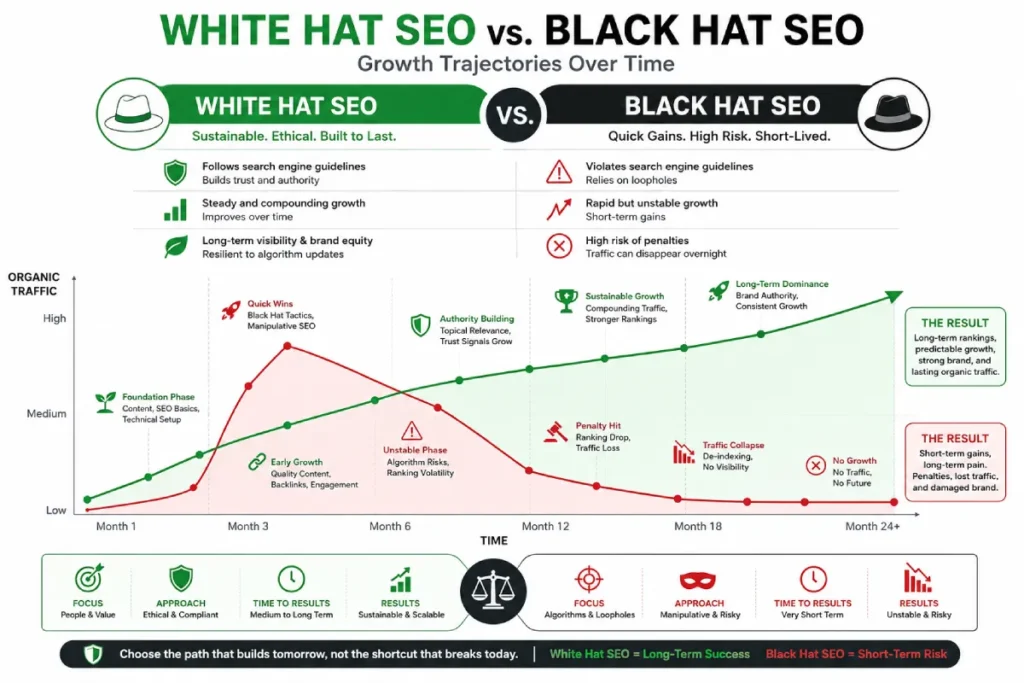
Defining the Boundaries: White Hat vs Black Hat
White hat SEO begins with full adherence to the foundational rules published by search engines. Rather than relying on secondary interpretations, ethical practitioners build directly on primary webmaster standards.
White Hat SEO Fundamentals
White hat SEO encompasses optimization tactics that fully align with search engine guidelines. The primary focus is serving user intent while maintaining technical excellence.
- Long-Term Asset Building: Focuses on compounding brand authority and sustainable organic growth.
- Intent Satisfaction: Content is written to answer user queries comprehensively rather than pad word counts.
- Technical Compliance: Pages meet fast-loading thresholds (Core Web Vitals), clean crawl architecture, and structured data standards.
- Natural Link Acquisition: Backlinks are earned through original data, digital PR, and link-worthy assets.
For the complete, up-to-date baseline framework, consult Google’s official Search Essentials documentation.
Black Hat SEO & Algorithmic Manipulation
Black hat SEO relies on deceptive tactics designed to exploit search algorithm vulnerabilities. While these methods may yield rapid short-term gains, they expose the domain to immediate manual actions or algorithmic suppression.
Common high-risk practices include:
- Keyword Stuffing: Forcing unnaturally high keyword density into content.
- Cloaking & Doorway Pages: Serving different content to search crawlers than to real users.
- Private Blog Networks (PBNs): Buying expired domains to build artificial link schemes.
- Scaled Low-Quality Content: Automatically generating thousands of unedited pages lacking human oversight or E-E-A-T.
Direct Comparison: White Hat vs Black Hat SEO
| Strategy Element | White Hat SEO | Black Hat SEO |
|---|---|---|
| Guideline Alignment | Fully compliant with Search Essentials | Violates search policies |
| Primary Focus | User experience and intent satisfaction | Algorithm manipulation and shortcuts |
| Growth Horizon | Sustainable, compounding over time | Short-lived spikes followed by drop-offs |
| Risk Profile | Exceptionally low risk | High risk of de-indexing and penalties |
| E-E-A-T Integration | High; backed by transparent author details | Absent; synthetic or anonymous content |
| Link Building | Organic PR, outreach, and editorial mentions | Paid link networks, PBNs, and comment spam |
The Role of E-E-A-T in Modern Search
Google evaluates content quality through E-E-A-T (Experience, Expertise, Authoritativeness, and Trustworthiness).
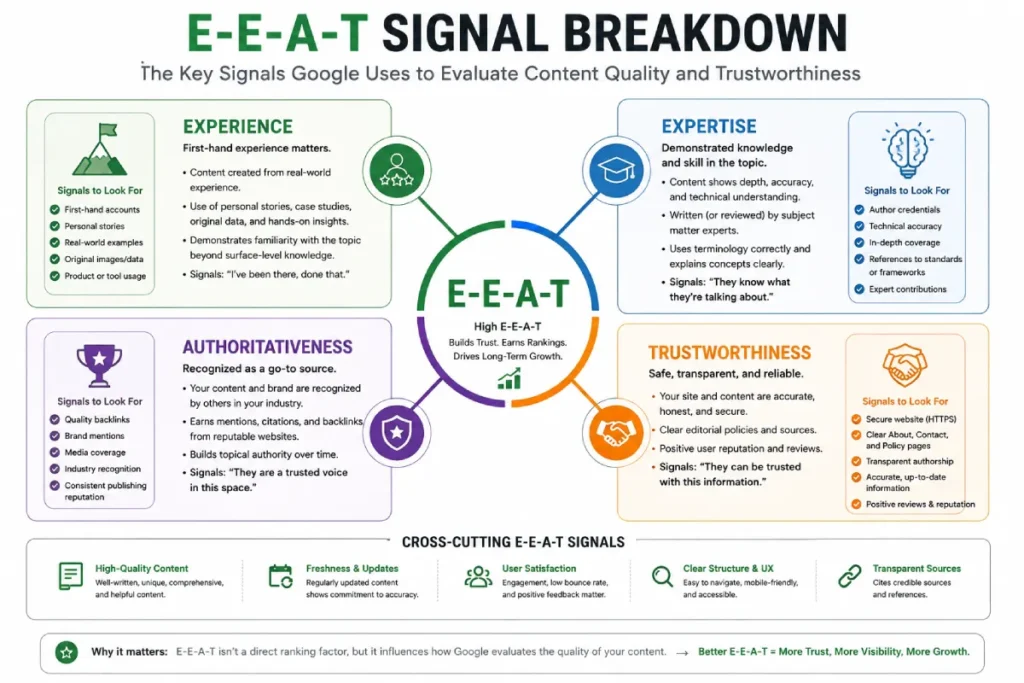
White hat strategies naturally build E-E-A-T by incorporating verified author profiles, hands-on testing, original citations, and transparent business details.
Conversely, black hat attempts to simulate authority—such as generating fake persona bios or purchasing low-quality review badges—are easily detected by modern entity recognition systems.
To understand how semantic entities strengthen domain trust, review our detailed guide on semantic SEO foundations.
White Hat Execution: Key Strategy Pillars
1. Topic Clusters & Semantic Depth
Keyword-centric optimization has evolved toward entity-based topic clusters. Modern systems analyze the semantic relationships between concepts rather than isolated strings.
Organizing content into comprehensive clusters satisfies user sub-intents and builds topical authority. Learn how to restructure your site strategy with our guide on prioritizing topics over keywords.
2. User Intent Mapping
Aligning content structure with user expectations reduces bounce rates and increases engagement. Content should immediately address the core search query before diving into deeper subtopics. To build frictionless content funnels, apply our keyword intent analysis framework.
3. Technical UX & Accessibility
White hat optimization extends to universal accessibility standards. Adhering to the W3C standards ensures your site is usable for all individuals across all devices.
Google rewards sites with superior user experience, fast load speeds, and intuitive layouts. For additional details, consult the official W3C Web Content Accessibility Guidelines (WCAG).
SpamBrain & Automated Detection Systems
Google utilizes SpamBrain, an advanced AI-driven spam prevention system, to identify manipulative search patterns in real time.
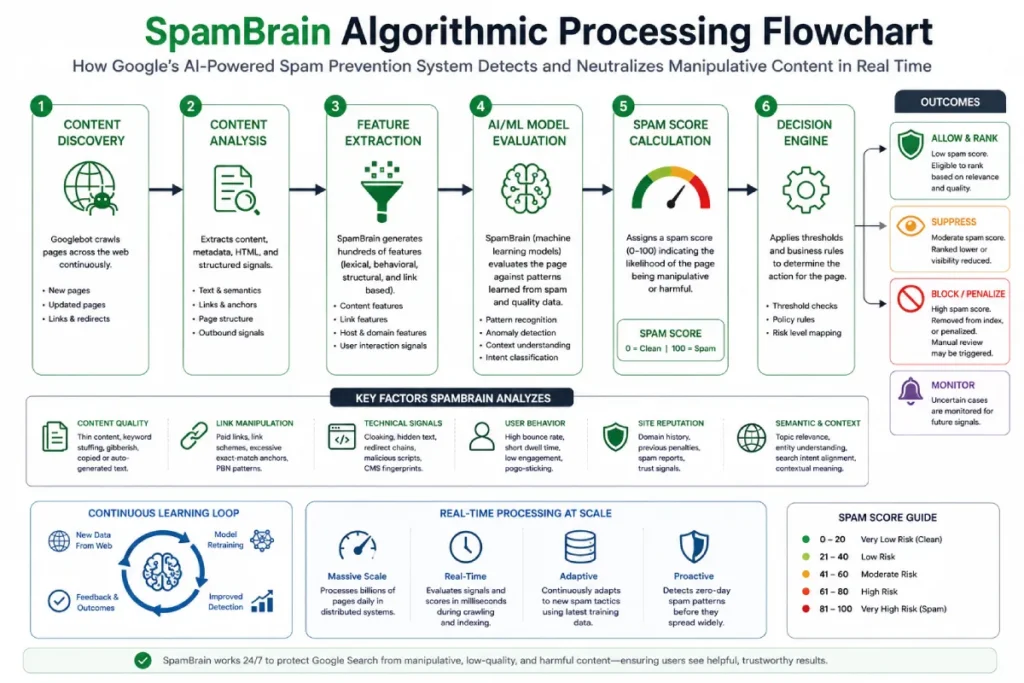
SpamBrain analyzes site-wide behaviors, link graph anomalies, and content patterns. While legacy black hat tactics could previously evade detection for months, SpamBrain identifies artificial link networks and scaled low-value content within days.
To review explicitly prohibited search practices, refer to Google’s official spam policies for web search.
Regulatory Compliance & Disclosure Standards
Beyond search engine penalties, manipulative marketing practices can violate consumer protection laws.
In the United States, the Federal Trade Commission (FTC) requires clear disclosures for commercial relationships, sponsored posts, and affiliate links. Undisclosed paid links or deceptive reviews introduce significant legal liability alongside search risks.
Ethical white hat practices ensure full transparency across all endorsement channels. For regulatory requirements on endorsement disclosures, review the FTC Endorsement Guides.
Recovering from Algorithmic & Manual Penalties
If a site has been impacted by black hat tactics or automated spam penalties, recovery requires a structured cleanup process:
- Full Link & Content Audit: Identify manipulative backlinks, thin content, and doorway pages.
- Remediation & Pruning: Remove low-quality automated pages, update thin content with original expertise, and request link removals.
- Disavow Unnatural Links: Use Google’s disavow tool cautiously for toxic link networks that cannot be manually removed.
- Reinforce E-E-A-T Signals: Add verified author credentials, clear citation chains, and updated business transparency details.
- Reconsideration Request: If facing a manual action, submit a detailed explanation of corrective actions via Google Search Console.
For insights on navigating major search algorithm adjustments, read our overview of recent Google algorithm updates.
Conclusion
Sustained organic visibility is built on technical integrity, high E-E-A-T signals, and user-centric content execution.
While black hat shortcuts present a tempting illusion of speed, they introduce systemic risks that destroy long-term brand equity.
By committing to a white hat framework, your site builds resilient topical authority that thrives through algorithmic evolution.