
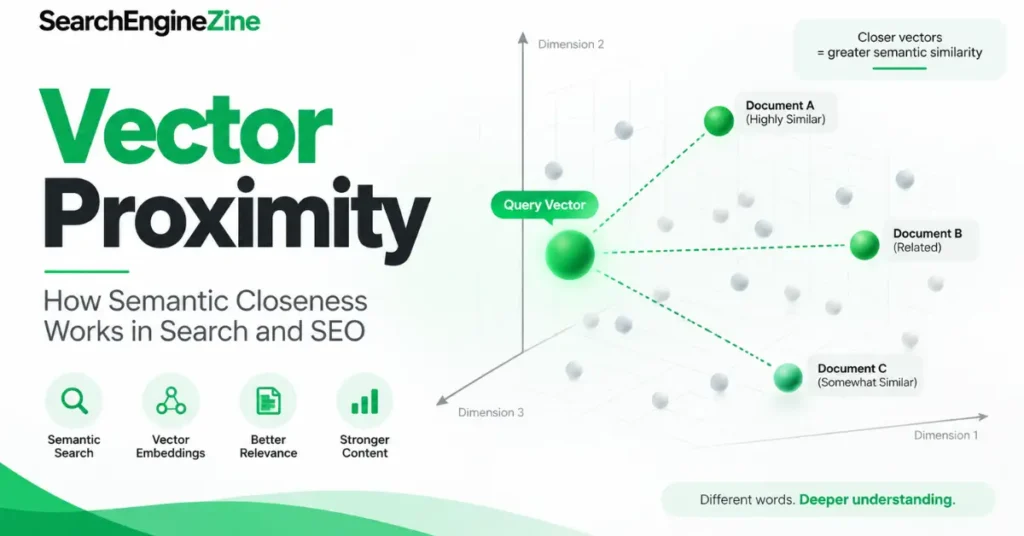
Vector proximity is the mathematical idea of how close two vector representations are within an embedding space. In semantic search, text such as a query and a document passage can be converted into vectors, and a similarity or distance function can then measure how closely those representations align.
Google’s machine-learning documentation describes embeddings as representations in which semantically related items can occupy nearby positions in an embedding space.
For SEO professionals, the important distinction is this: vector proximity is a useful way to understand semantic retrieval, but it should not be treated as a confirmed Google ranking factor or as a measurable “SEO score.” The actual meaning of proximity depends on the embedding model, the data being represented, and the similarity metric being used.
What Is Vector Proximity?
Vector proximity describes the relationship between two points in an embedding space.
Suppose a search system converts these concepts into vectors:
technical SEOcrawl budgetrecipe ingredients
The first two may occupy relatively nearby positions in a model’s embedding space because their representations capture related concepts. The third would generally be expected to occupy a different region.
Embeddings are designed to represent relationships and characteristics of data numerically, allowing systems to compare meaning beyond exact lexical matches. Google’s explanation of embeddings
A simplified model is:
Query
  ↓
Embedding model
  ↓
Query vector
  ↓
Compare against document vectors
  ↓
Similarity / distance calculation
  ↓
Nearest or most similar candidates
This is the underlying idea behind many vector-search and recommendation systems.
How Is Vector Proximity Measured?
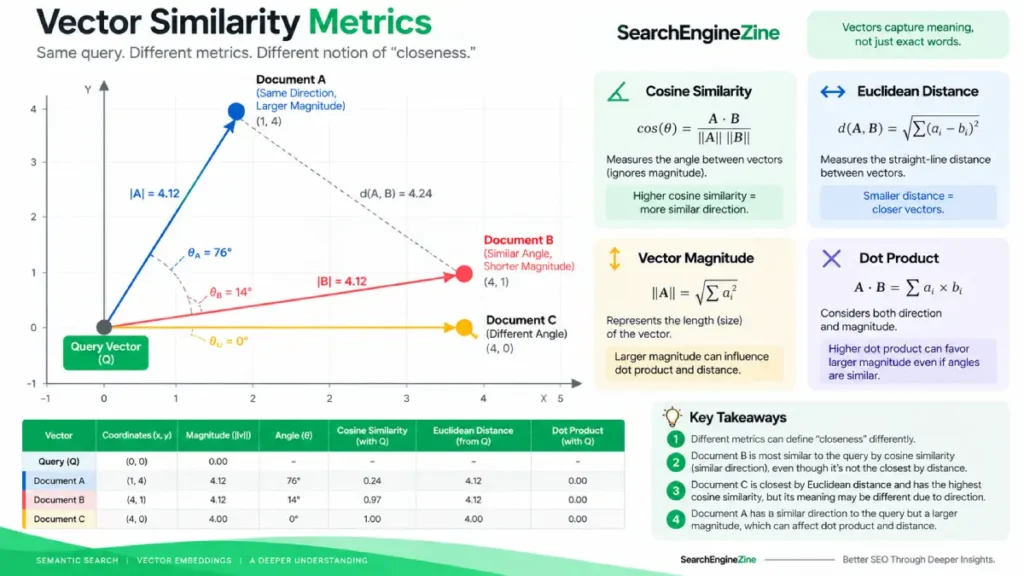
There is no single universal proximity calculation. Common measures include cosine similarity, dot product, and Euclidean distance. Google’s documentation on measuring embedding similarity, while Pinecone explains the practical differences between them.
| Measure | What it emphasizes | Typical interpretation |
|---|---|---|
| Cosine similarity | Direction/angle | Higher value generally means greater alignment |
| Dot product | Direction + vector magnitude | Higher value can reflect both similarity and magnitude |
| Euclidean distance | Physical distance | Smaller distance means greater closeness |
Cosine similarity
Cosine similarity measures the angle between two vectors:
Two vectors pointing in nearly the same direction have high cosine similarity.
This makes cosine useful when the direction of the embedding is more important than its magnitude. Pinecone’s explanation of cosine similarity describes it as measuring the angle between vectors rather than their magnitudes.
Euclidean distance
Euclidean distance measures the straight-line distance between two vectors:
A smaller distance indicates that the two vectors are physically closer in the embedding space.
Dot product
Dot product combines directional alignment with vector magnitude:
Consequently, the choice of metric can change which items appear closest to a query. Google’s retrieval documentation demonstrates how different similarity measures can affect candidate comparison.
Google’s retrieval documentation demonstrates that cosine similarity, dot product, and Euclidean distance can yield different candidate orderings.
Why Vector Proximity Matters in Semantic Search
Traditional lexical retrieval can depend heavily on matching terms or tokens. Vector retrieval adds another mechanism: representing data as embeddings and searching for vectors that are close according to a selected similarity measure.
Google’s documentation describes retrieval systems that convert queries and candidate items into embeddings and then search for nearby embeddings in the same space. Google’s documentation on embedding-based retrieval
Pinecone similarly describes vector similarity as a core component of semantic search, recommendation systems, and other retrieval applications.
This creates an important SEO concept:
Semantic relevance can exist even when two pieces of text do not use exactly the same words.
For example, a user might search for:
“how to make a website easier for Google to crawl”
A semantically relevant document might discuss:
crawl efficiency, crawlable URLs, robots.txt, internal links, and crawl discovery
without repeating the original query verbatim.
Vector representations can help retrieval systems identify relationships of this kind, although the exact behavior depends on the model and retrieval architecture.
Vector Proximity Is Not the Same as Keyword Similarity
This distinction is critical.
| Lexical matching | Vector-based comparison |
|---|---|
| Looks at tokens or terms | Compares numerical representations |
| Strong for exact terminology | Useful for semantic relationships |
| Can miss meaning expressed differently | Can identify related concepts without identical wording |
| Often easier to interpret | Embedding dimensions are generally difficult for humans to interpret |
| Depends on the retrieval system | Depends on the embedding model and similarity metric |
Modern search systems can also combine approaches rather than choosing only one. Google’s Vertex AI documentation describes hybrid search using both dense and sparse embeddings. Google Cloud’s Vector Search documentation
What Does Vector Proximity Mean for SEO?
For SEO professionals, vector proximity is most useful as a semantic-retrieval concept, not as an on-page optimization metric.
A practical interpretation is:
Search intent
      ↓
Concepts/entities
      ↓
Content representation
      ↓
Embedding space
      ↓
Similarity relationship
      ↓
Candidate retrieval
This suggests several useful editorial principles:
1. Cover the actual concept, not just the keyword
A page targeting crawl budget should explain the underlying concept and its associated entities rather than repeatedly inserting the phrase.
2. Keep important passages semantically focused
A passage explaining crawl budget should not suddenly switch into an unrelated discussion about link building.
That is an editorial principle that improves human comprehension and may also make individual passages more coherent for retrieval systems. It should not, however, be presented as a confirmed Google ranking formula.
3. Use related terminology naturally
Semantic coverage can include concepts such as:
- crawl capacity
- crawl demand
- Googlebot
- server response
- URL discovery
- duplicate URLs
- indexing
The goal is not to manufacture a list of related keywords. The goal is to explain the topic completely.
4. Separate different search intents
A page answering “what is vector proximity?” has a different task from a page explaining “how to implement vector search with a vector database.”
Combining unrelated intents into one passage can reduce clarity even before any discussion of embeddings begins.
A Practical SEO Example
Imagine a page about semantic SEO.
A weak section might say:
Semantic SEO uses semantic keywords. Semantic keywords help semantic SEO. Search engines understand semantic keywords and semantic SEO.
The lexical repetition is high, but the information value is low.
A more useful section could explain:
Semantic SEO focuses on relationships between concepts, entities, attributes, and search intent. Instead of treating a query as an isolated string, the content should address the underlying information need and the concepts required to resolve it.
The second passage introduces a richer conceptual structure.
That does not prove that its vector representation will be closer to a particular Google query. Only the relevant retrieval system and model could determine that.
But it demonstrates the more important editorial principle: write for the underlying information need rather than attempting to imitate a hypothetical embedding.
For a deeper discussion of how vector-oriented concepts intersect with SearchEngineZine’s existing semantic-search work, see Extractability Vector Mastery.
The Most Important Limitation: Proximity Is Model-Dependent
A vector does not have an inherent universal meaning.
The same text can produce different embeddings when processed by different models. Google notes that embedding spaces are trained to capture structure meaningful to the intended application, and embedding representations can change when models are retrained.
Therefore:
You cannot say that two pieces of content are universally “vector-close.”
A meaningful comparison requires at least:
- the embedding model;
- the representation being compared;
- the similarity or distance metric;
- the preprocessing or chunking method;
- the relevant embedding space.
This is why an SEO tool displaying a proprietary “semantic similarity score” should not automatically be interpreted as reproducing Google’s internal retrieval system.
Vector Proximity vs. SEO Ranking
This distinction deserves explicit attention. Vector proximity can explain how some semantic retrieval systems compare representations. It does not establish that Google assigns webpages a publicly measurable vector-proximity ranking score.
Google publicly documents embeddings, similarity measures, and retrieval architectures in its machine-learning materials, but that documentation is not equivalent to a published Google Search ranking formula.
So avoid claims such as:
- “Get your page within X vector distance of the query.”
- “Google ranks pages according to vector proximity.”
- “A cosine score above X guarantees rankings.”
- “Increasing semantic vector proximity will increase your Google position.”
Those statements go beyond what the available documentation establishes.
How SEO Professionals Should Use the Concept
Use vector proximity as a mental model for semantic relevance, not as a target number.
A practical workflow is:
- Identify the search intent.
- Define the primary entity or topic.
- Map the concepts needed to answer the query.
- Create focused sections around those concepts.
- Connect related entities naturally.
- Answer the user’s question directly.
- Support important factual claims with evidence.
- Avoid unrelated material that weakens topical clarity.
- Use internal links to move deeper into adjacent topics.
- Evaluate the finished page by usefulness rather than by a fabricated vector score.
This approach is compatible with the broader principle of information gain: the objective is not to make a page mathematically resemble a hypothetical competitor, but to provide useful information that satisfies the user’s task.
The Bottom Line
Vector proximity is the closeness between vector representations in an embedding space, measured through a similarity or distance function such as cosine similarity, dot product, or Euclidean distance.
For SEO, its greatest value is explanatory. It helps clarify how semantic retrieval can compare concepts beyond exact keyword matching. But vector proximity is not a publicly established Google ranking score, and SEO professionals should not optimize toward an invented numerical threshold.
The practical takeaway is simpler: understand the searcher’s underlying concept, build content that represents that concept clearly and comprehensively, and treat vector proximity as a model of semantic retrieval—not as a shortcut to rankings.