
What are Helpful Content Signals Updates?
Google’s Helpful Content system is no longer a standalone ranking system. Google introduced it in 2022 to promote content created primarily for people rather than content created mainly to attract search traffic.
In March 2024, Google incorporated the system into its broader core ranking systems. Google’s current guidance continues to emphasize original value, appropriate expertise, and content created to benefit people rather than manipulate rankings, as explained in its Creating helpful, reliable, people-first content guidance.
For SEO professionals and website owners, that changes how the topic should be understood: there is no separate “Helpful Content Update” to optimize for today. Instead, Google evaluates helpfulness through multiple ranking systems and signals, with people-first content remaining a central principle.
The practical focus is therefore not chasing a particular update date. It is creating content that provides original value, demonstrates appropriate expertise, satisfies the intended audience, and does not exist primarily to manipulate Search.
What Happened to the Helpful Content System?
Google introduced the Helpful Content Update in August 2022 as part of a broader effort to surface original, helpful content created primarily for people, rather than content produced mainly to attract search traffic, according to Google’s original Helpful Content Update announcement.
The evolution can be summarized as follows:
| Period | Development | What it meant |
|---|---|---|
| August 2022 | Helpful Content Update launched | Google introduced a system designed to reward people-first content |
| December 2022 | Expanded globally across languages | The classifier was no longer limited to the initial English-search rollout |
| 2023 | Guidance evolved | Google expanded guidance around page experience, AI-generated content, third-party content, and self-assessment |
| March 2024 | Integrated into core ranking systems | Helpful-content evaluation became part of Google’s broader core ranking architecture |
| 2026 | Standalone documentation archived/reorganized | Google now presents Helpful Content as a retired standalone system rather than a separate active ranking system |
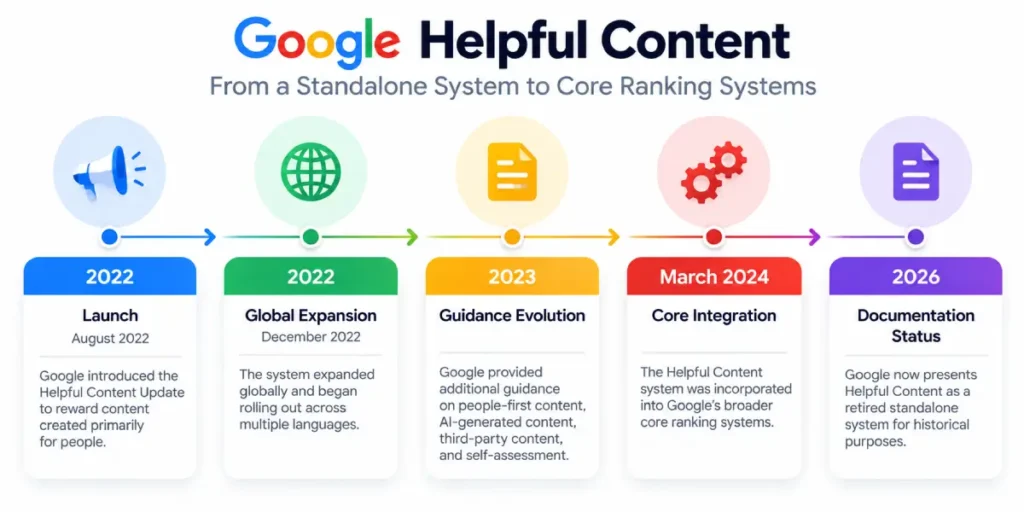
Google’s current ranking-systems documentation explicitly says the Helpful Content system evolved into Google’s core ranking systems in March 2024.
Google said the March 2024 core update marked an evolution in how it identified helpful content and involved multiple core systems rather than a single standalone system, as described in its March 2024 core update announcement.
That distinction matters because continuing to describe every later ranking change as a new “Helpful Content Update” can create an outdated mental model.
What Are Google’s Helpful Content Signals?
Google does not publish a single list of “helpful content signals” with individual weights. Instead, its documentation describes the qualities its automated ranking systems seek to recognize.
The strongest practical signals to evaluate are:
1. People-first purpose
Ask whether the content would still be worth creating if search engines did not exist.
Google’s guidance asks whether a site has an existing or intended audience that would find the content useful if they arrived directly. It also asks whether readers leave with enough information to accomplish their goal.
2. Original value
Google specifically encourages creators to ask whether content provides original information, reporting, research, analysis, or insights beyond what is obvious.
Simply rewriting several existing articles into one longer article does not automatically create additional value.
3. First-hand experience where appropriate
Google’s people-first guidance asks whether content demonstrates first-hand expertise and depth of knowledge.
This matters particularly for subjects where direct experience materially improves the usefulness of the information—such as product reviews, testing, practical implementation, or first-hand case analysis.
4. Topic focus
Google asks whether a site has a primary purpose or focus.
That does not mean a website can never cover adjacent subjects. The practical issue is whether the content makes sense for the site’s intended audience and purpose rather than being produced simply because a topic appears capable of attracting search traffic.
5. Satisfying the search task
A useful article should leave the reader with enough information to accomplish the intended goal.
Google’s own self-assessment questions include whether readers feel they have learned enough and whether they have had a satisfying experience.
6. Trust and evidence
Google’s current guidance discusses E-E-A-T—experience, expertise, authoritativeness, and trustworthiness—as concepts that can help explain what its systems seek to recognize.
Trust is particularly important. Clear sourcing, appropriate author information, evidence, and factual accuracy can make content easier for readers to evaluate.
What Google Does Not Say About Helpful Content
Several common SEO assumptions should be separated from Google’s documented guidance.
There is no preferred word count
Google explicitly asks creators whether they are writing to a particular word count because they believe Google has a preferred length—and answers that it does not.
A 700-word article can be more useful than a 2,500-word article when the shorter article completely satisfies the query.
Keyword density is not the objective
The goal is not to repeat the target keyword a predetermined number of times.
Use terminology naturally where it helps readers understand the subject. Build the article around the information the searcher actually needs.
AI use is not automatically the problem
Google has stated that appropriate use of AI or automation is not inherently against its guidelines; the focus is on whether content is useful, original, and created for people rather than primarily to manipulate Search, according to Google’s guidance on AI-generated content
A separate Helpful Content Update is not the current model
This is probably the most important terminology correction.
The original system existed as a named system. Since March 2024, Google has incorporated that system into its core ranking systems. Google’s current documentation now categorizes it as a retired system for historical reference.
How Should You Respond to a Traffic Drop?
Do not automatically assume that a traffic decline means your site was hit by “Helpful Content.”
Google’s March 2024 guidance emphasized that its core update involved multiple systems and signals rather than one isolated helpfulness signal.
A better diagnostic process is:
- Identify when the decline began.
- Compare affected queries and pages.
- Check whether the decline coincided with a confirmed Google update.
- Look for common characteristics among affected pages.
- Evaluate those pages against Google’s people-first guidance.
- Check factual accuracy, originality, intent satisfaction, sourcing, and experience.
- Improve the underlying content rather than making cosmetic changes.
Google itself recommends self-assessment and examining which pages and types of searches were most affected when investigating traffic drops.
What Should You Audit on an Existing Website?
A useful content audit can be organized around five questions:
| Audit question | What to examine |
|---|---|
| Why does this page exist? | Genuine audience need vs. search-traffic opportunity |
| What does it add? | Original analysis, evidence, experience, examples or useful synthesis |
| Does it satisfy intent? | Whether the reader can accomplish the intended task |
| Can the claims be trusted? | Sources, accuracy, authorship and evidence |
| Is the page worth keeping? | Whether it provides meaningful value compared with alternatives |
Do not delete or rewrite pages simply because they have a low word count. Likewise, do not expand every page simply to make it longer.
The objective is to improve the information value of the site, not its raw content volume.
Helpful Content vs. Scaled Content Abuse
These concepts should also be kept separate.
Google’s March 2024 spam-policy update introduced or expanded policies covering practices such as scaled content abuse.
Google defines this as producing many pages primarily to manipulate Search rankings rather than help users, regardless of whether humans, automation, or a combination produced them.
That means a large publishing operation is not automatically problematic.
The relevant question is whether the publishing process produces genuinely useful content or simply scales the production of pages whose primary purpose is ranking manipulation.
What Matters Most for SEO Teams Now?
The useful takeaway is not to build a strategy around “the next Helpful Content Update.”
Instead, build a content system around these principles:
Create for a defined audience → satisfy the search task → add information value → demonstrate appropriate expertise → support important claims → maintain factual accuracy → improve the experience → review the content when evidence shows it needs improvement.
Google’s current people-first documentation continues to emphasize original value, completeness, useful analysis, trust, appropriate expertise, and satisfying the reader’s goal.
The terminology has changed, but the underlying editorial challenge remains straightforward: does the page genuinely help the person who searched for it?
If a site experiences a significant ranking decline, see our Core Update Recovery Guide for a structured approach to diagnosing and addressing the problem.
Conclusion
Google’s Helpful Content system began as a distinct system in 2022, expanded beyond its initial rollout, and became part of Google’s core ranking systems in March 2024. In Google’s current documentation, it is no longer presented as a standalone active ranking system.
For website owners, the practical implication is important: do not treat “Helpful Content” as a checklist for surviving one particular update. Treat people-first content as an ongoing editorial standard.
That means producing original and useful information, satisfying the intended search task, demonstrating experience or expertise when relevant, supporting claims appropriately, and avoiding content whose primary purpose is to capture search traffic without providing comparable value.
There is no magic word count, keyword density, or single optimization that guarantees success. The strongest approach is to make every page defensible on its own merits—and useful enough that the reader does not need another search to finish the task.