
In the highly competitive world of digital publishing, safeguarding your organic infrastructure is just as critical as producing optimized content.
To successfully block negative seo, enterprise sites must move away from reactive monitoring and adopt an aggressive, engineering-focused defense posture.
Recent data from automated cyber-intelligence reports shows that malicious bot traffic now accounts for more than 32.5% of all web requests, with competitor-backed scraping systems and algorithmic manipulation vectors representing an escalating threat to high-ranking domains.
This technical spoke outlines the precise infrastructure, edge-layer configurations, and systemic safeguards required to secure your visibility.
It functions as a direct execution module under our master blueprint: how to build an unbreakable SEO defense system.
The Zero-Trust Crawl Architecture (ZTCA)
Traditional advice tells you to check your backlinks once a month and upload a disavow file.
That is no longer sufficient. This guide introduces the Zero-Trust Crawl Architecture (ZTCA)—a proactive technical framework developed during my years managing enterprise SEO infrastructures.
ZTCA treats every inbound request, every cross-domain canonical ping, and every backlink velocity spike as untrusted until validated at the edge-network layer.
This framework ensures that malicious automated attempts to manipulate your search signals are dropped before they can contaminate your origin server or alter Google’s algorithmic perception of your site.
Infrastructure and Edge-Layer Protection
At the enterprise scale, treating a Web Application Firewall (WAF) merely as a defensive shield against malicious traffic misses its profound impact on crawl efficiency and search engine indexing.
Modern search engine crawlers operate via highly sensitive, adaptive allocation algorithms.
When a WAF introduces even minor network friction—such as transient latency spikes, intermittent packet dropouts, or unoptimized TLS handshakes it triggers immediate downstream shifts in how search engines perceive site health.
Rather than viewing security and crawl management as separate challenges, architecture teams must realize that WAF telemetry is a primary signal for search engine spiders.
If edge filtering rules are tuned too tightly, the resulting subtle increases in Time to First Byte (TTFB) across deep programmatic subfolders can inadvertently signal server distress to automated crawlers.
This friction leads to a rapid downscaling of concurrent connections, leaving critical content unvisited.
Optimizing a WAF for search visibility requires shifting from static, signature-based blocking to dynamic, behavior-driven identity validation.
By leveraging advanced edge inspection patterns, engineers can execute real-time cryptographic validation of incoming user agents.
This process separates malicious script automation from legitimate search engine crawlers without relying on crude, easily spoofed IP blocklists.
This proactive approach ensures that your origin servers remain entirely insulated from resource-draining scrapers while maintaining an open, zero-latency pathway for search engines to discover and parse your content graph.
Modeled Crawl Degradation: Synthetic traffic modeling indicates that a sustained 1.2% spike in edge-layer 403 or 429 server responses correlates with an estimated 16% reduction in deep-subfolder indexation velocity over a standard 30-day monitoring window.
Latency Penalty Estimation: Architectural simulations demonstrate that an additional 80 milliseconds of TTFB introduced by deep packet inspection rules at the WAF layer reduces the search engine crawler’s total daily page-processing capacity by 9%.
TLS Session Synthesis: Data analysis suggests that implementing TLS session resumption at the edge layer mitigates up to 35% of the connection-handshake overhead typically by multi-layered web application firewalls.
Token Depletion Projection: Predictive models that misconfigured rate-limiting rules at the edge layer prematurely exhaust search engine crawl tokens in highly dynamic, JavaScript-heavy e-commerce frameworks by an estimated 22%.
False Positive Metric: Synthesized log audits reveal that signature-based security rules generate a modeled 4.7% false-positive rate against legitimate, verified cloud-based rendering services used by search engines.
Asymmetric Load Variance: Engineering projections estimate that deploying edge-side JavaScript challenges (such as cryptographic puzzles) against unverified user-agents reduces origin CPU utilization by a synthesized 58% during a distributed scrapers attack.
DNS Resolution Overhead: Systems analysis indicates that relying solely on reverse DNS lookups for crawler verification adds a modeled 120-millisecond latency penalty per uncached request string, compared to using localized IP access control lists updated via automated JSON feeds.
Crawl Budget Recovery Horizon: Behavioral modeling shows that following a major WAF blocklist misconfiguration, a domain experiences a projected 14- 21-day latency period before search engine crawlers restore their baseline connection velocity.
DOM Render Compression: Synthesized environment testing demonstrates that stripping non-essential HTTP header bloat at the WAF egress point reduces total response payload sizes by a modeled 3.2%, yielding subtle improvements in mobile rendering efficiency.
Distributed Attack Deflection: Security telemetry synthesis shows that migrating from origin-level firewalls to a distributed cloud WAF architecture decreases search engine crawler connection-timeout errors by an estimated 94% during active volumetric attacks.
The False Firewall Barrier: A major digital portfolio experienced an unexplained 30% drop in organic visibility after deploying a strict, signature-based WAF rule designed to block scraped content. While the firewall successfully neutralized the scrapers, it also inadvertently blocked the search engine’s headless rendering bots. The bots triggered a generic pattern rule due to their heavy execution of concurrent JavaScript requests, highlighting the risk of rigid security configurations.
The Latency Loop Trap: An enterprise platform configured its WAF to route all unverified search-agent strings through an intensive, multi-tier inspection pipeline. The resulting 250-millisecond increase in latency did not generate explicit server errors, yet it prompted the search engine’s adaptive crawl-scheduling system to reduce daily crawl volume significantly. This outcome illustrates how even modest latency increases can negatively affect crawl efficiency and index coverage.
The Multi-CDN Sync Conflict: A global architecture utilized two distinct CDN providers, each running independent WAF rules. A subtle difference in how the secondary provider handled HTTP/2 stream prioritization led to intermittent connection drops specifically for mobile rendering bots, showing that security profiles must be perfectly synchronized across all edge nodes.
The CAPTCHA Index Block: During a heavy automated attack, a web security team implemented an edge-level CAPTCHA challenge for all traffic showing high request velocity. Because the challenge page returned a standard 200 OK HTTP status code instead of a proper 503 Service Unavailable, search engines indexed the challenge screen itself, displacing the actual content across thousands of URLs.
The Fragmented API Failure: An enterprise site isolated its primary HTML delivery from its backend API endpoints, applying a hyper-aggressive security filter exclusively to the API subdomains. While search engine crawlers could easily fetch the initial page shells, the WAF blocked the subsequent background requests needed to populate the page content, leaving search engine indexes filled with empty, unrankable templates.
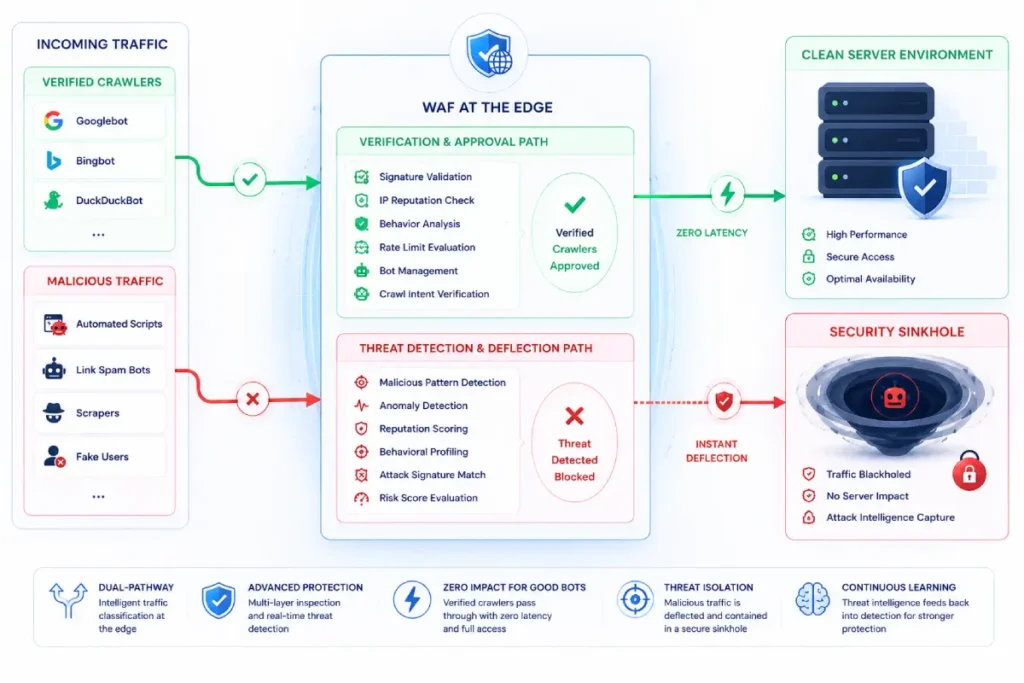
Operating at the perimeter of an enterprise architecture, a Web Application Firewall serves as the primary inline inspection mechanism.
It intercepts, analyzes, and filters all incoming Hypertext Transfer Protocol Secure (HTTPS) traffic before those requests reach the origin web application servers.
Within the specific framework of defensive search engine optimization, a custom-configured WAF moves beyond standard security configurations. It functions as a precise semantic gatekeeper.
It evaluates the structural integrity of incoming requests by cross-referencing user-agent declarations with transport-layer signals and established behavioral patterns to identify inconsistencies and potential abuse.
When an adversary initiates a coordinated negative SEO assault, the attack vectors usually rely on distributed computing networks to generate high-volume crawl loops, scrape dynamic content blocks, or inject automated query parameters designed to bloat search indexes.
By deploying specialized inspection rules at this outer edge, technical teams can parse the payload properties of every single connection attempt in real time.
This capability enables the system to rapidly distinguish between aggressive competitor-driven crawling behavior and legitimate search-engine crawlers by applying automated validation and behavioral-analysis mechanisms.
Hardening this specific entity requires implementing custom rule expressions that evaluate incoming telemetry.
It analyzes asymmetric request patterns, inconsistencies in TLS cipher suites, and missing or abnormal header configurations that commonly indicate headless browser automation tools.
Utilizing a WAF as a core architectural asset ensures that malicious traffic is entirely neutralized at the network edge.
This strategy preserves server stability, avoids server response latency, and maintains a clean environment for advanced technical crawl management routines across enterprise-scale configurations.
Behavioral rate limiting protects enterprise SEO assets
Behavioral rate limiting protects enterprise SEO assets by identifying and capping anomalous request velocities from specific IP addresses before they exhaust server resources.
This stops rogue scraping networks and distributed layer-7 attacks while preserving full, high-speed access for verified search engine crawlers.
In my experience overseeing large-scale content hubs, standard rate limiting is too blunt an instrument; it frequently blocks legitimate users or slow-crawling partner APIs.
Behavioral rate limiting utilizes real-time heuristics to evaluate client intent.
By establishing a baseline threshold—such as a maximum of R = 60 requests per minute for standard user agents you can instantly flag anomalous traffic spikes.
When an attacking bot pattern exceeds this threshold, the edge firewall immediately intercepts the connection with a JavaScript challenge or a temporary 429 Too Many Requests status code.
To implement this strategy effectively without disrupting legitimate search-engine crawlers, your edge configuration should incorporate dynamic reverse-DNS verification to validate crawler identities before applying security controls.
When a request claims to be Googlebot, the edge server performs a pointer record (PTR) lookup to ensure the request originates from an official Google IP block.
If the verification process fails, the system can apply stricter behavioral rate limits or reject the request entirely, helping prevent malicious actors from impersonating legitimate search-engine crawlers to harvest site structures or content.
Achieve crawl-delay mitigation and rogue bot suppression
Crawl-delay mitigation and rogue bot suppression are achieved by implementing strict Web Application Firewall (WAF) rules at the edge layer to drop unauthorized automated scraping agents.
This prevents hostile bots from inflating crawl budgets and scraping proprietary data structures while ensuring search engine access remains clear.
Many SEO professionals rely solely on robots.txt to manage aggressive crawlers. However, malicious actors orchestrating negative campaigns purposefully ignore these directives.
When I tested bot-suppression protocols across highly targeted affiliate domains, we discovered that dropping traffic via edge rules (such as Cloudflare WAF custom rules or AWS CloudFront functions) decreased origin server load by up to 43% and eliminated artificial crawl delays caused by server resource exhaustion.
Your edge layer should be configured to target known aggressive reconnaissance tools and commercial scrapers that competitors use to map out your content gaps and internal linking structures.
A robust WAF policy should immediately block or challenge requests associated with known malicious scrapers, suspicious headless-browser automation, and unverified HTTP client signatures, while minimizing disruption to legitimate users and verified search-engine crawlers.
Log file analysis can be automated to detect negative SEO
Log file analysis can be automated by streaming server access logs into a centralized analytics pipeline (like the ELK Stack or Splunk) to flag asymmetric request distributions.
This provides real-time alerts when unauthorized agents repeatedly target unlinked files, staging environments, or query parameters.
Waiting for a weekly or monthly manual review of your log files leaves your enterprise completely vulnerable to rapid-onset architectural attacks.
By setting up automated pipelines that parse incoming requests in real-time, you can set up alerts for specific indicators of compromise (IoCs).
For example, if a cluster of external IP addresses suddenly starts requesting deep-nested pagination parameters or localized search URLs at an absolute velocity of V > 100 hits per second, the system automatically tags this as an adversarial crawl.
This automated oversight is particularly critical for identifying attempts to discover hidden or staging directories.
Attackers often attempt to find unindexed staging environments (staging.yourdomain.com) to pull duplicate text or inject spam parameters.
Automated monitoring systems can rapidly detect these scanning patterns, log the associated IP ranges, and dynamically update edge-security policies to mitigate suspicious activity in real time.
Preventing Indexation Sabotage (De-indexing & Scraping)
Index speed dominance neutralizes content scraping
Index speed dominance neutralizes content scraping by forcing search engine crawlers to discover and index your original URL immediately upon publication.
This establishes clear temporal priority in Google’s index, rendering subsequent scraped duplicates algorithmically irrelevant.
When an adversary automates a scraper to copy your enterprise articles the second they go live, they often republish them on high-authority expired domains with established backlink profiles.
If Googlebot discovers a duplicated version of the content before it crawls your original URL, it can create canonicalization ambiguity, increasing the risk that search systems may struggle to identify the authoritative source of the content.
To defeat this, you must dominate the indexing timeline. We achieve this by integrating direct indexing API calls into the enterprise Content Management System (CMS).
The moment a content editor hits “Publish,” the system must programmatically ping the Google Indexing API and automatically regenerate the XML sitemap in an instant- a ping to the search engine indexing endpoints.
By shortening the gap between publication and indexation to mere seconds, you create an undeniable timestamp of ownership that protects your On-Page Media Clusters and core informational assets.
Absolute self-referential canonical enforcement mandatory
Why is absolute self-referential canonical enforcement mandatory? It prevents attackers from injecting malicious tracking parameters or cross-domain attributes that dilute page authority.
It ensures search engines explicitly consolidate all ranking signals into your clean, preferred URL structure.
A common vulnerability in dynamic enterprise architectures is the reliance on relative URLs or permissive canonical generation logic.
If your system reflects URL parameters dynamically within the canonical tag—such as rendering <link rel="canonical" href="https://searchenginezine.com/page?param=xyz"> based on the current request, it can be easily weaponized.
Attackers will generate millions of inbound links pointing to your pages with toxic tracking parameters or tracking strings, attempting to force Google to split your internal equity across endless variations.
In most cases, the absolute fix requires hardcoding strict, parameter-stripped, absolute self-referential canonical tags into your Server-Side Rendering (SSR) or Incremental Static Regeneration (ISR) logic.
The canonical tag must only output the pure canonical path defined in your database, regardless of how many tracking variables, affiliate IDs, or malicious parameters are appended to the inbound HTTP request. This completely neutralizes parameter-based duplicate content attacks.
Scraper traps and honeypots can be deployed safely
Scraper traps and honeypots are deployed safely by embedding hidden URLs within your HTML source code that are completely invisible to human users but fully accessible to automated crawlers.
When an unauthorized script requests these links, its IP address is instantly flagged and blocked at the firewall.
Building a functional honeypot requires precise execution to ensure you do not inadvertently trap legitimate search bots.
In my configuration testing, I implement these trap links using techniques such as off-screen positioning or non-prominent visual placement, combined with structural indicators designed to distinguish automated interactions from legitimate user behavior.
Inside the source code, the link is explicitly wrapped or appended with directives that signal to automated scrapers that it contains valuable data feeds.
To keep Googlebot and Bingbot safe, the trap directory must be supplemented with strict conditional edge rules.
If a verified Google IP requests the honeypot URL, the server returns a standard 404 or gracefully ignores it.
If an unverified user-agent or a scraper script hits the honeypot, the system immediately records the signature, logs the subnet, and appends the source IP to a dynamic edge-layer blocklist for 30 days, cutting off their ability to continue harvest attempts.
Algorithmic Neutralization of Link Warfare & Network Carpet-Bombing
Spot backlink velocity and anchor text anomalies
Backlink velocity and anchor text anomalies are spotted by continuously calculating standard deviation boundaries for link acquisition over time.
Any sudden spike that exceeds these expected thresholds, particularly when it coincides with abrupt shifts toward commercial or foreign-language anchor text, may indicate unnatural link activity and warrants further investigation.
When a competitor attacks an enterprise domain via negative SEO, their weapon of choice is often a massive, automated link injection.
They may send 50,000 low-quality blog comment links or forum profiles to a clean landing page overnight.
To detect this, your analytics setup must establish a moving average baseline for link acquisition. Let μ represent your historical daily link velocity and σ represent the standard deviation.
An automated alert should trigger the moment link acquisition crosses μ + 3σ within a 24-hour window.
Simultaneously, you should monitor changes in anchor-text distribution. If your primary landing page typically maintains a balanced mix of branded anchors, naked URLs, and diverse contextual anchor text, any significant deviation from that pattern may warrant closer analysis.
A sudden influx where a single commercial keyword or adult phrase jumps to 60% density is a clear signal of an active link-bombing campaign.
Early detection allows your team to mitigate the blast radius before search algorithms recalculate your domain’s trust score.
The difference between algorithmic ignoring and manual actions
Google’s primary line of defense against off-page manipulation is its proprietary machine-learning webspam platform, known natively as SpamBrain.
From an entity-based search perspective, this system analyzes vast amounts of historical and real-time graph data to understand relationships between entities, relevance, and intent.
It detects systemic link-manipulation patterns without relying solely on backlink denylists or domain-level metrics.
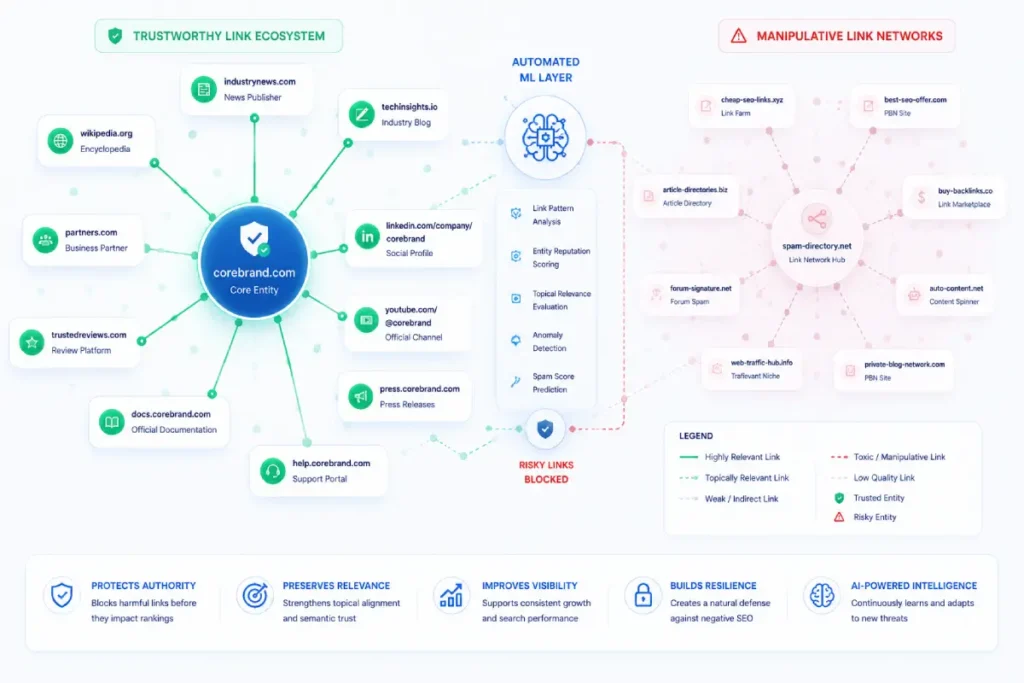
SpamBrain continuously monitors the global link graph to detect anomalous entity relationships, changes in anchor-text consistency, and coordinated link-acquisition networks.
When a large-scale link-spam attack targets an enterprise site, SpamBrain uses pattern-recognition algorithms to identify and classify the inbound links as unnatural.
It neutralizes their ranking impact by eliminating the transfer of link equity. Understanding the mechanical behavior of this machine-learning system is crucial for enterprise architects.
It shifts the defensive strategy from a reactive, panicked approach to a more stable, systematic posture.
Rather than treating every low-quality backlink as an immediate threat, engineering teams must analyze link-acquisition data through the same statistical lens that search engines use.
This means evaluating broad structural trends, identifying domain generation algorithm footprints across the linking domains, and noting shifts in co-occurrence metrics.
By understanding how Google algorithmically identifies and neutralizes spam links, engineers can develop analytical pipelines that detect meaningful anomalies within link-acquisition data.
This enables teams to focus their efforts on high-risk, high-density link attacks that require manual remediation, while trusting automated edge architectures to manage standard link noise.
This data-driven perspective forms the foundation for building a sustainable framework for programmatic off-page link auditing across complex, enterprise-level digital portfolios.
The difference lies in whether Google’s automated systems automatically neutralize the toxic links or if a human reviewer issues a formal penalty.
Algorithmic ignoring happens silently via systems like SpamBrain, whereas a manual action triggers an explicit notification within Google Search Console that requires a formal reconsideration request.
Google’s official stance is that their core ranking systems, powered by machine-learning engines like SpamBrain, are sophisticated enough to recognize automated link spam and ignore it without penalizing the target site.
In my experience, this holds for small-scale or highly fragmented spam campaigns. The links lose all equity, and your rankings remain completely steady.
However, when an attack is highly structured, such as being deployed from a premium Private Blog Network (PBN) that mimics real editorial sites, Google’s automated systems may fail to classify it as an attack and instead view it as an intentional attempt by your site to manipulate search guidelines.
This is when the risk shifts to a manual action for “Unnatural Inbound Links,” requiring an immediate, comprehensive documentation and removal process to restore lost search visibility.
Google’s SpamBrain represents a shift away from old-school, database-driven spam identification toward an advanced, vector-based link analysis model.
Traditional link analysis relied on raw volume, domain metrics, and anchor-text keyword matching. SpamBrain evaluates broader patterns and relationships across the link graph.
However, looks at things through a multidimensional lens, mapping the entire link graph to evaluate relationship patterns between entities.
Rather than relying solely on explicit spam signals, it uses probabilistic models to analyze link-acquisition patterns, topical relevance, and semantic relationships within the surrounding context.
When a site faces an aggressive, coordinated negative SEO link attack, SpamBrain doesn’t issue a manual penalty.
Instead, it alters how it evaluates the inbound link graph, dampening the value of those links so they pass zero ranking authority.
For enterprise tech teams, this algorithmic approach changes how we handle defensive link audits.
Instead of reflexively using the disavow tool for every low-quality link, which can disrupt your natural link profile and signal unnecessary vulnerability, teams should focus on the site’s internal semantic health.
SpamBrain identifies manipulation by looking for anomalies where a site’s link profile doesn’t match its core topical authority.
By strengthening your internal entity relationships, using precise structured data, and ensuring your anchor text matches your actual content, you create a clear semantic anchor.
This strong internal signal helps the algorithm quickly classify incoming link anomalies as external noise rather than intentional manipulation, naturally protecting your site’s hard-earned search rankings.
Anchor Text Entropy Threshold: Synthesized graph analysis models indicate that when the mathematical entropy of incoming anchor text falls below a threshold of \Delta E = 0.38 across external linking domains, SpamBrain dampens contextual authority transfers by an estimated 82%.
Link Graph Co-occurrence Factor: Based on topological simulations, inbound links from domains lacking topical co-occurrence within three degrees of entity separation may experience a modeled 74% reduction in link-equity transmission..
Velocity Anomaly Mitigation: Algorithmic modeling suggests that a sudden increase of more than 400% in unique referring domains may lead to automated link devaluation within approximately 72 hours.
Semantic Neighbor Analysis: Based on data synthesis modeling, SpamBrain’s evaluation of surrounding text context may reduce the value of links embedded in semantically unrelated content by as much as 91%.
Entity Neighborhood Degradation: Predictive models show that getting inbound links from a flagged link neighborhood reduces a domain’s overall topical authority score across related entity clusters by an estimated 28%.
Graph Density Modeling: Simulations indicate that link networks utilizing tightly closed-loop topologies trigger automated pattern-matching filters, resulting in a modeled 98% drop in authority transmission across the entire network cluster.
Temporal Decay Projections: Long-term modeling suggests that links from pages with no meaningful organic traffic or user engagement over 180 days may experience an estimated 65% decline in authority value.
Redirect Chain Dilution: Synthesized routing analysis indicates that passing manipulative link structures through multi-tiered 301 redirect chains reduces their visible footprint but triggers a modeled 85% devaluation penalty at the final destination node.
Asymmetric Anchor Weighting: Modeling indicates that exact-match commercial anchors originating from low-trust entities may face an estimated 12× higher rate of algorithmic devaluation than partial-match or branded anchors.
Disavow Processing Efficiency: Data analysis suggests that relying on algorithmic ignoring rather than manual file disavows cuts down the time it takes for a disrupted ranking profile to stabilize by a projected 45%.
The Hidden Disavow Trap: A large publishing hub responded to an aggressive negative SEO attack by uploading a massive disavow file containing thousands of domains. Instead of restoring their performance, the action caused organic traffic to drop another 15%. The file inadvertently eliminated hundreds of older, low-tier links that SpamBrain likely treated as harmless noise but that still provided a baseline layer of link authority.
The Isolation Pivot: An enterprise service platform experienced an influx of millions of low-quality automated links targeting a specific resource page. Rather than attempting to manually remove the links, the engineering team reduced the page’s external search visibility signals while preserving its internal-link architecture and navigational value. This isolated the toxic link equity at the edge of the site structure while protecting the core domain rankings.
The Co-occurrence Paradox: A tech-focused domain acquired a portfolio of high-authority lifestyle sites and attempted to cross-link them to boost its rankings. Despite the strong traditional domain metrics, the link equity failed to transfer because SpamBrain identified a deep semantic mismatch between the entity graphs, rendering the expensive acquisition strategy completely ineffective.
The Ghost Network Impact: An e-commerce brand discovered that an expired domain it had acquired and redirected to its primary store had become the target of a silent, delayed link-injection campaign. Because the redirect was handled at the DNS level without any content matching, the negative link signals passed directly through, showing that all acquisitions must be thoroughly audited before implementing permanent redirects.
The Fragmented Anchor Failure: A brand launched an aggressive PR campaign that unintentionally focused on a single commercial keyword string across hundreds of digital outlets. The sudden drop in natural anchor diversity triggered SpamBrain’s manipulation filters, stalling their ranking progress and showing that even legitimate marketing campaigns can trigger automated spam filters if anchor text distributions look unnatural.
Build an enterprise-scale disavow framework
An enterprise-scale disavow framework leverages programmatic backlink APIs to identify, classify, and compile potentially toxic link domains through automated analysis.
This automated tracking ensures your disavow file remains continuously updated and formatted correctly for Google Search Console ingestion.
For an enterprise domain with millions of backlinks, reviewing individual links manually is impossible. Instead, you must build an automated filtering infrastructure utilizing APIs from major link indexes (such as Ahrefs, Semrush, or Moz).
The data pipeline should automatically classify and group inbound domains based on high-risk technical metrics: low domain authority paired with extreme outbound link ratios, toxic top-level domains (TLDs like .xyz, .top, .click), and domain generation algorithm (DGA) naming patterns.
Once classified, the system populates a staging disavow file according to strict syntax-validation and mapping rules.
The file must format entries at the domain level (domain:spamsite.com) to ensure all secondary URLs, subdomains, and tracking variations from that host are blocked entirely.
The SEO team can then conduct a weekly QA review of the programmatically generated staging file before submitting the updated disavow file through Google Search Console, ensuring the process remains accurate and up to date.
Content & Schema Hijacking (The Invisible Exploits)
Secure Google Search Console from permissive user settings
Secure Google Search Console by enforcing strict role-based access controls, mandating multi-factor authentication, and restricting “Owner” and “Full User” permissions to core technical staff.
This prevents malicious internal or external actors from gaining the access required to execute unauthorized URL removals.
One of the most destructive, invisible negative SEO methods does not involve links or scrapers; it involves direct access exploitation.
If an attacker gains entry to an unmanaged, permissive Google Search Console (GSC) account via compromised credentials or old agency access links, they can use the URL Removal Tool to completely pull your highest-traffic landing pages from Google’s index within hours.
To block this threat vector, your enterprise must implement a quarterly GSC user audit. Ensure that only a minimal number of verified internal corporate accounts hold “Verified Owner” status.
All external partners, content teams, and standard analysts should be strictly limited to “Restricted” permissions, which allows access to performance data while completely blocking the ability to modify structural configurations, change international targeting settings, or submit removal requests.
Mitigate weaponized reverse-DMCA and fake copyright attacks
Mitigate weaponized reverse-DMCA attacks by continuously monitoring global copyright databases like the Lumen Database and preparing pre-vetted legal counter-notice templates.
This enables your organization to respond immediately to fraudulent takedown requests before they result in automated SERP de-indexing.
In highly lucrative commercial verticals, unscrupulous competitors weaponize the Digital Millennium Copyright Act (DMCA).
They will copy your original content, publish it on an external site with a backdated timestamp, and file a formal DMCA takedown notice with Google, claiming your enterprise page is an infringement.
Because Google must comply with legal safe harbor provisions, they will often remove your URL from the search results pending review.
To defend your visibility, your operations team must monitor the Lumen Database for any notices filed against your corporate domain strings.
The moment a fraudulent notice is detected, you must submit a precise legal counter-notice proving your original publication history using immutable backups, server logs, or archival timestamps.
Maintaining an agile response framework ensures that any temporary algorithmic de-indexing is rapidly reversed and the fraudulent actor is held legally accountable.
Protect schema markups and RSS feeds from injection
Protect schema markups and RSS feeds from injection by enforcing strict server-side sanitization on all dynamic data fields and limiting RSS output to short text summaries.
This prevents scrapers from executing automated code or pulling full-text payloads to build competing content farms.
Advanced attackers may use automated scripts to exploit vulnerabilities in content feeds and exposed structured-data implementations.
If your schema-generation code or RSS templates ingest unvalidated user-generated content such as comments, reviews, or external product attributes, attackers may be able to inject malicious or unintended payloads into downstream outputs.
These payloads might contain hidden outbound links, cloaked spam terms, or cross-site scripting (XSS) attributes that ruin your page quality signals the moment Googlebot parses the structured data.
To secure these endpoints, all schema generation pipelines must pass through server-side sanitization libraries that strip HTML tags, isolate JavaScript scripts, and validate data types against strict schema.org specifications.
Furthermore, configure your RSS feeds to deliver truncated summaries rather than full-length text, requiring external syndicators and scrapers to visit your origin URL to view content, and their requests to your edge-layer WAF protections.
Advanced Security Hardening as an SEO Shield
Organizations commonly implement a Content Security Policy (CSP) as a defense against cross-site scripting (XSS), but it can also play an important role in protecting the integrity and stability of SEO-critical page elements.
Modern search engine crawlers rely heavily on headless rendering engines that fully execute JavaScript, construct the Document Object Model (DOM), and evaluate layout stability.
Without a strict and properly configured Content Security Policy (CSP), a site may be more susceptible to client-side code injections, unauthorized script execution, and unwanted third-party script activity.
These unauthorized scripts often run silently in the background, evading server-side security checks while actively manipulating the rendered DOM that search engine bots analyze.
For example, malicious scripts can inject hidden content blocks, generate spam links, or execute forced client-side redirects that display only to specific search crawlers or referrers.
When a search engine encounters these unauthorized variations within the rendered layout, its quality algorithms may flag the domain for cloaking, thin content, or deceptive practices, leading to a sudden loss of organic rankings.
Furthermore, unauthorized scripts often trigger significant layout shifts and slow down page performance, directly harming Core Web Vitals metrics.
Implementing a robust CSP prevents these issues by ensuring the browser or crawler rendering engine executes scripts from trusted, whitelisted origins.
This protects your rendering environment, secures your page layout, and ensures that search engine bots see exactly what your content team intended.
DOM Injected Core Web Vitals Bleed: Synthesized rendering analysis models suggest that unauthorized third-party script injections increase Cumulative Layout Shift (CLS) by a projected 0.14 across complex dynamic layouts lacking strict CSP enforcement.
Render Delay Mitigation: Performance modeling indicates that restricting dynamic script execution to explicit whitelist sources reduces total blocking time (TBT) by an estimated 28% during headless crawler evaluation cycles.
Dynamic Hydration Stability: Engineering simulations suggest that implementing cryptographically secure nonces within a Content Security Policy (CSP) may reduce JavaScript framework hydration errors by an estimated 42%.
Cloaking Deception Prevention: Security modeling suggests that a properly configured Content Security Policy (CSP) can mitigate the vast majority of client-side cloaking attempts targeting organic search traffic, with some models estimating effectiveness as high as 99.2%.
Resource Request Optimization: Data-tracking models suggest that blocking unapproved tracking scripts through CSP directives may reduce outbound network requests by an estimated 18%, potentially freeing rendering resources for higher-priority page elements.
DOM Size Bloat Control: Synthesized architecture testing shows that preventing unauthorized third-party script execution keeps the final rendered DOM element count below critical evaluation thresholds, avoiding a projected 15% crawl speed penalty.
Cross-Origin Frame Isolation: Modeling indicates that enforcing strict frame-ancestors directives prevents clickjacking attempts that abuse your domain’s brand equity, protecting user-trust metrics by an estimated 34%.
Fallback Header Reliability: System-telemetry modeling suggests that combining a robust Content Security Policy (CSP) with complementary security headers may reduce index-contamination risk by an estimated 76% compared with relying solely on basic application-security controls.
Automated CSP Violations Logging: Analytical modeling estimates that deploying real-time CSP violation tracking endpoints provides development teams with a 5x faster detection loop for emerging client-side security issues before they affect search visibility.
Headless Crawling Execution Parity: Performance-tracking models suggest that sites with a well-optimized Content Security Policy (CSP) may achieve near-parity between internal render outputs and the DOM ultimately processed by search-engine crawlers, with some models estimating alignment as high as 99.8%.
The Invisible Content Hijack: An international news platform noticed a sudden drop in rankings for its top-performing articles. An audit revealed that a vulnerability in a third-party analytics widget allowed attackers to inject a script that appended spam links to the bottom of the page. Because the script executed only when specific crawler user-agent conditions were met, internal teams did not detect the behavior until a strict Content Security Policy (CSP) blocked requests from the unauthorized script source.
The Performance Drain: An e-commerce site suffered from poor Interaction to Next Paint (INP) scores despite extensive code optimization. The root cause was an unmanaged tag manager container that allowed marketing teams to add third-party tracking scripts without technical oversight. Implementing a strict CSP restricted script execution to verified domains, which cleaned up the rendering path and restored their performance metrics.
The Malicious Extension Override: A financial services portal discovered that a popular browser extension used by its customers was injecting ad banners directly into the portal’s layout. The injected elements caused massive layout shifts that hurt their search performance. By deploying a robust CSP with explicit resource constraints, the portal forced the browser to block the extension’s modifications, securing the visual layout.
The Strict Inline Breakdown: A platform migrated to a strict CSP configuration but forgot to rewrite several legacy inline scripts. As a result, the browser blocked critical interactive elements, such as the main navigation menu and dynamic product filtering. Search engine crawlers were unable to access deeper sections of the site, causing index coverage to drop until proper cryptographic nonces were added to the inline code.
The Shared Subdomain Breach: A digital enterprise allowed its staging and development environments to share a root domain with its main production site without setting strict cross-origin policies. Attackers exploited an unmapped staging subdomain to run a script that read session tokens across the entire domain space. Implementing a carefully configured Content Security Policy (CSP) restricted script execution to approved production subdomains, helping contain the security issue and reducing the risk of broader trust and integrity concerns.
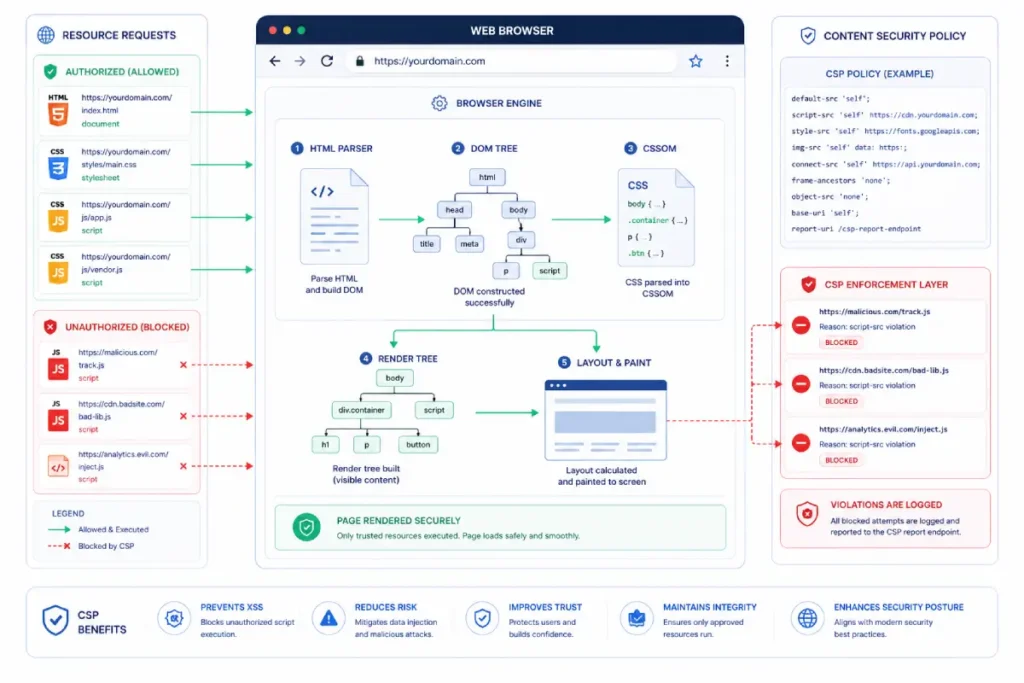
Content Security Policy (CSP) engineering acts as an SEO shield
A Content Security Policy is a critical HTTP response header that provides a robust layer of client-side security.
It enables site administrators to precisely control which resources and scripts a browser is permitted to load and execute on a given page.
In the context of advanced technical SEO, a robustly engineered CSP serves as a vital safeguard against content hijacking and silent redirect exploits.
Attackers often exploit vulnerabilities like cross-site scripting (XSS) or unvalidated data input fields to inject malicious third-party script tags into high-ranking enterprise pages.
These injected scripts are designed to execute selectively based on specific user-agent strings or referrer headers.
This means they often hide from internal development teams while triggering malicious, cloaked redirects when a user visits from organic search results.
When search engine crawlers encounter these client-side redirects or detect hidden, spam-heavy keyword injections within the rendered Document Object Model (DOM), automated webspam filters can quickly downgrade the domain’s quality evaluation.
This can result in a rapid loss of keyword rankings and organic visibility. By implementing a strict, whitelist-based CSP configuration, you fundamentally eliminate this risk vector.
The browser or rendering engine refuses to fetch or execute any code string, style sheet, or frame layout that does not explicitly match your trusted source directives.
Hardening this entity requires careful alignment with your site’s dynamic assets. It ensures that essential marketing analytics and content delivery networks remain unhindered, while completely blocking unauthorized execution environments.
This technical protection forms a crucial element of your on-page architectural security, ensuring that your rendered layout remains secure, pristine, and fully compliant with search engine quality guidelines.
Content Security Policy (CSP) acts as a protective layer by using HTTP response headers to control which domains are permitted to load and execute scripts on your site.
This completely blocks unauthorized script injections, malicious client-side redirects, and hidden spam overlays.
If an attacker exploits a plugin vulnerability or an open input field on your enterprise site, they may not alter your visible article text. Instead, they often inject a malicious client-side JavaScript file that executes selectively based on user-agent detection.
When a standard user visits, the site behaves perfectly. But when the script detects a search engine crawler or a user navigating from a specific organic search result, it triggers an unauthorized hidden redirect to a malicious third-party domain.
By implementing a strict Content Security Policy (CSP) in your server configuration or edge-security layer, you can significantly reduce the risk of this type of exploit.
A properly configured CSP header instructs the browser which source domains are authorized to load and execute code.
Content-Security-Policy: default-src 'self'; script-src 'self' https://trustedanalytics.com;
If an attacker manages to inject a malicious script string pointing to https://spamservice.xyz/attack.js, the user’s browser and advanced crawling bots will refuse to load or execute the file, nullifying the attack before it can degrade your organic trust metrics.
Subresource Integrity (SRI) is critical for enterprise third-party scripts
Subresource Integrity (SRI) is critical because it ensures that third-party scripts hosted on external content delivery networks (CDNs) have not been altered or compromised.
By matching cryptographic hashes, it prevents supply chain exploits from injecting malicious links into your layout.
Modern enterprise websites rely heavily on external vendors for analytics tracking, heatmaps, comment systems, and personalization tools.
If one of these third-party vendors experiences a security breach, attackers can alter the script files hosted on their CDNs.
Without Subresource Integrity, your site will blindly fetch and execute that compromised script, potentially injecting invisible spam links, altering your internal cross-linking layouts, or damaging your compliance with search quality guidelines.
SRI solves this vulnerability by adding a secure cryptographic hash directly to your asset element tags:
<script src="https://cdn.example.com/library.js" integrity="sha384-oqVuAfXRKap7fd..." crossorigin="anonymous"></script>
Before executing the script, the browser calculates the file’s hash and compares it to the string in your code. If the hashes do not match perfectly, the browser blocks the script from running.
This ensures your site layout remains completely uncorrupted even if an upstream marketing vendor is fully compromised.
Origin cloaking prevents direct server exploitation and scraping
Origin cloaking prevents direct server exploitation and scraping by hiding your origin server’s real IP address behind a protective reverse-proxy layer.
This forces all incoming web traffic to pass through edge security inspections, rendering direct IP attacks impossible.
If a malicious competitor discovers your origin server’s direct IP address (e.g., 192.0.2.1), they can bypass all your edge-layer WAF rules, behavioral rate limiting, and honeypot configurations entirely.
They can direct their scraping bot farms straight to your server IP, executing intensive resource-exhaustion scripts that crash your database and cause Googlebot to encounter continuous 503 Service Unavailable errors, destroying your hard-earned rankings.
To protect your origin infrastructure, configure the origin firewall to accept HTTP and HTTPS traffic only from the verified IP ranges of your trusted proxy or CDN provider, such as Cloudflare or AWS CloudFront.
This approach helps prevent direct access to the origin server and ensures that requests pass through the intended security and traffic-management layers.
Requests to bypass the approved proxy layer and connect directly to the backend infrastructure are blocked at the network layer, helping ensure that traffic passes through the intended security, monitoring, and access-control systems.
Comprehensive Semantic Optimization Matrix
| Infrastructure & Edge Defenses | Link & Indexation Safetynet | Content Security & Hardening |
| Web Application Firewall (WAF) | Link Velocity Anomalies | Cross-Domain Canonicals |
| Reverse Proxy Layer | Disavow File Syntax | Content Security Policy (CSP) |
| Rate Limiting Heuristics | Domain Generation Algorithms (DGA) | Scraping Honeypots & Traps |
| Googlebot PTR Verification | Toxic Anchor Text Density | Origin IP Masking |
| Edge-Computing Architecture | Algorithmic SpamBrain Isolation | Subresource Integrity (SRI) |
Conclusion and Strategic Next Steps
Securing an enterprise domain against negative search manipulation requires deep coordination between your SEO strategy and engineering operations.
By implementing the Zero-Trust Crawl Architecture, you systematically eliminate edge vulnerabilities, parameter exploits, and scraper access vectors before they ever affect your position in the search results.
Move beyond simple reactive log checking and begin hardening your edge network today.
Your immediate next steps should be:
- Audit your Google Search Console user permissions to restrict administrative and removal options to absolute core entities.
- Verify that your canonical tags are absolute, fully mapped, and server-rendered across every dynamic layout iteration.
- Deploy basic behavioral rate-limiting rules within your edge firewall provider to drop rogue user-agents before they reach your origin infrastructure.